
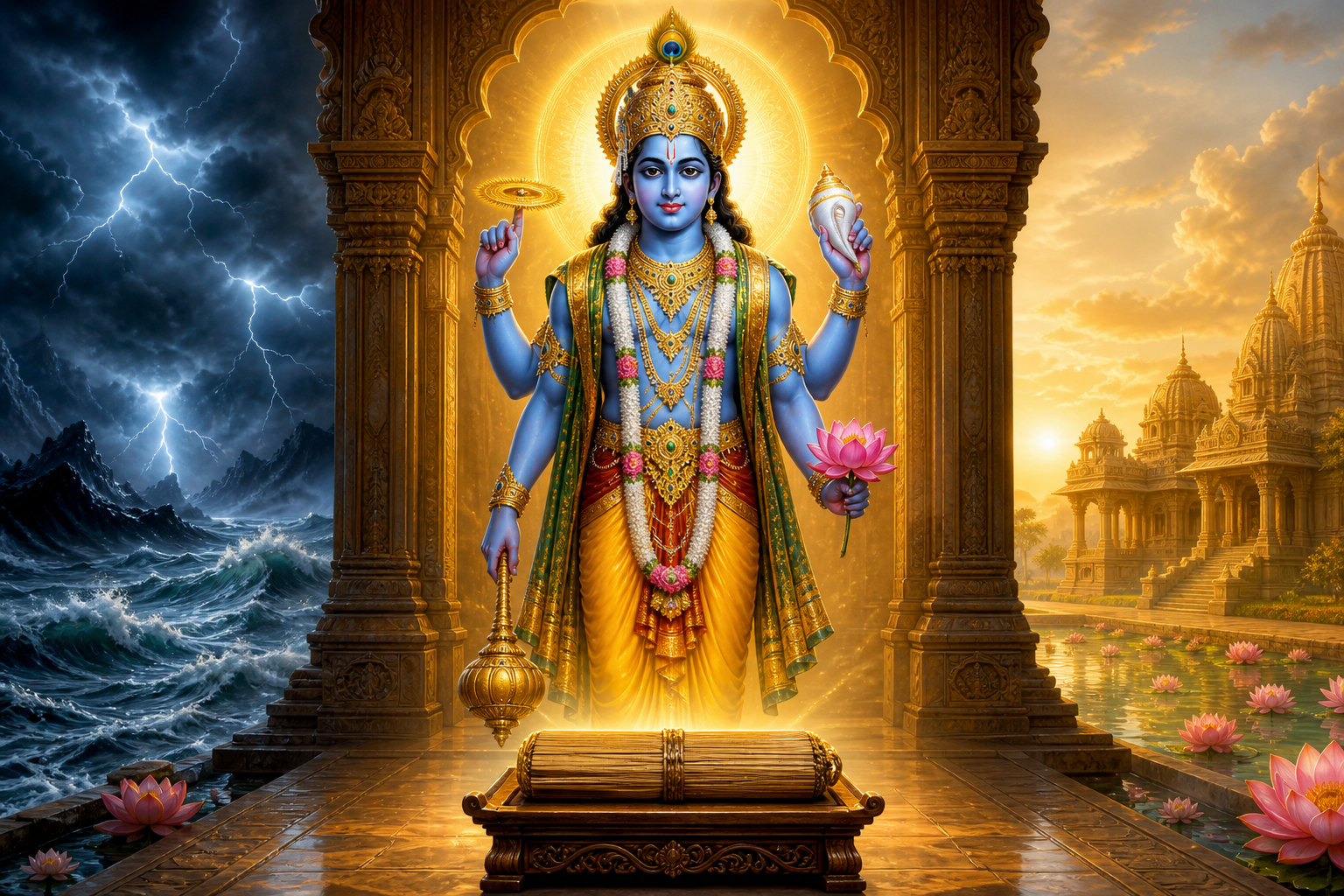
When you seek Vishnu’s protection, the practical question is not simply whether a difficulty will disappear. It is whether you can recognize what must be protected, restrain what threatens it, and act without becoming ruled by fear, anger, or confusion.
You can learn that discipline through two complementary forms of divine presence. Vishnu’s emblems make protection visible, while the Srimad-Bhagavatam is approached in Vaishnava tradition as the living book-form of Sri Krishna. One trains your sight; the other trains your hearing, judgment, and conduct.
Protection means preserving dharma, not guaranteeing ease
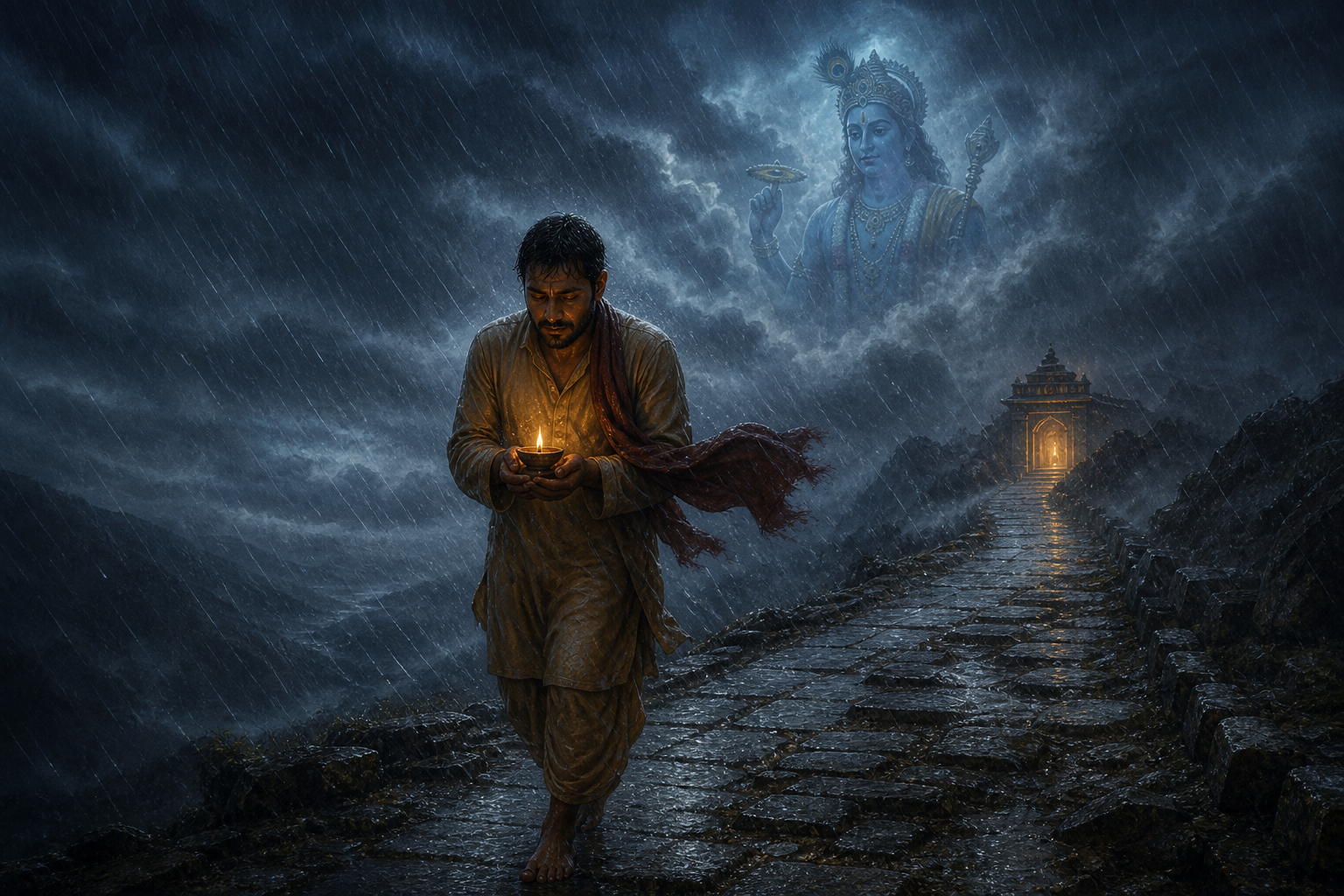
It is easy to reduce divine protection to rescue: remove this obstacle, defeat this adversary, or spare me this loss. Gadadhara Vishnu offers a more demanding understanding. His power exists to uphold dharma, and therefore it remains governed by wisdom, compassion, and self-mastery.
The gada in Vishnu’s hand is Kaumodaki. It may appear grounded or held with serene assurance, and that composure matters. Kaumodaki signifies protective authority, disciplined strength, and the capacity to subdue chaos. It is not a celebration of uncontrolled force. Its weight suggests responsibility before it suggests victory.
The Srimad-Bhagavatam places poshana, divine protection, within a much larger spiritual architecture. It also presents creation, cosmic order, moral impetus, sacred history, dissolution, liberation, and ashraya, the Supreme Shelter. Protection is therefore not an isolated intervention. It belongs to an ordered vision in which life has a source, dharma has a structure, actions have motives, and the soul has an ultimate refuge.
This changes the prayer you bring to Vishnu. Instead of asking only, “How can I escape this?” ask:
- What is genuinely dharmic here and therefore worth preserving?
- What disorder must be restrained rather than accommodated?
- Is my response being driven by clarity, or by wounded pride and fear?
- What duty remains mine even while I ask for divine shelter?
These questions do not make grace dependent on your competence. They keep the desire for protection from turning into passivity. Vishnu’s shelter strengthens dharmic agency; it does not excuse you from using it.
Read Vishnu’s four emblems as one discipline
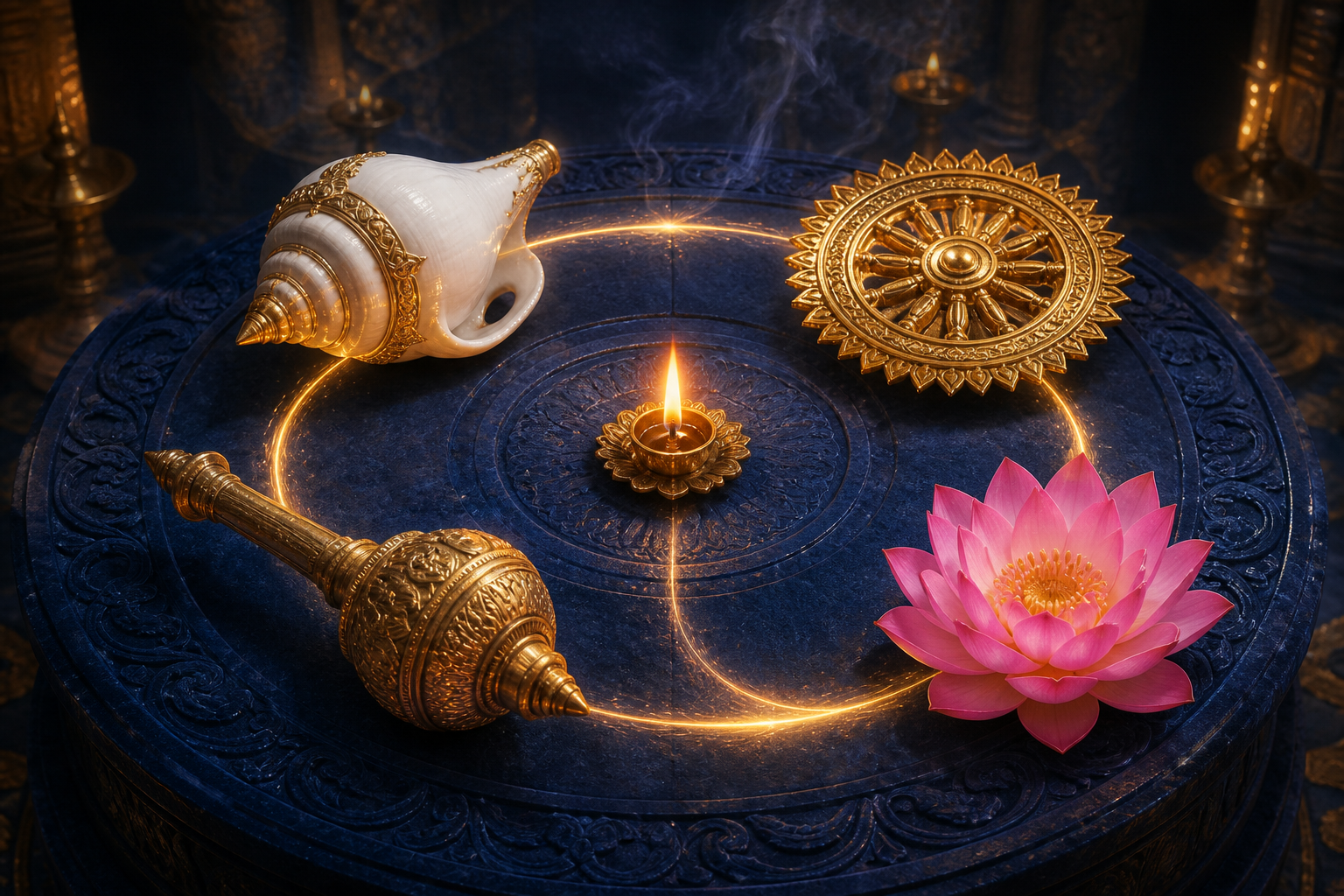
The name Gadadhara joins gada, mace, with dhara, bearer. Yet Vishnu does not bear the gada alone. The familiar ensemble of shankha, chakra, gada, and padma presents a complete grammar of awakening, discernment, disciplined strength, and purity.
A traditional symbolic reading associates the conch with awakening, the discus with the destruction of delusion, the mace with moral force, and the lotus with purity. You can turn those associations into four practical tests:
| Emblem | Spiritual function | Question for your conduct |
|---|---|---|
| Shankha, the conch | Awakening and the call to attention | What truth must I hear, remember, or speak clearly? |
| Chakra, the discus | Cutting through delusion | Which assumption, excuse, or confusion is distorting my judgment? |
| Gada, Kaumodaki | Moral force, discipline, and stability | What boundary or duty must I uphold steadily? |
| Padma, the lotus | Purity | Can I pursue the right end without corrupting the means? |
Using only one emblem produces an incomplete response. Strength without awakening can become reflexive aggression. Discernment without strength can identify adharma yet fail to resist it. Purity without firmness can deteriorate into fragile good intentions. The four emblems belong together because dharmic protection requires perception, judgment, resolve, and clean means.
At your next darshana, begin with Vishnu’s bearing rather than staring only at the weapon. Notice that Kaumodaki rests within a composed divine form. Then consider all four emblems and name the one your present situation is asking you to cultivate. Before leaving, translate it into a specific act: speak a truth without cruelty, keep a difficult commitment, refuse an unjust demand without hatred, or restore a neglected discipline.
This is also a safeguard against a common misreading. Kaumodaki does not sanctify rage merely because the angry person believes the cause is righteous. The relevant model is power mastered before it is exercised. If anger controls your language, makes humiliation feel satisfying, or turns every disagreement into an enemy, you are no longer imitating Vishnu’s steadiness. You are being carried by the very disorder the gada symbolizes the power to subdue.
Find protective presence in the Bhagavatam’s architecture
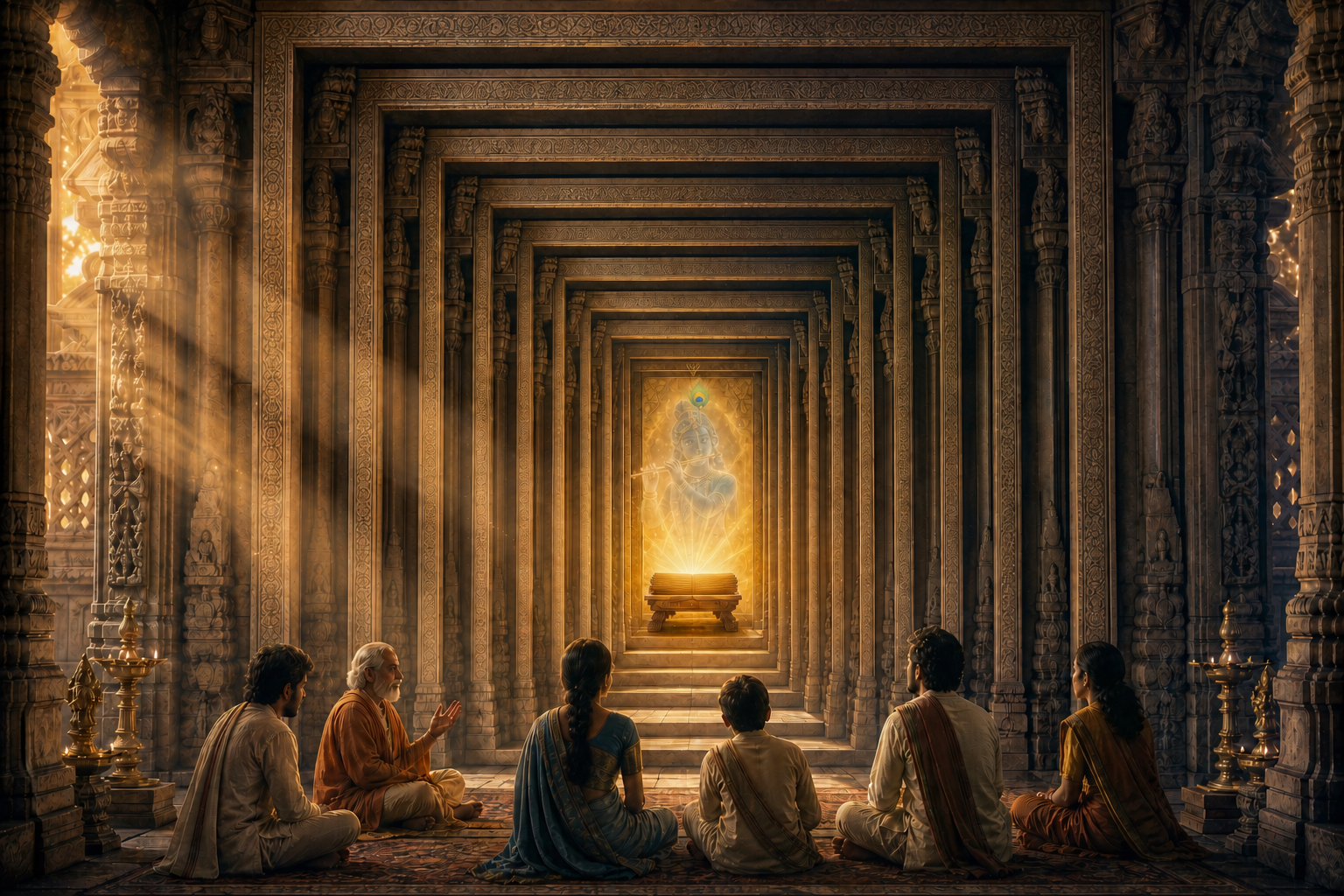
Vishnu’s iconography teaches through form. The Srimad-Bhagavatam teaches through sustained hearing and reflection. Its twelve cantos are understood devotionally as the bodily limbs of Sri Krishna, so approaching the work is not merely gathering religious information. It is a form of association with divine presence.
Across those twelve cantos, ten transcendent themes, known as the dashalakshana, organize cosmology, sacred narrative, devotion, liberation, and shelter:
- Sarga: primary creation.
- Visarga: secondary creation.
- Sthana: cosmic order and the placing or sustaining of beings.
- Poshana: divine protection.
- Uti: the impetus or motive behind action.
- Manvantara: the cycles associated with the Manus.
- Ishanukatha: accounts of the Lord and His devotees.
- Nirodha: dissolution.
- Mukti: liberation.
- Ashraya: the Supreme Shelter.
Do not treat these as ten disconnected labels to memorize. They give you a way to see the whole movement of spiritual life. Creation establishes the field. Order shows how that field is sustained. Motive explains why beings act within it. Protection preserves what serves the divine purpose. Sacred narratives disclose devotion in lived form. Dissolution and liberation prevent temporary arrangements from being mistaken for the final refuge. Ashraya reveals where every preceding theme ultimately rests.
This wider frame prevents two errors. The first is looking for protection only in spectacular deliverance. A passage may instead reveal protection through corrected understanding, moral courage, disciplined remembrance, or the preservation of devotion amid hardship. The second is treating protection as the final aim. Poshana leads the seeker toward ashraya: not merely receiving help from the Supreme, but learning to take the Supreme as shelter.
When you read or hear a passage, work through these questions:
<!– wp:list {