

You open a cupboard and find food that will expire before anyone eats it. A drawer holds duplicates bought for a future that never arrived. Your phone contains thousands of saved files you cannot meaningfully find. Each item once looked useful, prudent, or rewarding. Together, they demand space, maintenance, attention, and repeated decisions.
The Dharmic answer is not to condemn ownership or compete at minimalism. It is to recognize atyāhāra, the movement from sufficient provision into excess acquisition, and then establish a workable boundary for enough. That boundary lets you keep what genuinely serves your duties while releasing what merely occupies your life.
Find the line between wise provision and excess possession
A crowded shelf does not prove greed, and an empty room does not prove detachment. A household pantry, emergency reserve, library, workshop, collection of devotional objects, or set of professional tools may have a legitimate purpose. The relevant question is whether you can name that purpose and relate the quantity to it.
Use four tests when the line is unclear:
- Function: What concrete need, duty, practice, or form of beauty does this possession serve?
- Use: Is it being used, or is there a credible occasion for its use rather than a vague possibility?
- Boundary: What amount would satisfy the purpose? A shelf, budget, storage area, or replenishment cycle can make that limit visible.
- Burden: What does keeping it cost in space, upkeep, attention, family harmony, or waste?
An item can have sentimental or sacred value without frequent use; meaning itself can be a valid function. The problem begins when every object receives an indefinite exemption. If you cannot explain why something remains, where it belongs, or what limit governs the category, possession has probably outrun purpose.
The same test applies beyond the home. Extra income may protect dependants or fund service, but earning can also become a score that no longer answers to need. Saved information may support study, but collecting links can replace reading them. Atyāhāra concerns the relationship between acquisition and purpose, not one culturally approved number of possessions.
Atyahara names excess; aparigraha trains freedom
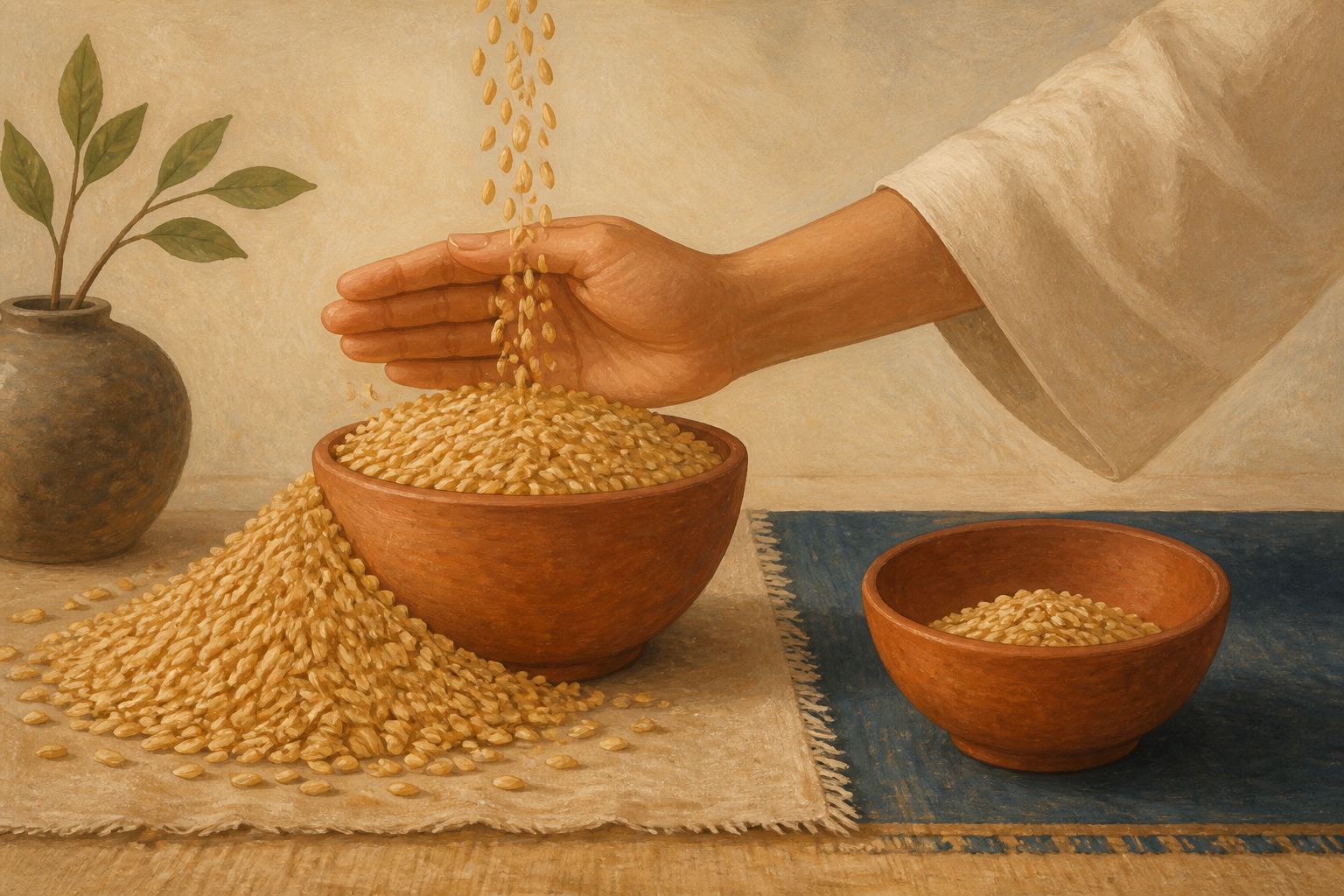
Atyāhāra is excess consumption or acquisition. Aparigraha, commonly rendered as non-possessiveness, addresses the grip that possessions acquire over the possessor. Asteya, non-stealing, adds an ethical edge: your consumption does not occur in isolation from other people or from shared ecological resources.
These ideas are related, but they are not synonyms. You restrain atyāhāra by limiting what comes in. You practise aparigraha by weakening attachment to what is already present. You honour asteya by refusing to make your appetite someone else’s deprivation or burden. A person may stop shopping while remaining fiercely attached to a storeroom; another may give away possessions impulsively while continuing to acquire. A durable practice must address both entry and attachment.
The wider Dharmic family approaches this discipline through distinct teachings. Hindu yogic and bhakti traditions warn that excess disturbs inner steadiness. Buddhism examines craving, taṇhā, and teaches a Middle Path rather than indulgence or self-punishment. Jain discipline gives aparigraha a particularly prominent place. Sikh teaching joins santokh, contentment, with vand chhakko, sharing what one has. Their doctrines and vows are not interchangeable, but they converge on a practical insight: freedom cannot depend on endlessly increasing possession.
Non-possessiveness therefore does not mean neglecting your family, discarding the instruments of your livelihood, or refusing prudent preparation. Dharma includes responsibility. Keep what enables that responsibility, care for it properly, and release the surplus that no longer serves it. The aim is not to own nothing; it is to prevent ownership from governing your attention, identity, and conduct.
Why more still feels necessary after usefulness ends

Reason alone often fails because acquisition delivers an immediate reward while its costs arrive later. In controlled tasks, people may keep earning beyond any practical use, even when they know the reward cannot be retained. The activity of gaining has detached from the utility of what is gained.
Several tendencies can produce the same result:
- Loss aversion: Once an object feels like yours, giving it up can register as a loss even when keeping it provides no benefit.
- Uncertainty-driven stockpiling: A vague fear of future scarcity converts every possible need into a reason to keep or buy.
- Forecasting error: You imagine more future use, pleasure, energy, or free time than the possession is likely to receive.
- Variable reward: Bargain hunting, collecting, and scrolling remain compelling because the next find might be unusually satisfying.
- Social comparison: Other people’s visible consumption quietly resets your sense of what a normal household, wardrobe, library, or lifestyle requires.
Digital systems intensify these tendencies. Acquisition may require one tap, while evaluation and disposal demand attention. Unlimited-looking storage conceals the burden until search becomes difficult and the archive becomes another source of unfinished decisions.
When the urge appears, name the mechanism before debating the item. Is this a real need, fear of scarcity, reluctance to accept a past mistake, desire for status, or enjoyment of the hunt? Naming it creates a small distance between impulse and action. That distance is where restraint becomes possible.
Build aparigraha into the way possessions enter and leave

Set the limit before desire starts negotiating
A limit chosen in the presence of an attractive object is easy to move. Decide what enough means while you are calm. For consumables, base the quantity on normal use until the next planned purchase, plus any reserve attached to a named contingency. For books, clothing, tools, or collections, use a defined storage boundary. For digital material, require a project, reference purpose, or deletion rule.
Before acquiring anything non-routine, answer these questions:
- What exact task, duty, or enjoyment will this serve?
- Do I already own something that serves the same function?
- Where will it live, and what upkeep will it require?
- Does it fit the boundary already set for this category?
- Am I seeking usefulness, or temporary relief from uncertainty, boredom, disappointment, or comparison?
A breath-awareness or gratitude pause can help, but it should lead to a decision rather than become a decorative ritual. Pause long enough to answer honestly. If the purpose remains vague, do not acquire yet.
Review one bounded category from use to circulation
Trying to purify an entire house in one burst can turn restraint into agitation. Begin with one drawer, shelf, type of purchase, digital folder, or recurring expense. Then work through a complete cycle:
- See what is already there. Bring the category into view before buying containers or replacements. Hidden duplicates are part of the problem.
- Name the purpose of each possession. Keep active-use items and reserves justified by a specific responsibility or contingency.
- Choose a real path for surplus. Assign it to gifting, donation, sale, recycling, or responsible disposal rather than creating an indefinite decision pile.
- Complete the handoff. A donation bag stored for months remains part of your inventory. Confirm that the recipient accepts the item and that it is usable.
- Record the new boundary. Decide what may re-enter, under what condition, and what must happen when the available space is full.
This turns decluttering into abhyāsa, repeated practice. The goal is not a dramatic before-and-after image. It is a reliable relationship among receiving, using, caring, sharing, and releasing.
Let surplus circulate through dana and seva
Dāna and sevā give surplus a direction larger than disposal. Food that can be shared, money that can support a worthy need, equipment another person can use, and time redirected from managing clutter can all return to circulation. Sikh vand chhakko makes the same practical point through sharing, while santokh challenges the assumption that dignity depends on continual expansion.
Giving must still respect the recipient. Broken, expired, unsafe, or unwanted material is not transformed into service by changing owners. Ask what a person or community can actually use. Clean it, describe its condition honestly, and choose recycling or responsible disposal when donation would merely transfer your burden.
Keep the practice humane, especially when distress is severe

Aparigraha can itself become a source of pride, harshness, or control. Different households have different duties, resources, occupations, devotional practices, and vulnerabilities. Judge a possession by its relationship to responsible use, not by whether it fits someone else’s image of simplicity.
There is also an important difference between ordinary over-accumulation and a serious hoarding problem. If possessions make essential rooms or exits unusable, create fire or sanitation hazards, generate severe distress, or repeatedly damage close relationships, do not treat the situation as a mere failure of discipline. A qualified mental-health professional familiar with hoarding can help assess it. Immediate physical hazards may also require appropriate local safety assistance. Meditation, gratitude, and spiritual counsel may support the person, but they are not substitutes for professional care.
If the possessions belong to someone else, do not weaponize Dharma to force a sudden clearing. Involve the person in decisions whenever safety permits. Non-possessiveness cultivated through coercion is not inner freedom.
Key takeaways
- Atyāhāra begins when acquisition exceeds a purpose you can clearly name and bound.
- Aparigraha concerns attachment as well as quantity; stopping purchases is only half the practice.
- Set limits before shopping, earning, saving, or collecting activates the desire for more.
- Review one bounded category and give every surplus item a completed exit path.
- Use dāna, sevā, santokh, and vand chhakko to turn surplus from stored value into shared value.
- Seek qualified help when accumulation creates danger, severe distress, or loss of ordinary household function.
Choose one bounded place today: a pantry shelf, a clothing drawer, a downloads folder, or one type of recurring purchase. State what it is for, decide what enough looks like, and move one genuine surplus item into a responsible path of circulation. The value of the practice lies in repeating that decision before more becomes your default.
References
