
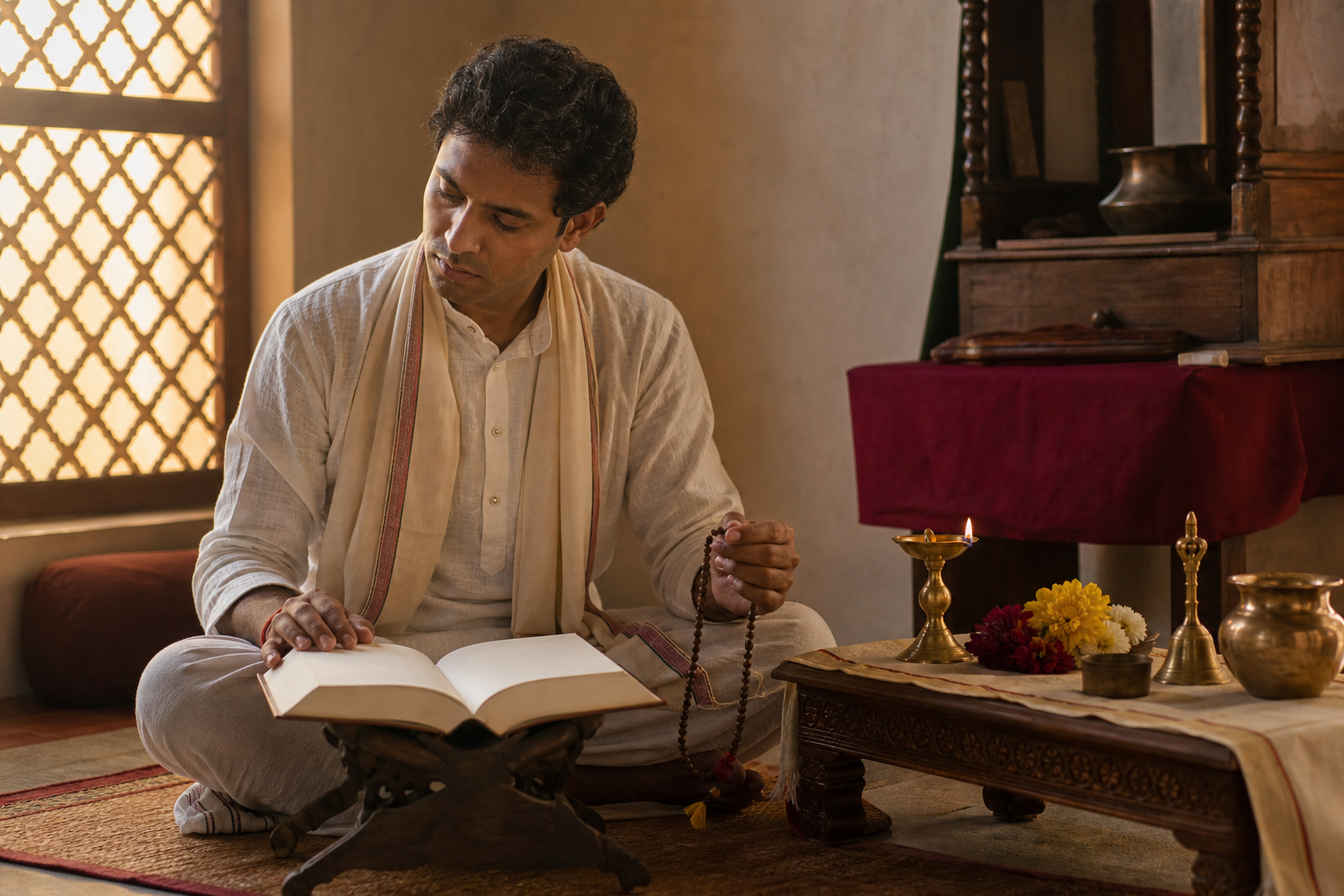
You light the lamp, offer aarti, repeat a mantra, visit the temple, or observe a festival because the practice belongs to your family and your life. Then someone asks why it is done, which text supports it, or what it is meant to change in you. Suddenly, “this is how we have always done it” feels inadequate.
You do not have to choose between inherited practice without understanding and scholarship without devotion. A better path lets practice generate precise questions, lets shastra refine practice, and lets a trustworthy teacher preserve the context that neither a search result nor an isolated quotation can supply.
Your inherited practice is a syllabus waiting to be opened
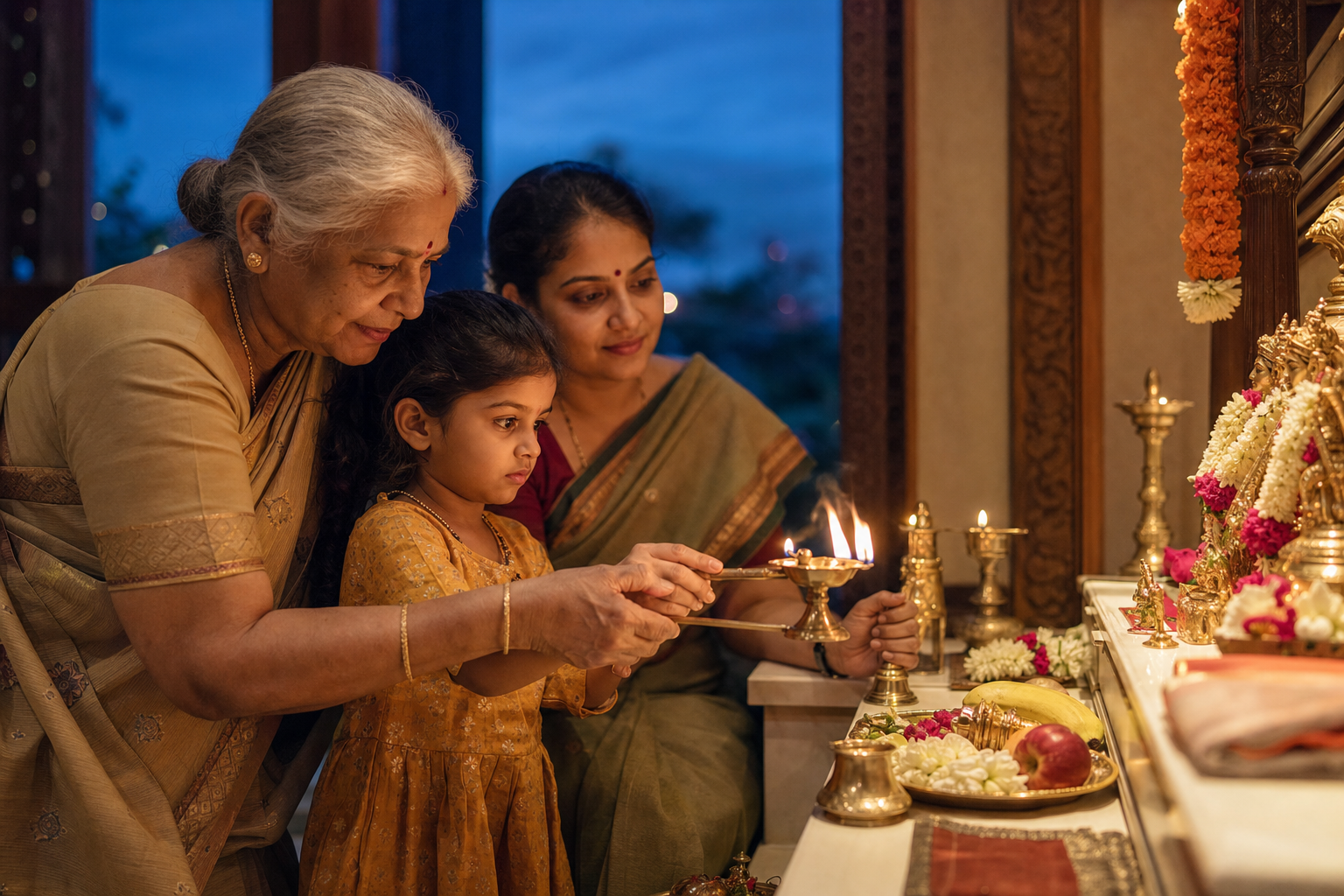
The first obstacle is usually not a lack of devotion. It is the assumption that becoming scripturally informed means beginning at the first page of an enormous library and mastering everything before you can worship intelligently.
Hindu Dharma is not organized around a single canonical book. Its knowledge traditions include the Vedas, Upanishads, Itihasas, Puranas, Agamas, Tantras, Darshanas, Smritis, Dharmashastras, Vedangas, and the teachings preserved by living sampradayas. These bodies of knowledge do different work, overlap in important ways, and are interpreted through different philosophical and devotional lineages.
This is why a random reading list often makes the confusion worse. A text concerned with philosophical inquiry is not automatically the best place to learn the procedure of temple worship. A narrative about a crisis of dharma cannot always be converted into a context-free rule. A ritual instruction from one sampradaya should not be silently imposed on every Hindu household.
Begin with the Dharma already in front of you. Make a simple inventory of the practices you actually perform:
- Name the practice precisely: home puja, aarti, japa, temple darshana, vrata, festival worship, recitation, seva, or pilgrimage.
- Record where you learned it: a parent, grandparent, priest, guru, temple, regional custom, devotional organization, or personal reading.
- Write the exact point you do not understand. “Why do Hindus worship this way?” is too broad. “Why is this offering made at this point in our family puja?” can be investigated.
- Note what you want to clarify: the words, pronunciation, sequence, symbolism, theological meaning, ethical purpose, or authority for the practice.
- Identify the next occasion when you will perform it. That gives your learning a practical destination.
This inventory turns inherited memory into a curriculum. It also prevents a common mistake: abandoning a sound family or temple practice merely because you cannot yet explain it. Lack of explanation is a reason to inquire, not proof that the practice is meaningless.
The continuity of familiar mantras, rituals, festivals, and sacred places shows how scriptural civilization remains active in ordinary Hindu life. Familiarity, however, is only the beginning. Recognizing the Gayatri Mantra, Mahamrityunjaya Mantra, or a Shanti Mantra does not by itself establish that you understand its setting, pronunciation, meaning, or the discipline governing its use in your tradition.
Learn the scriptural map before choosing a starting text

You need orientation before accumulation. The following map is intentionally practical. It is not an airtight classification, because texts overlap and schools differ in how they rank and interpret them. Use it to locate your question, not to force the tradition into separate boxes.
| Body of knowledge | Questions it helps you investigate | A sensible entry point |
|---|---|---|
| Vedas and Vedangas | Vedic mantra, yajna, recitation, language, meter, ritual setting, and the disciplines that support preservation and interpretation | Begin with the mantra or rite you actually encounter, using accurate pronunciation guidance and a teacher familiar with its traditional use |
| Upanishads and Darshanas | The self, consciousness, reality, knowledge, bondage, liberation, and the means by which claims are examined | Read a complete passage with commentary from the philosophical tradition you are studying rather than collecting detached sayings |
| Itihasas and Puranas | Dharma under difficult conditions, devotion, sacred memory, exemplary lives, cosmology, pilgrimage, deities, festivals, and observances | Follow a full episode and ask what each character knows, what duties conflict, and what the narrative actually resolves |
| Agamas and Tantras | Forms of worship, temple traditions, murti worship, mantra, ritual disciplines, theology, and lineage-specific practice | Learn through the relevant temple, priest, acharya, or initiated lineage, especially when a practice has rules of eligibility or transmission |
| Smritis and Dharmashastras | Conduct, duties, social order, institutions, and the application of dharma in human life | Read with historical, textual, and sampradaya context; do not turn an isolated prescription into a timeless pan-Hindu command |
This map lets you choose a textual neighborhood before choosing a title. If your question concerns the sequence of murti worship, investigate the Agamic and local tradition behind that worship. If you are wrestling with conflicting duties, study how an Itihasa presents dharma in a complete situation. If your question concerns the self or liberation, identify the Upanishadic passage and the Darshana through which your teacher interprets it. If you want to understand a vrata, festival, or tirtha, look for its Puranic, regional, temple, and family setting.
The same question may receive different answers in Shaiva, Shakta, Vaishnava, Smarta, and other traditions. That does not make every answer interchangeable. It means you must ask a second question: “Within which sampradaya, commentary, temple tradition, or regional practice is this answer authoritative?”
Do not begin by asking which Hindu scripture is the equivalent of the single definitive book expected in another religious framework. That question imports a structure Hindu Dharma does not possess. Ask instead which body of shastra, interpretive lineage, and lived tradition governs the matter you are trying to understand.
Use one precise question to build a study-practice loop
Reading becomes transformative when it returns to worship, conduct, and attention. Practice becomes intelligent when it sends honest questions back to shastra. You can build that loop without waiting to become a Sanskrit scholar.
- Choose one practice you already perform. Do not begin with “all of Hinduism.” Begin with your aarti, japa, temple visit, vrata, or current scripture class.
- Turn your uncertainty into a narrow question. Ask what a particular word means, why a particular action occurs, what disposition is expected, or what textual and lineage setting governs it.
- Locate the relevant scriptural family. Use the map above to decide whether you should first look toward Itihasa, Purana, Agama, Vedanta, another Darshana, a ritual manual, or an inherited regional tradition.
- Select a coherent interpretation. Know the translator or commentator, the sampradaya represented, and whether you are reading a primary passage, traditional commentary, modern explanation, or personal application.
- Read enough context to understand the passage. Include the surrounding argument or episode. Record what the text states, what the commentator explains, and what you are personally inferring as three distinct things.
- Ask a qualified person about the remaining gap. Take the exact passage and question to a guru, acharya, priest, knowledgeable practitioner, or teacher rooted in the relevant tradition.
- Return to the practice with one justified correction. It might be better pronunciation, closer attention to meaning, a restored sequence, a more fitting intention, or a clearer understanding of what should not be changed casually.
Consider aarti. Searching for a universal explanation of “why Hindus do aarti” may give you a broad symbolic answer, but it will not necessarily explain the form used in your home or temple. A better inquiry names the deity, temple or household tradition, sequence of offerings, prayer being sung, and person from whom the practice was received. You can then ask whether the form is Agamic, regional, inherited through a sampradaya, or a combination of these.
Family elders are part of this inquiry. Ask them to demonstrate the complete practice, name the person who taught it to them, recall whether the sequence changes during a festival, and identify the family deity or temple connection. Their answers may not settle the scriptural question, but they preserve the chain of transmission you are trying to understand. Record first; correct only after you have adequate context.
Mantra requires particular care. Transliteration and pronunciation aids can help a beginner enter Sanskrit learning, but printed syllables do not replace oral correction. If your tradition treats a mantra or ritual as initiation-dependent, restricted, or suited to a particular adhikara, do not treat online availability as authorization. Ask what preparation, pronunciation, and method your lineage requires.
Adhikara is not a convenient way to stop questions. It asks whether a teaching or practice is being given to a person with the relevant preparation, responsibility, competence, and setting. Its exact application varies. The practical response is to ask openly: “Is this practice appropriate for me, and what preparation does this tradition expect?”
Choose teachers and communities that preserve context
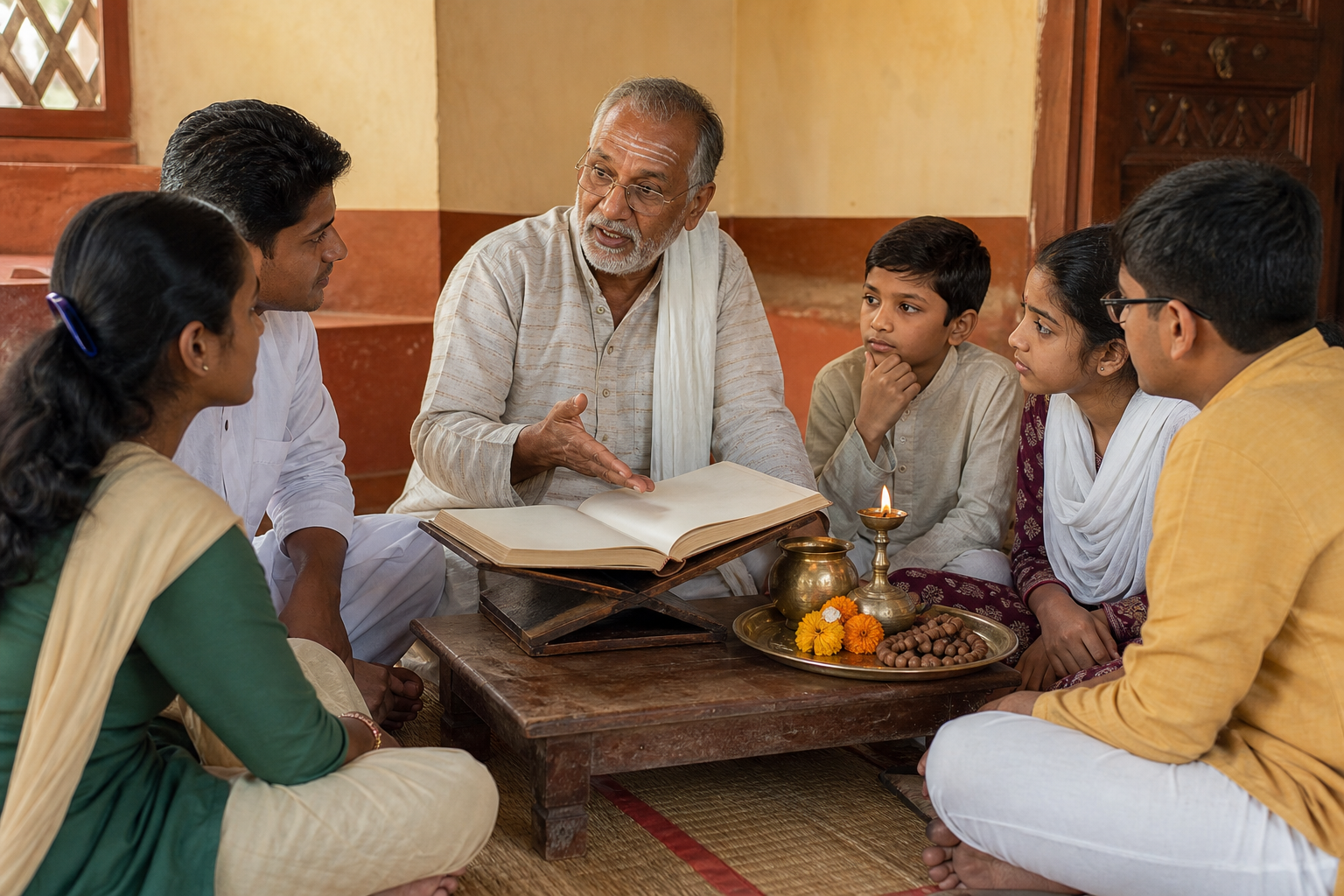
Scriptural literacy is not built by books alone. A living devotional ecosystem can join Bhagavad-gita and Srimad-Bhagavatam classes, sadhu-sanga, Ekadashi observance, seva, outreach, sacred geography, and enduring relationships among devotees. That is a specifically Vaishnava example, not a template every Hindu school must copy, but its underlying lesson travels well: recurring learning, shared worship, service, and accountable relationships reinforce one another.
A busy stream of devotional talks is still not a curriculum. Moving among unrelated clips, teachers, translations, and schools can produce a vocabulary of Sanskrit terms without a stable understanding of any argument. Follow a recurring class or a complete textual sequence long enough to learn how the teacher reads difficult passages, handles objections, and connects interpretation to conduct.
Use these criteria when deciding whom to learn from:
- The teacher names the text and passage instead of relying on anonymous sayings or screenshots.
- The teacher makes the interpretive standpoint visible. You know which sampradaya, acharya, commentary, or philosophical school is guiding the explanation.
- The teacher distinguishes the wording of the text from commentary, customary practice, and personal inference.
- The teacher can say when a rule is lineage-specific, temple-specific, regional, historically situated, or dependent on adhikara.
- The teacher welcomes sincere questions and can acknowledge uncertainty rather than producing instant certainty on every subject.
- The teaching returns you to disciplined worship, ethical conduct, reflection, humility, and seva rather than merely giving you arguments to use against other people.
Be cautious when someone uses a single translated verse to pronounce judgment on all Hindus, dismisses every inherited practice as superstition, or insists that every local custom is a universally binding command. The first approach severs scripture from practice. The second can protect human invention from examination. Neither does the patient work of determining what a text says, how a tradition understands it, and how that teaching should shape your life.
Intellectual humility is not an apology for Dharma. It is part of sound inquiry. Hindu knowledge traditions contain questioning, debate, interpretation, contemplation, and experiential discipline; openness and nuance are necessary when entering that complexity. You can be rooted without pretending that every question has one quick, pan-Hindu answer.
Key takeaways for a sustainable devotional rhythm

- During daily worship, keep one current scriptural question beside the practice. Let repetition deepen attention instead of turning into automatic motion.
- At your recurring study session, follow one text and commentary in sequence. Mark clearly what belongs to the primary passage, the commentator, the teacher, and your own application.
- Before a festival, vrata, pilgrimage, or special puja, investigate one feature you will actually encounter. Ask about its textual family, regional form, and sampradaya context.
- When you find conflicting explanations, do not average them into a vague compromise. Identify the traditions speaking, their authorities, and whether they are answering the same question.
- When a practice involves mantra, initiation, specialized ritual, or questions of adhikara, seek guidance from the relevant living tradition before changing or adopting it.
- Judge progress by what becomes clearer in your worship and conduct: more accurate practice, steadier attention, better questions, greater reverence, and less need to pretend certainty.
Start with the practice you will perform next. Write one precise question about it, identify the scriptural family most likely to govern it, and take that question to the nearest trustworthy commentary or teacher in its own tradition. That small circuit – practice, question, shastra, guidance, corrected practice – is how inherited devotion becomes informed bhakti without ceasing to be lived Dharma.
References
- Pragyata – Why Are We This Way? A Guide to Rediscovering Hindu Shastras
- Dandavats – Weekly Feed Archive – August 9, 2026
