
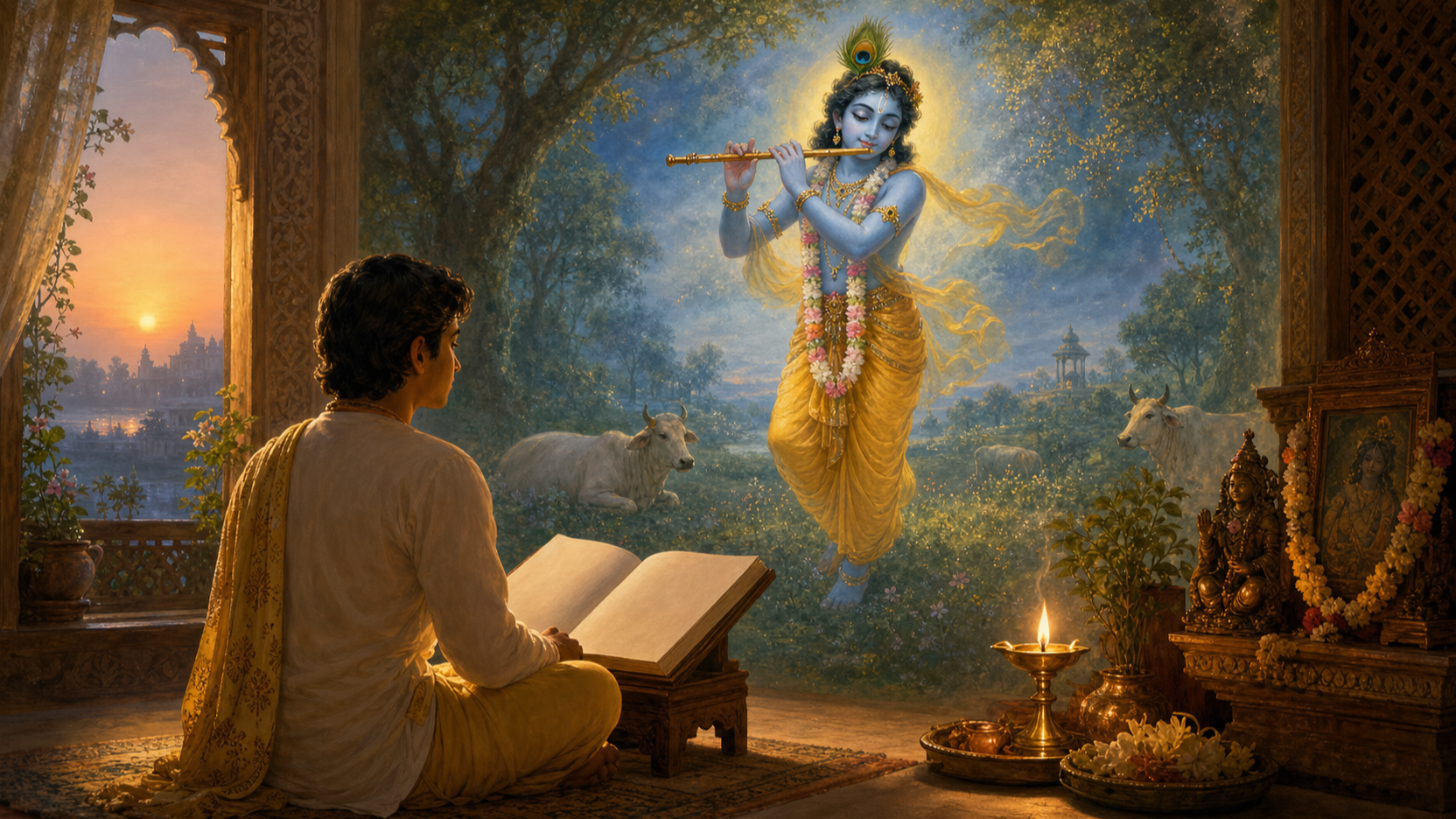
You may own a respected edition, hear katha regularly, and begin each reading with sincere intention. Yet by midday, the mind may be back to rehearsing its injuries, ambitions, anxieties, and plans. The difficulty is not a lack of sacred material. You have read about Krishna without giving your attention a definite way to return to Him.
Use a smaller and more deliberate loop: read one coherent passage, state what it reveals about Krishna, choose one exact point to remember, and recall it at a predictable moment later in the day. This makes study feed meditation instead of leaving the two as separate activities.
Make Krishna the subject before making yourself the subject
The Bhagavatam is not meant merely to add sacred information to your memory. Its larger devotional purpose is to facilitate meditation on the Supreme Absolute Truth. That changes the measure of a successful reading. Finishing pages matters less than allowing your attention to be reoriented toward Krishna.
Our habitual inner world casts us as the main character in the drama of life. Scripture can then become supporting material for that drama: a way to defend our decisions, explain our pain, improve our performance, or confirm an identity. Even a sincere reading can quietly make Krishna a secondary figure in a story that remains centered on us.
Interrupt that habit by asking Krishna-centered questions before asking how the passage applies to you:
- What does this passage disclose about Krishna, the Supreme, or His relationship with devotees?
- Which action, quality, name, instruction, or relationship carries the spiritual weight of the passage?
- How do the people within the passage respond to Krishna, and what does their response reveal?
- What assumption about Krishna am I bringing into the reading rather than receiving from it?
- Which precise detail can I remember without reopening the book?
Only then ask what should change in you. Personal application is necessary, but its proper place is response. First receive what the passage reveals; then decide how to live in light of it. This order keeps the Bhagavatam from being reduced to religious self-help.
If you cannot yet say what the passage reveals about Krishna, do not manufacture an answer. Write down the unresolved question. Honest uncertainty is a better foundation for study than a confident interpretation that the text has not actually supplied.
Turn one passage into a complete study-to-meditation cycle
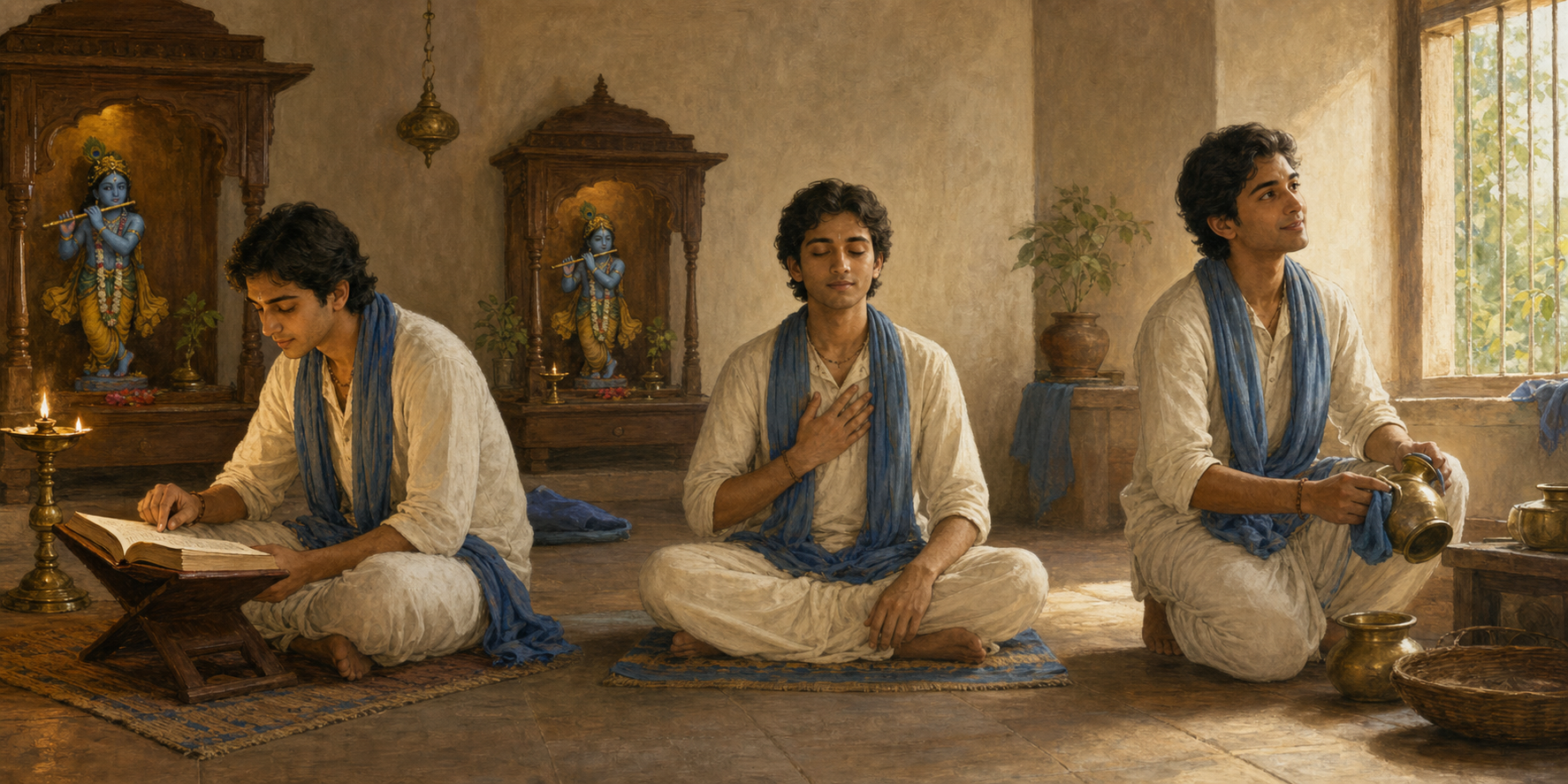
Here, meditation means the deliberate return of attention to a Krishna-centered meaning received through reading or hearing. It may include a name, action, quality, relationship, instruction, or scene. The point is not to generate an impressive private experience. The point is to let a real passage govern what you remember.
Bhagavatam hearing can be tightly focused: SB 2.1.19 or SB 2.2.29-30 can each become the center of a class. It can also take the broader form of Krishna-katha. For personal meditation, begin with the focused scale. A small unit gives the mind something definite to retrieve later.
- Choose one coherent unit. Take a verse, a short exchange, or a compact narrative movement. Stop where the thought is complete, even if you could comfortably read more.
- Establish the immediate context. Identify who is speaking, who is listening, what prompted the words, and what happened immediately before them. If the passage does not give you enough context, mark that gap instead of filling it with imagination.
- Write one Krishna-centered sentence. Complete a sentence such as: Here Krishna is revealed as…, or: This passage presents the Supreme as…. If Krishna is not directly named, state how the instruction, cosmology, devotee, or event stands in relation to Him.
- Recall the meaning without looking. Close the book and restate the passage in your own words. If you remember only your moral lesson and not what was revealed about Krishna, return to the text.
- Select one textual anchor. Choose a name, action, quality, relationship, or concrete detail that carries the meaning. Stay with what the passage gives you; do not decorate it with invented imagery.
- Attach remembrance to a real cue. Decide when you will return to the anchor: before opening your phone after a meal, while beginning a familiar journey, or at another predictable transition. A vague intention to remember Krishna later gives the wandering mind no definite instruction.
- Begin the next sitting with retrieval. Before reading something new, recall yesterday’s anchor and Krishna-centered sentence. Notice what remained and what disappeared. Use that observation to adjust the size of the next passage.
This cycle is not a memory examination. Retrieval reveals whether study has entered your working attention. When nothing remains, the answer is usually not to consume more material. Reduce the unit, make the central sentence more precise, and choose a clearer cue.
If you already follow instructions for japa or another established sadhana, do not replace them with mental analysis. Let Bhagavatam study supply a remembered orientation toward Krishna while each practice retains its proper form.
Approach the Tenth Canto with devotion and interpretive restraint
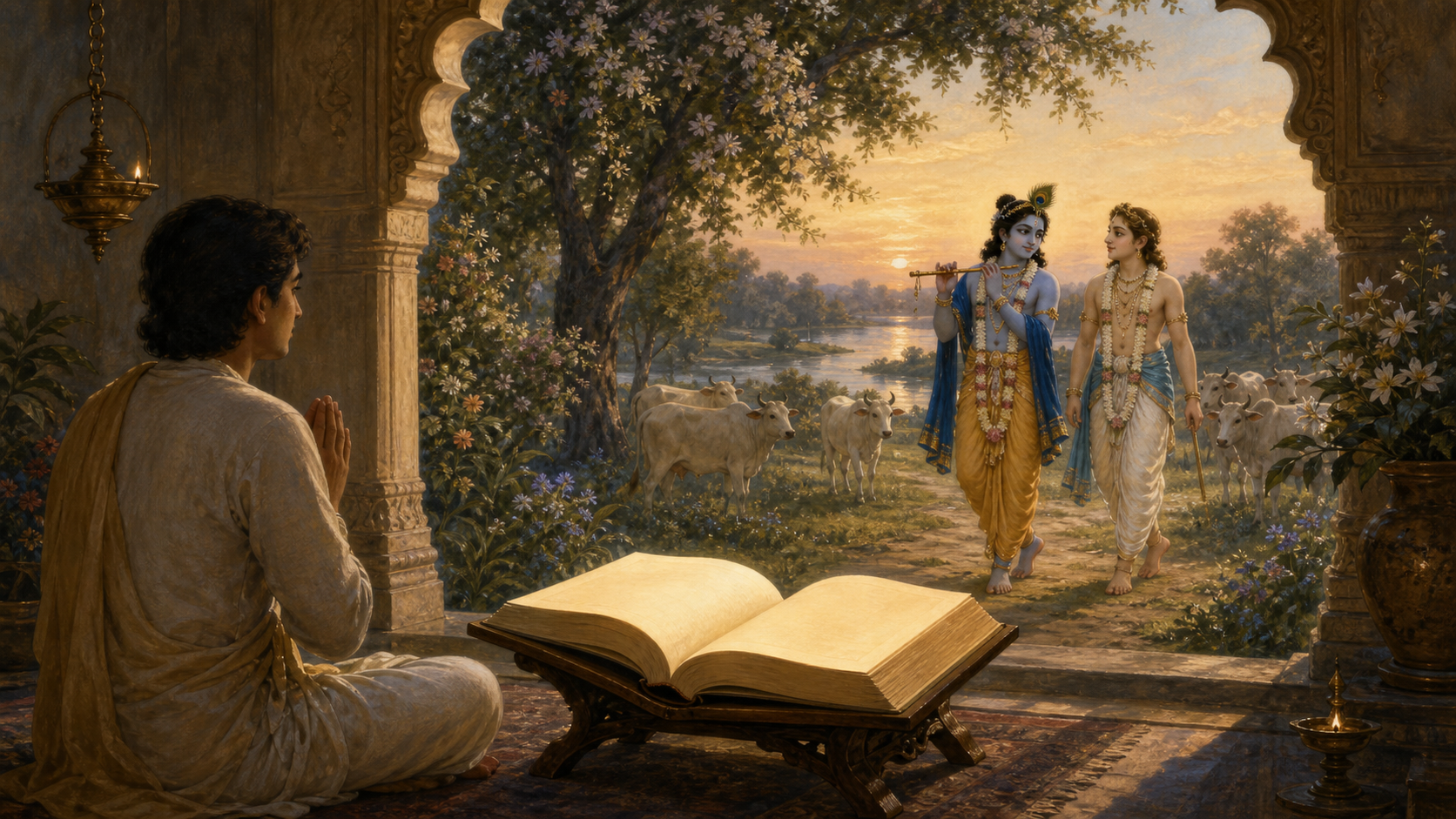
The Tenth Canto is revered as the crown jewel of Vedic literature. Its vivid and intimate lilas naturally attract the attention. That attraction should make you more careful, not less careful, because a powerful narrative can easily be detached from its theological setting and pulled into the categories of ordinary behavior.
A challenging episode such as vastra-harana lila tests the quality of your method. One mistake is to isolate the episode as though it were a free-standing anecdote. Another is to silence every question with a quick declaration that no explanation is needed. Neither response produces disciplined meditation.
- Read what precedes and follows the lila before drawing a conclusion from one scene.
- Separate observation from interpretation. Write what the passage actually narrates in one column of your notes and what you infer from it in another.
- Ask what the lila reveals about Krishna and the devotees’ relationship with Him before converting it into a general statement about human conduct.
- Consult a trusted commentary or a qualified teacher within your sampradaya when the theological context is unclear.
- Do not use a sacred lila as permission to imitate its outward action. Narrative resemblance alone does not establish spiritual equivalence.
- When sound guidance is not yet available, preserve the question and defer a confident conclusion.
Reverence and careful reading belong together. You do not need to neutralize every difficult reaction immediately. You do need to prevent that reaction from hardening into either casual dismissal or easy rationalization.
Diagnose the point where remembrance is breaking down
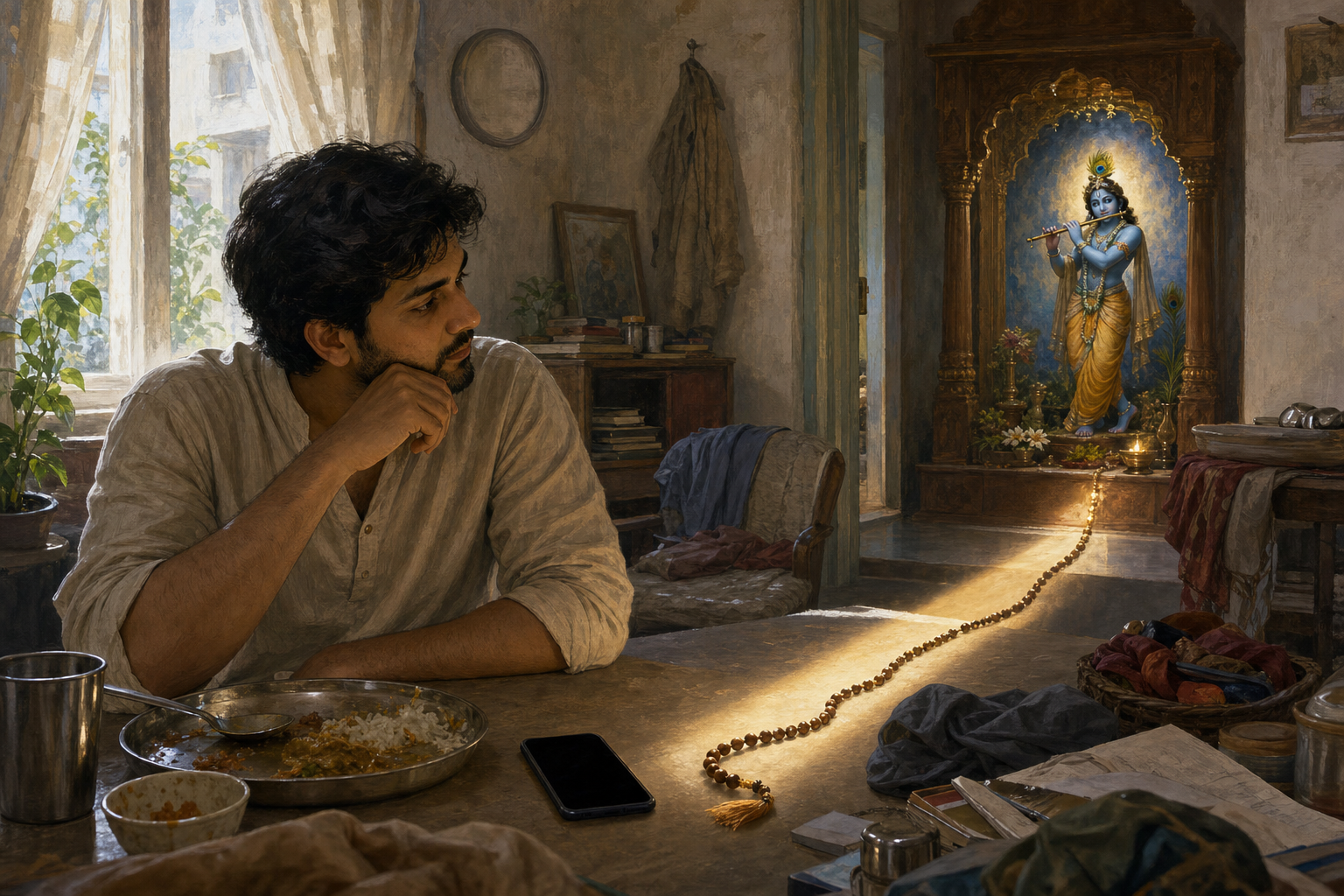
When study feels sincere but does not become meditation, look for the precise handoff that is failing. The adjustment should match the failure rather than simply adding more reading time.
| What you notice | What may be happening | What to change |
|---|---|---|
| You can explain the lesson, but Krishna is absent from your explanation. | You have converted the passage into ethics or self-improvement too early. | Write the Krishna-centered sentence before writing any personal application. |
| The passage feels clear while the book is open, but nothing returns later. | You have recognition during reading but no retrieval cue during the day. | Choose one textual anchor and attach it to a predictable daily transition. |
| Your meditation becomes elaborate, but you are unsure which details came from the text. | Visualization has outrun careful reading. | Return to one supplied name, action, quality, or relationship and leave unspecified details unspecified. |
| One difficult lila dominates your attention as an argument. | The episode may have been isolated from context or read without adequate guidance. | Broaden the textual context, record the exact question, and seek commentarial or teacher-guided clarification. |
| You keep redesigning your routine but rarely repeat it. | The plan is larger than the habit it is meant to support. | Keep the same small cycle: coherent passage, central sentence, anchor, cue, and next-day recall. |
| You remember yourself mainly as a successful or unsuccessful practitioner. | Spiritual performance has become another version of the self-centered drama. | Drop the internal scorekeeping and return attention to the specific truth about Krishna that you received. |
The final row matters most. Ahankara can appropriate even devotional discipline, making your consistency, insight, purity, or failure the main subject. When that happens, do not start a second argument with yourself. Return to the passage. Krishna-centered attention is restored by returning to Krishna, not by giving the ego a longer monologue about its spiritual condition.
Key takeaways
- Ask what the passage reveals about Krishna before asking what it says about you.
- Use one coherent passage rather than reading beyond what you can accurately recall.
- Move through a repeatable cycle: context, Krishna-centered sentence, recall, textual anchor, daily cue, and next-day review.
- Keep meditation tied to details supplied by the text instead of filling gaps with invented imagery.
- Slow down around difficult Tenth Canto lilas, preserve context, and seek guidance before settling on an interpretation.
- Measure the practice by honest returns of attention to Krishna, not merely by pages completed or plans maintained.
At your next sitting, do not begin with a completion target. Open to one short, coherent passage. Before you close the book, say plainly what it revealed about Krishna, select the detail you will carry, and name the moment when you will return to it. Then let the next day’s reading begin with remembrance rather than novelty.
References
- Dandavats – Vastra-harana lila. Lecture 1 (Zurich) – Bhakti Vijnana Goswami
- Dandavats – SB class | SB 2.1.19 | By HG Atmarama prabhu. Montreal, 29.07.2026
- Dandavats – SB 2.2.29-30 – HH Hanumat Presaka Swami – 07/31/2026
- Dandavats – Special Krishna Katha with HG Mahatma Prabhu
