
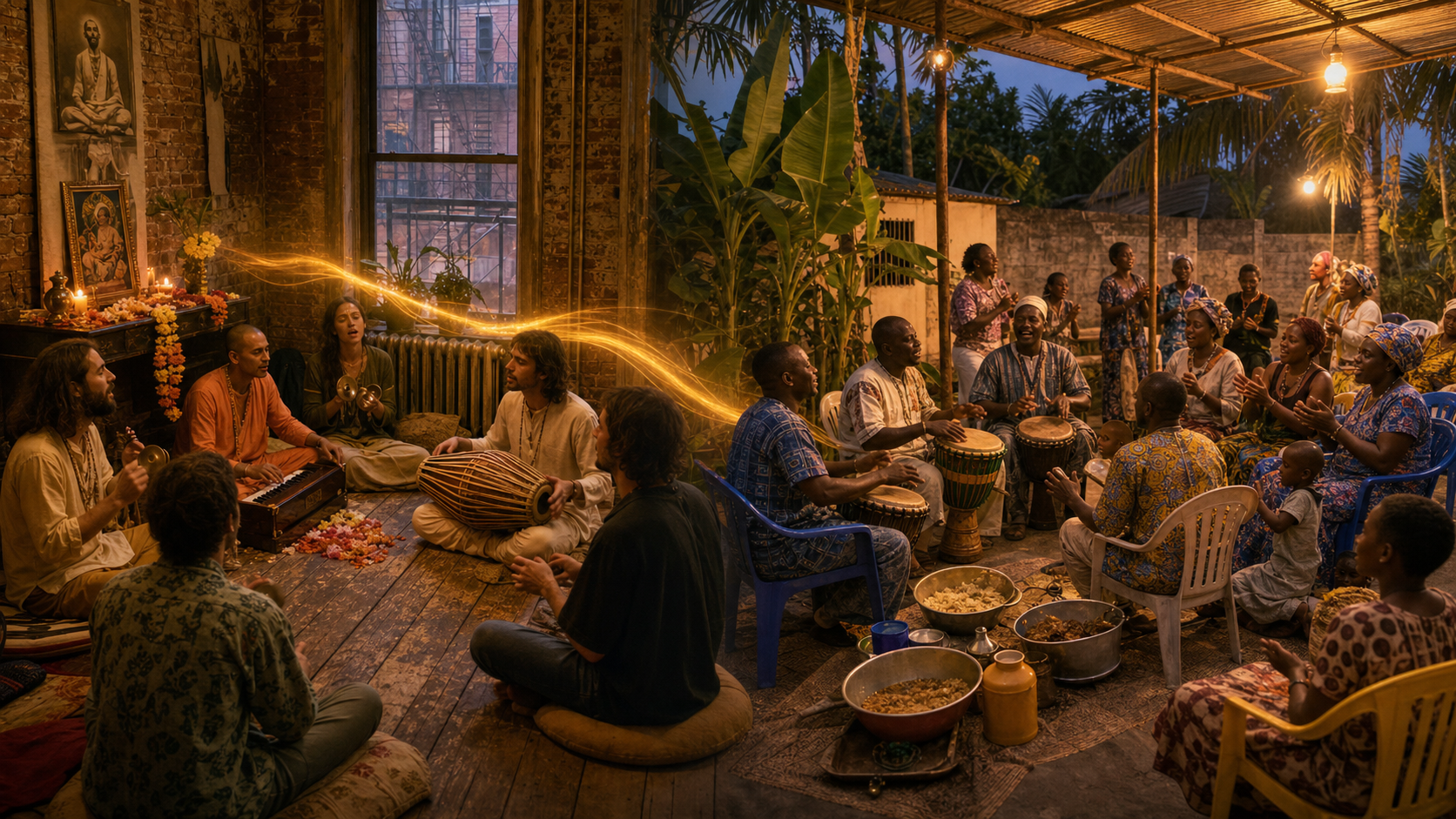
If you are trying to decide whether ISKCON is an Indian tradition, a Western movement, or a modern global institution, the answer depends on which layer you mean. The institution began in New York, while the Krishna-bhakti lineage and disciplines it carried came from Bharat’s Gaudiya Vaishnava tradition.
The clearest way to understand its expansion is to place two very different centres in the same frame: the first Western temple at 26 Second Avenue and a small congregation in Lomé, Togo. The distance between them was crossed not simply by constructing temples, but by making a demanding spiritual practice repeatable, communal, and locally sustainable.
Key takeaways
- ISKCON is a modern institution founded by A.C. Bhaktivedanta Swami Prabhupada, not the beginning of Krishna bhakti itself.
- Its first Western temple at 26 Second Avenue gave an ancient Vaishnava tradition a durable institutional base in New York.
- What travelled most effectively was a complete pattern of practice: mantra meditation, congregational kirtan, worship, disciplined conduct, teaching, and service.
- A small centre can demonstrate genuine global reach without proving that the movement is numerically large in that country.
- You can assess an ISKCON community more accurately by looking at the regularity of its sadhana and local stewardship than by judging its building alone.
The New York origin belongs to a much older lineage
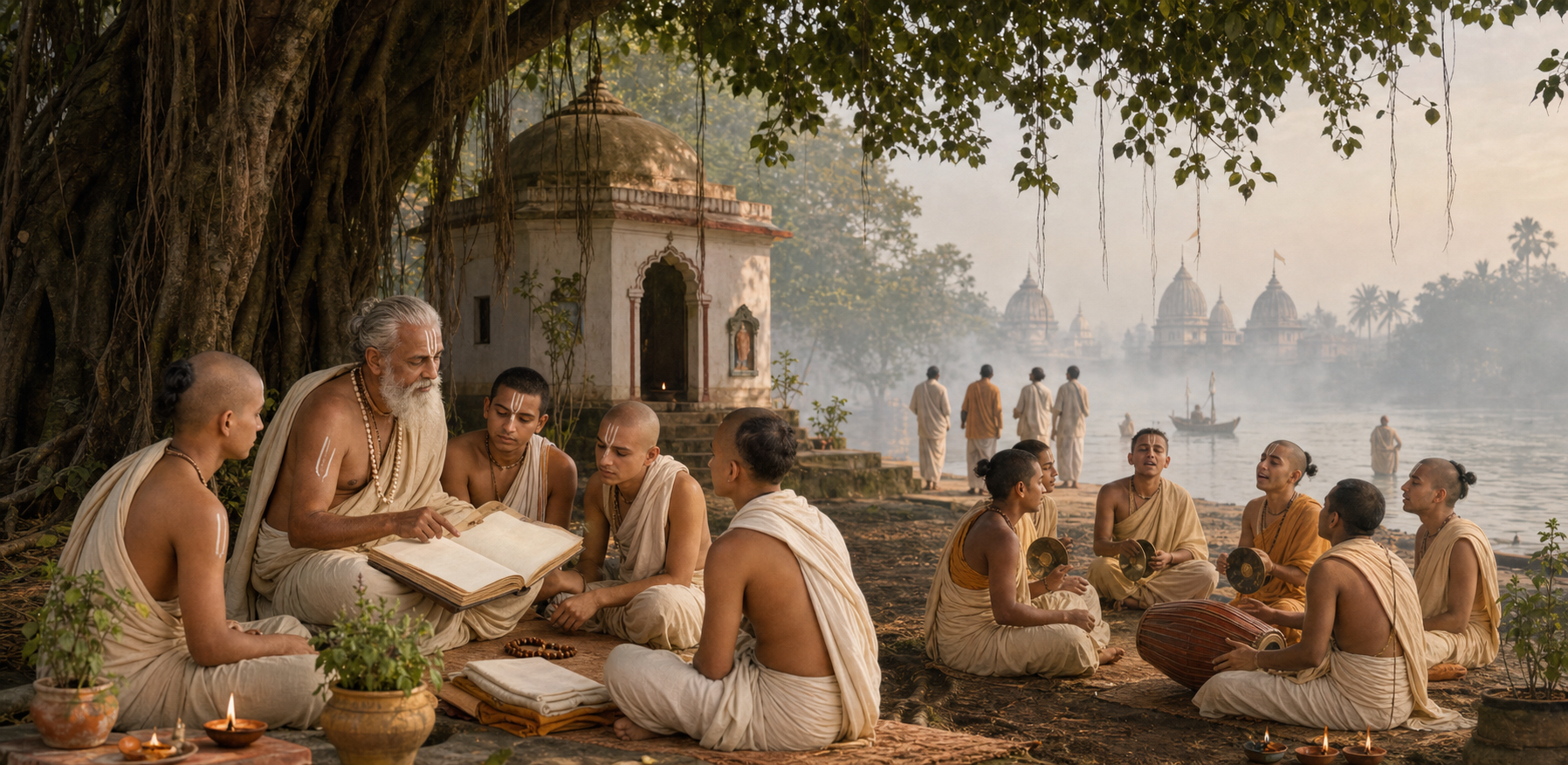
In 1966, A.C. Bhaktivedanta Swami Prabhupada established the International Society for Krishna Consciousness in New York. Its modest premises at 26 Second Avenue became his first temple in the West and the institutional starting point for ISKCON’s international mission.
That date marks the birth of the organisation, not the birth of its religion. Krishna bhakti long predates ISKCON. The movement belongs to the Gaudiya Vaishnava tradition associated with Sri Chaitanya, in which devotion to Krishna is cultivated through remembrance, service, scriptural learning, deity worship, and the chanting of the divine names.
This distinction matters because two opposite misunderstandings are common. One treats ISKCON as though it invented Krishna devotion in twentieth-century America. The other treats the modern institution as though its corporate identity, international administration, and temple network had existed unchanged for centuries. Neither view is accurate.
- Krishna bhakti is the older spiritual current.
- Gaudiya Vaishnavism is the particular lineage and theological tradition through which ISKCON understands and practises that devotion.
- ISKCON is the modern organisation created to teach, organise, and sustain that tradition internationally.
Keeping these layers separate lets you recognise both continuity and innovation. Prabhupada did not manufacture a new object of worship for Western seekers. He carried an inherited sampradaya into a new social setting and built an institution capable of training people who had not grown up inside that setting.
New York therefore remains more than a nostalgic location. A 60th-anniversary gathering there brought together more than 450 attendees, with Hema Malini among the speakers. Such a celebration shows institutional memory and public visibility. It should not, by itself, be mistaken for evidence about the strength of every local congregation. Anniversaries tell you that a community remembers its origin; daily practice tells you whether that inheritance is still alive.
What travelled was a complete pattern of practice
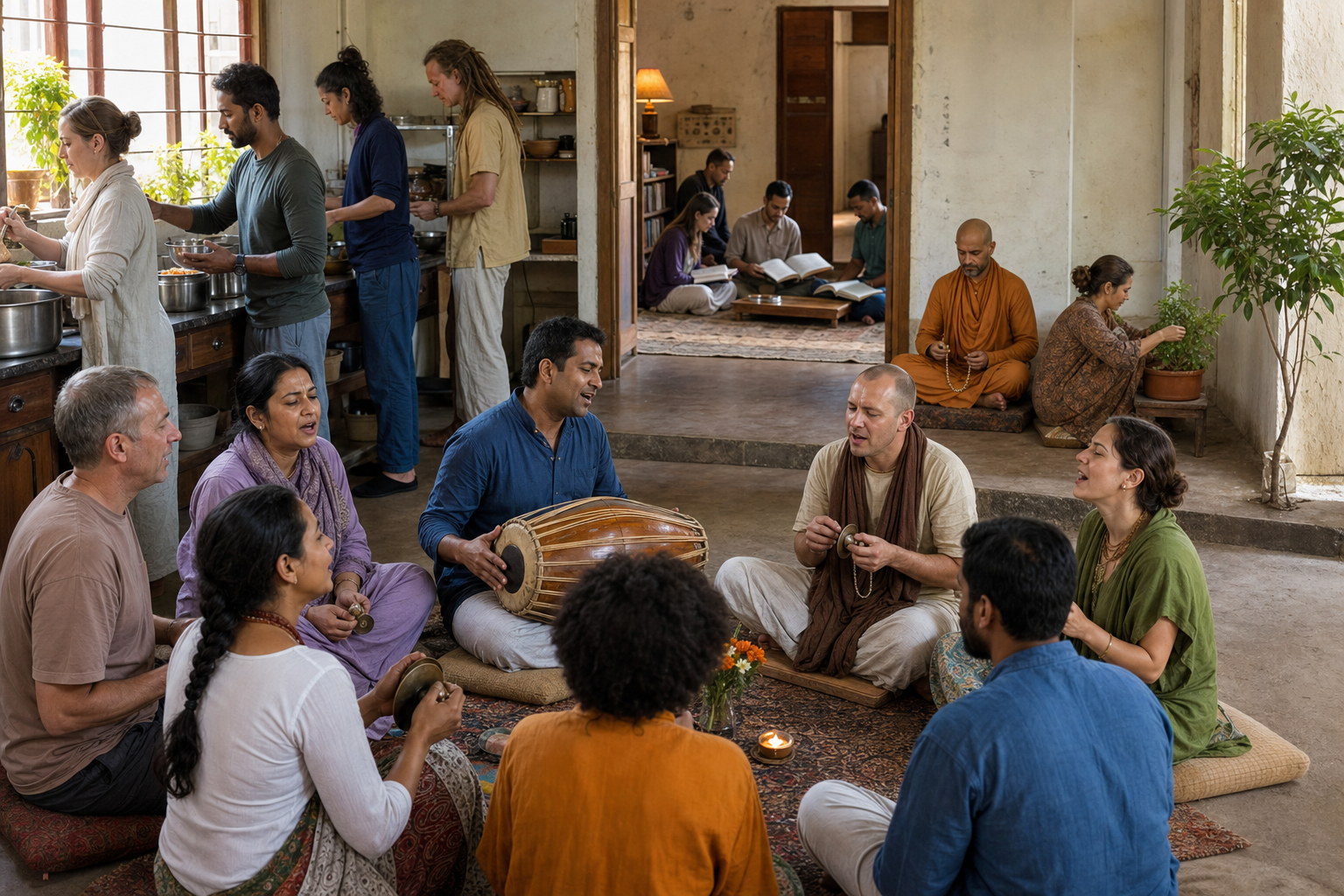
ISKCON’s global expansion is sometimes reduced to a map of temples. Buildings matter, but they come late in the process. A congregation can begin in a rented room, a home, or a temporary structure because the essential practices are portable.
The Hare Krishna maha-mantra can be chanted by one person or a public gathering. Kirtan is participatory rather than dependent on a large professional clergy. Teaching can take place wherever people can listen and ask questions. A regular cycle of worship creates shared time, while common disciplines create a recognisable community across differences of language and nationality.
A useful way to read the expansion pattern is as a sequence of capacities:
- Invitation: people first encounter the tradition through chanting, teaching, worship, devotional food, or personal relationships.
- Repetition: occasional interest becomes a regular gathering with a dependable rhythm.
- Discipline: participants adopt sadhana and standards of conduct that make the community more than a cultural event.
- Local responsibility: devotees learn to lead kirtan, organise worship, care for the congregation, and maintain practical operations.
- Institutional stability: the community acquires or improves a facility, trains others, and develops the capacity to continue beyond one charismatic organiser.
Not every centre passes through these stages in precisely this order. The model is useful because it stops you from equating expansion with real estate. A grand building without regular spiritual life may have less missionary depth than a plain room whose local devotees maintain worship every morning.
The four regulative principles also help explain the movement’s cohesion. They are not decorative customs added after conversion; they set demanding boundaries around conduct. Following them can be especially conspicuous where vegetarianism and abstinence are not familiar social norms. That cost creates friction, but it also prevents the tradition from dissolving into a vague appreciation of Indian spirituality.
Adaptation still occurs. Local devotees may use their own languages, musical sensibilities, outreach methods, and organisational arrangements. The portable core, however, remains identifiable: the maha-mantra, Krishna-centred devotion, guru and scripture, worship, ethical discipline, and service. Globalisation works here through adaptation around a stable centre, not through erasing the centre.
Lomé reveals what global expansion looks like at ground level
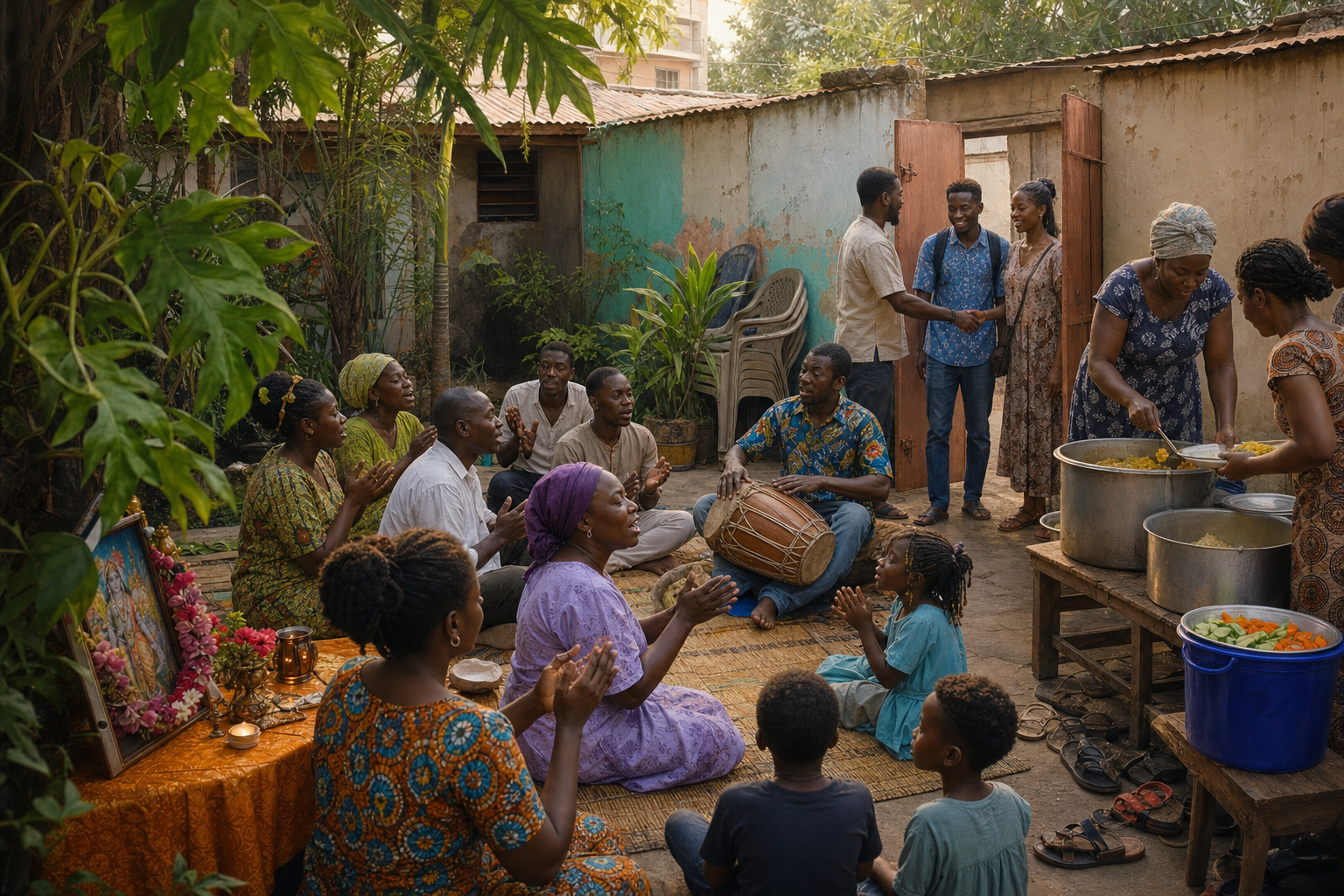
The presence of an ISKCON community in Lomé is instructive precisely because it does not resemble a large anniversary gala. During one early-morning visit, three devotees participated in a sequence that included Guru-puja, Narasimha-arati, Tulasi-puja, and congregational chanting. Their former roof had collapsed, they were using a small temporary structure, and a new temple building was under construction. The centre also maintained a goshala with four cows.
Those details show the same institutional grammar found in much larger centres: scheduled worship, shared mantra, service to sacred cows, hospitality to a visiting devotee, and an effort to create a more permanent home. The scale is different, but the practices make the community recognisable.
You should also notice what this example does not prove. Three people at one early-morning service are not a census of the congregation. One temple does not establish how widely ISKCON has spread through Togo, how many regular practitioners it has there, or what resources are available to them. It proves presence and continuity under constraint, not national scale.
That is an important rule whenever you evaluate claims about religious growth. A photograph of a crowded festival may capture a special occasion rather than ordinary participation. A quiet morning may undercount everyone who attends later. A construction project indicates ambition and organisation, but not necessarily financial security. Ask what the evidence actually measures before turning it into a claim about the whole movement.
Hardship should not be romanticised either. A collapsed roof represents a material and potentially serious safety problem, not a test that devotees ought to welcome. Nor should a visitor’s decision to disregard warnings about an unsafe area become a model for pilgrimage. If you plan to visit a centre in an unfamiliar place, contact its local organisers first, confirm the programme, use verified transport, and follow credible local safety advice. Faith can guide the purpose of a journey; it does not remove ordinary risk.
The more useful lesson from Lomé is that a community can preserve a demanding devotional routine with limited facilities. Its spiritual continuity depends on people who arrive, chant, worship, care for one another, and accept responsibility even while the physical institution remains fragile.
How to read ISKCON’s worldwide footprint accurately

If you encounter an ISKCON centre and want to understand what the global movement has become, start with questions that reveal function rather than appearance:
- Is the practice regular? Confirm whether kirtan, arati, teaching, and other programmes happen on a dependable schedule. A posted timetable is useful, but current local confirmation is better.
- Who carries the daily responsibility? Look for local devotees who can lead worship, teach, welcome newcomers, and manage practical needs. A community dependent entirely on occasional visitors is more vulnerable.
- What does the facility actually support? A small room may sustain serious sadhana. A larger complex may support festivals, education, food distribution, residential training, or cow care. Judge the building by what it enables.
- What remains stable, and what has adapted? Distinguish the core devotional commitments from local language, architecture, music, food customs, and outreach. Variation around the core is not necessarily dilution.
- What kind of evidence are you seeing? A gala demonstrates gathering power and public recognition. A morning service demonstrates routine. A new building demonstrates intention and some organisational capacity. None of these alone supplies a complete measure of growth.
This method also clarifies ISKCON’s place in the wider Dharmic world. The movement is neither a substitute for the full diversity of Hindu traditions nor an alien body merely wearing Indian symbols. It is a specific Vaishnava institution that translated one lineage’s disciplined life into forms that people outside Bharat could enter, learn, and eventually steward for themselves.
That may be its most consequential form of global influence. Bharat did not reach Lomé only as philosophy to be admired from a distance. A living practice took root there: names were chanted, pujas were performed, cows were cared for, standards were maintained, and a local community worked toward a permanent temple.
If you want to understand the ISKCON centre nearest you, do not begin with assumptions about its size or with photographs from a major festival. Verify a public programme, attend respectfully, and speak with the people responsible for its daily life. Then look for the three signs that connect New York to Lomé: continuity of practice, local responsibility, and the patience to build an institution one service at a time.
References
- Dandavats – Photos and videos from the 60th Anniversary of ISKCON gala in NYC
- Dandavats – An Unexpected ISKCON Temple in West Africa
