
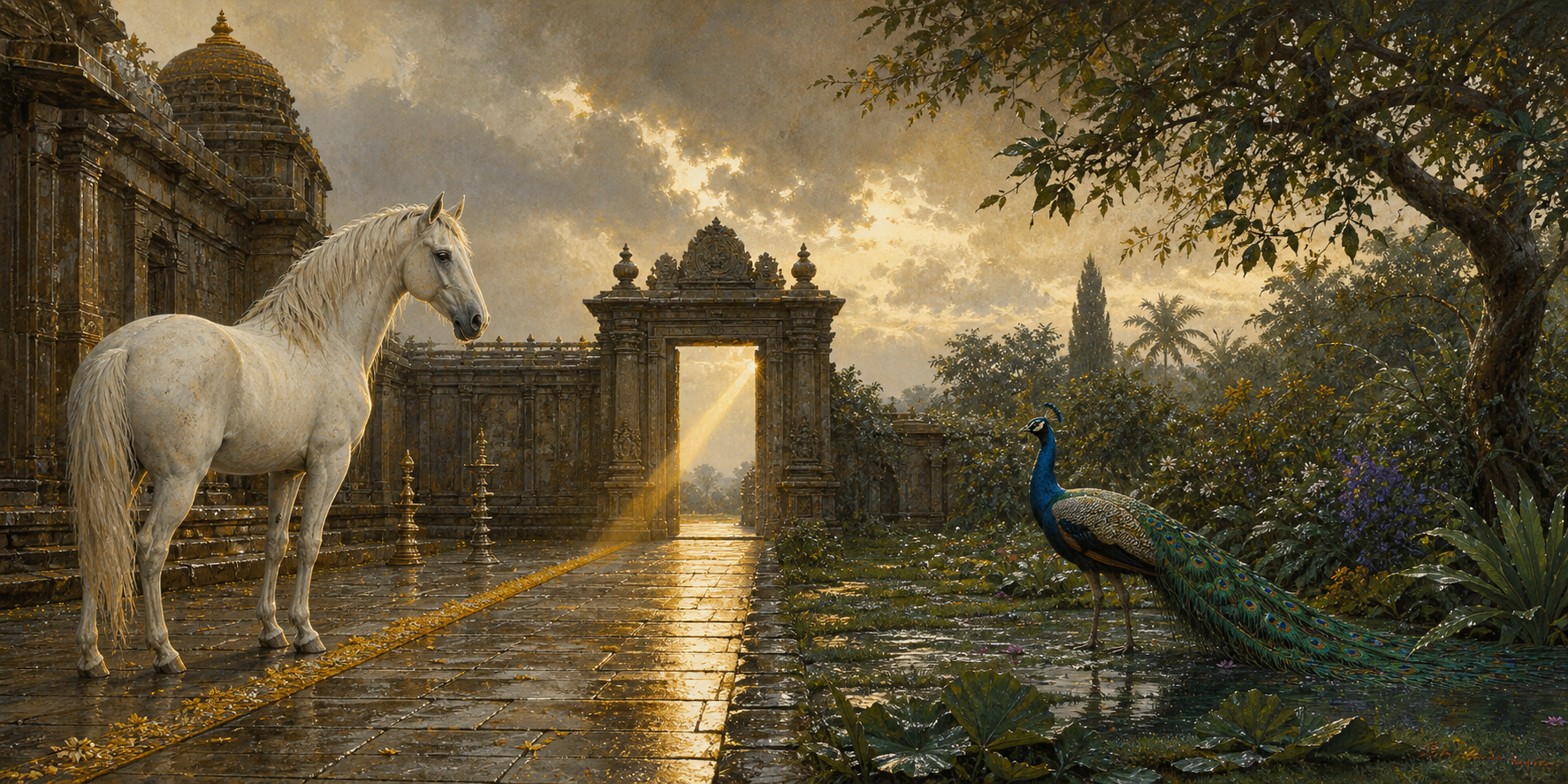
You recognize the deity, but the animal beside the deity leaves you uncertain. Is it a vehicle, a devotee, a divine being, a natural creature carrying symbolic meaning, or all of these at once?
You do not need a single master list of animals and meanings. You need a reliable way to read the relationship. Kalki’s white horse and the divine peacock make especially useful teachers because each animal changes meaning with its narrative role, physical qualities, and place in worship.
Identify the animal’s role before assigning its meaning
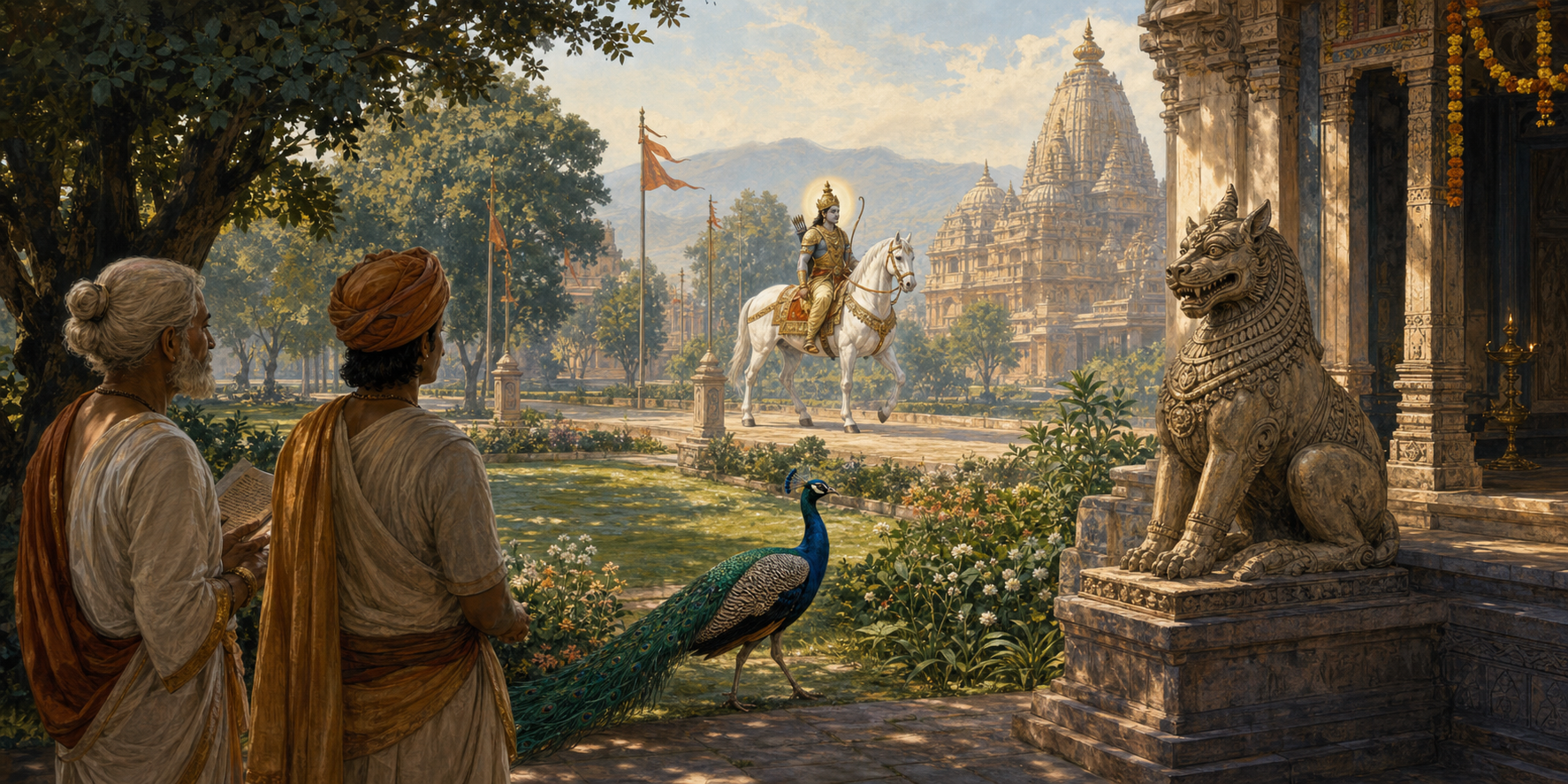
The word “sacred” can conceal several distinct relationships. An animal may carry a deity, assist one during a crisis, embody a cosmic force, mirror a faculty of the human person, or become part of ritual service. These roles can overlap, but they are not interchangeable.
A vahana, for example, is more than a decorative mascot. The animal’s powers are placed in relationship with the deity’s authority. Speed, strength, vision, or ferocity does not disappear; it becomes directed. That relationship often supplies the first interpretive clue: ask what kind of force the animal possesses and how the deity governs, transforms, or employs it.
- Vehicle: The animal carries divine agency into the world. Its natural power becomes disciplined power.
- Ally or protector: The animal acts within a story and may receive recognition or a boon. Gratitude and reciprocity become central.
- Cosmic image: The animal’s movement, form, or color helps make time, vitality, sovereignty, or natural order visible.
- Inner metaphor: The animal represents something you must understand within yourself, such as the senses, attention, breath, or will.
- Ritual presence: Feathers, images, dance, and ceremonial objects carry the remembered relationship into lived devotion.
This distinction prevents a common mistake. The peacock connected with Indra in one protective episode does not thereby become Indra’s vahana; that role belongs to Airavata, the celestial elephant. The peacock is more firmly recognized as the vahana of Skanda or Kartikeya. Narrative assistance and permanent iconographic identity are different kinds of sacred association.
When you encounter an unfamiliar animal in a temple sculpture or painting, begin with grammar rather than symbolism. Who is riding? Who is acting? Who is being protected? What is the animal looking toward? The composition often tells you which relationship you are seeing before any dictionary of symbols can help.
Devadatta shows how power becomes answerable to dharma
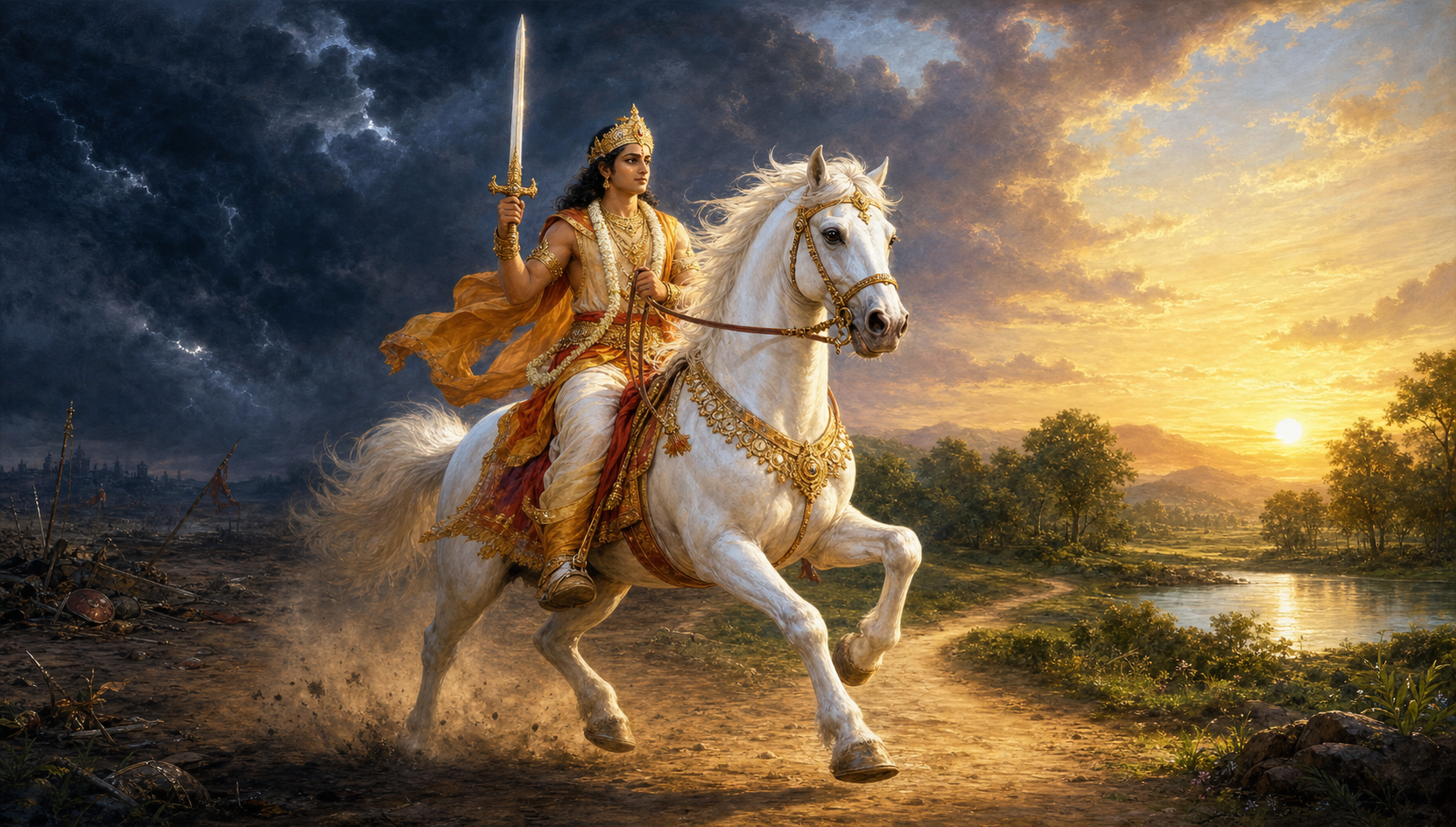
Kalki is envisioned in Puranic tradition as the future manifestation of Bhagwan Vishnu who appears at the end of Kali Yuga, removes adharma, and turns the cycle toward renewal. His radiant white horse is traditionally called Devadatta, a name that conveys something divinely given. The image therefore begins with authorization: this is not uncontrolled violence or private ambition, but force made answerable to cosmic order.
Color, animal nature, and narrative timing work together. White carries the associations of sattva: luminosity, balance, purity, and discriminative clarity. The horse contributes speed, vitality, breath in motion, and trained strength. The ending of Kali Yuga supplies the need for decisive movement. The resulting image is not merely “purity riding fast.” It is dynamic power governed by sattvic discernment.
This matters because speed has no moral value by itself. The same energy can carry you toward duty or scatter you among distractions. Devadatta represents vigor that has accepted direction. You can read the horse as rajas, the quality of motion and activity, brought under the guidance of sattva. Action remains forceful, but clarity gives it purpose and restraint.
The older Vedic and Upanishadic background deepens that reading. The horse is associated with swift energy, prana in motion, solar power, and the ordered passage of cosmic time. The Brihadaranyaka Upanishad’s cosmic treatment of the ashvamedha maps the horse onto the larger order of existence. The Katha Upanishad brings the image inward: the senses are horses, the mind functions as reins, and buddhi is the charioteer.
That inner map does not claim that the Katha Upanishad is explaining Kalki’s horse directly. It gives you a legitimate interpretive resonance. A perfectly responsive Devadatta can be contemplated as the human instrument brought into harmony: senses no longer pulling in incompatible directions, attention no longer ruled by every stimulus, and vitality placed at the service of discernment.
The sword sometimes shown in Kalki’s hand can likewise be read at more than one level. In an ethical and contemplative interpretation, its cutting power is viveka, the capacity to separate truth from falsehood and duty from appetite. The horse then becomes the moving foundation of discrimination: enough energy to act, enough discipline not to become reckless.
Keep Kalki’s equestrian image distinct from Hayagriva. Kalki rides a horse while appearing for temporal and ethical renewal. Hayagriva has a horse’s head and is associated with knowledge and the recovery of the Vedas. Their equine imagery shares an atmosphere of order and awakened intelligence, but the iconographic forms and theological emphases are not the same.
To use Devadatta as a practical mirror, do not ask whether you possess enough energy. Ask whether your energy obeys your clearest understanding of dharma. Notice where your attention bolts ahead of discernment, where urgency replaces duty, or where strength turns into harshness. The correction is not passivity. It is to put the reins back into the hands of buddhi.
The peacock joins vigilance, beauty, and gratitude
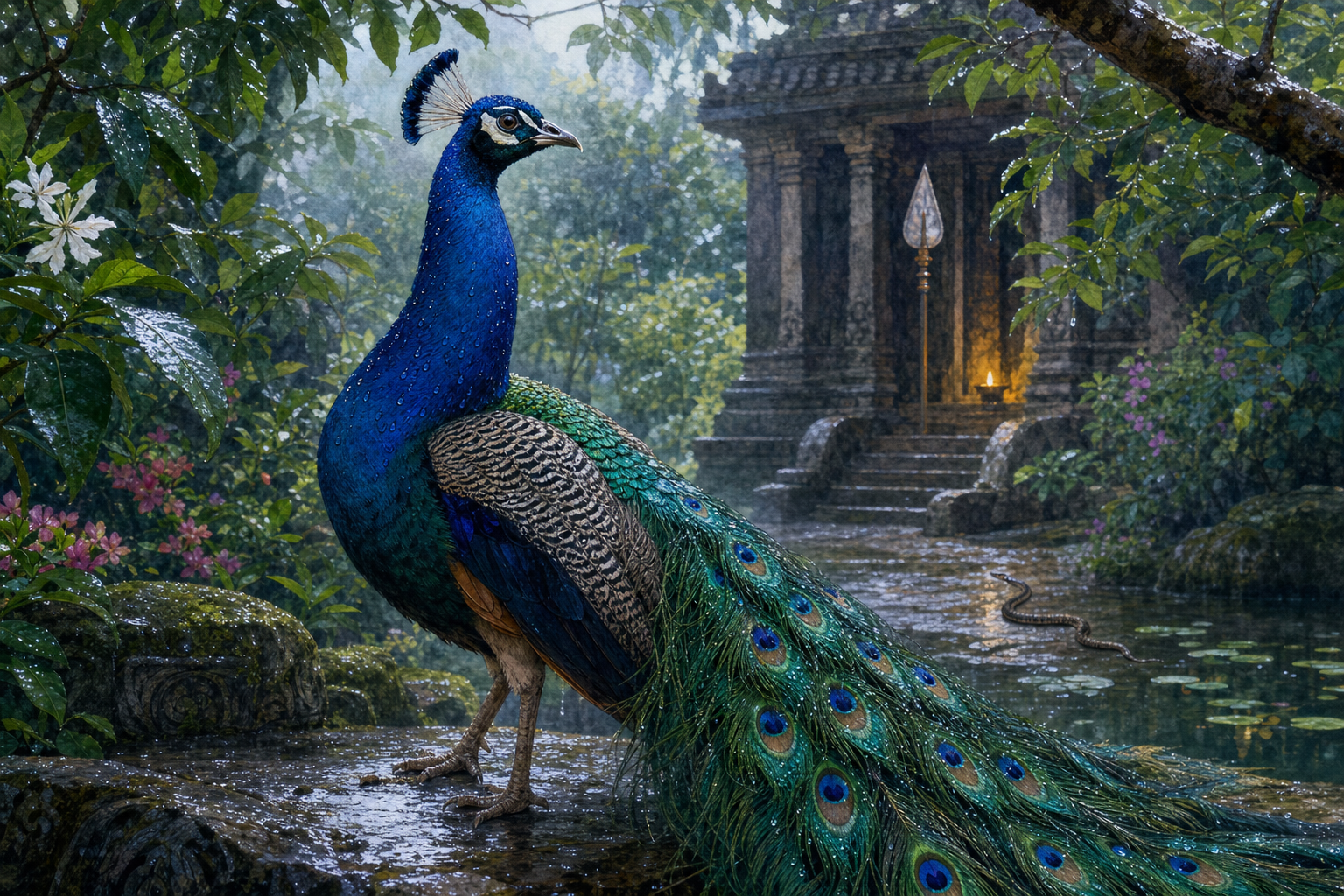
The peacock carries a different form of sacred power. In tellings connected with the Uttara Ramayana, Indra faces Ravana during the latter’s rise to formidable power. A peacock intervenes at a critical moment by concealing, shielding, distracting, or otherwise helping Indra. Details vary across recensions, regional tellings, popular memory, and temple tradition, so the responsible question is not which embellished detail must be universal. The stable ethical center is that a seemingly modest creature protects divine order and receives grateful recognition.
Indra’s boons explain the bird’s magnificence in sacred terms. The eye-like markings on its train become associated with Indra as Sahasraksha, the thousand-eyed one. Other tellings connect the peacock with brilliant plumage, rain, fertility, and freedom from fear of snakes. Natural behavior, visible form, and theological imagination meet in an image of watchful protection rewarded by gratitude.
The “eyes” are especially instructive. They turn beauty into vigilance. The peacock does not merely look splendid; its whole displayed form appears to look back. Within a dharmic reading, attention becomes protective when it notices danger, recognizes assistance, and refuses to overlook a small ally because a powerful conflict dominates the scene.
Physical explanation does not have to compete with sacred meaning. The shimmering blues and greens of peacock feathers arise through structural coloration, in which microscopic arrangements interact with light. A narrative of divine blessing answers a different question. It places the bird’s visible brilliance inside a moral world of protection, reciprocity, rain, and renewal. One account concerns physical process; the other interprets significance.
The peacock’s strongest vahana relationship belongs to Skanda, also known as Kartikeya or Subrahmanya, commander of the divine hosts. In that pairing, dazzling beauty does not soften martial readiness. It shows power held with dignity. The bird’s association with snakes also supports an image of danger mastered rather than ignored. Read beside Skanda, the peacock becomes a lesson in alert, disciplined protection.
Ritual and performance carry these meanings beyond narrative. Peacock feathers appear in ceremonial fans and devotional settings, while Mayil Attam gives stylized movement to the bird in worship connected with Subrahmanya. The peacock’s responsiveness to the monsoon further joins divine kingship, rain, agrarian renewal, and the rhythms of Bharat’s natural world.
The bird also helps you recognize kinships across Dharmic traditions without pretending they are identical. Buddhist traditions associate the peacock with wisdom capable of transforming poison, especially through Mahamayuri. Jain monastics use the peacock-feather pinchi or rajoharana with careful regard for tiny forms of life. Sikh sacred service has included the morchal as an emblem of reverence. These are distinct practices with distinct theological settings. Their convergence lies in disciplined care: beauty and power become sacred when they protect rather than dominate.
The peacock’s practical demand is therefore sharper than “admire beauty.” Look for the helper whose contribution is easy to miss. Acknowledge assistance while it can still strengthen a relationship. Keep your attention wide enough to see vulnerable life at the edge of an important undertaking. Gratitude becomes dharmic when it changes how the helper is treated, not when it remains a private feeling.
Use this method when you meet any sacred animal
A sacred animal rarely yields its full meaning to a one-word label. “Horse equals power” and “peacock equals beauty” may be starting points, but they discard the relationship that makes the power or beauty morally intelligible. Use the following sequence when you study a story, murti, painting, dance, or household devotional object.
- Name the precise relationship. Determine whether the animal is a vahana, ally, adversary, divine manifestation, sacrificial image, emblem, or inner metaphor. Do not promote a temporary ally into a permanent vehicle or reduce a divine form to a decorative symbol.
- Locate the narrative layer. Ask whether the association is Vedic, Upanishadic, epic, Puranic, regional, or primarily iconographic. A regional telling can carry authentic devotional meaning without being presented as a uniform detail in every recension.
- Observe the creature before decoding it. Note speed, gait, color, plumage, habitat, sound, defensive behavior, and relation to the seasons. Hindu narratives often receive qualities already visible in nature and place them within a moral and cosmic order.
- Read the whole composition. A white horse at the end of Kali Yuga means more than a white horse considered alone. A peacock shielding Indra means something different from a peacock bearing Skanda. Deity, gesture, weapon, direction of movement, color, and narrative crisis interpret one another.
- Separate textual statement from contemplative application. It is fair to use the Katha Upanishad’s chariot model to reflect on disciplined senses. It would be careless to claim that every appearance of a horse is explicitly a coded reference to that passage. Mark an inward reading as an interpretation, then test whether it respects the narrative.
- Compare traditions through an ethical theme. Protection, ahimsa, gratitude, self-mastery, and service can reveal Dharmic affinities. Preserve differences in doctrine, practice, and sacred history rather than forcing every animal into a single universal archetype.
Key takeaways
- A sacred animal’s meaning begins with its relationship to the deity or narrative, not with a fixed symbol dictionary.
- Devadatta represents vitality and speed placed under sattvic clarity, discernment, and dharmic purpose.
- The peacock expresses vigilant protection, gratitude, monsoon renewal, and power carried with beauty and restraint.
- Natural explanation and sacred interpretation can operate together because they answer different kinds of questions.
- Shared motifs across Hindu, Buddhist, Jain, and Sikh traditions should reveal ethical kinship without erasing theological distinctions.
Let the animal direct a concrete dharmic response
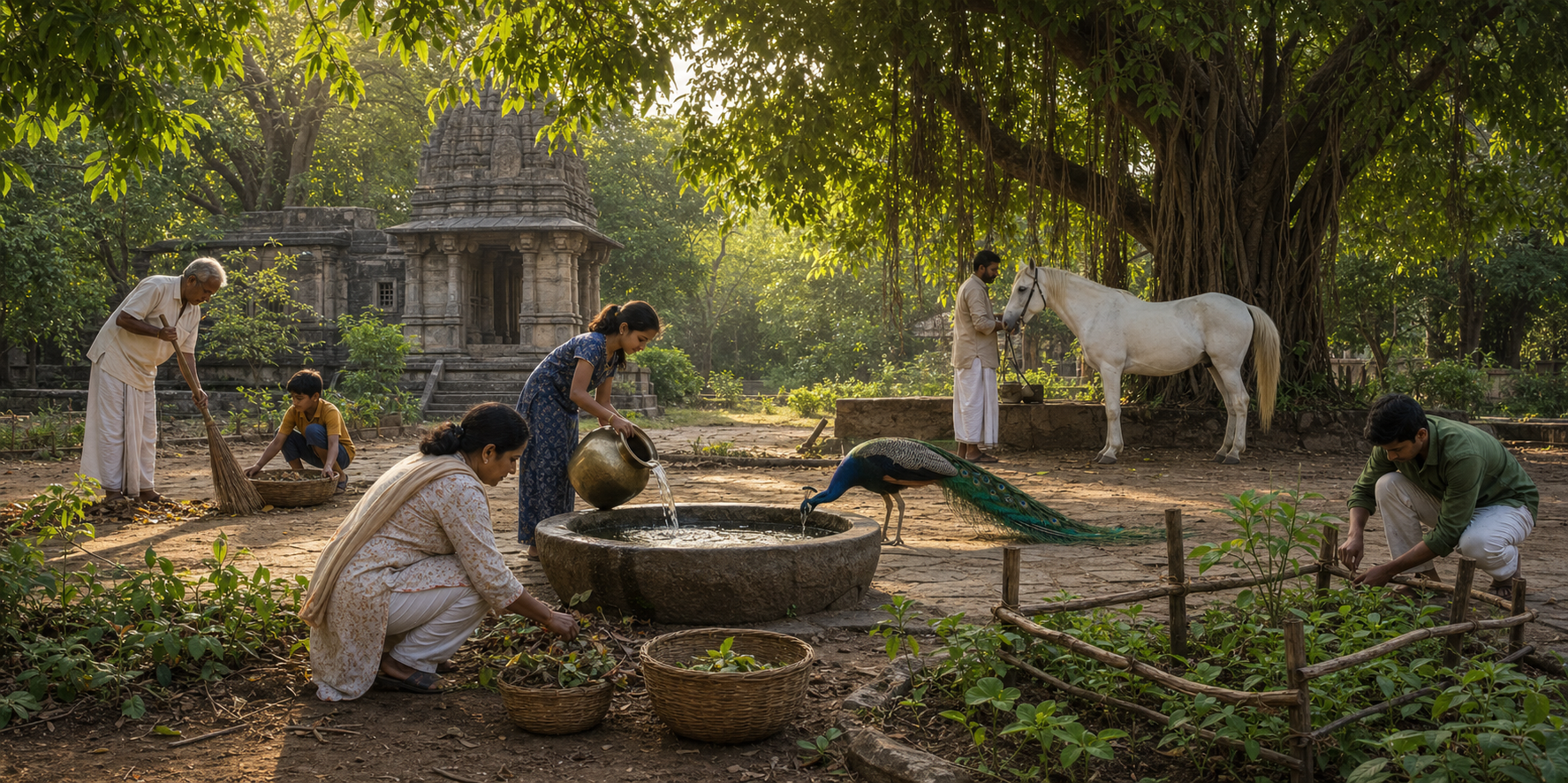
Sacred symbolism has done only half its work when you can identify an animal in an image. Its fuller purpose appears when recognition corrects conduct.
When your difficulty is scattered energy, work with the horse. Name the duty that should govern your next action. Bring the senses back from competing stimuli. Let buddhi decide the direction before speed takes over. Devadatta’s lesson is not to move slowly; it is to make movement obedient to clarity.
When your difficulty is inattentiveness to others, work with the peacock. Identify the person, creature, or quiet act that helped preserve something valuable. Respond with visible gratitude. Then widen your field of care so that beauty, status, or conflict does not distract you from vulnerable life.
The next time an animal appears beside a deity, resist the urge to name one meaning and move on. Identify the relationship, follow the narrative, observe the animal’s living qualities, and ask what kind of human power is being trained. That question turns iconography from a collection of facts into a practice of dharmic attention.
References
- DharmaRenaissance Blog – Kalki’s White Horse Devadatta: Profound Symbolism, Dharmic Unity, and Timeless Renewal
- DharmaRenaissance Blog – Indra, Ravana, and the Divine Peacock: A Ramayana Tale of Protection, Boons, and Dharmic Unity
