

Someone forwards a claim that confirms what you already suspect about Bharat, a religious community, a colleague, or a relative. It feels obvious. It also seems to demand an immediate response. The danger is not that you care too much. The danger is that your concern quietly begins deciding what counts as evidence.
Before you share, accuse, defend, or decide, you need more than an instruction to calm down. You need a way to separate what happened from what you inferred, examine a question from more than one standpoint, expose your own attachments, and still act when values are at stake. The Dharmic traditions offer exactly that kind of discipline.
Objectivity does not require moral neutrality
The practical aim is not to become a person with no commitments, loyalties, or emotions. It is to prevent unexamined attraction and aversion, traditionally described as raga-dvesha, from distorting what you notice and how you judge it.
If you want a particular story to be true, confirming details appear decisive while contrary details feel irrelevant. If you dislike the person making a claim, you may reject sound evidence because accepting it would seem like conceding status to that person. If an issue touches your identity, a request for verification may feel like an attack. None of these reactions proves that your conclusion is wrong. They do show that it has not yet been tested well enough.
Dharmic objectivity therefore avoids three common mistakes:
- It does not confuse equanimity with numbness. Anger, grief, fear, and affection can alert you to something important. They are data about your condition, not automatic proof about the external situation.
- It does not confuse fairness with moral equivalence. Giving rival claims a fair hearing does not require treating truth and falsehood, protection and aggression, or dharma and adharma as interchangeable.
- It does not confuse open-mindedness with endless hesitation. You can acknowledge incomplete knowledge and still choose the most defensible action available.
This matters whenever someone invokes objectivity to demand silence in the face of injustice. A Dharmic approach is not value-empty. Satya, ahimsa, fairness, responsibility, and the welfare of the larger community remain active standards. What changes is the quality of attention brought to them.
Clear judgment rests on three different disciplines

Hindu, Jain, Buddhist, and Sikh traditions do not teach one interchangeable philosophy. Their views of self, consciousness, reality, and liberation differ. For practical judgment, however, they illuminate three complementary tasks: test how you know, widen the standpoint from which you look, and steady the mind doing the looking.
First discipline: identify how you know
Nyaya asks you to examine the means by which a belief was formed. Its familiar framework distinguishes perception, inference, comparison, and trustworthy testimony: pratyaksha, anumana, upamana, and shabda. The point is not to decorate an opinion with Sanskrit. It is to stop several different kinds of claim from collapsing into one another.
Suppose a colleague did not reply to an important message. The missing reply is an observation. The belief that the colleague is deliberately undermining you is an inference. A co-worker’s description of an earlier incident is testimony. Your comparison with another dispute is an analogy. The inference may eventually prove correct, but it should not be recorded as though you directly witnessed the intention behind the silence.
Mimamsa and Vedanta expand the inquiry with arthapatti and anupalabdhi. Arthapatti asks what explanatory postulate could reconcile facts that otherwise do not fit. Anupalabdhi considers when a genuine failure to observe something counts as evidence of absence. That last test requires care: a missing item is informative only when it should have been present and the conditions were suitable for detecting it.
For any consequential claim, write four short lines:
- Observed: What did you directly see, hear, or read?
- Inferred: What conclusion did you add to those observations?
- Reported: Who supplied testimony, and what makes that testimony dependable or questionable?
- Unresolved: What alternative explanation still fits what you know?
This small separation prevents a surprisingly common error: defending an interpretation as though it were the event itself.
Second discipline: examine more than one standpoint
Jain Anekantavada begins from the recognition that a complex reality can exceed any single description. Syadvada puts that humility into language by qualifying a claim according to the respect, condition, or standpoint from which it holds. This is many-sided inquiry, not the claim that every opinion is equally correct.
Use it by constructing at least three plausible readings of the same facts. Include your own standpoint, the strongest reasonable standpoint of the other party, and the standpoint of someone affected by the decision but absent from the argument. In a family dispute, that third view might belong to the person receiving care. In a workplace dispute, it might belong to a customer or another team. In public controversy, it might be the long-term interest of the community rather than the immediate advantage of either faction.
State each view conditionally. From one standpoint, a strict deadline protects accountability. From another, it ignores a constraint that was never disclosed. From a third, the real problem is a process that depends on last-minute intervention. Conditional wording lowers the pressure to declare one person wholly right before the relevant dimensions have even been separated.
Many-sidedness has a stopping rule: perspectives deserve examination, but conclusions still answer to evidence and ethics. A viewpoint does not become sound merely because someone holds it. Once the competing accounts are stated fairly, return to the facts and ask which account explains them with the fewest unsupported additions.
Third discipline: steady the mind that is judging
You cannot reason clearly while treating every thought as a command. Sankhya-Yoga develops the witness stance, or sakshi-bhava, in which mental events are noticed without being mistaken for the whole of the observer. Patanjali’s pairing of abhyasa and vairagya joins repeated practice with non-clinging. Buddhist mindfulness and insight similarly train attention to notice sensations, feelings, and thoughts as conditioned and changing rather than as unquestionable identity.
These approaches should not be collapsed into one metaphysical doctrine. Sankhya’s witness consciousness and the Buddhist teaching of anatta follow different philosophical routes. Their practical challenge to reactivity is still useful: a thought can be present without receiving immediate obedience.
When you feel the urge to react, pause for one complete breath without composing your reply. Notice the bodily signal first: a clenched jaw, tightened chest, heat, or restless movement. Then name the mental event precisely. Replace They are dishonest with I am having the thought that they are dishonest. Replace I must answer now with I feel urgency. This does not acquit anyone. It keeps an internal condition from impersonating external proof.
Sikh ideals add a necessary ethical direction. Nirbhau and nirvair, without fear and without enmity, challenge two opposite corruptions of judgment. Fear can make you appease what should be resisted. Enmity can make you punish beyond what justice requires. Sewa and sarbat da bhala then ask whether clearer perception is being used for service and shared welfare rather than personal victory.
A seven-step protocol for a difficult decision

Use this process when a decision carries emotional weight, affects another person, or is likely to be defended publicly. Write the answers. A mental review is too easy to bend toward the conclusion you already prefer.
- Interrupt the reaction. Take one deliberate breath, repeat a brief japa if that is part of your practice, and do not use the pause to rehearse an argument. The purpose is to create a small distance between stimulus and action.
- Frame the decision without embedding a verdict. Ask What response is justified by what I know? rather than How do I stop this dishonest person? The second question has already convicted someone inside its wording.
- Sort the pramanas. Record direct observations, inferences, analogies, and testimony separately. Note what makes each witness credible, what remains second-hand, and whether another explanation fits the observed facts. If absence is part of the case, identify why the missing evidence should have been detectable.
- Map at least three standpoints. Give each standpoint its strongest reasonable formulation. Do not weaken an opposing view merely to defeat it. Note which facts all sides accept and which disagreements concern interpretation, priority, or value.
- Audit raga-dvesha. Ask what outcome you want, what conclusion you fear, which identity or loyalty feels threatened, and what result would embarrass you. Then ask whether you would apply the same evidential standard if the people involved exchanged sides.
- Apply the ethical filters and act. Test the available options against satya, ahimsa, fairness, and wider welfare. Choose an action you can defend truthfully, that avoids needless harm, applies a principled standard, and serves more than your pride. The Bhagavad Gita’s buddhi-yoga places action within steadiness: responsibility remains yours even though the outcome cannot be controlled.
- Debrief after the result. Compare what happened with what you expected. Which inference held? Which testimony proved reliable? Which attachment narrowed your attention? What new fact should change your view? Updating a judgment is not defeat; it is evidence that the method is working.
If you keep a decision note, make it brief enough to use consistently:
- Decision in one sentence
- Directly observed facts
- Inferences and testimony
- Three plausible standpoints
- Desired and feared outcomes
- Satya, ahimsa, fairness, and common-welfare checks
- Chosen action and the fact that would make you revise it
The final line is especially important. If you cannot name any possible evidence that would alter your conclusion, you may be protecting an identity rather than investigating a claim.
The hardest test is applying the method to your own side
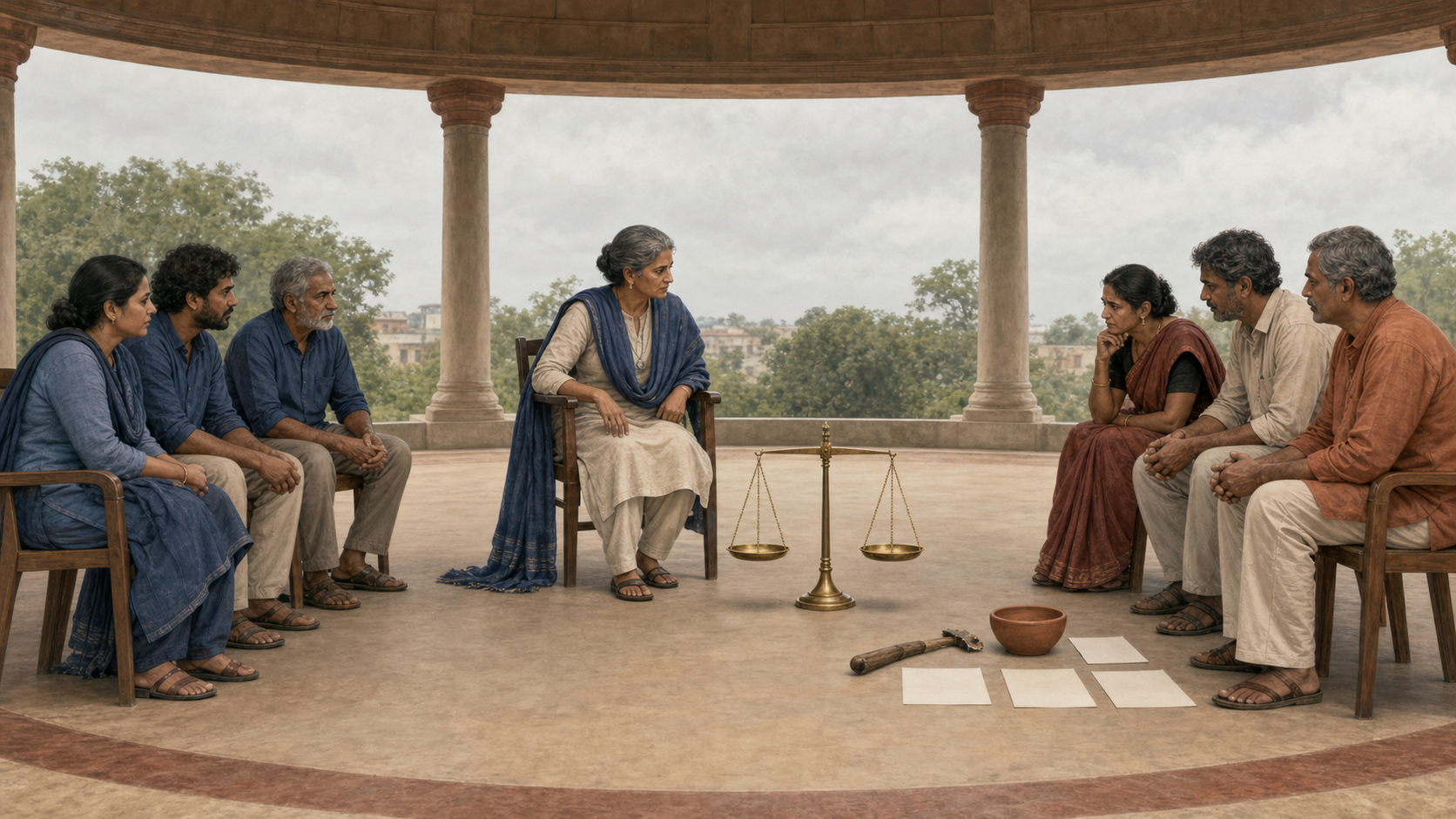
Objectivity is easiest when examining a stranger’s mistake and hardest when a claim benefits your community, political preference, institution, or family. Loyalty can serve dharma, but loyalty that demands falsehood eventually injures the very cause it intends to defend.
For cultural or geopolitical claims, begin by isolating the exact proposition. Do not investigate a cloud of outrage. Write one sentence that could, in principle, be supported or contradicted. Then distinguish the underlying event from judgments about intention, historical meaning, collective guilt, or future danger. Those judgments may be warranted, but each requires its own reasoning.
Before sharing a claim that favors your side, ask:
- Would the same evidence satisfy me if it supported an opponent?
- Have I seen the full statement or only a fragment presented by someone else?
- Am I treating one person’s conduct as proof about an entire community?
- Can I state the strongest contrary interpretation without ridicule?
- What action follows if the claim is true, and what harm follows if it is false?
This does not require ideological disarmament. It requires disciplined advocacy. You can defend Hindu interests, challenge prejudice, or oppose injustice while refusing exaggerated claims that weaken credibility. Correcting an error from your own side is not assistance to an adversary. It protects the standard by which you expect your valid claims to be judged.
The Mahabharata offers a useful political balance. Vidura-niti values counsel that distinguishes fact from rumor and public welfare from factional gain. In the Udyoga Parva, Krishna’s diplomacy joins persistence in seeking peace with refusal to treat injustice as acceptable. Patience and firmness can therefore belong to the same objective response.
The same balance works closer to home. During workplace criticism, separate the exact feedback from the conclusion that your whole contribution has been rejected. During a family disagreement about caregiving or education, identify which points concern shared values and which concern preferences or practical constraints. When values are shared, the dispute often becomes a solvable question of means. When values genuinely differ, naming that difference is more honest than arguing indefinitely over surface details.
Clarity must not become an excuse for passivity. Once the evidence is adequate for the stakes and an option survives the ethical tests, decide. The Gita’s image of stable intelligence is not withdrawal from responsibility; it is action no longer controlled by praise, blame, gain, loss, or compulsive attachment to a particular result.
Key takeaways
- Objectivity means reducing distortion from attachment, aversion, fear, and enmity; it does not mean abandoning moral commitments.
- Separate observation, inference, analogy, and testimony before deciding what a claim establishes.
- Construct at least three plausible standpoints, then judge them by evidence and ethics rather than treating every view as equally true.
- Regard emotion as information about your present condition, not as proof of another person’s intention.
- Test an action against satya, ahimsa, fairness, and wider welfare, then review the result and revise your judgment when facts require it.
On your next difficult decision, do not aim to feel nothing. Take one deliberate breath, write what you observed separately from what you inferred, and add the strongest standpoints you initially resisted. Then choose the action your evidence and Dharmic commitments can both defend. Repeated through abhyasa, that sequence turns objectivity from an occasional effort into a reliable habit of character.
References
