

If you live abroad, you may feel pushed toward two poor choices: keep Hindu life private, or make Hindu identity visible mainly through controversy. There is a more durable path. Become known as the community that shows up, keeps its word, and serves without asking anyone to become Hindu first.
This does not require hiding who you are. It requires translating dharma into public conduct: seva that answers a local need, treats every recipient with dignity, and is accountable enough for your neighbours to trust.
Make public conduct carry the identity
The word civic can sound like electioneering. Here it means something more basic: how you participate in the shared life of the place where you live. A civic Hindu community notices hunger, isolation, educational needs, environmental neglect and other local burdens, then accepts a fair share of the work.
A temple can conduct beautiful worship. An association can defend Hindu interests. A family can preserve language, festivals and memory. All of that matters. Civic trust, however, tests an additional question: when a need becomes visible beyond your own circle, can other people rely on you to help competently and consistently?
During a visit to the ISKCON temple in New York, RSS chief Mohan Bhagwat participated in a food-distribution drive. One appearance cannot establish a long-term service record, but the form of the action offers a useful clue. A recognisably Hindu setting performed work whose value did not require doctrinal agreement: people were fed.
The sequence matters. Begin with a duty that meets a real need. Perform it well. Then explain, when explanation is useful, that seva arises from your Dharmic commitments. If the explanation comes first and the service exists mainly to validate it, recipients can quickly become props in somebody else’s identity campaign.
Give your committee a simple test. Ask everyone to complete this sentence: People living near us should be able to depend on us for ______. If the blank produces only a slogan, you do not yet have a civic commitment. If it names a service, a partner and a promise you can keep, you have somewhere to begin.
Serve the place where you live without hiding your roots
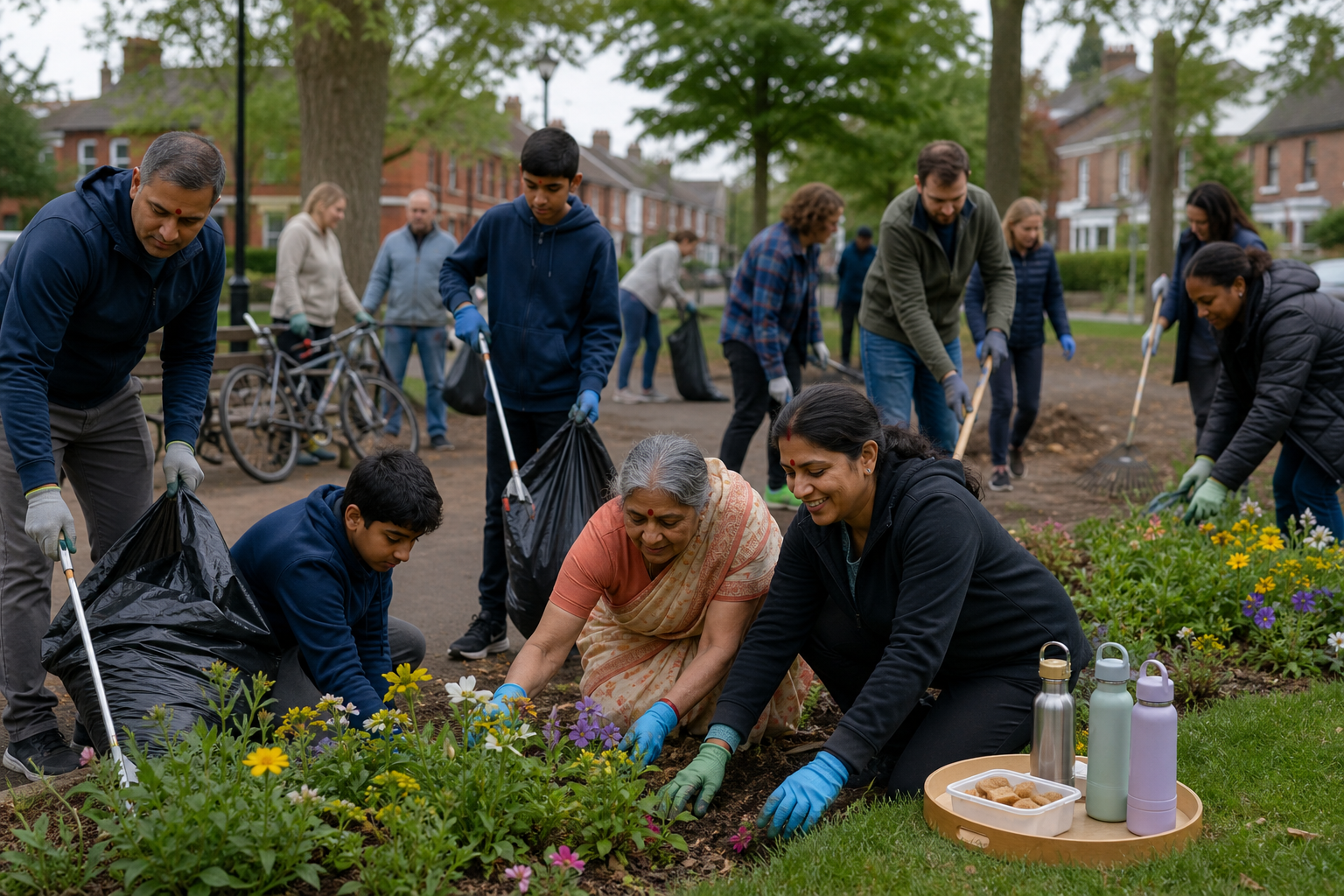
Diaspora communities often encounter a false choice. One path is religiously vivid but entirely inward-facing. The other is publicly useful but treats Hindu identity as an embarrassment that must be concealed. Neither is necessary.
You can name the Hindu organisation sponsoring the work. You can call the practice seva and explain it in ordinary language as service offered without expectation of personal reward. Volunteers can draw motivation from their traditions. The decisive boundary is that access to help must not depend on belief, ritual participation, political agreement or gratitude toward the sponsoring organisation.
Before approving a project, apply three tests:
- Would the work still be worth doing if no photograph or social-media post came from it?
- Could a non-Hindu neighbour describe the practical benefit without first learning Hindu vocabulary?
- Could a Hindu child volunteering beside you understand why this work is an expression of dharma?
A sound project should pass all three. The first protects sincerity. The second makes the work publicly legible. The third prevents public service from becoming culturally hollow.
This does not mean every community resource must be directed outward. Temple maintenance, teaching children, helping newly arrived families and supporting elders are legitimate responsibilities. Label the functions honestly. Member care sustains the community; public service shares responsibility for the wider place. A mature institution can do both without pretending they are identical.
Build a service promise people can rely on

Public events are easy to announce. Reliability is harder. Civic identity is built when an organisation becomes dependable after the enthusiasm of the launch has passed. Use the following sequence to turn good intention into a workable promise.
- Listen before selecting the cause. Contact an established food pantry, school, shelter, neighbourhood group, municipal office or interfaith partner. Ask which recurring task is being neglected because there are too few dependable hands. Do not begin by asking where your organisation would receive the most visibility.
- Choose one narrow promise. Offer a specific kind of help on a schedule your volunteers can actually maintain. A modest commitment completed repeatedly creates more trust than an ambitious programme that quietly disappears.
- Name an owner for every dependency. Someone must manage volunteers, someone must communicate with the partner, and someone must check safety and administrative requirements. When everybody is responsible in theory, missed work has no owner in practice.
- Strengthen an existing effort when possible. A local organisation may already possess facilities, knowledge and trusted relationships. Ask what it needs before duplicating its work under a Hindu banner. Partnership allows your volunteers to add capacity without making recipients navigate another system.
- Protect dignity as part of delivery. Obtain meaningful consent before photographing people. Do not make prayer, testimony or religious conversation a condition of assistance. Collect only information genuinely needed for the work, and restrict access to it.
- Measure whether the promise was kept. Record planned activities, completed activities, volunteer attendance, partner feedback, unresolved problems and any safety incidents. Count attention only if attention was the actual public benefit; otherwise, likes and impressions are not service outcomes.
A useful example from Bharat shows why ownership and measurement belong together. In Khowai, Tripura, a cooperative of 100 women managed the town’s waste ecosystem, helped more than 90% of households segregate waste at source and reduced roadside waste accumulation by around 90%. Women who had been treated as low-paid sanitation workers became owners and decision-makers in the system.
That experience is not a ready-made diaspora template. Its transferable lesson is structural: place responsibility with people close to the work, define participation clearly, and track an observable result. A service programme becomes more than charity when participants gain agency and the community can see what changed.
Your own record can remain simple. Review it with the local partner, not only with your internal committee. Ask what burden was actually reduced, what your volunteers made harder, and whether the promise should be continued, corrected or ended. If an activity produces attractive pictures but no dependable benefit, redesign it.
Set the boundaries before publicity begins

Good intentions do not automatically prevent misuse. A written service covenant gives volunteers, partners and the public a standard against which to judge the work. Establish these boundaries before the first public announcement:
- No religious test. Help is based on the stated need and the programme’s capacity, not the recipient’s faith or willingness to participate in Hindu practice.
- No political bundling. Do not attach party literature, campaign requests or ideological loyalty tests to assistance. Seva can arise from a strong civilizational identity without turning a person in need into a political audience.
- No dignity-for-publicity exchange. A meal, supply package or place in a programme is not payment for a photograph. Refusing publicity must not reduce someone’s access to help.
- No amateur risk-taking. Before distributing food, transporting minors, handling donations or collecting personal information, verify the rules that apply where you live. Work through a qualified local partner when your group lacks the required competence or safeguards. An avoidable compliance or safety failure can harm people and destroy trust.
- No opaque finances. Record what was collected, what was spent and who approved it. Give donors a plain account of how funds were used, while protecting recipients’ personal details.
- No inflated claims. Describe the work you actually completed. Do not turn one distribution event into evidence that an entire city now understands Hindu civilisation.
The covenant should identify the sponsor, intended benefit, access conditions, operational partner, responsible contact and method for receiving complaints. Transparency is especially valuable when a Hindu organisation encounters suspicion. Grand declarations rarely settle such doubts. Inspectable boundaries and consistent conduct can.
Criticism still needs discernment. If someone identifies a genuine delivery failure, acknowledge it and correct the process. If someone insists that service is acceptable only when you conceal its Hindu inspiration, decline that condition calmly. Transparency means making your identity and conduct visible at the same time.
Separating service from electioneering does not require political silence. Hindus abroad may advocate for their interests and speak about Bharat. The boundary protects the aid relationship from being used as leverage. Political advocacy should stand on its own arguments; a recipient should never owe political agreement in return for help.
Key takeaways for your next service cycle
- Hindu civic identity becomes credible through recurring, competent and verifiable service.
- Local belonging and civilizational continuity are not competing loyalties; dharma can guide how you meet duties in the place where you live.
- Begin with a need identified by people already close to it, not with an event designed around your organisation’s visibility.
- Keep Hindu sponsorship transparent while making access to assistance independent of belief, ritual and politics.
- Measure delivery, partner feedback and unresolved problems rather than treating publicity as proof of impact.
- Set clear boundaries among seva, proselytising, party activity and promotion before volunteers begin work.
At your next temple or association meeting, put one question on the agenda: Which nearby institution is carrying a burden we can reliably share? Leave with a named person responsible for contacting that institution. Return with one manageable promise, an operational owner, a plan for checking local requirements and a date for reviewing the result.
Then keep the promise. Improve it with the partner. Keep it again. Public trust will not grow because everyone accepts a Hindu community’s description of itself. It grows when neighbours encounter dharma as dependable conduct.
References
- Dandavats — RSS chief Mohan Bhagwat visits ISKCON Temple in New York, joins food distribution drive
- Hindu Post — Bharat Rising: Celebrating National Pride and Success
