
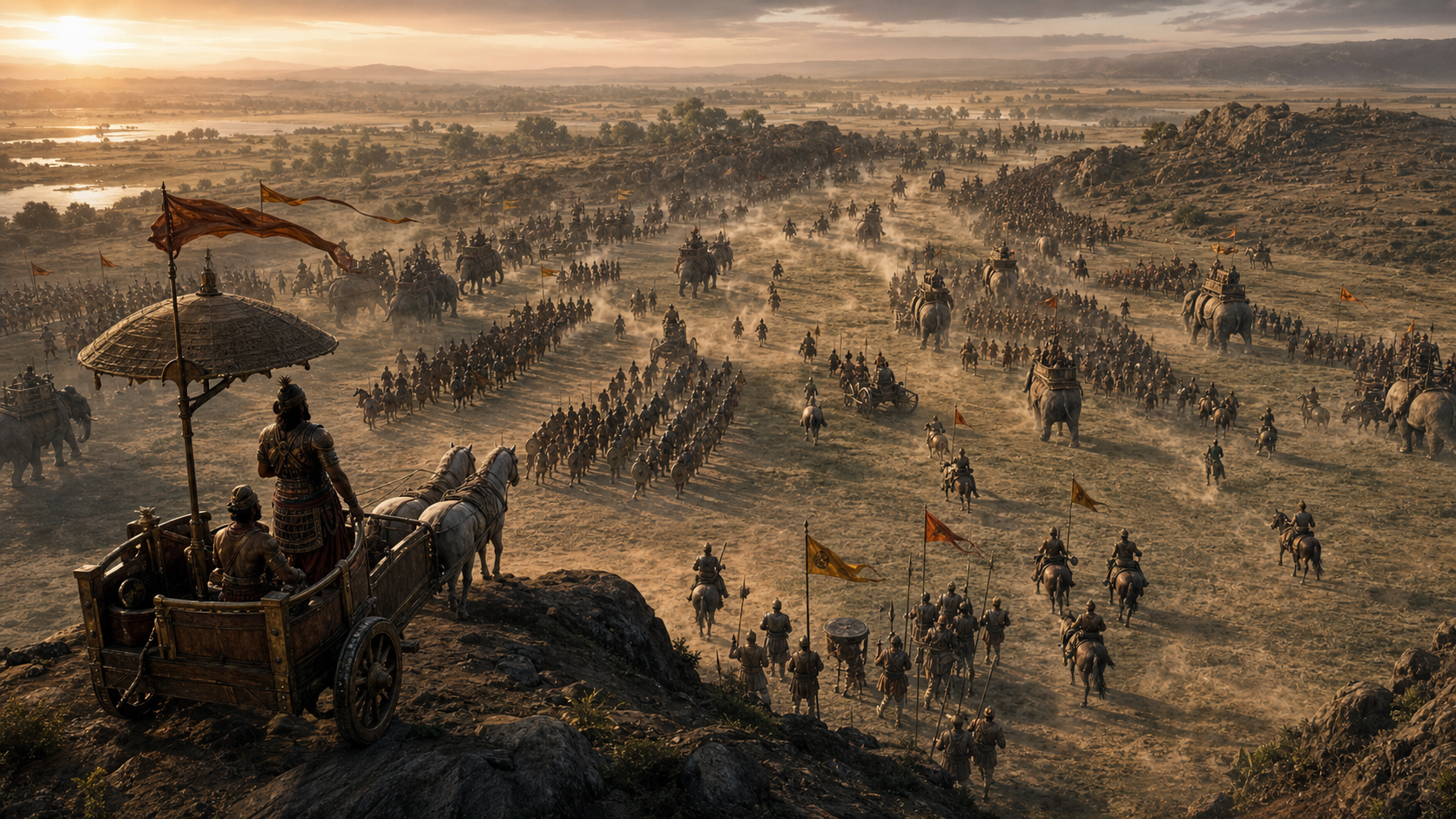
If you came looking for a neat chart of eighteen battle formations, pause before memorizing silhouettes. A collection of circles, wedges and lines cannot tell you what a commander wanted the troops to accomplish, how the arrangement was supposed to change under pressure, or why it failed.
You need a method that separates what the Mahabharata narrates from what a modern diagram merely imagines. Read every vyuha through five connected questions: mission, movement, command, failure and dharma. That turns an attractive picture into a serious study of military judgment.
Stop reading a vyuha as a static diagram
A vyuha, in its military sense, is an ordered deployment of forces. Its visible shape matters, but shape is only the beginning. A useful reconstruction must also account for depth, coordination, timing, leadership and the response expected from the enemy.
Think of a diagram as one frame from a moving sequence. It may show where the front and centre begin, yet conceal who advances, who holds, who reinforces a breach and who decides when the arrangement must change. Here, military science means systematic thought about deployment and decision-making. It does not require us to pretend that an epic description is a modern field manual.
| Lens | Question to ask | What it helps you notice |
|---|---|---|
| Mission | What battlefield problem is this arrangement meant to solve? | Whether the force is trying to protect, penetrate, contain, delay or draw an opponent out |
| Geometry | Where are strength, depth and exposed edges located? | What the formation appears to value and where it may be vulnerable |
| Movement | What must open, close, advance or hold when contact begins? | The difference between a recognizable outline and a functioning system |
| Command | Who must understand the plan, receive signals and react to disruption? | How much the arrangement depends on disciplined coordination |
| Continuity | What happens after penetration, separation or the loss of a leader? | Whether the formation has reserves, recovery options or only an initial manoeuvre |
| Failure | What single breakdown could make the whole design dangerous to its own side? | The assumptions hidden beneath an impressive plan |
This framework also protects you from a common mistake: treating a name as a mechanical specification. A wheel-like name does not, by itself, prove that every rank rotated like a physical wheel. It may describe appearance, movement, strategic effect or a memorable way of explaining the arrangement. Mark those possibilities as interpretations until the passage gives you more.
Use the eighteen formations as a question set
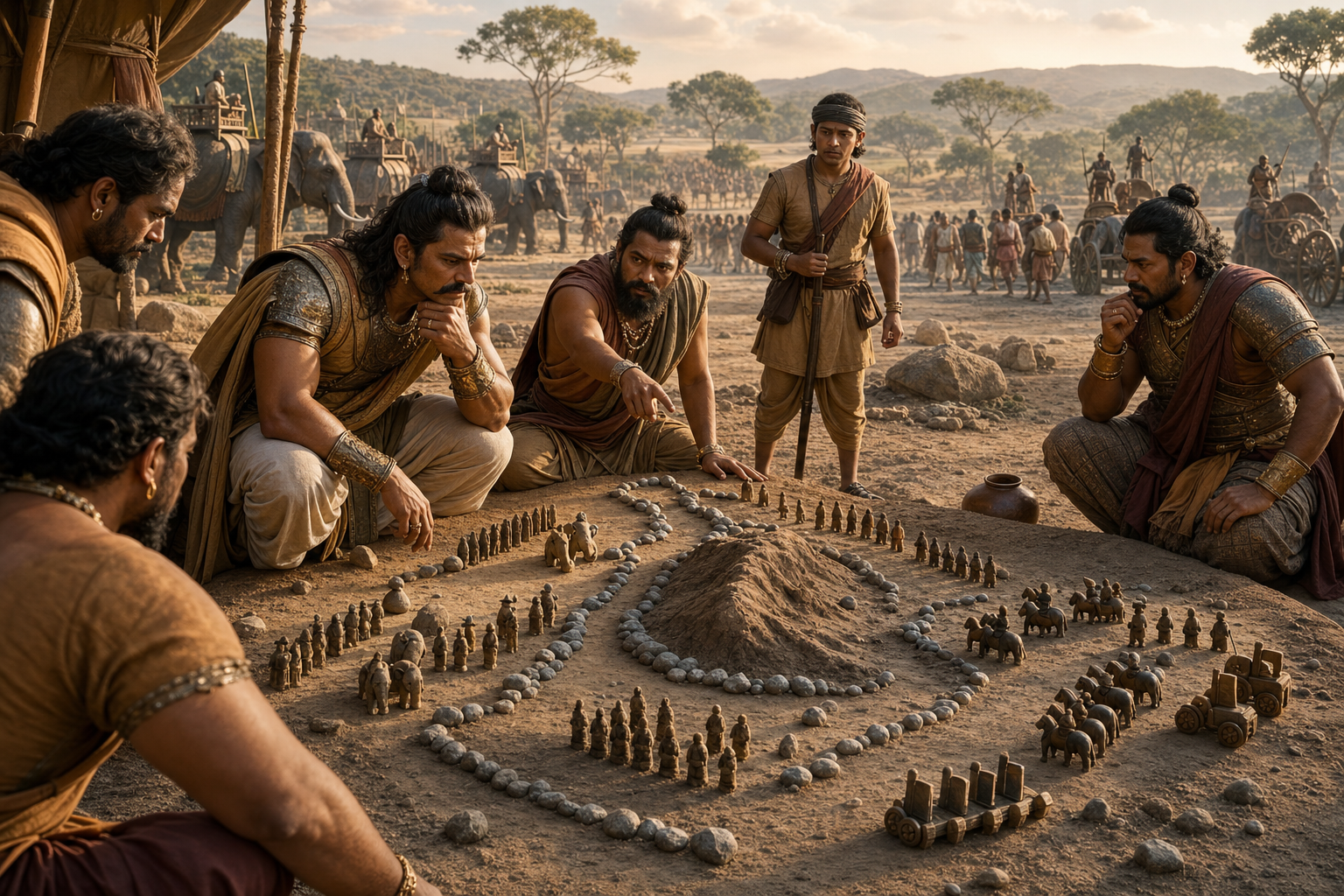
The enumeration of eighteen Kurukshetra battle formations is most useful as a syllabus. It gives you a set of cases through which to examine recurring military problems. The number alone does not turn every diagram circulating under those names into a canonical reconstruction.
Create a formation card for each vyuha you encounter. Keep it beside the passage rather than beside an unreferenced image. Each card should contain:
- Textual anchor: the edition, translation and episode you are actually reading.
- Explicit description: only the positions, actions and relationships stated in that passage.
- Proposed mission: the tactical problem the arrangement appears designed to address.
- Movement rule: what must change after engagement begins, if the narrative makes this clear.
- Command dependence: who needs knowledge, timing or support for the design to work.
- Counteraction: what the opposing side attempts and which assumption it attacks.
- Outcome: whether the arrangement succeeds, fails or succeeds at an unacceptable cost.
- Confidence: label each conclusion as stated, reasonably inferred or speculative.
That last line is essential. If the text names a formation but does not supply enough detail to recover exact troop positions, say so. If two retellings attach different diagrams to the same name, preserve the disagreement instead of blending them into a more elaborate image. Intellectual restraint does not diminish Bharatiya military thought. It keeps genuine insight from being buried under decorative certainty.
You can then compare formations by the problems they address rather than by appearance alone. Which one concentrates strength? Which one protects something important? Which one tries to channel an advance? Which one depends most heavily on coordination? Even when a precise reconstruction remains uncertain, those questions produce a disciplined reading.
Abhimanyu’s Chakravyuha reveals the whole system
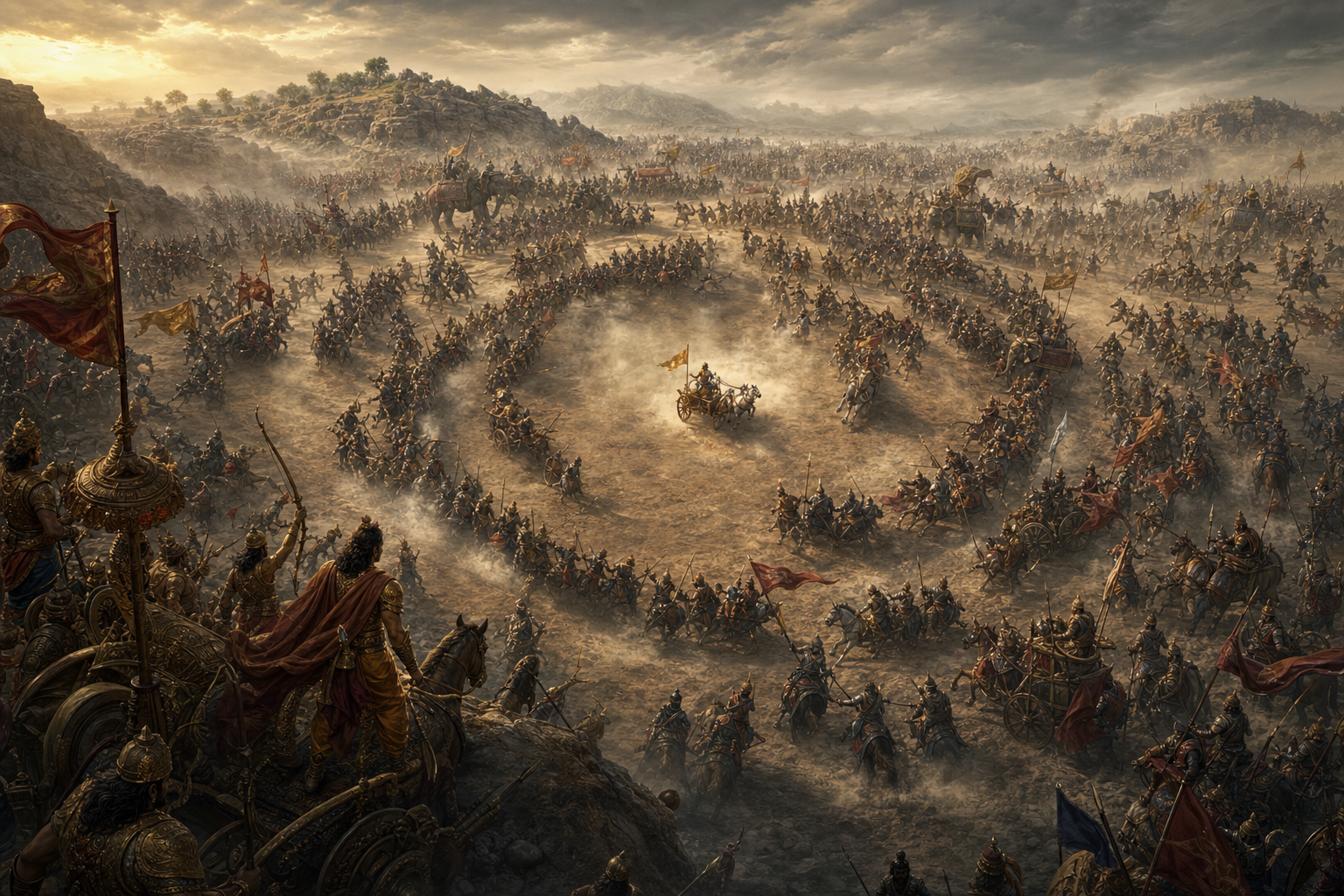
The Chakravyuha episode associated with Abhimanyu is the clearest test of this method. In the familiar telling, he penetrates the enemy arrangement but becomes isolated within it. Popular memory often compresses the tragedy into incomplete knowledge of how to leave. That matters, but it is not the only military lesson.
Entry, exploitation and extraction are three different operations. A warrior may accomplish the first and still be endangered if supporting forces cannot follow, if the opening closes, or if no workable route exists for regrouping. Personal courage can create a breach; it cannot, by itself, replace coordination across the force.
Write the episode as a failure chain: penetration leads to a support gap; the support gap permits isolation; isolation gives the surrounding force local advantage; the absence of extraction turns success at entry into entrapment. Treat that chain as an analytical model, not as a substitute for the wording of your chosen edition.
- Access is not mastery. Knowing how to enter a complex system is different from knowing how to operate within it and leave it safely.
- A breach needs a follow-on plan. The commander must decide who exploits the opening, who preserves it and what happens if the next element is delayed.
- Cohesion is a form of strength. Separation can reverse the value of individual skill by allowing the opponent to concentrate locally.
- Doctrine must match available knowledge. A plan becomes fragile when its success depends on expertise held by too few participants.
- Contingencies belong in the original plan. Withdrawal, relief and regrouping cannot be improvised only after isolation occurs.
This is why the episode remains more instructive than a polished Chakravyuha graphic. It exposes the relationship between formation, knowledge, leadership and support. It also prevents a shallow conclusion that the larger or more intricate pattern automatically represents superior strategy.
Dharma is part of battlefield intelligence
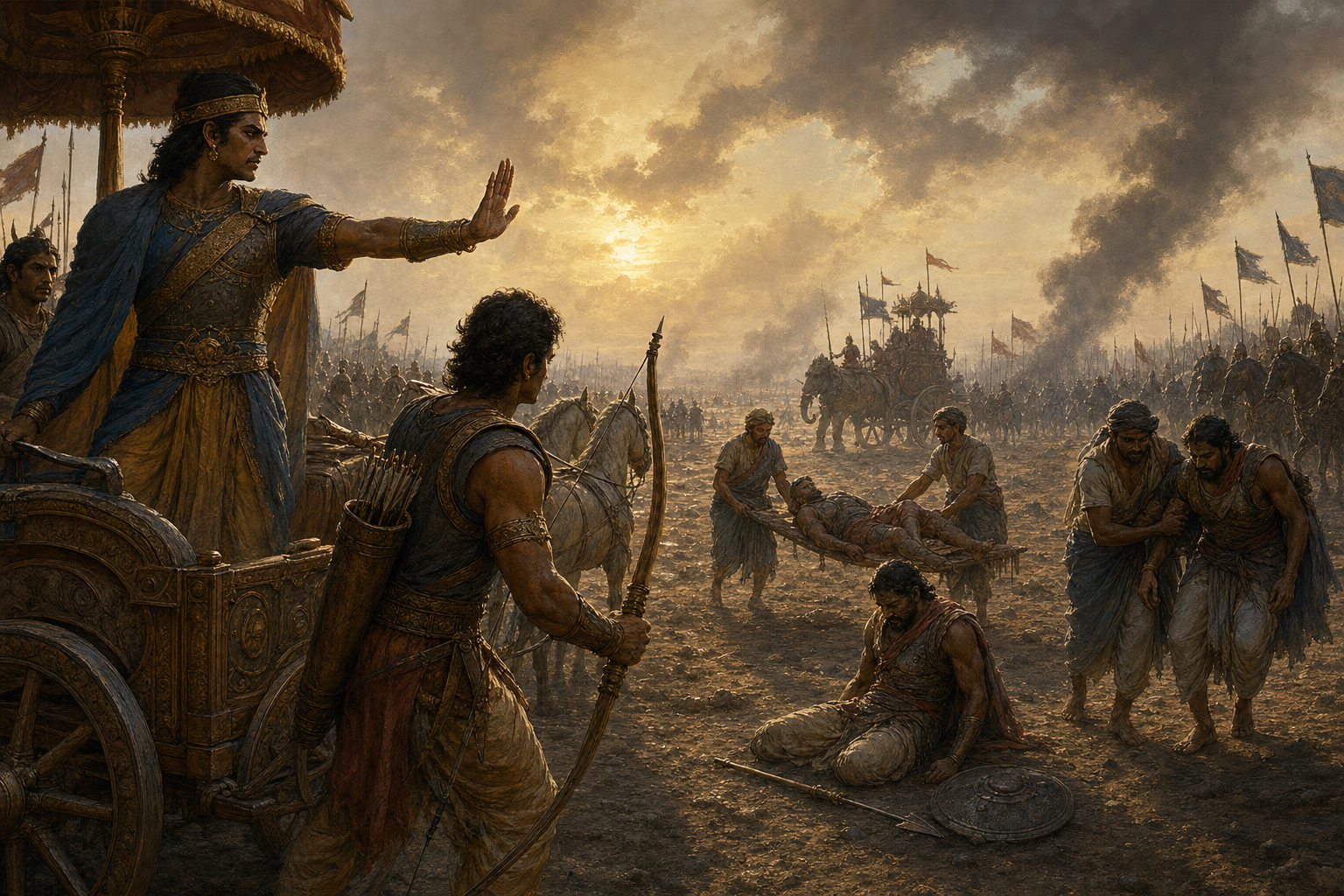
Dharmic military science cannot be reduced to efficient violence. The Mahabharata repeatedly places power inside a field of duty, restraint, loyalty, promises and consequences. Tactical competence answers whether an action can work. Dharma asks whether it should be chosen, how it may be carried out and what kind of order it leaves behind.
Do not classify a formation itself as righteous or unrighteous. Geometry has no moral status independent of purpose and conduct. Judge the decision to employ it through a four-part audit:
- Purpose: What duty or legitimate objective is the action meant to serve? Is the decision still directed toward that purpose, or has vengeance displaced it?
- Role and authority: What obligations belong to the commander, the individual warrior and those responsible for supporting the plan? Where do those duties conflict?
- Means and restraint: Which limits are acknowledged before the crisis, and are they honoured when advantage becomes available?
- Consequence: Does the immediate gain preserve an order worth defending, or does the manner of victory deepen adharma and future disorder?
Apply this audit to the Chakravyuha narrative. The tactical questions concern penetration, isolation and concentrated force. The dharmic questions concern responsibility for an isolated warrior, the conduct used to secure victory and the obligations that survive even when battle creates an opportunity. Reading only the first set turns the episode into a puzzle. Reading only the second misses the machinery that produces the moral crisis.
This integration is the distinctive lesson. Dharma does not make preparation unnecessary, and strategy does not suspend moral judgment. The commander has to see both the battlefield mechanism and the human order affected by its use.
A disciplined method for studying every formation
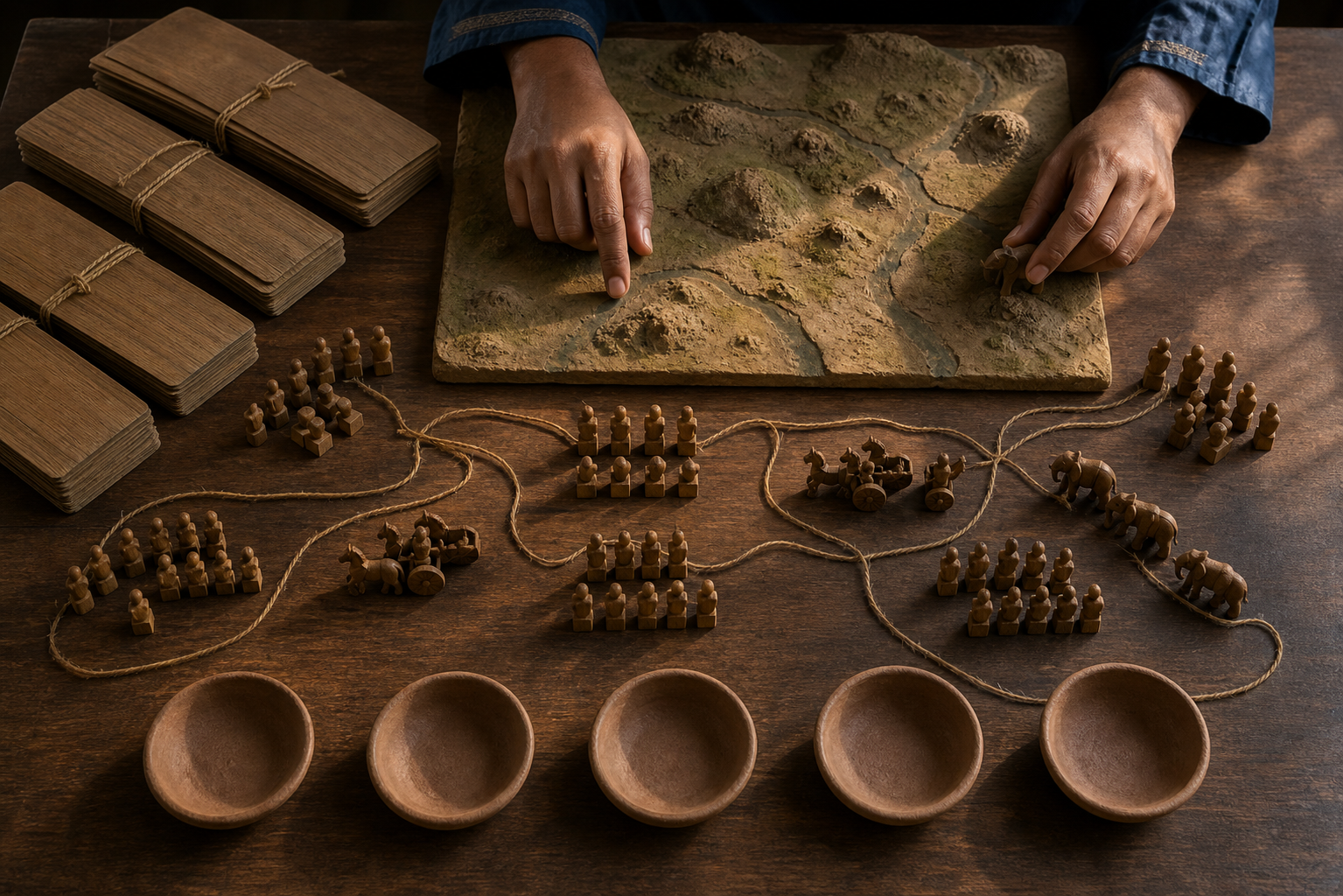
You can use the same workflow for any named vyuha without claiming more certainty than the narrative permits.
- Begin with one bounded episode. Record the edition or translation so that later disagreements do not become invisible.
- Extract before interpreting. Note the named formation, stated objective, described positions, changes during battle and narrated result. Leave blank what the passage leaves blank.
- Draw a sequence, not a logo. Make an initial sketch and a second sketch after contact. Use solid arrows for movement supported by the passage and dotted arrows for inference.
- Build a failure tree. Test what happens if timing breaks, support is delayed, leadership is lost, a line opens unexpectedly or a warrior becomes isolated.
- Run the dharmic audit. Examine purpose, responsibility, restraint and consequence alongside tactical effectiveness.
- Compare only after establishing a baseline. Add later retellings and proposed reconstructions in separate columns. Do not silently transfer a detail from one version into another.
A simple two-column notebook is enough. Put textual statement on the left and your interpretation on the right. Add a confidence mark beside every interpretation. This habit makes it immediately visible when a dramatic reconstruction rests on one word, a later tradition or an unsupported assumption.
Key takeaways
- A vyuha is a dynamic command system, not merely a geometric outline.
- The eighteen-formation framework is valuable as a programme of inquiry, not as automatic proof of eighteen recoverable technical blueprints.
- Abhimanyu’s ordeal shows that penetration, support and extraction must be planned as separate but connected phases.
- Military effectiveness and dharmic judgment answer different questions, and a complete reading requires both.
- Separate what the text states from what you infer, and separate reasonable inference from visual speculation.
The next time you encounter a named formation, resist searching for an image first. Open the episode, complete a formation card, draw the sequence and label the confidence of every conclusion. You will learn more from that one disciplined page than from a wall of unexplained silhouettes.
That practice respects the Mahabharata as a work of strategic and dharmic reflection while refusing to turn reverence into credulity. The aim is not to make the epic resemble a modern manual. It is to become a more careful reader of how Bharatiya thought joins power, responsibility and consequence.
References
