
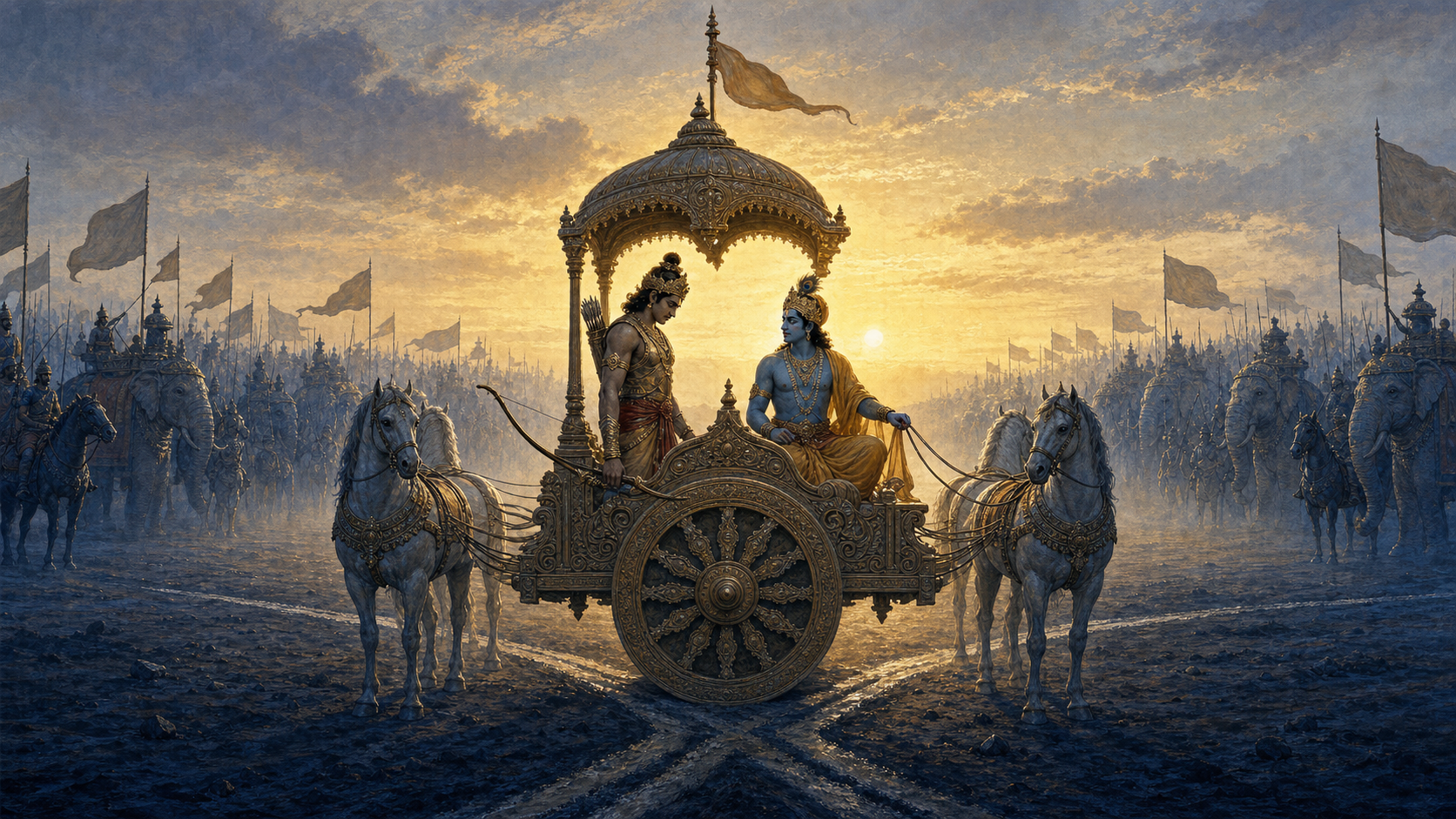
You may turn to the Mahabharata hoping it will tell you which rule to follow. Instead, it gives you something more demanding: a way to think when two legitimate duties pull in opposite directions, every available action carries a cost, and doing nothing is itself a choice.
That is why its narrative remains useful beyond Kurukshetra. You can use it to examine a family conflict, a professional obligation, a public injustice, or a promise that has begun to protect the wrong thing. The epic does not reduce dharma to obedience, loyalty, victory, or personal purity. It asks whether your conduct sustains justice, protects those entrusted to you, uses proportionate means, and remains accountable for its consequences.
Dharma becomes visible when good duties collide
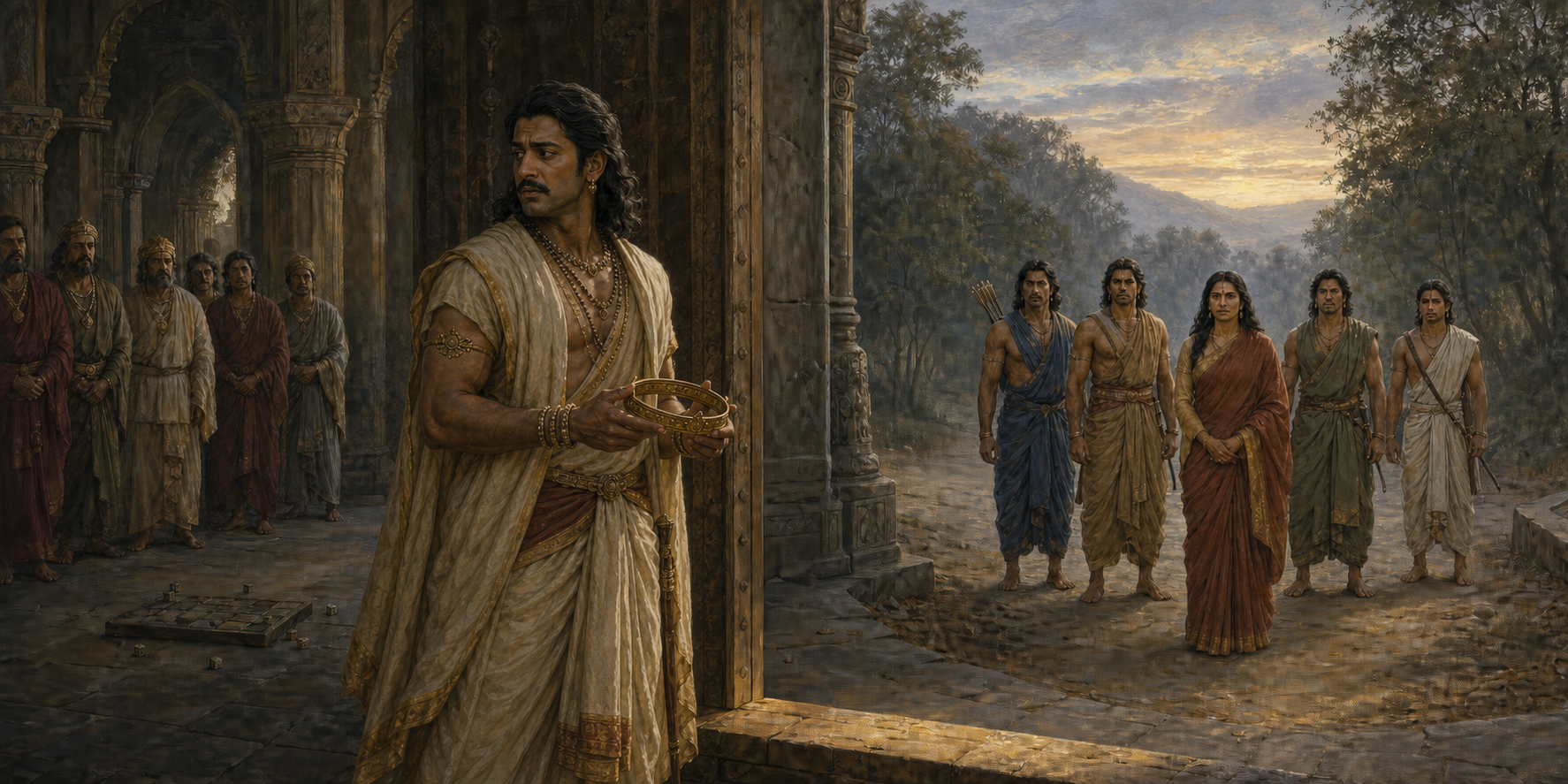
In ordinary speech, dharma can sound like a fixed command: tell the truth, honor a promise, respect your elders, remain loyal, protect your family, or fulfill your social role. The Mahabharata shows why none of these instructions is sufficient by itself. A virtue can serve dharma in one situation and conceal adharma in another.
Bhishma’s vow of lifelong celibacy secures his father’s marriage. Karna’s gratitude binds him to Duryodhana. Yudhisthira is known for truthfulness, yet he accepts a disastrous game in which he loses his wealth, kingdom, brothers, and Draupadi. Each begins with something recognizable as noble: sacrifice, loyalty, or fidelity to an accepted code. The crisis appears when that virtue becomes detached from the people and order it was supposed to serve.
This gives you a better first question than “Which rule applies?” Ask instead: What is this rule meant to protect here, and what will it permit if I follow it mechanically? A promise that enables abuse is not rescued by the sincerity with which it was made. Loyalty that assists wrongdoing is no longer innocent loyalty. Truth spoken to manipulate, humiliate, or evade responsibility is not made dharmic by literal accuracy alone.
The scale of the epic supports this form of moral inquiry. Its 18 parvas and roughly 100,000 shlokas do not merely stretch a family dispute into a long story. They place decisions inside ancestry, vows, institutions, rivalries, negotiations, war, bereavement, governance, and renunciation. You are repeatedly shown that the meaning of an act depends on its role, intention, method, timing, and foreseeable effect.
When you face a difficult choice, therefore, do not ask only whether one part of your conduct can be called virtuous. Examine the whole chain. Who created the situation? What obligation is genuinely yours? Who lacks the power to refuse? What precedent will your decision establish? Who will bear the cost if your judgment is wrong? Dharma is tested at those points of pressure.
Three narrative tests expose false claims of righteousness
The dice hall: procedure cannot make degradation just
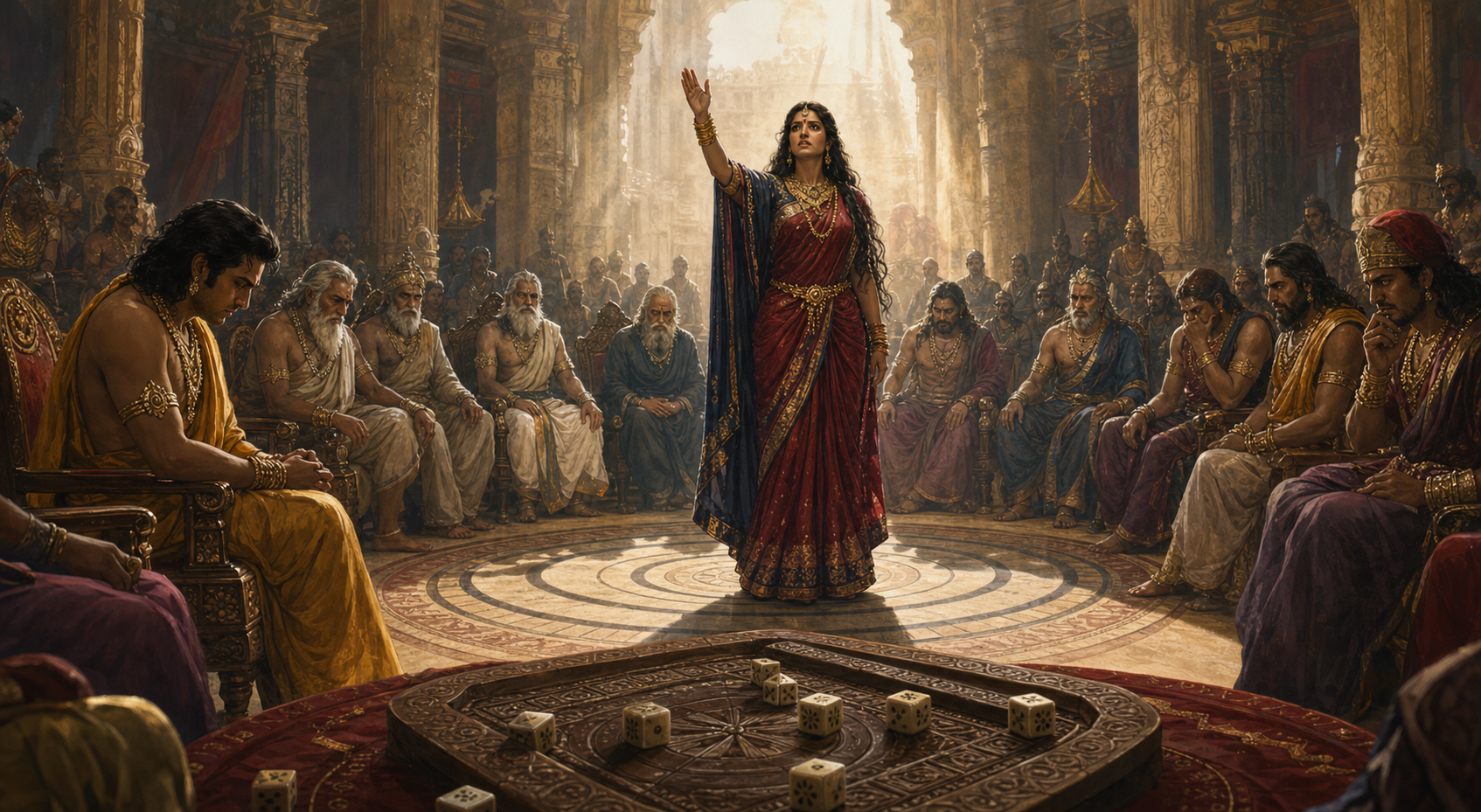
Duryodhana and Shakuni lure Yudhisthira into gambling. The wagers escalate from property and sovereignty to human beings, culminating in Draupadi’s attempted disrobing. The episode is remembered not simply because gambling produces a bad result, but because an elite assembly allows the appearance of procedure to displace its duty to protect dignity.
The distinction matters whenever someone says, “Those were the rules,” “He agreed,” or “The process was followed.” A process can be formally recognizable and morally corrupted. Consent can be compromised by manipulation, dependency, unequal power, or stakes that no one has the moral authority to place on another person. The dice hall tells you to inspect the substance of an arrangement, not just its ritual or institutional form.
Use a simple stop condition in your own decisions: if a process turns a person into property, leverage, collateral, or an instrument of someone else’s honor, do not let procedural language settle the matter. Pause the transaction or deliberation. Restore the affected person’s voice. Ask what duty the powerful participants owe before debating what the rules permit. Draupadi’s rescue through divine grace does not absolve the human beings and institutions that failed her.
The peace mission: force is not righteous merely because your claim is
The Pandavas have a serious claim to redress, but the narrative does not move directly from injury to battle. Krishna serves as a peace envoy and seeks conciliation, including a minimal settlement of five villages. Duryodhana refuses. Only after diplomacy is exhausted does the conflict become the great dharma-yuddha.
This sequence corrects a common misuse of moral certainty. Being wronged does not make every response righteous. Before escalating, you must still seek a proportionate remedy, give the other party a real opportunity to change course, and distinguish restoration from vengeance. The stronger your conviction that you are right, the more important this discipline becomes, because certainty can hide appetite, pride, and avoidable harm.
In a present-day conflict, your “five villages” is the smallest concrete settlement that protects the essential principle without demanding the other side’s total humiliation. State it plainly. Keep a record of the offer. Set a reasonable boundary. Use peaceful and lawful channels while they remain viable. If escalation later becomes necessary, you should be able to explain which remedies were attempted, why they failed, and what limit still governs your response.
This is not appeasement. Krishna’s diplomacy does not deny the Pandavas’ claim. It tests whether justice can be restored without unleashing consequences that will engulf people far beyond the original wrong. Peace is not dharmic when it merely preserves domination, but force is not dharmic until less destructive remedies have genuinely failed.
The war and its aftermath: necessity does not erase moral residue
Once battle begins, the epic refuses to offer a clean spectacle of righteous victory. Abhimanyu enters the chakravyuha and is brutally killed. Yudhisthira’s strategically framed announcement that “Ashvatthama is dead” refers to an elephant but breaks Drona’s will. Arjuna kills Karna when Karna’s chariot wheel is trapped. Bhima defeats Duryodhana with a strike to the thigh that violates the rules of the mace duel. Ashvatthama then massacres the sleeping Pandava forces.
These events should not be flattened into the claim that every side is equally right or equally wrong. They serve a more useful purpose: they prevent necessity from becoming moral amnesia. Some actions arise under extreme conditions, some answer earlier violations, and some are plainly presented as descents into adharma. None becomes costless merely because it contributes to victory.
You can apply that lesson without importing battlefield conduct into ordinary life. If an emergency forces an exception to a sound rule, name it as an exception. Record why it was necessary. Limit its duration and scope. Do not turn it into a precedent for convenience. Then examine the harm it caused and undertake whatever repair remains possible. An action may have been the least damaging available choice and still leave duties of truth, restitution, mourning, or reform.
The narrative places the lamentations of women in Stri Parva after the battlefield victory, followed by Bhishma’s extensive teachings on rule, crisis ethics, liberation, charity, justice, and restraint. That order matters. Before the victors discuss good government, they must confront the human cost of the order they are about to govern. If your success leaves you unable to hear those who paid for it, the Mahabharata would not treat your victory as sufficient evidence of dharma.
The Bhagavad Gita joins right action to inner discipline
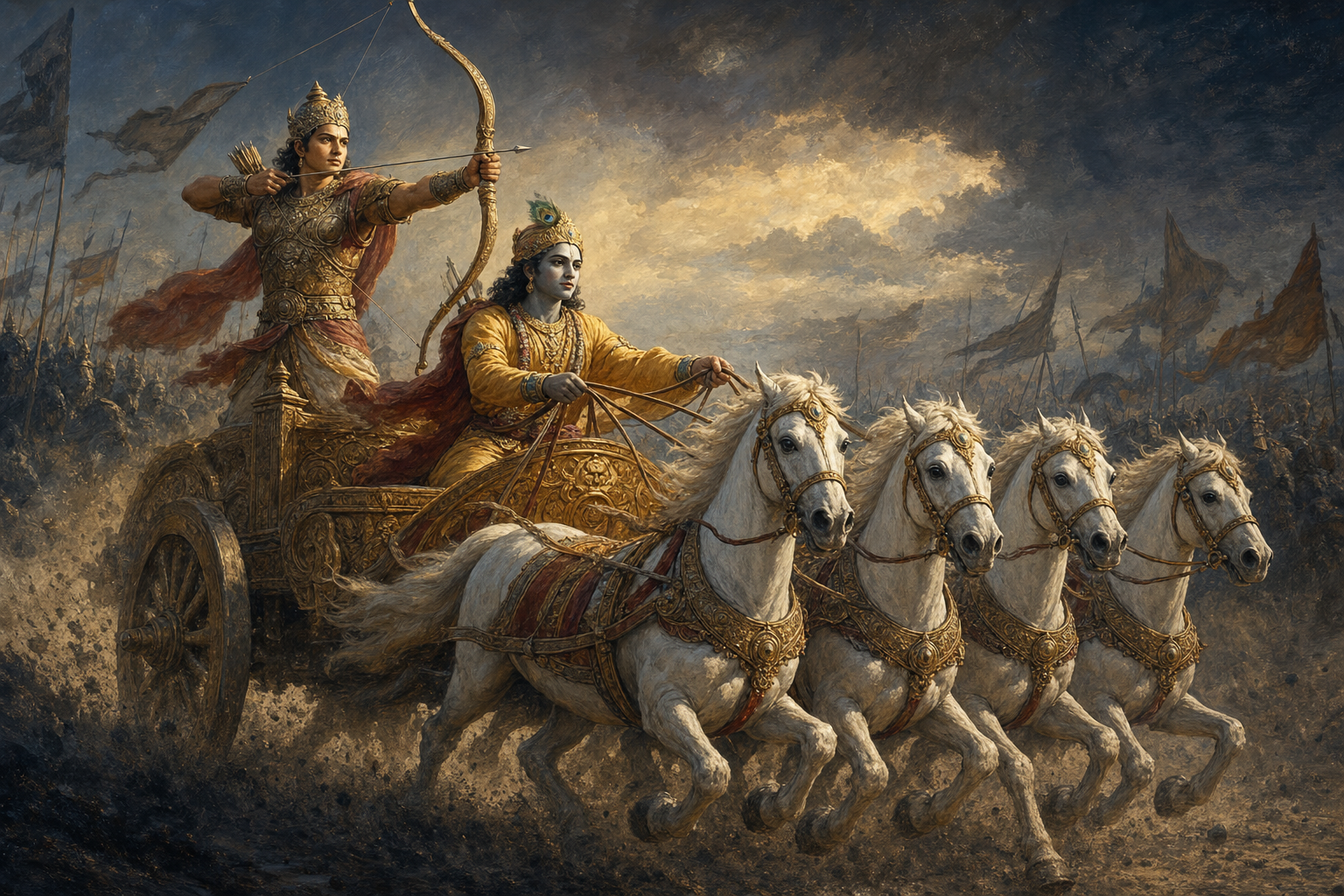
Arjuna’s crisis on the eve of battle is not simple cowardice. He sees teachers, relatives, allies, and social destruction on both sides. His compassion detects a real moral danger. Yet his withdrawal would also have consequences: it would abandon a responsibility after peace had failed and allow refusal to act to masquerade as innocence.
Krishna responds with a synthesis of jnana, karma, and bhakti: knowledge that clarifies reality, action appropriate to one’s duty, and devotion that releases the ego’s claim to control and possess the result. The teaching is not a command to stop caring about consequences. It asks Arjuna to act without making fear, reward, reputation, grief, or hatred the master of his judgment.
This distinction can change how you approach a hard duty. Attachment says, “I must win, be praised, preserve my image, or avoid all blame.” Responsible non-attachment says, “I will discern carefully, use the most defensible means available, perform the duty that is actually mine, and accept that I cannot command every result.” The first posture turns action into self-protection. The second makes room for courage and correction.
The Gita therefore cannot honestly be used as a blank cheque for obedience. Arjuna questions. Krishna teaches at length. The decision follows moral inquiry, knowledge of the situation, failed diplomacy, and attention to role. If an employer, leader, relative, or political authority invokes duty merely to silence your conscience, the setting of the teaching itself tells you what is missing: discernment.
Nor does non-attachment mean emotional numbness. The Mahabharata gives grief a public place after the war. You may carry sorrow even when you believe your decision was necessary. That sorrow can preserve humility. It reminds you that choosing the least harmful path is not the same as making harm good.
Key takeaways: a six-question dharma check
When obligations collide, work through these questions in order. Do not begin with the answer you want and use dharmic language to decorate it afterward.
- What role is genuinely mine? Name it precisely: parent, child, friend, citizen, professional, trustee, leader, or witness. A role creates responsibilities, but it also has limits. You are not entitled to gamble another person’s dignity merely because you are responsible for a family, team, or institution.
- Who is vulnerable, absent, or unable to refuse? Identify the person who will bear the risk without sharing your power. If the decision is being made over that person’s head, bring that interest into the room before discussing convenience, loyalty, or reputation.
- Which virtues are in conflict? Write them separately. The real choice may be loyalty versus justice, truthfulness versus protection, peace versus resistance, or fidelity to a vow versus present responsibility. Naming both duties prevents one attractive word from monopolizing the moral field.
- Have proportionate and peaceful remedies been tried? Formulate the smallest settlement that protects the essential right. Offer it clearly enough that acceptance is possible and refusal is unmistakable. Do not call escalation a last resort when no serious attempt at resolution has been made.
- Can the means withstand public moral accounting? Ask whether you could explain the method to the affected person, not only to your allies. Urgency may justify a narrow exception, but secrecy, humiliation, manipulation, and irreversible harm require a far stronger burden of justification than ordinary inconvenience.
- What duty remains after the decision? Plan for repair before declaring the matter finished. That may mean acknowledging grief, restoring dignity, compensating harm, correcting a rule, limiting an emergency power, or listening to those who experienced your victory as loss. Bhishma’s post-war instruction makes governance an ongoing discipline of restraint rather than a prize awarded to the winners.
This check will not make every choice painless, and that is part of its value. The Mahabharata does not teach you how to feel spotless. It teaches you to notice when a noble word is sheltering ego, when passivity is helping adharma, when a necessary action is becoming excessive, and when success still leaves an unpaid moral debt.
Take one unresolved decision and write six short answers today. If you cannot identify the vulnerable person, the peaceful alternative, or the repair you would owe after acting, you are not yet ready to call your preferred course dharma.
References
