
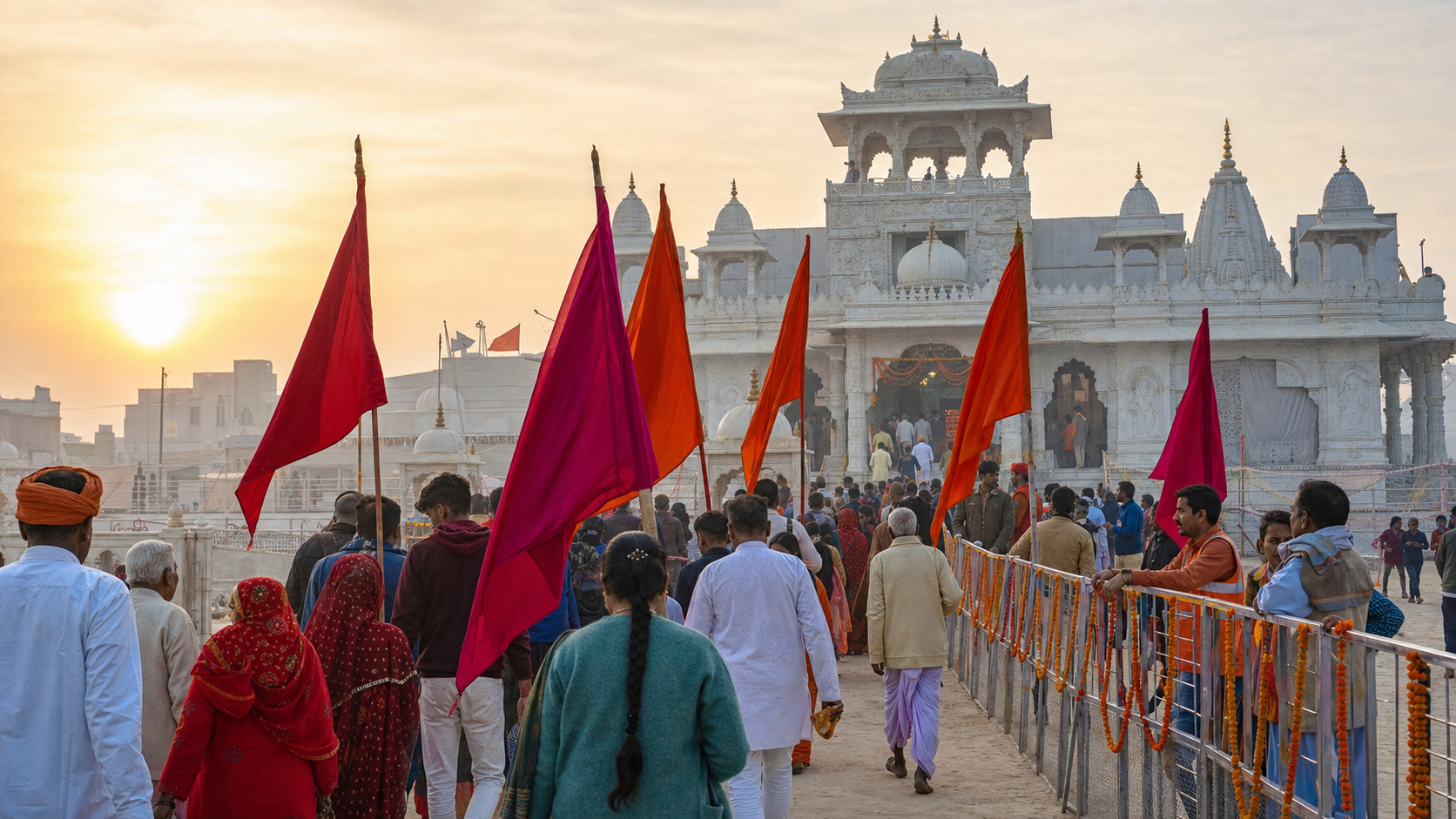
You may be deciding whether to make a simple darshan visit, carry a Nishan with a walking group, or take parents and children to Khatu during the Falgun rush. Those are three different journeys. The route may be the same, but the demands on your time, body, accommodation, and group discipline are not.
Start with the calendar, but do not stop there. The announced 2026 mela window was 18–28 February. Those dates belong specifically to 2026; they are not permanent annual dates. For any later Falgun pilgrimage, confirm that year’s temple and district notices before paying for travel or accommodation.
Choose the pilgrimage you are actually making
Falgun Mela is also called the Lakkhi Mela because lakhs of devotees converge on Khatu. That scale changes the meaning of an ordinary temple visit. You are not merely choosing a destination. You are choosing how much walking, waiting, procession activity, and crowd exposure your group can realistically manage.
A darshan-focused visit is the simplest form. Your main decisions are where to stay, how to reach the pedestrian corridor, and when your group can tolerate a long or changing queue. A Nishan Yatra adds collective walking, a sacred flag, group coordination, water, first aid, and responsibility for keeping everyone together. A seva-focused visit may centre on a bhandara, kirtan, or another organised act of service and should be coordinated with the responsible group before arrival.
The inner purpose should be equally clear. Khatu tradition remembers Shyam Baba as Barbarika, the Mahabharata warrior whose courage was joined to an ethical commitment to stand with the helpless. Sri Krishna’s blessing gives this tradition its devotional centre. The sacred head of Barbarika is traditionally believed to have been discovered at Shyam Kund and later enshrined at Khatu.
This matters because a Falgun yatra can easily become a race for access: reach first, move faster, secure a better position, finish darshan. Shyam Baba’s moral image points in the opposite direction. Strength is meaningful when it protects rather than overwhelms. In a dense queue, that teaching becomes practical: do not push, do not split another family, and do not treat a volunteer’s safety instruction as an obstacle to your devotion.
If you are making a sankalp or carrying a mannat, state it simply before the journey. Pair the prayer with a duty you can perform: an act of dana, service at an organised bhandara, support for someone vulnerable, or a change in your own conduct. This keeps the vow within the yatra’s living emphasis on bhakti, sankirtan, charity, and seva, rather than reducing darshan to a transaction.
Build the journey around the last mile into Khatu
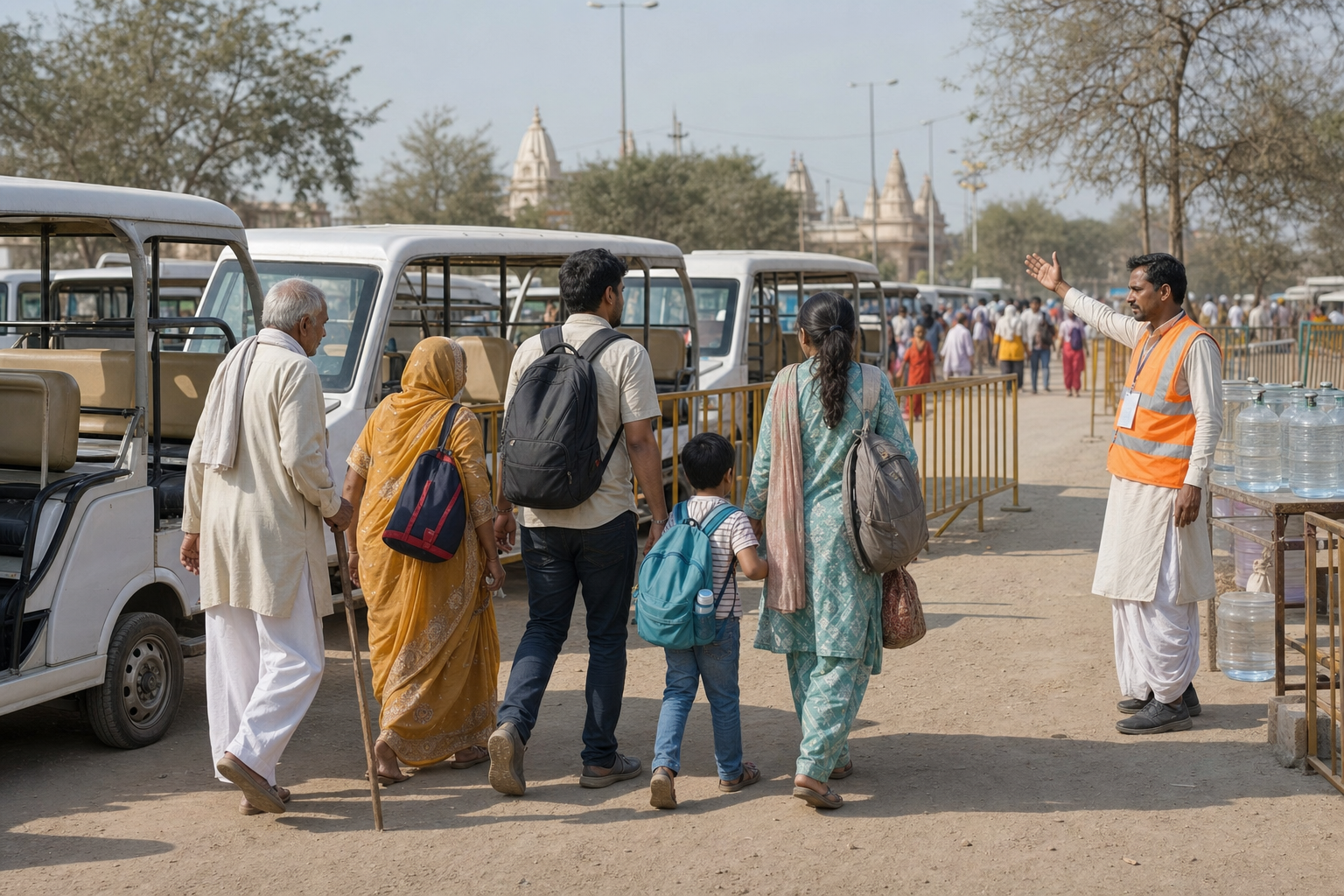
The long-distance journey is usually the predictable part. The difficult part is the last movement from railhead, road, parking area, or lodging into the controlled temple zone. During the mela, parking may be placed outside the core and connected to pedestrian corridors or shuttle arrangements. A vehicle reaching the wider Khatu area does not mean it can take you close to the temple.
Ringas, also written Reengus, is the nearest railway junction, roughly 17–20 km from Khatu. Autos, taxis, and shuttle services ordinarily connect the two. Jaipur is the nearest major airport, and Khatu is approximately 80–90 km from Jaipur by the road approach through the Sikar and Ringas side. Travellers coming from Delhi generally approach through the Jaipur corridor and then continue towards Ringas, subject to diversions and live traffic conditions.
| Place to stay | Best suited to | Trade-off to plan for |
|---|---|---|
| Khatu | Devotees prioritising proximity to the temple town | Demand rises sharply during the mela, and the core area carries the heaviest crowd pressure |
| Ringas | Rail travellers and larger groups needing a clear transport base | You still need a 17–20 km last-mile transfer to Khatu |
| Sikar | Families seeking more private lodging choices and amenities | Every darshan attempt requires an additional road journey |
| Jaipur | Air travellers or families who need a major-city base | The 80–90 km approach makes it unsuitable for a hurried same-day plan during peak congestion |
Reserve the stay before arranging the rest of the itinerary. Dharamshalas, budget lodges, and hotels are available across Khatu, Ringas, and Sikar, but mela demand is not evenly distributed. A room in Khatu can reduce road transfers, while Ringas offers easier access to the railway network. Sikar or Jaipur can provide a more comfortable base for some families, but the price of that comfort is a longer pilgrimage day.
Do not calculate arrival time only to the railway station, airport, or parking ground. Add separate time for the local transfer, security screening, walking corridor, holding area, and darshan queue. Keep your arrival day light if you are travelling with a senior, a small child, or anyone who cannot comfortably stand for an uncertain period.
If you want to include Jeen Mata Temple, Salasar Balaji, or Harshnath Temple, give the circuit additional days. These sites express the interwoven Shakta, Vaishnava, and Shaiva life of the region, but they should not be treated as items to squeeze in after an exhausting peak-day queue. Let Khatu have its own day, then decide how much travel your group can undertake without turning pilgrimage into endurance tourism.
Treat Nishan Yatra as disciplined group sadhana
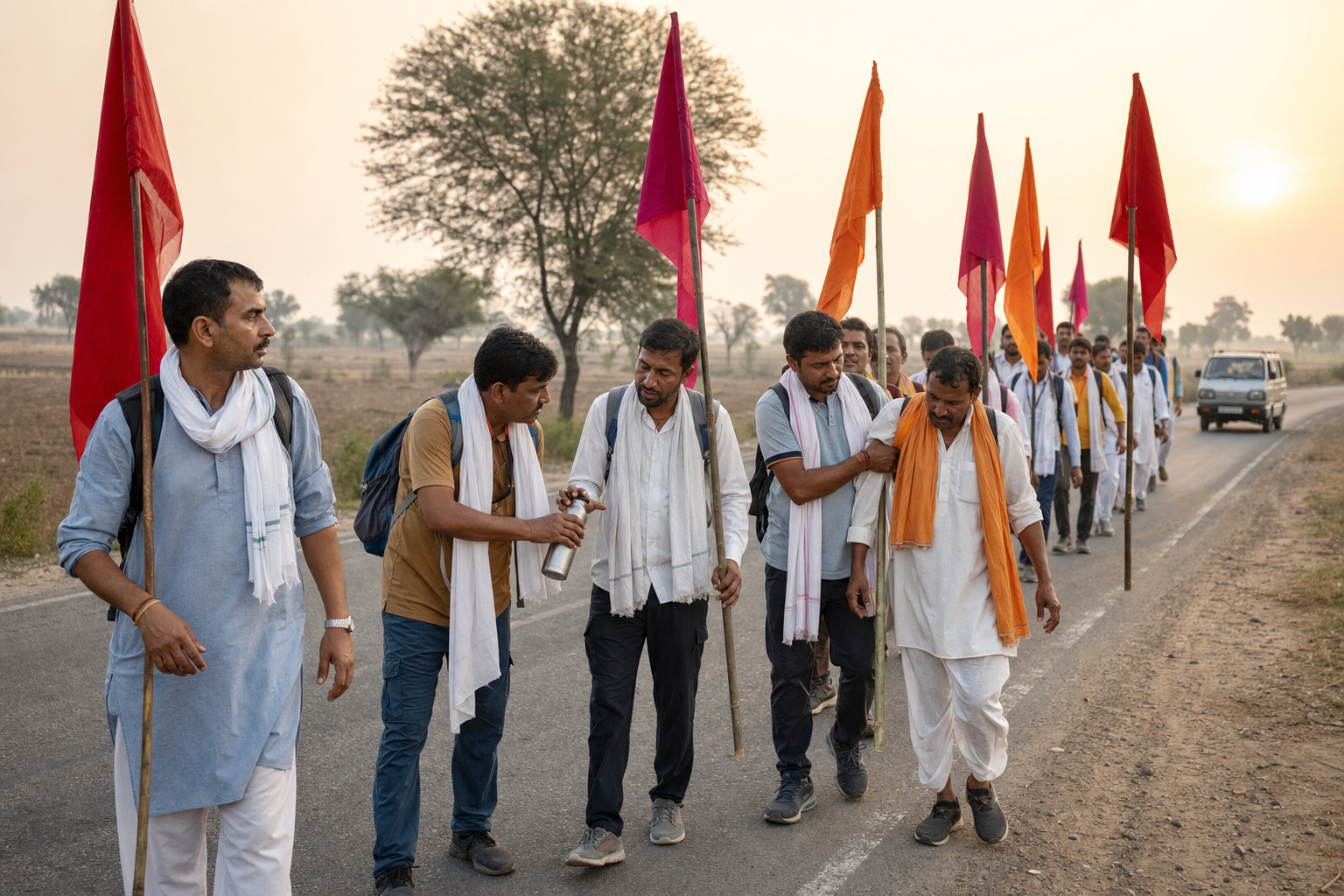
The Nishan Yatra is one of the defining sights of Falgun at Khatu. Devotees carry saffron triangular flags bearing Shyam Baba’s sacred name, often walking with bhajans, drums, and collective chanting before offering the Nishans at the temple. The emotion is powerful, but the yatra works because shared devotion is supported by practical discipline.
Before your group begins walking, settle the matters that are easy to ignore in the excitement:
- Name a group coordinator whose instructions everyone recognises.
- Agree on the walking pace according to the slowest member, not the strongest walker.
- Keep water and a basic first-aid kit accessible rather than buried under offerings.
- Use reflective bands for any stretch walked in darkness.
- Choose clear regrouping points in case crowd controls divide the procession.
- Decide in advance who will assist children, seniors, and anyone who becomes fatigued.
- Follow the designated approach and offering procedure when the group reaches the temple zone.
A Nishan is a sacred offering, not permission to block a corridor or force a route through another group. Keep the flag controlled in dense spaces, listen to volunteers, and accept temporary holding when crowd movement stops. If the administration redirects the procession, the safe route takes precedence over the route your group expected to use.
Carry as little as possible. A small daypack, drinking water, suitable walking footwear, layered clothing, and sun protection answer the ordinary conditions of late February around Khatu, when mornings and evenings are generally cool. Bulky baggage makes security checks and pedestrian movement harder. Leave luggage at your accommodation rather than bringing it towards the temple gates.
Bhandaras and water points are an important part of the mela’s hospitality, but they do not remove personal responsibility. Carry your own bottle and use authorised refill points. Accept food with gratitude, keep the serving area moving, and dispose of waste properly. Avoiding single-use plastic is a small but direct way to honour the sanctity shared by the temple town and the pilgrims who follow you.
Plan darshan around changing queues, not a fixed clock
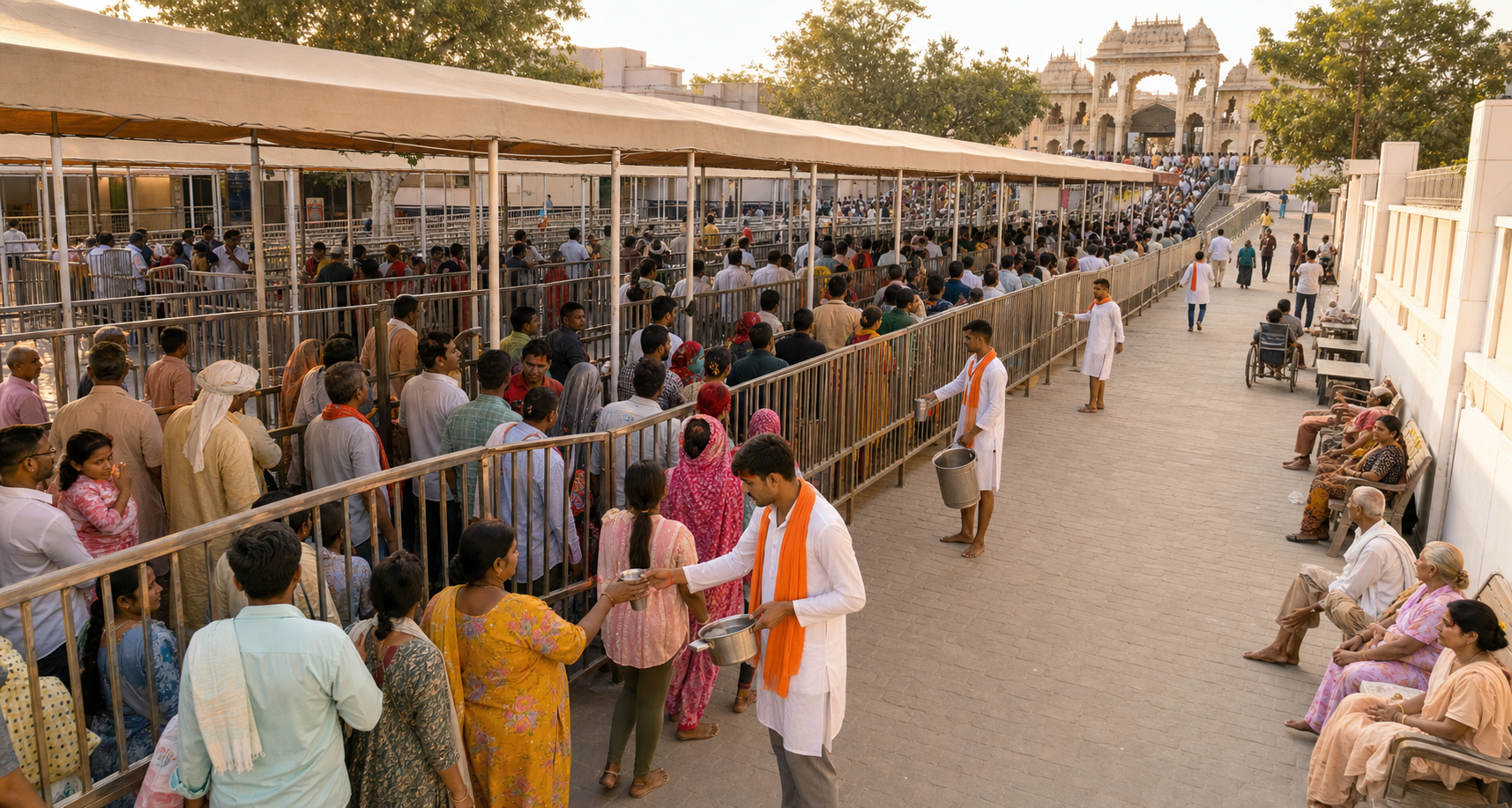
Khatu’s daily worship ordinarily moves through Mangala Aarti at dawn, Shringar and Bhog in the forenoon, followed by Sandhya and Shayan Aarti later in the day. During peak Falgun periods, darshan may be extended or operate nearly continuously so that the temple can receive the crowd. That does not make a normal timetable reliable. Daily access remains subject to temple management, security requirements, and district crowd controls.
Use a sequence that is simple enough to survive a change in the queue plan:
- Check the current on-ground advisory before leaving your lodging.
- Carry only what the security screening and pedestrian journey require.
- If you intend to take the customary snan at Shyam Kund, follow the posted access and bathing rules.
- Enter the assigned darshan corridor and remain with your group without pushing between lanes.
- Offer the Nishan or other permitted offerings only through the procedure being used that day.
- Receive prasad or charnamrit according to temple arrangements, then move clear so the next devotees can proceed.
Do not build your plan around an assumed special lane. Segmented queues, holding areas, and separate arrangements for elderly devotees or people with special needs may be used where feasible, but availability depends on the day’s management. Ask the authorised staff on arrival and follow the arrangement they identify. A family member who cannot safely manage the ordinary queue should not be pushed into it merely because the group has already travelled far.
Medical posts, ambulances, and first-aid teams are generally deployed around high-density areas during the mela. Know where the nearest marked help point is when you enter a corridor. If someone becomes faint, confused, breathless, or unable to continue walking, alert a volunteer or medical worker and move out of the crowd flow when directed. Darshan can wait; a medical problem should not.
Modest clothing, patient movement, and compliance with volunteers are part of temple etiquette, not merely crowd-control rules. Photography may be prohibited in the garbhagriha or other marked zones. Put the phone away when signage or staff requires it. Buy flowers, prasad, or other offerings from authorised counters or reputable sellers, and do not argue for an item to enter if security personnel refuse it.
The waiting itself can remain devotional. Quiet nama-japa, a bhajan sung without obstructing instructions, or helping an anxious member of your group keeps attention on Shyam Baba. The mela’s akhand kirtans, jagrans, shared meals, and volunteer networks show that worship at Khatu is larger than the few moments visible inside the shrine. Darshan is the centre, but patience and seva determine how the whole gathering is experienced.
Key takeaways for your final plan
- Confirm the Falgun Mela dates for your actual year; the 18–28 February dates applied to the announced 2026 schedule.
- Choose between a darshan visit, a Nishan walk, and an organised seva commitment before booking transport.
- Treat Ringas-to-Khatu movement, parking, screening, and queueing as a separate last-mile journey.
- Book accommodation early and choose the base according to your group’s mobility, not proximity alone.
- For Nishan Yatra, appoint a coordinator and carry water, first aid, and reflective bands for night walking.
- Do not depend on a fixed aarti time, unrestricted vehicle access, or a guaranteed special queue during peak days.
- Keep baggage small, obey photography and offering restrictions, and seek medical help promptly when someone cannot continue safely.
- Make your sankalp practical by connecting prayer with dana, seva, or a concrete duty after you return home.
Before you pay for the journey, write down your travel base, last-mile route, group leader, mobility needs, and the official notice you will check near departure. Then leave room in the itinerary for the mela to move at its own pace. You go to Khatu for Shyam Baba’s darshan; you honour that darshan by refusing to make another devotee’s journey harder.
References
