

Your body is still, but your mind is replaying a conversation, arranging tomorrow, and defending a role no one is presently questioning. The usual response is either to fight those thoughts or to believe them. The Srimad Bhagavatam asks you to make a more exact distinction: something can appear within your experience without being your deepest identity.
Its practical movement is clear. First, understand how far the material apparatus extends. Then notice how ahankara turns its functions into claims of “I” and “mine.” Finally, give attention a positive center in Vishnu. Meditation then becomes more than an attempt to feel calm. It becomes training in how to see, choose, serve, and carry responsibility.
Key takeaways
- In the Bhagavatam’s devotional Sankhya, matter includes subtle functions such as mind and sensory organization, not only the visible body.
- Ahankara is the principle that appropriates experience: it claims to be the doer, controller, owner, or social role.
- Recognizing that you are not reducible to body and mind does not excuse neglect, dishonesty, or irresponsibility.
- Bhagavatam meditation is positive and relational. Attention is offered to Vishnu rather than merely emptied of thoughts.
- The strongest test of spiritual understanding is behavioral: less pride, quicker correction, steadier duty, and greater willingness to bow when wrong.
Matter reaches further inward than the body

In ordinary speech, matter means something you can weigh or touch. That definition is too narrow for the Bhagavatam’s analysis. Material nature has gross and subtle dimensions. The body is material, but invisibility does not make every inner event spiritual.
SB 3.26.24-26 places mind and senses within the unfolding of material nature from threefold ahankara. Ahankara appears through agency, instrumentality, and effect: the claim to act, the apparatus through which action occurs, and the resulting identification with what has been produced.
This corrects a common meditation error. A thought can be subtle, persuasive, morally serious, and still belong to the changing apparatus. So can an intention, memory, preference, mental image, or judgment. You know each because it appears, changes, and sometimes disappears. The conscious self is not exhausted by any one of those passing conditions.
| What appears | The mistaken identity | The useful correction |
|---|---|---|
| Bodily comfort, discomfort, strength, age, or appearance | “This condition is the whole of me.” | Care for the body as an entrusted instrument without making it the complete self. |
| Sensory attraction or aversion | “Because I feel this pull, I must obey it.” | Notice the contact and leave room for discrimination before action. |
| Plans, memories, fears, and preferences in the mind | “Whatever the mind produces is my truth.” | Recognize the event as a mental movement that can be examined and redirected. |
| The claim to be doer, owner, controller, or status-holder | “My temporary function defines my being.” | Name the role accurately, perform its duty, and release the demand that it establish your worth. |
| Awareness of these changing states | “The knower must be one more object among the objects known.” | Attend to the difference between a changing experience and the self to whom it is disclosed. |
The distinction is not an invitation to despise matter. The body, senses, and mind are instruments of embodied dharma. An instrument can be valuable without being the person who uses it. Your vehicle requires care, but you do not become the vehicle merely because its condition affects your journey.
Try changing the grammar of experience. Instead of immediately concluding, “I am restless,” notice, “Restlessness is active in the mind.” Instead of “I have been destroyed by criticism,” ask, “Which role or self-image feels threatened?” This is not a trick for suppressing emotion. It creates enough distance to decide whether the next action will come from habit, pride, or dharma.
Identity becomes visible in behavior, especially under correction
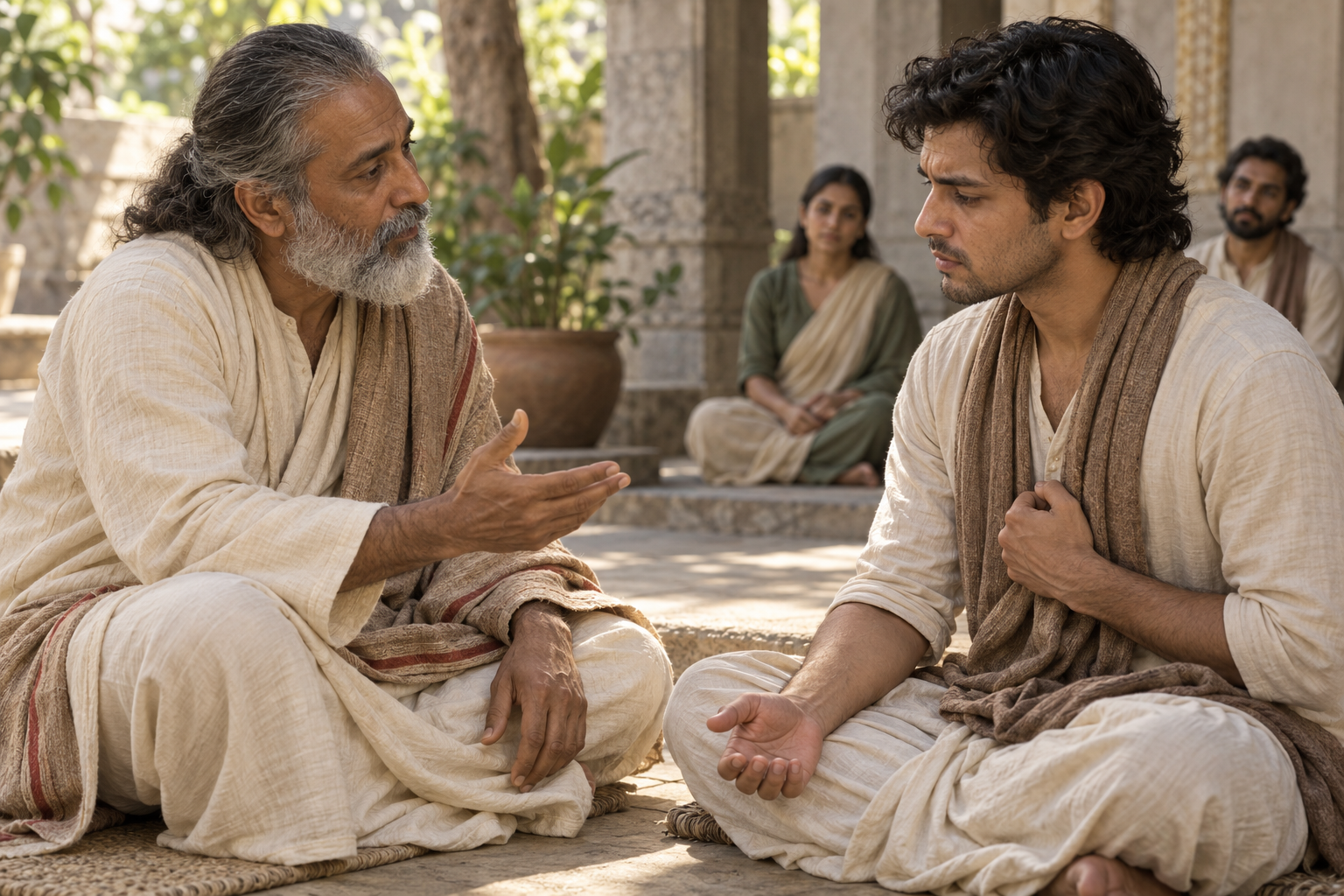
False identity is easy to discuss while nothing challenges it. Its hold becomes visible when your competence, authority, community standing, or moral self-image is questioned. At that moment, a temporary designation demands protection as if the self itself were in danger.
King Rahugana provides a practical standard. After receiving instruction capable of loosening the knot of false identity, he does not protect his royal performance. He responds by stepping down, bowing at Jada Bharata’s feet, asking forgiveness, and relinquishing kingly pride. His philosophical recognition becomes a bodily and social act.
That response clarifies what detachment from a role actually means. Rahugana does not cease to exist when he steps down from the palanquin. Nor does admitting error erase every legitimate responsibility of kingship. What falls is the assumption that royal position makes him intrinsically superior or immune to correction.
You can test your own identification in the same way:
- When someone corrects your work, can you examine the correction before defending your status?
- When you hold authority, do you treat another person’s dignity as dependent on rank?
- When you make a mistake, can you apologize without turning the apology into another performance about yourself?
- When a role ends, do you experience disappointment, or does it feel as though your very being has disappeared?
- When duty is inconvenient, do you misuse “I am not the body” to avoid consequences that the embodied person has created?
The last question matters. Spiritual identity is not an escape hatch from material responsibility. If your speech caused harm, the fact that speech operates through a material body does not cancel the need to correct it. If the body is ill or exhausted, understanding that it is not the complete self does not justify neglecting it. If you possess a title, detachment does not mean abandoning the people who depend on you.
Ahankara can even appropriate spiritual language. The claim “I am spiritually advanced while others are trapped in matter” preserves the same structure of superiority under a sacred label. The useful question is not whether your vocabulary sounds detached. It is whether the identification has weakened enough for truth to change your conduct.
Meditation gives attention a sacred object

Analysis can show what you are not, but analysis alone does not tell the mind where to rest. If every thought is rejected and nothing worthy receives attention, practice can become a tense struggle against mental activity. The Bhagavatam’s answer is positive absorption.
Kapila’s instruction culminates in meditation within the heart on Vishnu’s smiling or laughing countenance. The lips, the jasmine-bud-like teeth touched by their rosy radiance, and the Lord’s captivating expression give the mind a definite form to contemplate. The mind is offered with devotion until it no longer searches for a separate object of satisfaction.
This is distinctively Bhagavata meditation. It is not a universal definition imposed on every Hindu, Buddhist, Jain, Sikh, or yogic discipline. Within this Vaishnava frame, discrimination between self and matter prepares attention for relationship with the Supreme Person. The goal is not merely a blank mind or a more efficient nervous system. It is loving recollection of Vishnu.
The personal detail is important. A command such as “stop thinking” gives the mind only a prohibition. A remembered face gives it somewhere to return. Vishnu’s smile also establishes the devotional mood: the object of meditation is not an impersonal test that you must pass, but the gracious Lord to whom attention can be repeatedly offered.
You do not need unusually vivid visual imagination to begin. If mental imagery is weak, contemplate the features through their meaning: the Lord is present, beautiful, gracious, and worthy of undivided attention. You may first look carefully at a traditional murti or image of Vishnu, then close your eyes and remember one feature. Vivid mental pictures are not the measure of devotion. Sincere and repeated return is the practice.
Nor should you turn the chosen feature into mere decoration. Stay with it long enough for attention to become relational. Rather than observing a smile as an isolated shape, remember whose smile it is. Rather than grading the clarity of the image, notice whether the mind is becoming willing to remain in the Lord’s presence.
A repeatable practice for sitting and daily life

During the sitting
Use the sequence below as a framework, not as a mechanical substitute for mantra, puja, scriptural study, or guidance received within your sampradaya.
- State the purpose. Begin with a simple intention: to recognize the changing instruments without confusing them for the complete self, and to offer attention to Vishnu.
- Notice the body as body. Register posture, pressure, temperature, breath, and discomfort. Make a reasonable adjustment if needed. Then stop renegotiating with every minor sensation.
- Notice sensory activity. Sound, light, smell, and touch are contacts occurring through the senses. You need not chase them or resent them.
- Notice the mind as mind. Plans, memories, imagined conversations, and preferences are movements within the subtle apparatus. Name the category without continuing the story.
- Locate the claim of ahankara. Ask what the disturbance is trying to establish: that you must control the outcome, receive recognition, defeat another person, preserve a title, or own the result.
- Make the identity distinction. The bodily and mental states are present, but they do not exhaust the conscious self. Do not argue with every thought. Withdraw the authority you automatically gave it.
- Turn positively toward Vishnu. Bring the Lord’s face and smile to the heart. Let reverence and affection accompany the feature. If you use a mantra, allow the name and remembered form to support each other.
- Return by recognition. When distraction appears, identify it as sensation, sense contact, mental movement, or ahankara’s claim. Then return to Vishnu. Each return is part of meditation, not evidence that meditation has failed.
- Carry one correction into action. Before rising, identify a concrete expression of the insight: an apology to make, a duty to complete without seeking praise, a harsh reply to withhold, or service to perform without advertising yourself.
During ordinary conflict
The same method can operate before you send a defensive message, issue an order, or answer criticism. Pause and ask: What role is active? What is the mind adding to the bare event? What does ahankara want to prove? Which response serves dharma rather than status?
Rahugana’s example supplies the decisive movement: step down inwardly before responding outwardly. That may mean asking a clarifying question, acknowledging a fact you dislike, or apologizing without qualifications. Humility does not require pretending that every accusation is true. It requires that position and pride no longer prevent you from seeing what is true.
Mistakes to catch early
- Trying to force an empty mind: replace combat with classification and return. A noticed distraction is already different from an unconsciously obeyed distraction.
- Mistaking numbness for detachment: the Bhagavata path does not require you to become indifferent to duty or another person’s suffering. It loosens possessiveness so that action can become cleaner.
- Treating the body as dirty or irrelevant: care for it as an instrument of seva. Non-identification and neglect are not synonyms.
- Building a superior witness identity: if the thought “I am above these material people” appears, recognize ahankara wearing philosophical clothing.
- Chasing visual intensity: return to the meaning and presence of Vishnu when the image is indistinct. Meditation is not a competition in producing inner pictures.
- Measuring progress only by calm: a quiet sitting followed by pride and cruelty has missed the behavioral test. Look for greater truthfulness, humility, steadiness, and service.
What progress looks like
You need not wait for an extraordinary experience to assess the practice. Notice whether thoughts lose some of their automatic authority. Notice whether you catch role-based pride earlier, recover from correction sooner, and return to the chosen form of Vishnu with less negotiation. Notice whether responsibility feels less like a claim of ownership and more like an opportunity for service.
At your next sitting, do not begin by fighting the mind. Sort what appears, refuse to promote every passing state into an identity, and place attention before Vishnu. Before the day ends, let one truthful act show that the distinction reached your conduct. That is where analysis becomes meditation, and meditation begins to shape dharma.
References
- Dandavats — Srimad Bhagavatam Text 3.28.34 Speaker – H.G. Kripanidhi Das
- Dandavats — HH Bhakti Vighna Vinasa Narasimha Swami Maharaj, SB 5.10.14
- Dandavats — HG Prasanatma Pr (ACBSP), SB 3.26.24-26, ISKCON Rishikesh

Leave a Reply
You must be logged in to post a comment.