
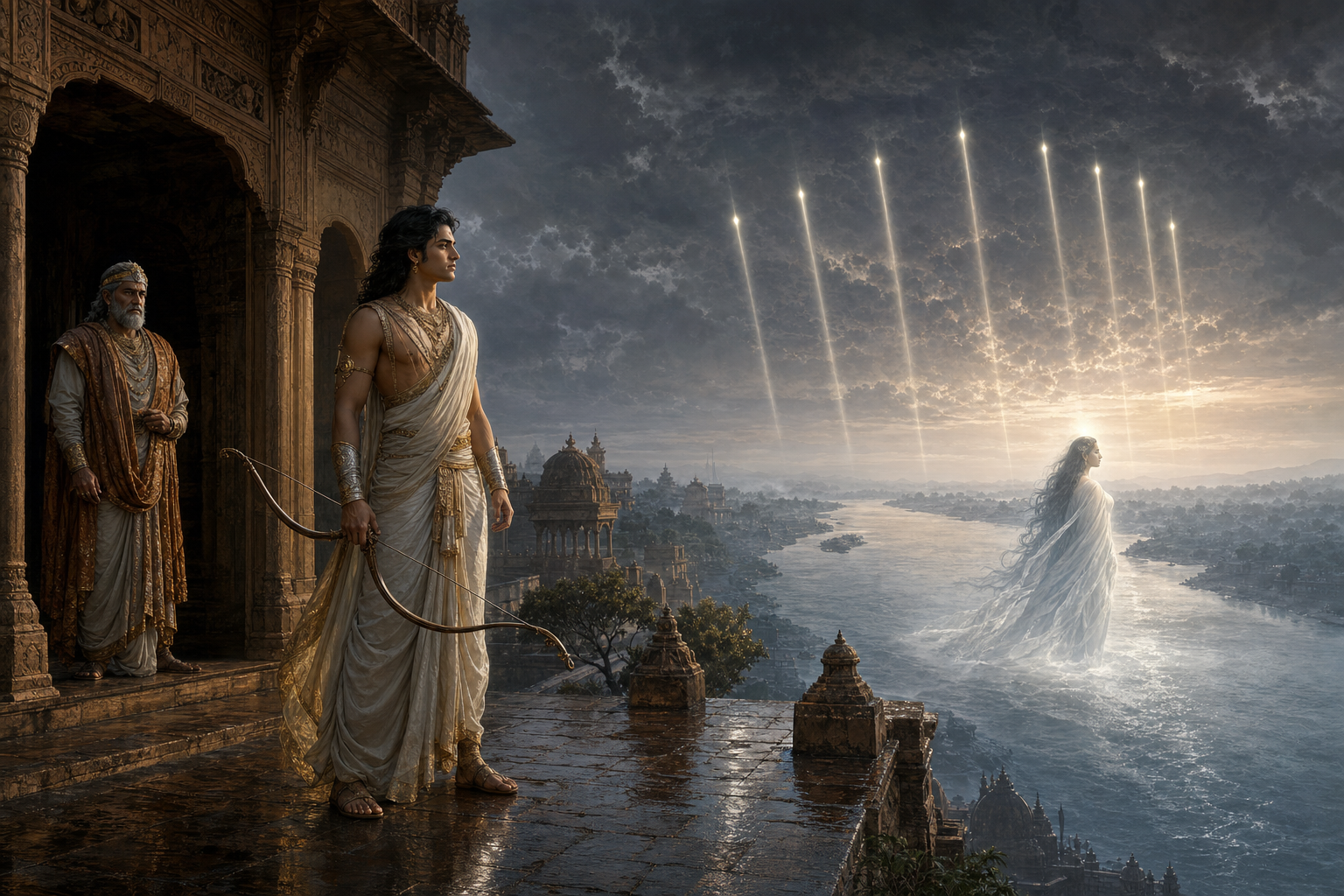
If the Kuru family tree has ever seemed broken before the Pandavas and Kauravas even appear, begin several generations earlier. The decisive sequence starts with a king’s undisciplined gaze, passes through the mortal births of eight celestial beings, and reaches its dynastic turning point in Bhishma’s renunciation.
This prelude does more than explain who fathered whom. It teaches you how to read the Mahabharata’s causality. A curse establishes difficult conditions, but it does not abolish choice. A vow may be righteous in motive and still transfer danger to the next generation. The coming war is prepared through the interaction of karma, character, and succession rather than through fate acting alone.
Start with two curses, not one
The first curse concerns Mahabhisha. Although his austerities and righteous kingship had gained him admission to Brahma’s celestial assembly, he failed a subtle test of restraint. When a breeze displaced Ganga’s garments, the devas and rishis lowered their eyes. Mahabhisha continued looking. Brahma answered that breach of celestial propriety by sending him back to earthly life, where desire would have consequences that could not be escaped by status.
Mahabhisha was therefore reborn as Shantanu, son of Pratipa in the Kuru line. His identity crossed from the Ikshvaku or Suryavamsha lineage into the Chandravamsha. That transition matters because the curse does not merely demote a king from heaven. It places him inside the royal house whose succession will dominate the Mahabharata.
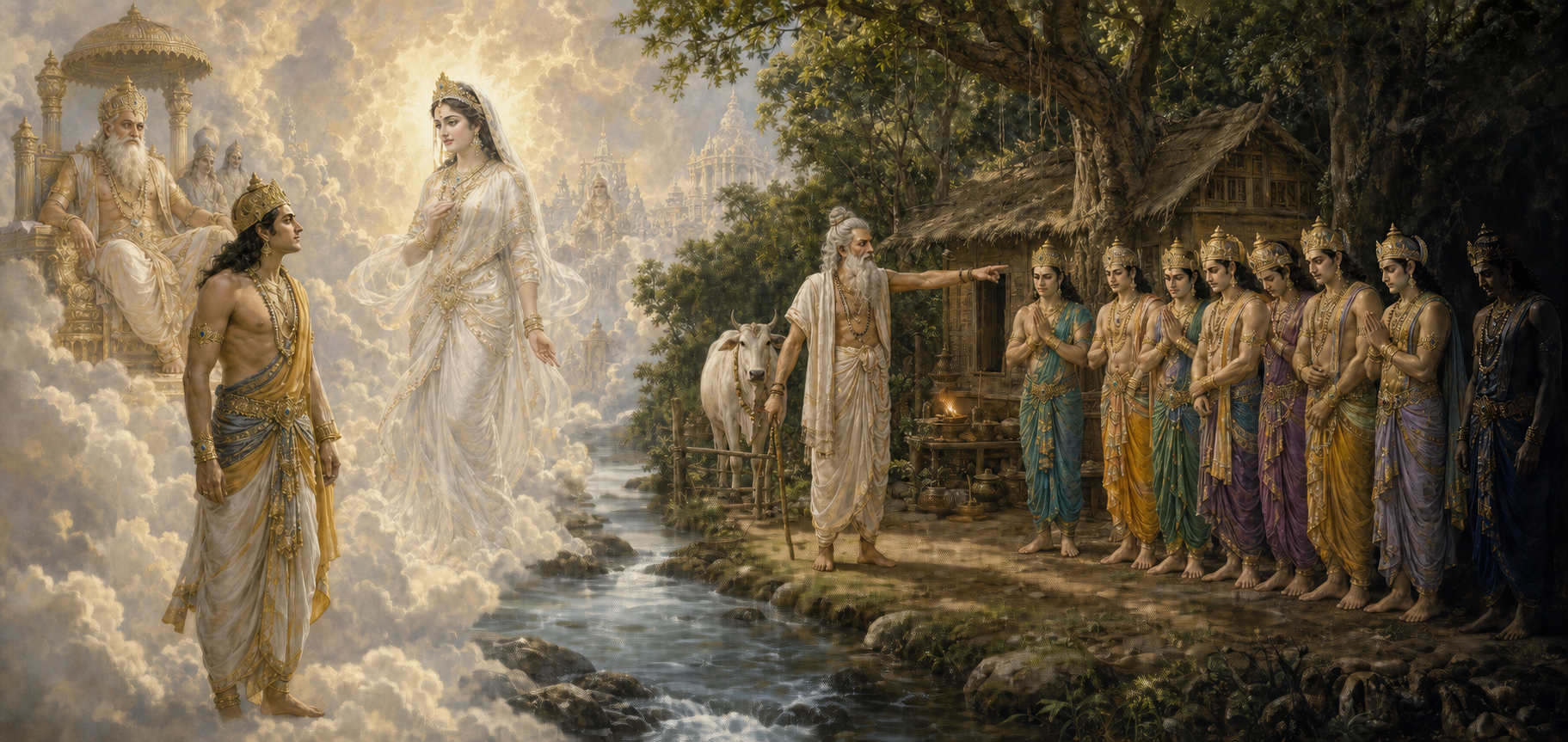
The second curse belongs to the eight Vasus. After they attempted to take the sage Vashistha’s divine cow, Nandini, they were condemned to human birth. Their sentence was mitigated: seven would spend only a brief time in mortal existence, while one would remain on earth for a long and burdensome life. Recensions differ over some names and over which Vasu bears the principal burden, so the stable point to retain is the unequal sentence rather than a disputed identification.
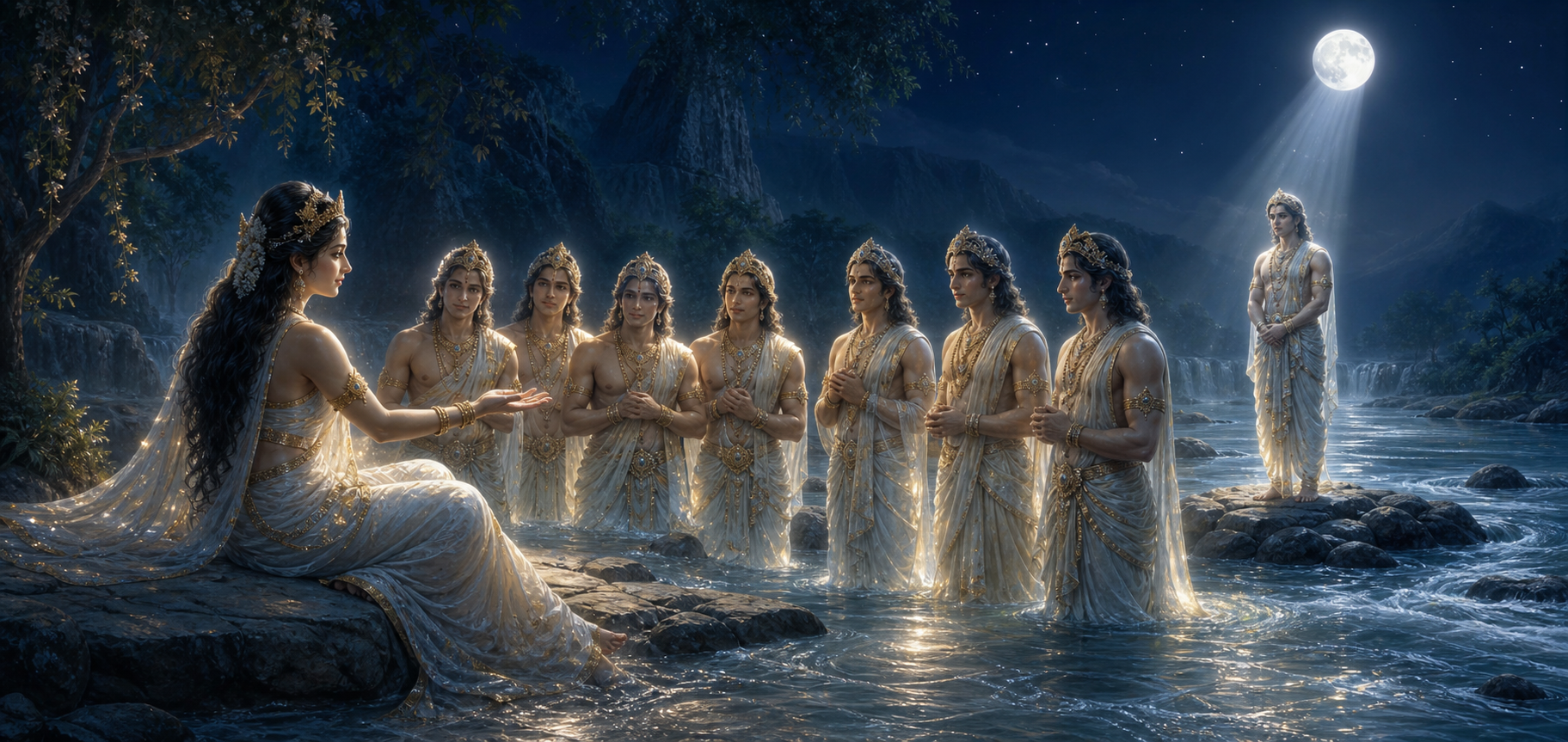
Ganga agreed to become their mother and release the first seven quickly. She then entered Shantanu’s life under a condition: he could marry her only if he never questioned what she did. What appears at first to be a romance is therefore already carrying two karmic histories. Shantanu is living out the result of Mahabhisha’s lapse, while Ganga is undertaking the liberation of the Vasus.
- Mahabhisha fails to restrain his gaze in Brahma’s court and is reborn as Shantanu.
- The eight Vasus incur Vashistha’s curse and must enter human life.
- Ganga marries Shantanu on the condition that he will not challenge her conduct.
- She consigns seven newborn sons to the river, ending their mortal sentences almost immediately.
- Shantanu objects when the eighth child is born, breaking his promise and ending the marriage.
- Ganga raises the surviving child and later returns him as Devavrata, the future Bhishma.
- Devavrata renounces marriage and the throne so that Shantanu can marry Satyavati and her descendants can inherit.
- Satyavati’s sons, Chitrangada and Vichitravirya, die without secure heirs, forcing the Kuru house to seek another route of succession.
- Through niyoga, Veda Vyasa fathers Dhritarashtra, Pandu, and Vidura. From this reconstructed line emerge the two branches whose rivalry ends at Kurukshetra.
Keep those turns separate when you read. Mahabhisha’s curse explains why Shantanu and Ganga meet. The Vasus’ curse explains the births and Ganga’s conduct. Bhishma’s vow explains why Shantanu’s most capable son will not continue the dynasty. The eventual succession crisis arises from all three layers, not from a single supernatural command.
Ganga’s terrible mercy creates a real dharmic conflict
Ganga’s treatment of her children is the point at which many modern readers either reject the narrative too quickly or excuse everything by invoking divine purpose. Neither response is sufficient. You need to hold the human and cosmic perspectives together.
From Shantanu’s position, a mother is repeatedly taking his newborn children to the river. He does not know the history of the Vasus, yet his promise forbids him from asking for an explanation. His silence is not indifference. It is an increasingly severe discipline imposed by his word.
From Ganga’s position, the births are not ordinary beginnings that she arbitrarily destroys. She has promised to free seven celestial beings from prolonged mortal bondage. As river-goddess and mother, she is simultaneously carrying out law, compassion, and release. Her agency is central to the restoration of order; she is not merely delivering a male dynasty to its next stage.
The eighth birth brings the two obligations into open collision. Shantanu can preserve his promise, or he can act as a father to protect the child before him. He protests. Ganga then reveals the concealed karmic history, leaves with the surviving son, educates him, and eventually returns him to his father as Devavrata.
This is why the episode should not be reduced to the lesson that promises must always be obeyed. The Mahabharata makes the promise itself part of the test. A vow governs Shantanu’s conduct, but it does not remove his paternal responsibility. When those duties become irreconcilable, every available choice carries loss.
You can use three questions whenever the epic presents an act that seems morally impossible:
- What does each person know? Ganga knows the Vasus’ history; Shantanu does not. Their different knowledge changes the moral meaning of the same event.
- Which duties are colliding? Ganga has undertaken liberation, while Shantanu is bound both by his word and by fatherhood.
- What does each choice preserve and sacrifice? Shantanu’s silence permits seven releases. His objection preserves the eighth life, ends the marriage, and makes Bhishma’s earthly career possible.
That method lets you respect the narrative’s cosmology without switching off ethical judgement. It also prevents a familiar mistake: treating dharma as a list of rules whose correct application always produces a painless result. Here, the pain is evidence that legitimate obligations have collided.
Bhishma’s vow solves a marriage problem but weakens succession
Devavrata returns to a kingdom in which he is the natural continuation of Shantanu’s line. He possesses royal birth, education, and an acknowledged place in the succession. Then Shantanu desires marriage with Satyavati, and the future claims of her children become an obstacle.
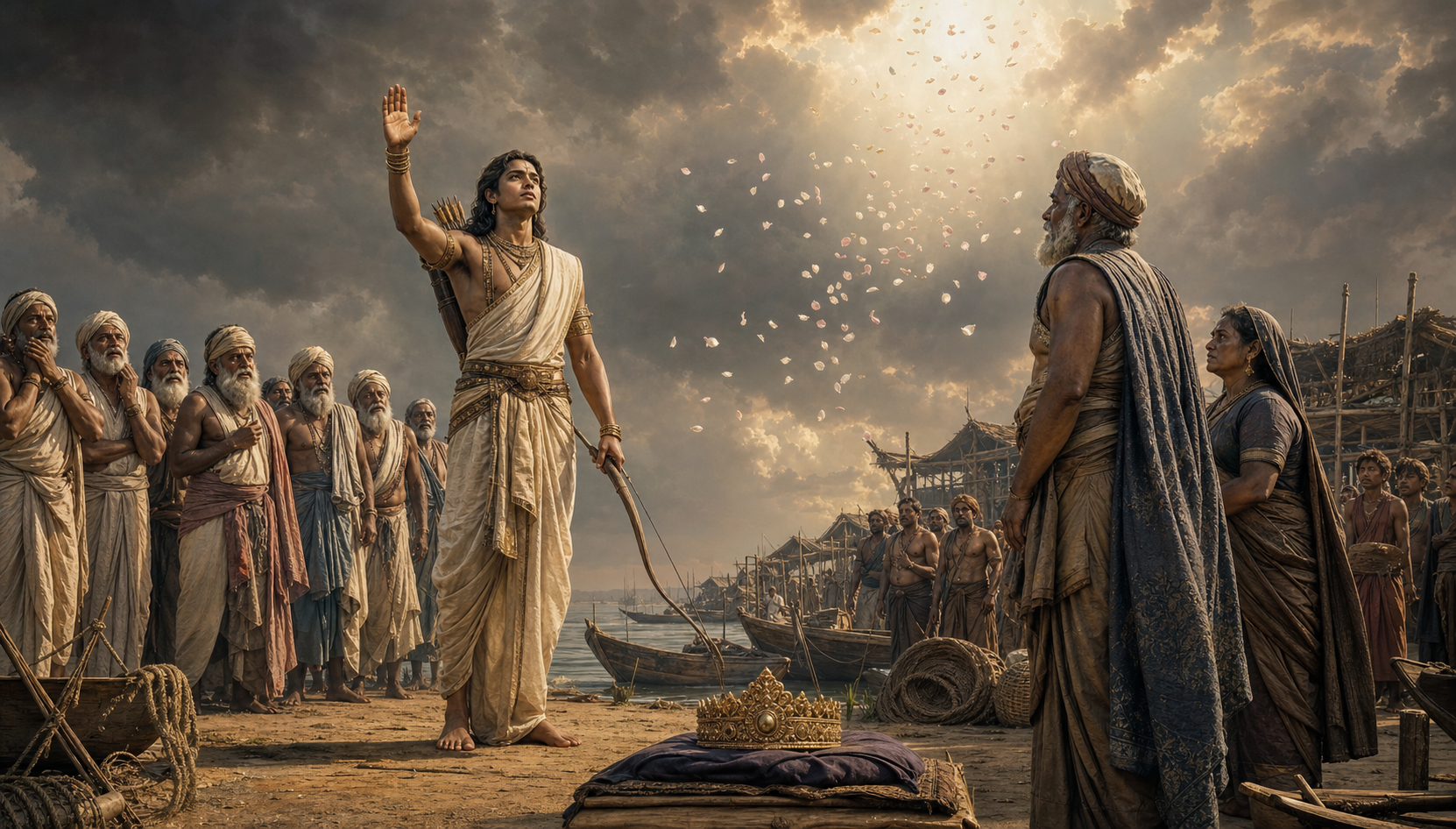
Devavrata removes that obstacle with extraordinary finality. He renounces his claim to the throne and vows lifelong celibacy, ensuring that neither he nor any child of his can compete with Satyavati’s descendants. The force of this Bhishma Pratigya establishes Devavrata as Bhishma. It is an act of filial loyalty, self-command, and personal sacrifice.
It is also a structural gamble. Bhishma solves Shantanu’s immediate problem by permanently removing himself and his possible descendants from the line of inheritance. The continuity of the Kuru house now depends on Satyavati’s sons. When Chitrangada and Vichitravirya die without secure heirs, the dynasty has no ordinary path forward. The vow cannot be revised to meet the changed circumstances because its power lies precisely in its absoluteness.
Niyoga preserves the house, with Veda Vyasa fathering Dhritarashtra, Pandu, and Vidura. Yet preservation is not the same as restoration to an uncomplicated succession. The Kuru line continues through an emergency response to a problem partly intensified by the removal of Bhishma from marriage and kingship.
This does not make Bhishma the sole cause of Kurukshetra. Satyavati’s sons still meet their own fates, the reconstructed dynasty produces several distinct agents, and later generations make consequential choices of their own. The vow changes the architecture of the royal house; it does not dictate every act performed inside it.
The distinction is useful beyond genealogy. Before admiring any sweeping sacrifice, ask what happens to the duty being surrendered. Does the burden disappear, or does it move to people who had no voice in the decision? Bhishma pays an immense personal price, but future generations inherit the succession risk. The epic asks you to evaluate both sides of that ledger.
- Name the immediate problem: Shantanu’s desired marriage requires an uncontested future for Satyavati’s descendants.
- Name the chosen remedy: Devavrata gives up both kingship and the possibility of children.
- Identify the transferred risk: the dynasty becomes dependent on a narrower line of heirs.
- Check whether the remedy can adapt: Bhishma’s absolute vow remains fixed after the succession conditions change.
- Preserve later agency: structural weakness explains vulnerability, not every later decision or injustice.
Read the prelude through restraint, consequence, and agency
The opening lapse is small in duration but not in moral content. Mahabhisha does not seize a kingdom or wage a battle; he fails to govern his gaze. In a setting ordered by reverence, dṛṣṭi itself becomes conduct. The lesson is not that vision is sinful. It is that attention can express entitlement, and high status does not exempt a person from restraint.
Brahma’s curse should therefore be read as corrective causality rather than arbitrary revenge. Mahabhisha returns to the human condition in which desire, attachment, silence, and loss become unavoidable teachers. Shantanu’s life places him close to Ganga again, but now the attraction he once indulged is joined to a demanding promise and the anguish of fatherhood.
Several Dharmic traditions offer resonant disciplines for noticing the same inner danger. Hindu teachings emphasize indriya-nigraha, governance of the senses, and viveka, discernment. Buddhist practice connects mindfulness with ethical conduct. Jain discipline places weight on non-possessiveness and chastity. Sikh teaching answers ego with humility and alignment with hukam. These concepts are not interchangeable, but they converge on one practical insight: disorder usually enters action before it becomes publicly dramatic.
Use four lenses to follow that process through the Mahabharata:
- Restraint: What appetite, fear, or attachment is the person failing to govern? For Mahabhisha, the first failure is the gaze.
- Commitment: What promise narrows the person’s future choices? Shantanu accepts silence; Bhishma accepts celibacy and renunciation.
- Institution: How does a private decision alter the kingdom? Bhishma’s sacrifice changes who can inherit the Kuru throne.
- Residual agency: Which choices remain after karma has established the conditions? Shantanu can still object, Ganga can still disclose, and later Kuru generations remain responsible for their conduct.
This last lens is essential. If karma is mistaken for fatalism, responsibility disappears: every later wrong can be blamed on an ancient curse. The epic’s actual moral tension depends on the opposite. People inherit conditions they did not choose, yet their responses continue to generate consequences.
Key takeaways
- Two distinct curses drive the prelude: Mahabhisha’s earthly rebirth and the Vasus’ mortal births.
- Ganga’s immersion of seven children is framed as release from a karmic sentence, while Shantanu experiences it without that hidden knowledge.
- The eighth child’s survival produces Devavrata, whose later vow earns him the name Bhishma and redirects Kuru succession.
- Bhishma’s renunciation is righteous in motive but costly in institutional effect; it concentrates the dynasty’s future in a fragile branch.
- The curses create conditions for crisis, but vows, family decisions, and later acts of agency carry the dynasty toward war.
As you continue into the Mahabharata, mark each major decision by what it solves now and what it leaves for someone else. That habit turns the genealogy from a confusing preface into the epic’s first sustained lesson in governance: private self-mastery and public continuity cannot be separated for long.

References
