
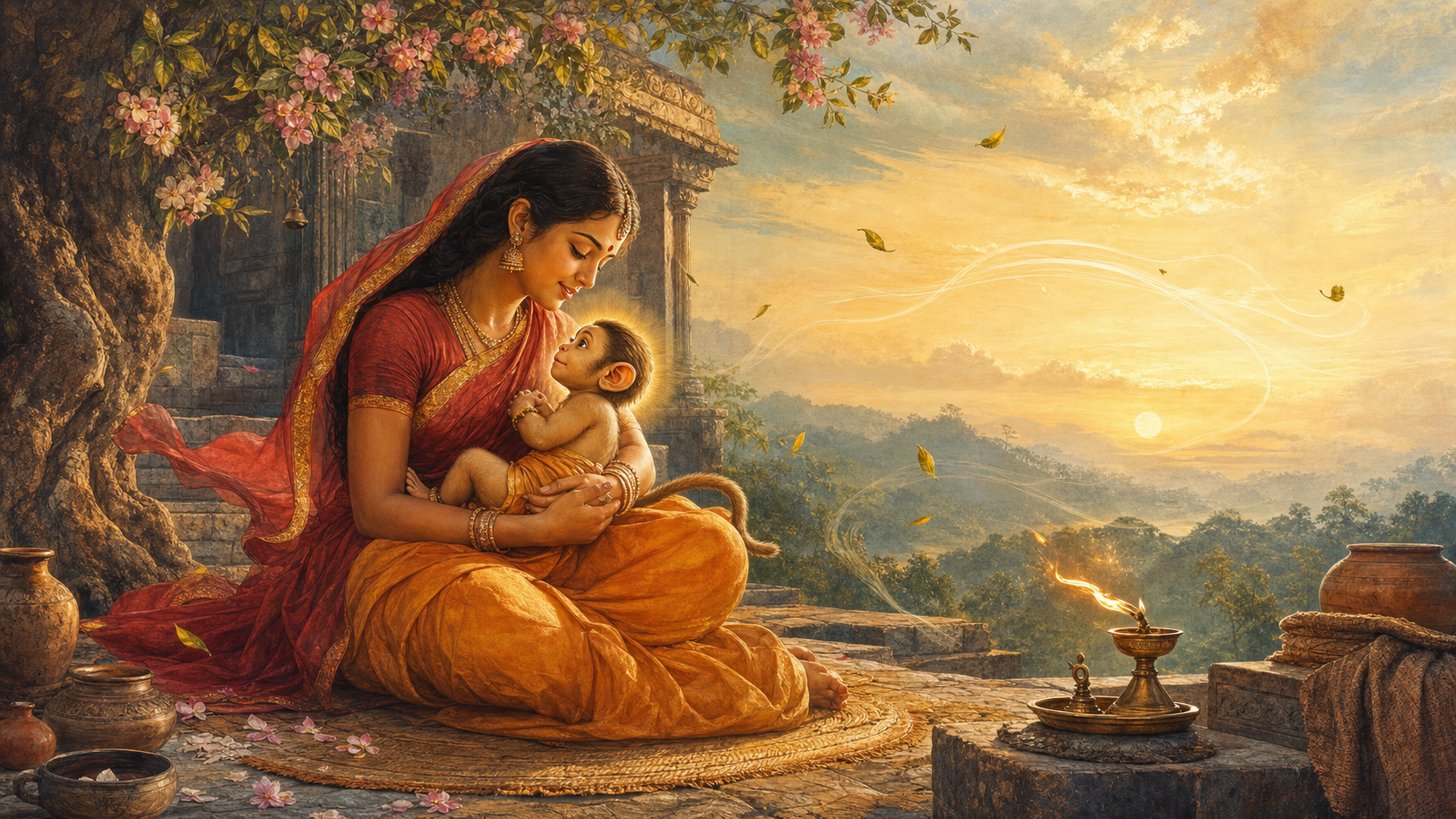
If you came with one narrow question – does the Kamba Ramayana tell of Vali trying to destroy Hanuman before he was born? – the careful answer is that the motif belongs to a South Indian tradition associated with Kamban’s Tamil Ramayana. Its complete form also circulates through related regional and later tellings, so it should not be presented as an identical passage found in every Ramayana.
That distinction lets you approach the birth story with both shraddha and precision. You don’t have to flatten a living sacred tradition into one standardized version, and you don’t have to discard a meaningful episode merely because another recension places its emphasis elsewhere.
The birth story without collapsing its layers
A prophecy announces the coming of an extraordinary child born to Anjana and blessed through Vayu. This child will change the balance of strength, wisdom, and dharma. Vali, the formidable ruler of Kishkindha, hears the prophecy not as a promise but as a threat to his position.
Vali already possesses exceptional power, including a boon associated with drawing away an opponent’s strength. Yet the predicted child represents a kind of power that worldly might cannot safely control: strength aligned with a larger dharmic purpose. Fear turns Vali’s attention toward Anjana during her pregnancy, and he attempts to prevent the child from being born.
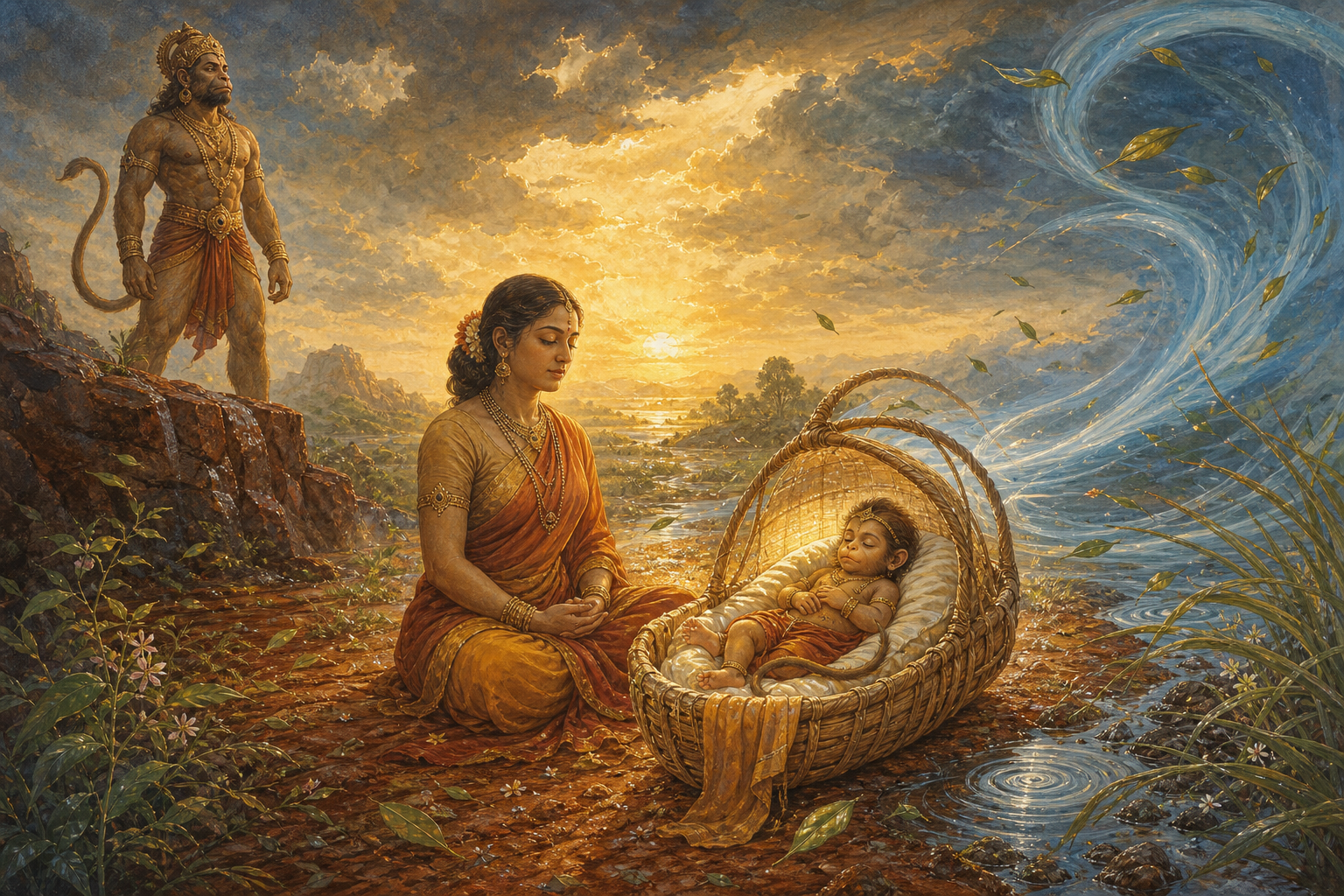
At the decisive moment, Vayu envelops Anjana and her unborn child in protective prana. The wind deity is not simply another powerful combatant entering the scene. Vayu protects through the life-bearing force by which the child is already sustained. The threatened birth therefore becomes an image of life guarded by life itself.
A broader pan-Indic understanding of Hanuman’s advent also brings together the grace of Shiva and the agency of Vayu. It is wiser to preserve that convergence than to force it into a single mechanical account of conception. The theological point is clear enough: Hanuman’s extraordinary nature arises through divine purpose, but the power he receives will be expressed through humility, restraint, devotion, and seva.
Where Kamban ends and regional memory continues
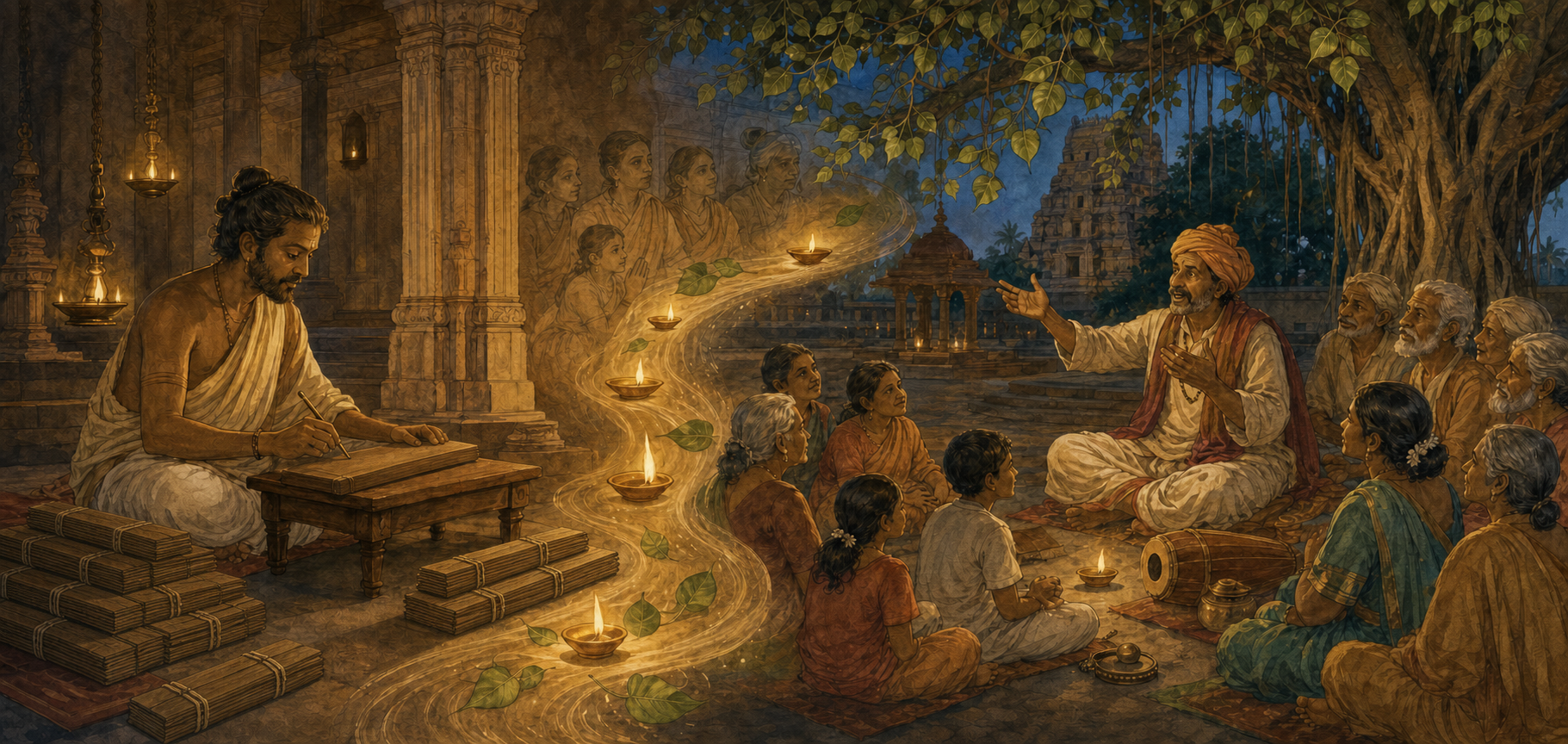
The Ramayana has never lived only as one fixed sequence of incidents. Sanskrit, Tamil, and other regional tellings preserve a shared sacred world while selecting, expanding, or interpreting particular moments differently. That is why you may encounter the prenatal threat as part of the Kamba Ramayana’s narrative world even when a particular edition or translation does not present the complete episode in the form you heard from an oral teacher or regional storyteller.
Three layers are often blended in casual retelling: Kamban’s Tamil composition, regional versions connected with it, and later South Indian narrative memory. They belong to the same living ecosystem, but they are not interchangeable as textual citations. A precise claim about a canto or verse requires a named Tamil edition or translation. If you don’t have one, do not manufacture a location.
The most reliable wording for a class, discussion, or devotional talk is: “In a South Indian tradition associated with the Kamba Ramayana, Vali tries to prevent Hanuman’s birth, and Vayu protects Anjana and the unborn child.” That sentence identifies the tradition, preserves the episode, and does not pretend that every manuscript or retelling contains identical wording.
The distinction becomes especially important when comparing this account with the Valmiki Ramayana. Valmiki’s telling gives prominence to events after Hanuman’s birth, including the child mistaking the sun for a fruit and being struck by Indra’s vajra. The prenatal confrontation and the postnatal encounter are not competing descriptions of one event. They are different episodes carrying different emphases.
Textual variation need not be treated as either embarrassment or proof of corruption. It tells you how a sacred narrative has remained active across languages and communities. The responsible response is to name the layer you are using. Devotion is not weakened by accurate attribution; it becomes less vulnerable to avoidable objections.
What Vali, Vayu, and Anjana reveal about power
The prophecy does more than predict Hanuman. It exposes Vali. A secure ruler might recognize the promised child as a future defender of dharma. A ruler governed by fear sees only a rival. The moral crisis therefore begins before any physical attack: power becomes adharma when preserving control matters more than protecting innocent life.
Anjana’s womb functions as a sanctum in this telling. The unborn Hanuman has performed no deed against Vali and issued no challenge. He is targeted for what he may become. That detail turns the episode into a sharp warning about anticipatory injustice – harming someone not for a wrong committed, but because fear has converted possibility into guilt.
Vayu answers that injustice with protection. Wind and prana carry a double meaning: they are both cosmic presence and the sustaining breath of embodied life. Vayu’s intervention is therefore more than a display of superior force. His strength takes the form of guardianship. He does not imitate Vali’s possessiveness; he places power around the vulnerable.
Hanuman’s later greatness is already foreshadowed in that contrast. Vali has immense strength but fears displacement. Hanuman will possess immense strength without making himself its center. His courage serves, his discipline restrains, and his devotion directs his abilities toward a purpose greater than personal sovereignty.
When you read the episode, track three things: who holds power, whom that power protects, and what fear makes each person do. This turns a miraculous birth account into a practical test of character. Authority governed by insecurity treats promise as a threat. Strength governed by dharma creates room for life, service, and rightful possibility to grow.
Key takeaways for a responsible reading
- Hanuman is born to Anjana through divine grace, with Vayu acting as the life-bearing and protective presence around his birth.
- The attempt by Vali to destroy Hanuman before birth is best identified as a South Indian regional tradition associated with the Kamba Ramayana.
- The motif should not be assigned to a precise canto, verse, manuscript, or translation unless that textual location has actually been verified.
- The Valmiki Ramayana places greater emphasis on postnatal episodes such as infant Hanuman reaching for the sun and encountering Indra’s vajra.
- Vali represents strength distorted by fear, while Vayu represents strength used to shelter vulnerable life.
- Hanuman’s divine power matters because it matures into humility, disciplined devotion, restraint, and selfless service.
Carry the episode into your next decision
You don’t need to invent a ritual to make this birth story practical. Before a difficult use of authority, write three short sentences: name the person, trust, or principle that is vulnerable; name the fear that could distort your judgment; then name one protective act you can perform without turning yourself into the center of the situation.
This exercise separates Vali’s model of power from Vayu’s. One moves first against a possible rival. The other safeguards life without demanding ownership of its future. It also prepares you to recognize Hanuman’s distinctive greatness: his abilities become most radiant when they disappear into seva.
The next time someone says that the Kamba Ramayana describes Vali attacking Hanuman in the womb, neither repeat the claim carelessly nor dismiss the tradition outright. Ask which Tamil edition or regional narration is meant, use the Kamba-associated wording when no exact passage is available, and then attend to the episode’s dharmic demand: let your strength protect what fear would destroy.
References
