
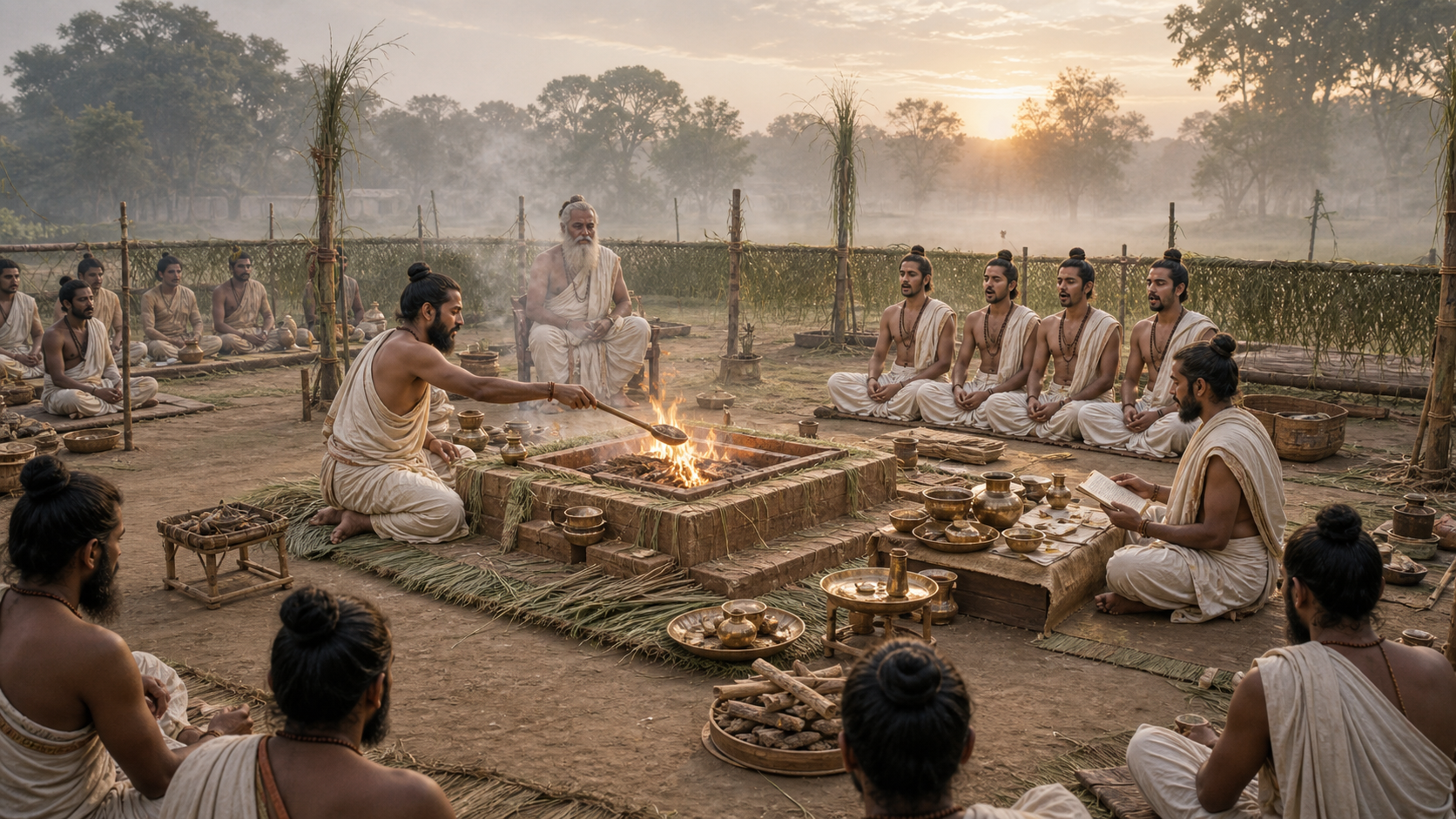
If you have encountered Gavamayana as the “journey of cows,” you may be wondering whether the phrase describes a cattle procession, a meditation on abundance, or a fire ritual. The useful answer begins with its form: Gavamayana is a collective Vedic sacrificial session whose participants sustain one demanding ritual undertaking together.
That structure explains more than the translation does. It shows you why Gavamayana requires several kinds of priestly expertise, why continuity matters as much as any individual offering, and why its modern lesson is disciplined cooperation rather than the casual imitation of an ancient rite.
Key takeaways
- Gavamayana belongs to the sattra form of Shrauta yajna, in which the officiating priests also share the position of yajamana.
- The customary rendering “journey of cows” joins the symbolism of nourishment and collective prosperity to a sequenced passage through ritual time.
- The Hotr, Adhvaryu, Udgatr, Brahman, and assisting ritviks contribute different forms of expertise to one continuous undertaking.
- Collective responsibility does not make the ritual informal. It increases the need for training, coordination, accurate transmission, and dependable handoffs.
- A modern community can learn from this architecture without claiming to perform Gavamayana: define the scope honestly, distribute real responsibilities, preserve knowledge, and connect learning with seva.
Start with the ritual category, not the English translation
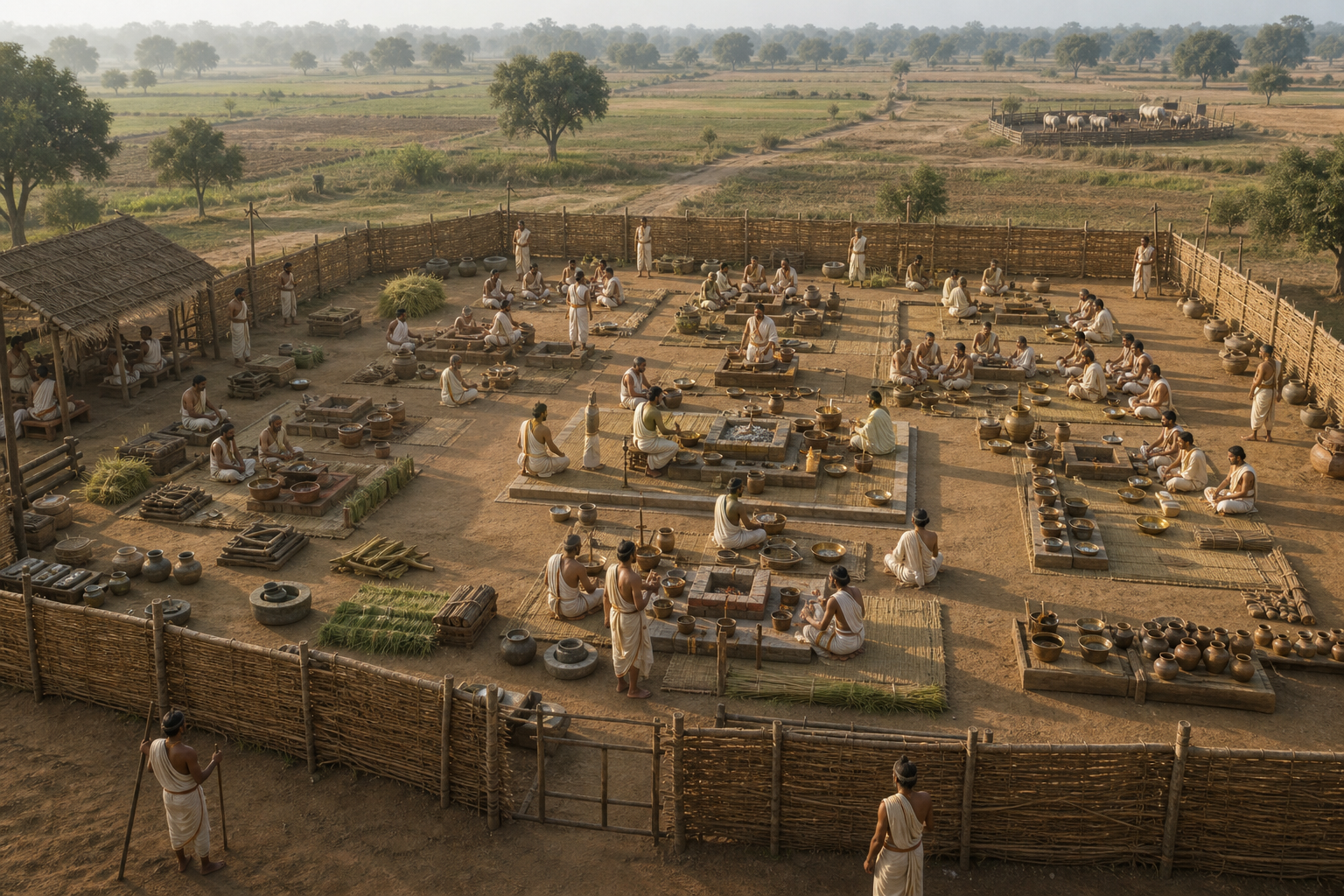
Gavamayana is classified as a Sattrayaga within the classical Shrauta system. A sattra is a sacrificial session maintained by a body of ritviks, or ritual priests. Its defining feature is not simply that many people attend. The officiants themselves also serve collectively as yajamanas, bearing the responsibility and receiving the spiritual fruit associated with the undertaking.
This is the first distinction to keep in view. In the familiar patron-centred picture of yajna, a yajamana commissions a rite and qualified priests perform their appointed duties. In a sattra, the centre of responsibility rests within the officiating body itself. The group must hold a common intention while preserving the differences among its specialist offices.
Shared responsibility therefore does not mean interchangeable responsibility. A person trained for one liturgical function cannot simply move into another because the undertaking is communal. The cooperation works precisely because duties are differentiated, learned, and coordinated.
The name Gavamayana is commonly understood as the “journey of cows.” Cattle belong here as signs of nourishment, abundance, reciprocity, and social well-being within the Vedic world. The word “journey” can also help you see the rite as movement through ordered ritual time: successive observances, chants, offerings, and transitions contribute to a larger whole.
Do not turn that conventional translation into a literal stage direction. The meaning of Gavamayana cannot be recovered merely by imagining cows travelling from one place to another. Nor should the entire rite be reduced to a general statement about reverence for cattle. Its symbolism lives inside the sattra structure, where material sustenance, ritual continuity, and collective welfare are brought into relation.
When you assess an explanation of Gavamayana, ask four questions:
- Does it identify Gavamayana as a sattra rather than treating it as an ordinary one-patron ceremony?
- Does it explain that the officiants share yajamana responsibility, not merely that several priests happen to be present?
- Does it place cattle symbolism within the Vedic concerns of nourishment, reciprocity, and prosperity?
- Does it distinguish a broad explanation from the exact procedures preserved by particular Shrauta traditions?
If one of those elements is missing, you may still have a useful devotional reflection, but you do not yet have an adequate account of how Gavamayana works.
The rite works through coordinated priestly systems
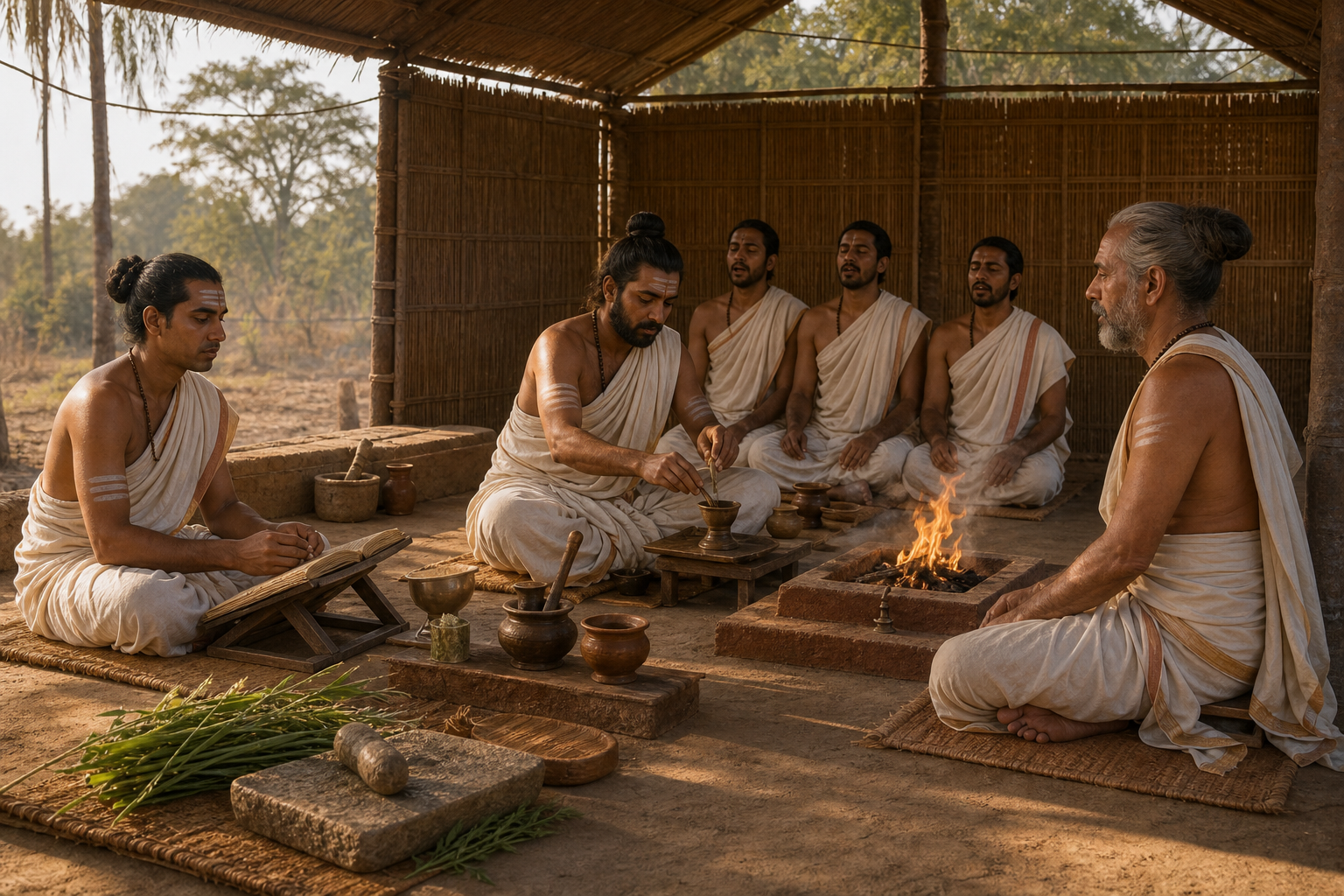
Gavamayana unfolds through defined phases of recitation, chanting, offering, and observance. Sacred fires must be maintained, oblations measured, texts delivered, and transitions made without losing the momentum of the session. Some scholastic treatments relate its extended structure to wider calendrical rhythms, but that does not justify assigning a precise duration whenever the textual or traditional basis for that claim has not been identified.
The core priestly organization brings together the Rig, Yajur, and Sama recitational traditions. The following map gives you the functional logic without pretending to replace a ritual manual or oral instruction:
| Ritual office | Primary orientation | Contribution to the whole |
|---|---|---|
| Hotr | Rig Vedic recitation | Maintains the stream of prescribed invocations and recited formulas. |
| Adhvaryu | Yajur Vedic procedure | Coordinates measured ritual actions and oblations with the liturgical sequence. |
| Udgatr | Sama Vedic chanting | Supplies the melodic liturgical dimension at its appointed points. |
| Brahman | Supervision of the rite | Watches the undertaking as a whole and safeguards procedural coherence. |
| Assisting ritviks | Supporting offices | Help the principal roles maintain continuity across the successive phases. |
This organization is easier to understand if you watch for three kinds of continuity.
- Textual continuity: the right recitation or chant must appear within the right ritual setting. Memorizing an isolated passage is not the same as knowing its place in a complete sequence.
- Temporal continuity: an extended session depends on correct transitions, sustained observance, and the maintenance of the fires. A strong individual segment cannot compensate for a broken sequence.
- Human continuity: each ritvik depends on the readiness of the others. The ritual is not a collection of private devotional acts occurring beside one another; it is one coordinated action.
This is why a list of offerings cannot by itself explain Gavamayana. The rite’s intelligence lies partly in the relationships among its elements. A recitation has a time, an offering has a measure, a chant has an appointed place, and every specialist acts within a shared procedural field.
Collaboration increases the demand for discipline
The word “collaborative” can mislead a modern reader. It may suggest an open activity in which everyone participates in the same way. A sattra represents something more exacting: common ownership of an undertaking combined with differentiated competence.
That combination corrects two opposite errors. The first is to imagine that collective ritual has no hierarchy of knowledge. The second is to imagine that ritual precision leaves no room for genuine fellowship. Gavamayana requires both: trained offices remain distinct, while responsibility for the session is shared.
The arrangement also helps explain how ritual knowledge survives. Oral transmission needs more than a gifted reciter. It needs teachers, learners, correction, repetition, supporting roles, and a community willing to sustain the conditions under which precision remains possible. When several recitational traditions must operate together, training the connections between roles becomes as important as training each role separately.
If you are supporting Vedic education, this gives you a practical standard. Do not count only how many people can recite a passage or attend a programme. Look for the less visible signs of continuity:
- Are learners being trained for named responsibilities rather than treated as generic volunteers?
- Is there a clear relationship between senior instruction, repeated practice, and correction?
- Are the handoffs among recitation, chanting, procedure, and supervision taught explicitly?
- Can the programme explain which parts are liturgical performance, which are instruction, and which are public demonstration?
- Is there a path by which today’s learners can become tomorrow’s custodians?
Lay participation also needs a clear frame. A community does not become more inclusive by pretending that specialized offices require no preparation. People who are not performing a priestly role can still sustain learning, hospitality, organization, documentation, service, and respect for the practitioners who preserve the tradition. Inclusion here means contributing truthfully, not claiming interchangeable authority.
The same clarity should govern any public event associated with Gavamayana. A study session, a recitation programme, a heritage demonstration, and a full Shrauta undertaking are not four names for the same thing. Name the scope honestly. If qualified practitioners and the required ritual continuity are absent, describe the activity as study, commemoration, or inspiration rather than borrowing the authority of the complete yajna.
Carry the architecture into community life without imitation

Most communities will encounter Gavamayana through teaching and study rather than by organizing the complete rite. That is not a reason to leave its collaborative wisdom in the past. It is a reason to translate the structure carefully, without claiming that a modern project is ritually equivalent to a sattra.
You can apply that structure to a Vedic study circle, cultural-preservation programme, collaborative recitation, or service initiative through six decisions:
- State one shared purpose. Write a sentence that explains what the group is sustaining: textual learning, oral transmission, community service, care for living beings, or cultural education. A collection of private motives will not produce the coherence of a common undertaking.
- Name distinct responsibilities. Separate textual instruction, recitation practice, scheduling, hospitality, public explanation, and service. Do not give everyone the same vague title and expect coordination to emerge by itself.
- Respect the boundary of expertise. Let trained custodians direct liturgical and textual matters. Administrative authority should not be mistaken for ritual qualification.
- Design for continuity. Use a defined calendar, assign handoffs, and identify who carries each responsibility when a regular participant is unavailable. The lesson of an extended rite is that continuity must be planned before it is tested.
- Join learning to welfare. Connect cultural preservation with a concrete expression of seva, environmental responsibility, or care for living beings. Keep that activity clearly identified as an ethical application, not as a replacement for the yajna.
- Prepare the next cohort. Give learners repeated responsibilities under guidance. A programme that depends permanently on one expert may display knowledge, but it is not yet transmitting it.
Gavamayana can also support Dharmic solidarity, provided that the comparison remains disciplined. Its cooperative ethos can resonate with sangha in Buddhism, communal vrata and ahimsa in Jainism, and seva and sangat in Sikhism. These are meaningful points of contact around discipline, fellowship, service, and collective welfare.
They are not interchangeable institutions. A Buddhist sangha is not a Vedic sattra, Sikh sangat is not a Shrauta session, and Jain vrata should not be absorbed into the language of sacrifice. The parallel is ethical and organizational, not a claim that the traditions share identical liturgies. If you are planning an inter-Dharmic gathering, let each tradition describe its own practice in its own vocabulary before drawing out the common values.
This approach produces a stronger form of unity. It does not ask anyone to surrender a distinctive path. It asks every participant to recognize a familiar discipline: shared purpose becomes credible when people accept duties, honour limits, care for others, and remain responsible for the whole.
Your next step can be modest and exact. Take one programme, event proposal, or explanation associated with Gavamayana and ask: What is its actual scope? Who holds the relevant knowledge? How are responsibilities divided? What preserves continuity? If those answers are clear, you have the beginning of responsible engagement. If they are not, correct the description before enlarging the activity. Sacred collaboration starts with shared intention, but it endures through disciplined truthfulness.
References
