
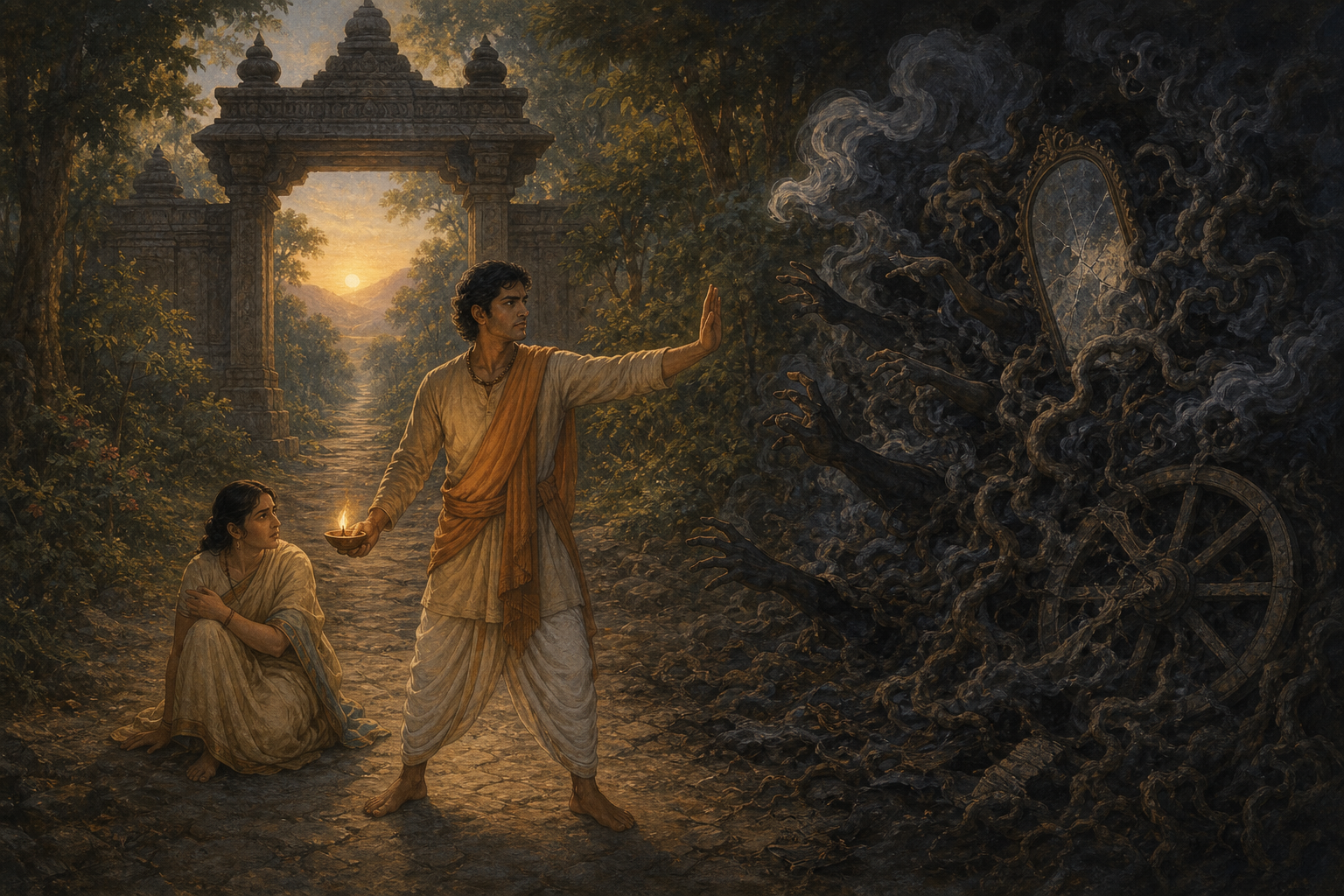
You are trying to answer a deceptively simple question: if Hinduism has no Satan, what explains deliberate cruelty? Saying only that Hindus do not believe in the devil leaves the hardest part unanswered. It can even sound as though Dharma has no serious account of evil.
The fuller answer is more demanding. The Dharmic family of traditions does not require an eternal, all-evil adversary to explain wrongdoing. It asks you to identify the ignorance, craving, ego, passion or adharma producing harm; stop the harm; accept the consequences of action; and undertake the discipline that prevents its return. Evil is confronted without making evil the permanent essence of any being.
Key takeaways
- Dharmic traditions can condemn an act as gravely wrong without treating evil as an independent cosmic power equal to the Divine.
- Hinduism commonly explains wrongdoing through adharma, karma, avidya and the disordering influence of the gunas rather than through an external tempter.
- Buddhism, Jainism and Sikhism use different doctrines, but each directs attention toward conditions such as craving, delusion, violence, attachment and ego.
- The possibility of transformation does not cancel accountability. Protecting others, stopping misconduct and requiring repair come before speculation about a wrongdoer’s inner state.
- A practical Dharmic response asks what happened, which duty was violated, what tendency drove the act, what consequence is required and which discipline can prevent repetition.
Evil is a diagnosis before it becomes an identity

The English word evil often bundles two different claims together. The first is moral: an action is cruel, destructive or profoundly unjust. The second is metaphysical: evil exists as a permanent being or power whose nature is wholly opposed to God. Dharmic traditions can affirm the first claim without accepting the second.
This distinction prevents two common mistakes. One is minimising cruelty because there is no Satan figure to blame. The other is turning a wrongdoer into a different kind of creature whose conduct no longer requires explanation. A Dharmic analysis does neither. It names the act, traces the conditions that produced it and holds the agent responsible.
Adharma is the most direct moral category. It is action out of alignment with right conduct and the order that sustains life. Because dharma is lived through concrete duties, relationships and circumstances, its application is contextual. Context, however, is not a licence for relativism. It identifies which responsibilities are active; it does not allow appetite, fear or factional loyalty to redefine a harmful act as righteous.
Avidya, or ignorance, operates at a deeper level. In Advaita Vedanta it is central to bondage and misperception. A person who mistakes the ego, possession, status or desire for the whole of the self will act from a distorted understanding of reality. Calling this ignorance is an explanation, not an acquittal. Ignorance can produce real victims, and the resulting actions still carry consequences.
The three gunas offer another diagnostic vocabulary. Sattva tends toward clarity and harmony, rajas toward restless drive and passion, and tamas toward inertia and obscuration. They are tendencies, not permanent moral species. When agitation, fixation or dullness governs the mind, judgment deteriorates. The useful question is therefore not merely, Who is bad? It is also, Which quality is dominating this mind, this institution or this crowd?
Karma completes the account of responsibility. Intentional action bears consequences, including consequences extending across lifetimes. No external tempter is needed to make moral causation work. Your choices help shape future conditions, habits and bondage. This makes agency unavoidable: temptation may explain pressure, but it does not perform the action on your behalf.
When you assess wrongdoing, keep four things separate: the act, the tendency behind it, the consequence it caused and the person who performed it. You can say, with full force, that an act was adharmic, driven by greed and deserving of a serious consequence. You need not add that the person is eternally or essentially evil. That extra claim contributes nothing to protection or justice.
Four traditions locate the adversary in different places
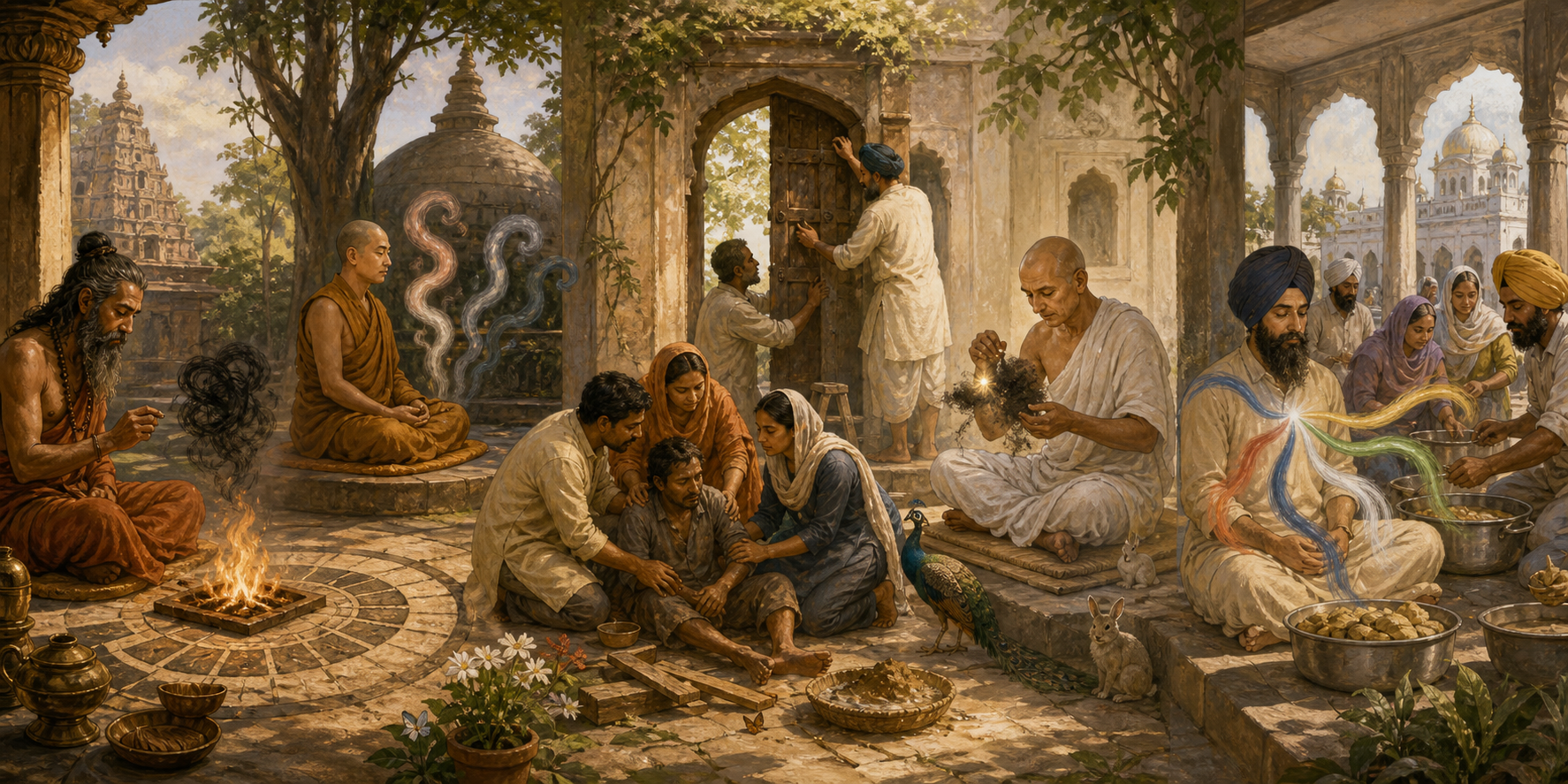
Hinduism, Buddhism, Jainism and Sikhism are not four denominations of a single church. Their accounts of the self, liberation, karma and ultimate reality differ. A responsible Dharmic overview should preserve those differences. Their family resemblance lies in the practical refusal to make an eternal devil carry the moral burden that belongs to consciousness, conduct and discipline.
Hinduism: adharma, ignorance and disordered qualities
Hindu traditions generally locate moral failure in some combination of ignorance, attachment, ego, past conditioning and departure from dharma. Different darshanas give these factors different philosophical weight. Advaita Vedanta foregrounds ignorance, while devotional, yogic and other philosophical paths organise the problem through their own teachings about bondage and liberation.
This plurality gives you a practical principle: match the discipline to the failure. Confused understanding calls for study and self-inquiry. An uncontrolled mind calls for meditation and restraint. Self-importance may require service and devotion. Habitual misconduct calls for ethical action repeated long enough to form a different disposition. No single method fits every temperament, but every method must alter how you perceive or act.
Buddhism: craving, fear and delusion
Buddhist traditions speak of Mara in connection with temptation and obstruction, but Mara is not an eternal evil power competing with ultimate truth. The more immediately useful adversaries are craving, fear and delusion as they arise in consciousness. They gain power when you mistake an impulse for a command or a frightened mental story for an accurate picture of reality.
The practical move is observation before obedience. When anger or craving appears, notice its arrival, the story it tells and the action it is urging. That pause does not solve every moral conflict, but it exposes the point at which a mental condition is about to become harmful conduct.
Jainism: passions, violence and karmic bondage
Jain thought places unusual ethical weight on the way passions and violence bind the living being through karma. The enemy is not a demonic ruler but the pattern by which anger, pride, deceit, greed and harmful action deepen bondage. Ahimsa and self-restraint are therefore not decorative virtues. They directly interrupt the mechanism that keeps the being unfree.
This lens asks you to notice harm before it reaches its most dramatic form. A violent outcome usually has a history of permitted impulses, rationalisations and smaller violations behind it. Restraint begins earlier, at the stage where desire still presents itself as entitlement and anger still claims to be moral clarity.
Sikhism: haumai and the five thieves
Sikh teachings identify haumai, the ego-centred orientation of the self, and the five thieves: kama, krodh, lobh, moh and ahankar, commonly understood as lust or uncontrolled desire, anger, greed, attachment and pride. They are called thieves because they quietly take possession of attention and conduct. A person may believe that he is defending honour, serving a cause or protecting a relationship while ego and attachment are directing the response.
Seva, remembrance of the Divine and ethical living counter that capture by moving attention away from self-importance. A useful test is to ask whether your supposedly righteous action still serves truth when recognition, victory and personal status are removed from it. If the motivation collapses without an audience, ahankar may be doing more work than dharma.
Moral complexity strengthens accountability

Devas and asuras are often flattened into gods and demons, then mapped onto an absolute division between good and evil. Dharmic narratives resist that shortcut. Devas can err. Asuras can possess learning, discipline or devotion. Rakshasas and bhutas belong to their own narrative and metaphysical categories; none is simply a Hindu replacement for Satan.
This does not make the stories morally vague. Ravana’s learning and devotion do not neutralise his ego or adharmic conduct. Complexity makes the judgment more exact: admirable capacities can coexist with catastrophic choices. Intelligence, religious practice and cultural refinement do not prove that a person’s conduct is righteous. You still have to examine what the person actually does.
The Mahabharata and Bhagavad Gita likewise present Kurukshetra as a real field of duty and an ethical struggle. Reading the battlefield inwardly should not dissolve the outward demand to act. The point is not that every conflict is merely psychological. It is that action becomes righteous only when the actor also confronts fear, attachment, confusion and self-interest within.
Valmiki’s transformation from bandit to sage establishes the other side of this moral vision: a person’s history need not become an eternal identity. Transformation is possible, but possibility is not evidence that it has already occurred. Repentance must become changed conduct. Forgiveness need not mean restored access, immediate trust or freedom from proportionate consequences.
Within Hindu moral cosmology, naraka is generally understood as impermanent and corrective rather than a realm of endless damnation. Yama administers justice within the moral order; he is not a satanic sovereign ruling an independent kingdom of evil. Punishment therefore belongs to accountability, purification and balance rather than eternal metaphysical rejection.
That corrective outlook must never be turned into permissiveness. If someone is causing harm, the first duties are to stop the conduct and protect those affected. Understanding the wrongdoer’s ignorance may guide rehabilitation later; it must not become a reason to leave another person exposed now. Compassion for a person’s capacity to change and firmness about present boundaries can coexist.
Karma also must not become a tool for blaming the sufferer. You cannot see another person’s complete karmic history, and speculation about hidden past causes does nothing to meet an immediate duty. When suffering or injustice is visible, respond to what is visible: relieve the suffering, establish the facts, restrain ongoing harm and act according to dharma. Your own present action is the part of karma for which you are answerable now.
Use this five-question test when wrongdoing is in front of you

A Dharmic understanding becomes useful only when it changes your next action. Work through these questions in order. If harm is continuing, protection comes before philosophical interpretation.
- What exactly happened? Describe the observable conduct before assigning an identity. Separate what you know from rumour, inference and group loyalty. This guards against both denial and demonisation.
- Which dharma was violated? Name the concrete duty involved: truthfulness, non-harm, fidelity to a promise, responsible use of authority, protection of a dependent or another obligation created by the relationship. A precise breach leads to a more precise remedy.
- What condition drove the act? Look for ignorance, craving, anger, greed, attachment, pride, fear or a rajasic or tamasic distortion. This diagnosis explains the pathway to harm. It does not reduce the doer’s responsibility.
- What protection, consequence or repair is required now? Stop ongoing misconduct, secure the affected person’s safety, correct falsehood, restore what can be restored and apply proportionate consequences. Do not postpone these steps while waiting for inner transformation.
- Which discipline could prevent repetition? Choose a practice that addresses the identified cause: ethical restraint for an undisciplined impulse, meditation for an unruly mind, study or self-inquiry for confusion, ahimsa for habitual harm, seva for ego and remembrance of the Divine for self-centredness. Judge progress by changed behaviour, not spiritual vocabulary.
Suppose a community leader uses status to humiliate a critic. Calling that leader a demon may feel decisive, but it does not tell you what to do. Verify the conduct, protect the targeted person, name the misuse of authority, restrict the opportunity for repetition and require appropriate repair. Only then ask whether anger, attachment to position or ahankar is sustaining the pattern. The person’s capacity for reform does not require the community to restore authority before trust has been earned.
A concise answer for an interfaith conversation
If someone asks for the Dharmic equivalent of Satan, you can answer plainly: Dharmic traditions generally do not need an eternal being of absolute evil. They explain wrongdoing through adharma, ignorance, craving, ego and harmful passions. Karma preserves accountability, while disciplined practice preserves the possibility of transformation.
That answer is stronger than saying there is no devil because it explains where the real battle occurs. It also prevents an easy escape. You cannot attribute your greed to a cosmic tempter, your anger to an evil essence in another group or your inaction to fate. Your conduct remains yours.
The next time you face serious wrongdoing, replace the question Who is inherently evil? with three more useful ones: What is this action doing, which inner force is feeding it, and what does dharma require now? Stop the harm first. Then choose the consequence and discipline that make repetition less likely. That is how a Dharmic understanding turns moral judgment into moral responsibility.
References
