
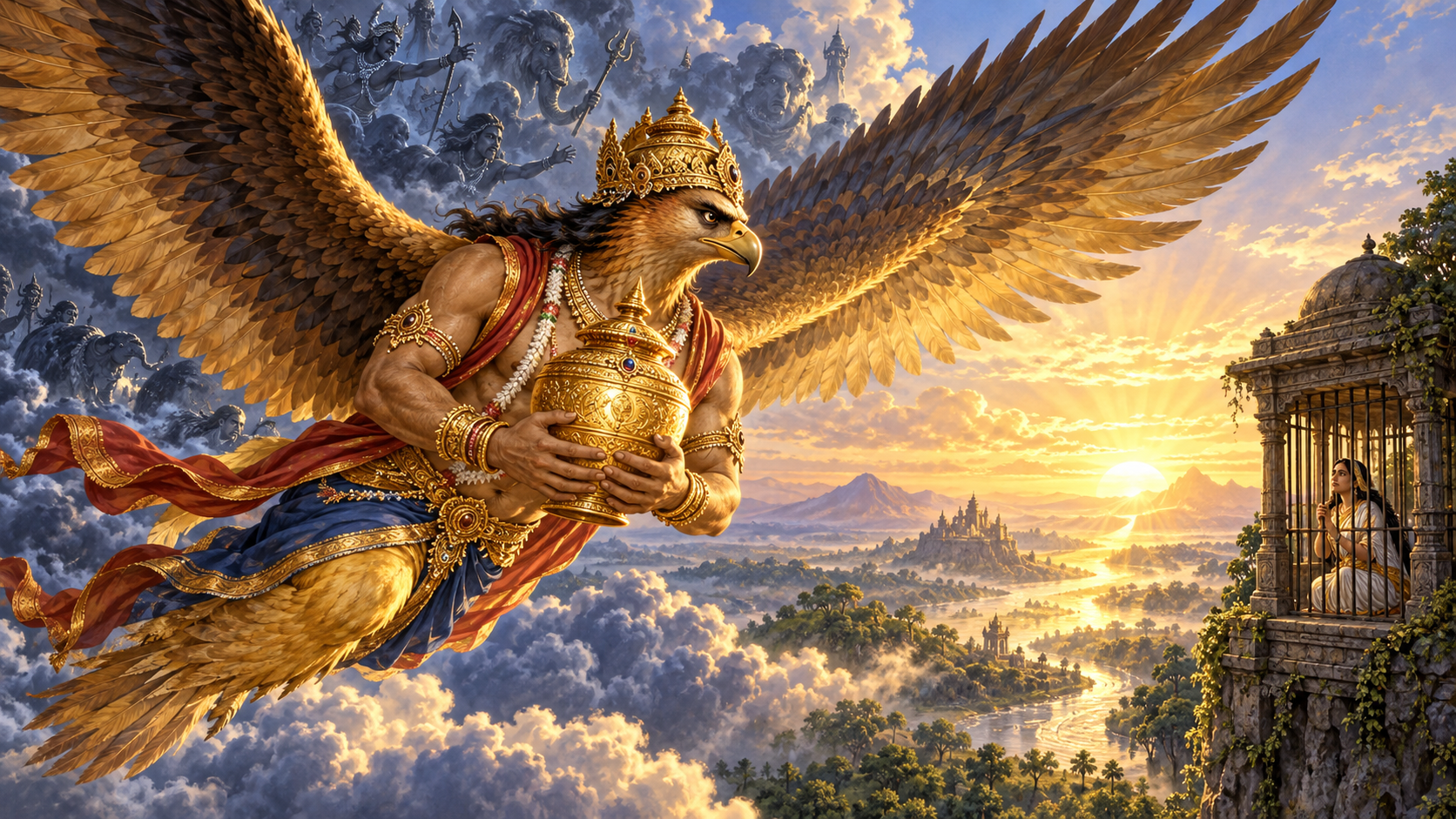
Perhaps you came looking for why Garuda fought the Devas for amrita, or what the episode is meant to teach beyond its spectacle. The shortest reliable answer is this: Garuda seeks the nectar because it is the condition imposed for his mother Vinata’s freedom.
That motive changes the whole story. Amrita is not simply a treasure, and Garuda is not an adventurer chasing immortality for himself. His quest begins with bondage, proceeds through duty, and tests whether extraordinary strength can remain directed toward liberation rather than possession.
The quest begins with a debt Garuda did not create
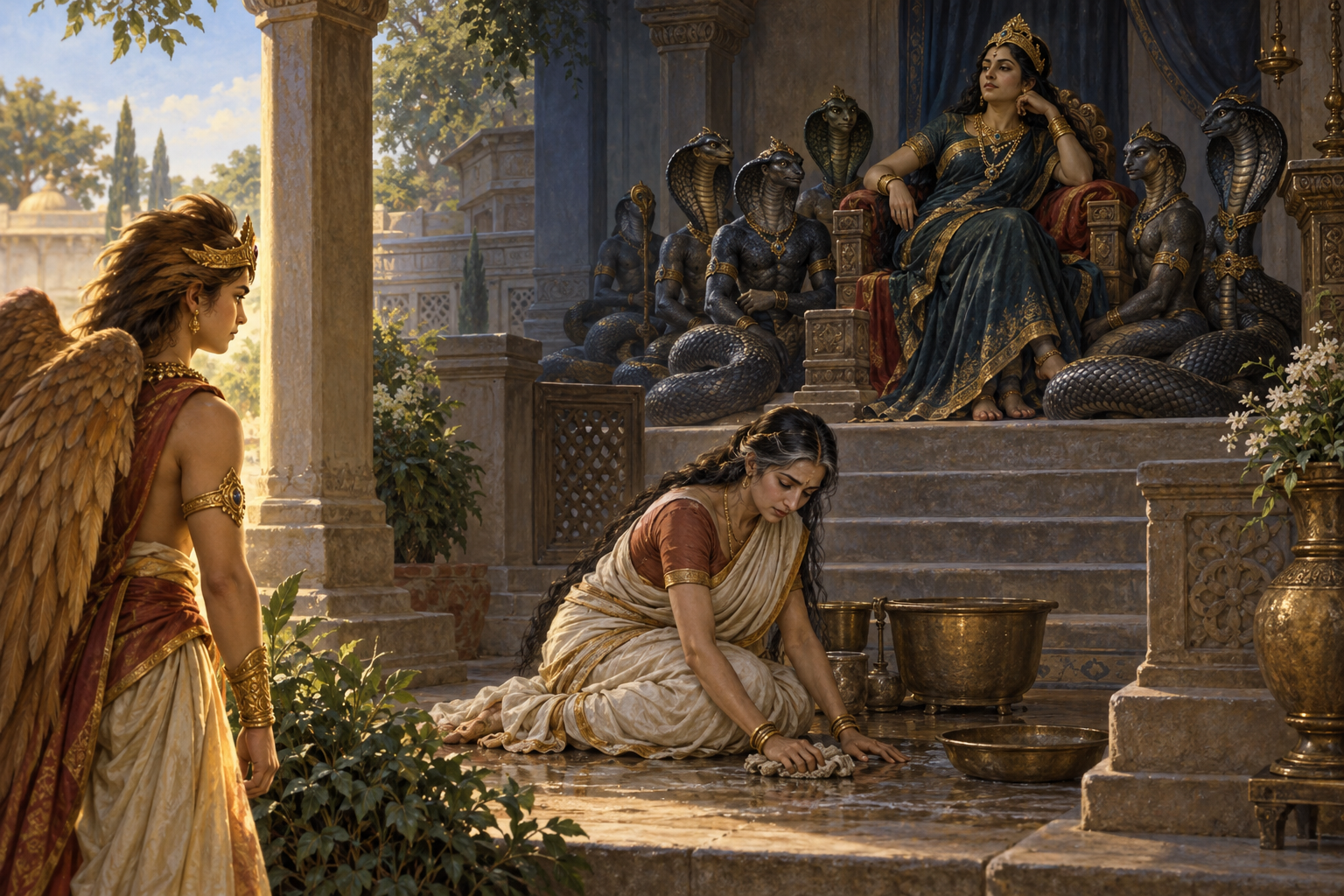
The episode belongs to chapter 28 of the Astika Parva in the Adi Parva of the Mahabharata. Its moral structure is established before Garuda takes flight: Vinata loses a wager to her sister Kadru and becomes her slave; Kadru’s serpent sons agree to release her only if Garuda brings them amrita.
Four distinct roles matter here:
- Vinata makes the wager. The original mistake is hers, not Garuda’s.
- Kadru benefits from the result. Vinata’s defeat becomes an unequal relationship of mistress and slave.
- The serpents set the condition. They turn amrita into the price of release.
- Garuda accepts the quest. He acts against a bondage he did not cause and eventually prevails against the Devas in his effort to obtain the nectar.
This sequence prevents a common misreading. Garuda is not trying to escape the consequences of his own error. He is deciding what to do about the consequences of another person’s error when those consequences have fallen upon someone to whom he owes love and duty.
If you are reading the episode for its dharmic meaning, keep three things separate: who caused the crisis, who suffers under it, and who has the power to respond. They are not the same person. Dharma often becomes difficult precisely when responsibility and agency are divided in this way.
Amrita is the means; Vinata’s freedom is the end
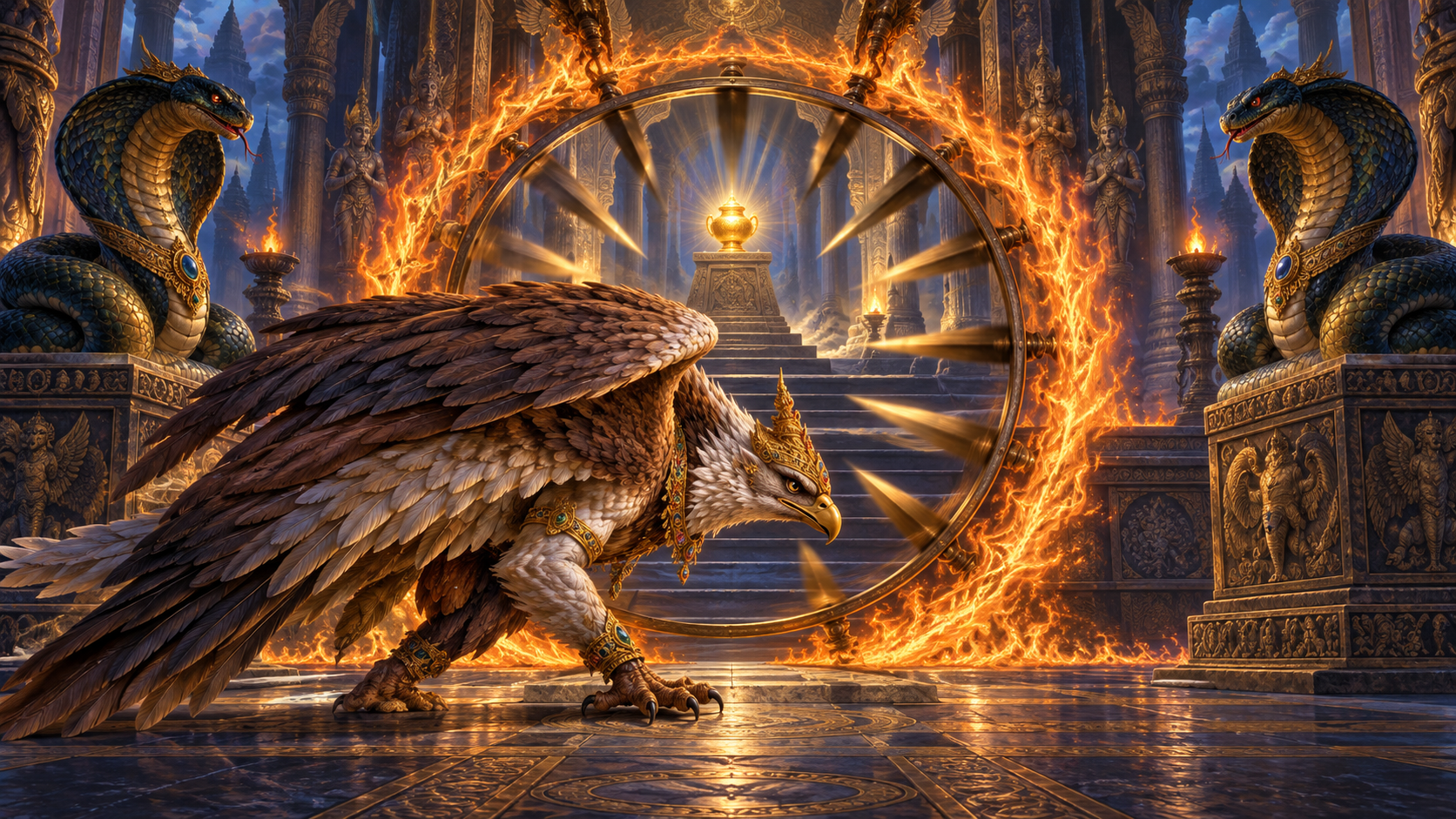
Amrita ordinarily evokes the highest possible prize: escape from mortality. Yet the serpents’ demand changes its function within this episode. For Garuda, the nectar is not the final purpose of the journey. It is the demanded means by which he can end his mother’s servitude.
That distinction is the key to interpreting his conduct. If you treat amrita as Garuda’s personal ambition, the story becomes a contest for power. If you follow his actual motive, it becomes an inquiry into service: how far should a son go to restore his mother’s freedom, and what must govern his strength as he goes?
This gives you a useful method for reading other Dharmic narratives. Before assigning symbolic meanings to an object, ask three literal questions:
- Who wants the object?
- Who demands that it be obtained?
- What human or moral end will possessing it serve?
Here, the serpents want amrita, they make its delivery a condition, and Garuda seeks it to free Vinata. The object and the hero’s purpose therefore cannot be collapsed into one thing. Coercion has placed the nectar in his path; it has not made immortality his defining desire.
The distinction is practical as well as literary. You can spend years pursuing a qualification, payment, approval, or victory that is only a means to something else. If you forget the true end, the means begins to command you. Garuda’s quest asks you to name the freedom you are serving before you become absorbed by the instrument required to secure it.
Filial dharma is presented as responsible action
Garuda’s devotion is not merely an emotion. It takes the form of accepting danger and effort on Vinata’s behalf. He cannot undo her wager, but he can refuse to treat her bondage as somebody else’s problem.
This is an important distinction between responsibility and agency. You may not be responsible for creating a harmful situation, yet you may still possess the capacity to change it. Garuda does not need to pretend that he made Vinata’s mistake before he can act for her. Nor does love require him to deny that the mistake occurred. His duty begins from reality as it stands.
Read this carefully, because filial duty is easily reduced to passive obedience. That is not what Garuda displays. He does not remain beside his mother and call sympathy sufficient. He identifies the concrete condition attached to her release and undertakes the work placed before him. His reverence becomes initiative.
At the same time, a mythic quest should not become a blanket instruction to satisfy every demand made by a controlling person. The demand for amrita comes from those holding Vinata in servitude. That fact should sharpen your moral attention, not suspend it. In your own circumstances, test a demanded condition before complying:
- Name the actual bond. What, precisely, is restricting the person’s freedom?
- Separate cause from present need. Who made the earlier mistake, and what help is required now?
- Examine the condition of release. Will meeting it really end the bond, or merely strengthen the person imposing it?
- Identify your rightful agency. What can you do without surrendering your own discernment or creating a new injustice?
Garuda’s example supports courageous assistance, not thoughtless compliance. The dharmic question is not simply, “What have I been told to do?” It is, “What action genuinely serves freedom, and what will that action set in motion?”
The battle with the Devas reveals competing duties
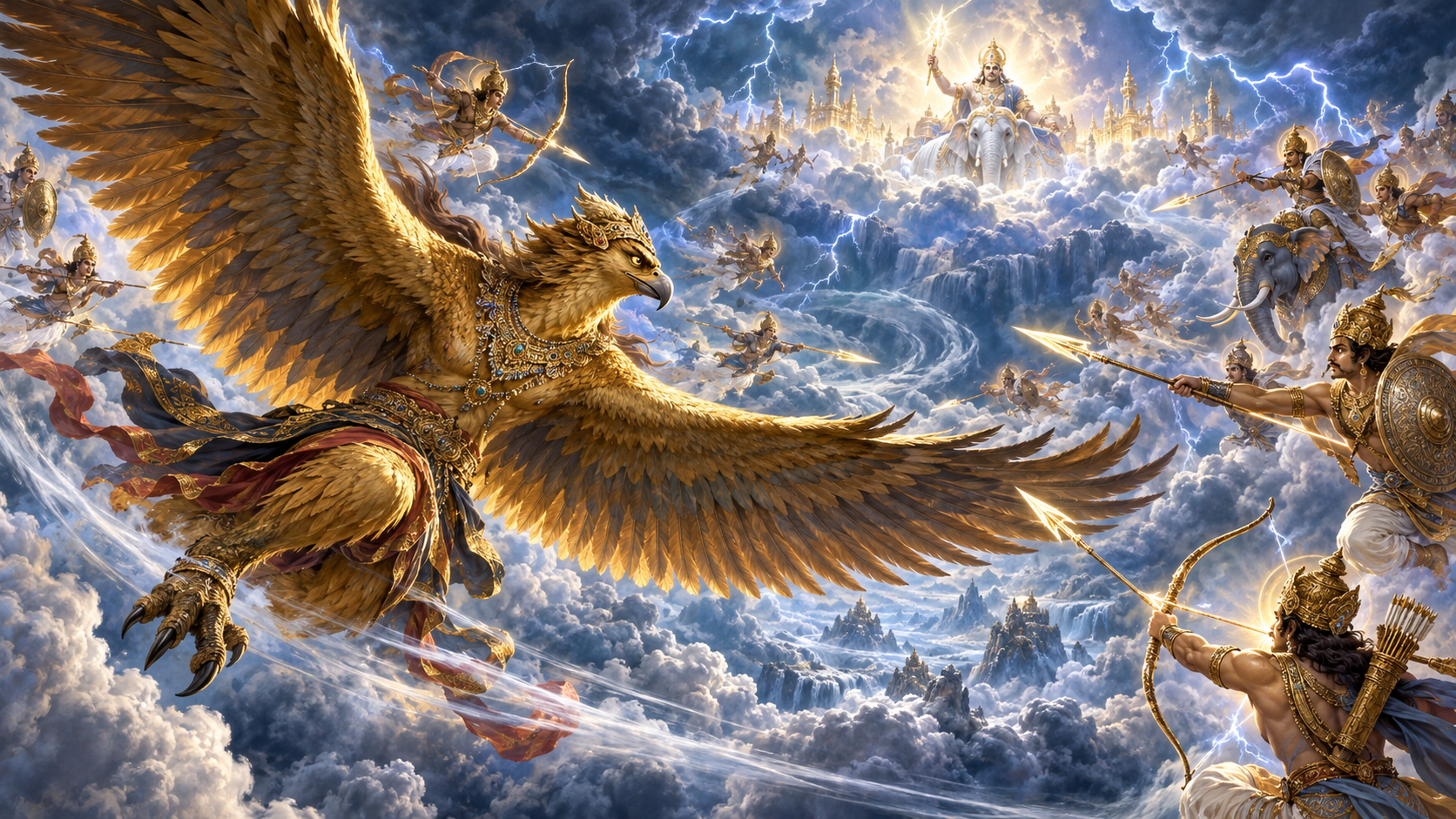
Garuda’s attempt to secure amrita brings him into conflict with the Devas. It is tempting to flatten that conflict into a familiar pattern in which one side is good and the other evil. The moral setting is more demanding than that.
Garuda has a compelling claim: his mother’s freedom. The Devas stand on the other side of his effort to obtain the nectar of immortality. The resulting battle places two different concerns in collision. One side is driven by filial duty; the other resists the transfer of an extraordinary substance demanded by the serpents.
This is one reason Garuda’s courage matters. Courage is not just physical superiority. It is the ability to remain answerable to a purpose when formidable opposition appears. Garuda’s strength becomes intelligible because you know whom he is trying to free and why amrita stands in the way.
Yet a noble motive does not automatically answer every ethical question about means. The episode invites you to hold motive, action, and consequence together. When you face a serious conflict, ask:
- What legitimate good is each side trying to protect?
- Is the disputed object the true goal, or only an instrument?
- Who will bear the consequences if either side succeeds?
- Will victory restore freedom, or simply transfer domination?
Those questions keep courage from becoming mere aggression. They also keep reverence from becoming moral laziness. A Dharmic reading does not require you to assume that every conflict has a simple villain. It asks whether power remains disciplined by duty, discernment, and a clearly named end.
Key takeaways

- Garuda seeks amrita because Kadru’s serpent sons make it the condition for freeing Vinata from slavery.
- Vinata creates the original crisis by losing her wager, but Garuda possesses the agency to respond to its consequences.
- Amrita is an instrument in Garuda’s quest, not the deepest object of his desire; his governing aim is his mother’s freedom.
- His filial devotion is active: it converts concern into difficult, purposeful action.
- His conflict with the Devas should be read as a collision of serious claims, not as permission to equate strength with righteousness.
- The practical lesson is to separate cause, condition, means, and end before deciding what duty requires.
To turn the episode into self-study, take one obligation you have inherited rather than created. Write four short lines: the original cause, the present bondage, the condition said to resolve it, and the freedom you actually want to serve. Then examine whether your planned action advances that freedom or only obeys the condition. That small distinction is where Garuda’s quest stops being distant mythology and begins training your discernment.
References

Leave a Reply
You must be logged in to post a comment.