

You may have authority, responsibility, and sincere intentions yet still be unsure whether a difficult choice is dharmic or merely convenient. That uncertainty becomes sharper when every available option carries a cost. Scripture is most useful at that moment when it gives you more than an admired hero: it gives you an order in which to examine yourself, your relationships, your methods, and the consequences of acting.
The Ramayana and the life of King Prthu offer complementary models. The Ramayana maps transformation through successive tests, from the formation of character to the relinquishment of power. King Prthu shows how public duty can remain oriented toward devotion and transcendence. Used carefully, these models help you lead without confusing conviction with ego, popularity with justice, or victory with dharma.
The seven thresholds between good intentions and good leadership

A contemplative reading of the Ramayana treats its seven Kandas as successive thresholds of transformation. This does not reduce the epic to psychology or claim that symbolism is its only meaning. It asks a practical question: what must change within you before you can exercise power without being possessed by it?
| Kanda | Inner work | Leadership test | Immediate practice |
|---|---|---|---|
| Bala | Sankalpa, training, humility, and character | What principles will govern you before pressure arrives? | Write the value you will not trade for approval, comfort, or speed. |
| Ayodhya | Dharma chosen over attachment | What legitimate comfort or advantage must you surrender to keep faith with duty? | Name the personal benefit you are willing to forgo. |
| Aranya | Tapas, mindfulness, and purification | Which fear, desire, resentment, or distraction is distorting your judgment? | Separate what you know from what you fear and what you want. |
| Kishkindha | Satsanga, alliance, justice, and collective effort | Who can correct you, and who must cooperate for the work to succeed? | Seek counsel from someone able to disagree without dependence on your favor. |
| Sundara | Bhakti, courage, concentration, and seva | Can you carry the mission faithfully without making yourself its center? | Choose the next act that serves the purpose rather than your image. |
| Yuddha | Principled resistance to adharma | Have peaceful remedies been exhausted, and will your means remain ethical? | Protect the innocent, reject hatred, and constrain action to what duty requires. |
| Uttara | Public trust, accountability, legacy, and tyaga | Can the decision survive honest scrutiny, and can you release the role when its work is done? | Record your reasons, accept the consequences, and prepare to let go of control. |
The order matters. A leader who jumps directly to Yuddha may call aggression courage without first examining attachment, fear, counsel, or service. A leader who remains in Bala may keep refining principles but never accept the cost of living by them. A leader who reaches Sundara without Kishkindha may possess devotion and courage but lack trustworthy allies and institutional discipline.
You do not graduate permanently from any of these thresholds. A new responsibility can return you to Bala because it demands new training. A public controversy can place you in Aranya because your own mind has become difficult terrain. Success can send you back to Ayodhya because status has become the comfort you must renounce. The map is cyclical in practice even though the epic moves forward in narrative.
King Prthu adds the vertical axis: duty must answer to the ultimate
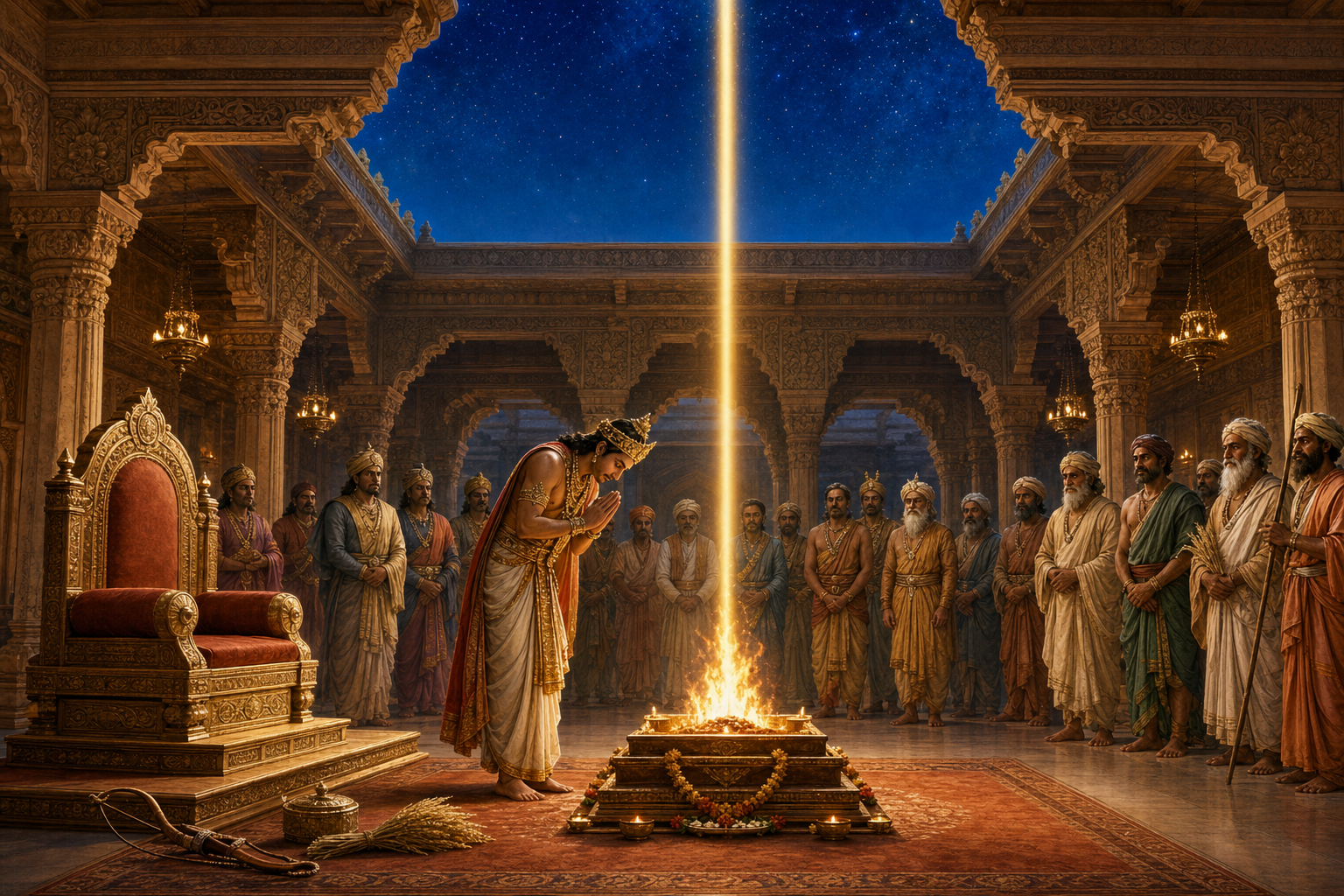
The Ramayana’s progression shows how a person is formed through trials. King Prthu supplies another test: what keeps public responsibility from becoming an ultimate identity? Within the Puranic frame of the Srimad-Bhagavatam, Prthu and Queen Arci relinquish their material bodies and ascend to Vaikuntha. Its theological claim places rajadharma and bhakti within one life. Responsible governance is not treated as a substitute for spiritual realization, nor is devotion used as an excuse to neglect worldly duty.
This distinction is vital for anyone trusted with power. Your role may be necessary, but it is not your deepest self. Your institution may deserve service, but it is not the ultimate object of devotion. When office, reputation, or a political cause becomes absolute, almost any method can be justified in its name. Orientation toward the ultimate places a boundary around power: duty must remain accountable to truth, self-restraint, compassion, and a reality greater than the officeholder.
The Prthu tradition also treats hearing and recounting the virtues of an exemplary ruler as spiritual practice. Shravana and kirtana are not passive admiration in this setting. Repeated attention trains the mind to recognize what deserves imitation. A community shaped by stories of sacrifice, service, and restraint will notice different qualities in its leaders from a community that celebrates domination, cleverness, or fame.
You can make that principle concrete in a family, satsang, temple committee, civic body, or professional team:
<!– wp:ordered-list {