
The Śrīmad-Bhāgavatam does not treat every intense desire as spiritually equivalent. It can portray longing as a force that clouds judgment and crosses ethical boundaries, yet it can also present longing for Kṛṣṇa as the heart of mature devotion.
Read together, the accounts of Śiva’s encounter with Mohinī-mūrti and the gopīs’ search for Kṛṣṇa provide a demanding test: desire is known not merely by its strength or its object, but by what it does to perception, conduct, and relationship.
Two forms of intensity, moving in opposite directions

The first source discusses Śrīmad-Bhāgavatam 8.12.25–28, where Lord Śiva encounters Mohinī-mūrti, the enchanting form of Lord Viṣṇu. It reports that Śiva’s discernment is temporarily overwhelmed, his senses become agitated, and his attraction turns into pursuit. The article interprets this not as a sectarian attempt to diminish Śiva, whom it describes as an exalted devotee and master of yoga, but as a demonstration of divine potency and a warning against spiritual pride.
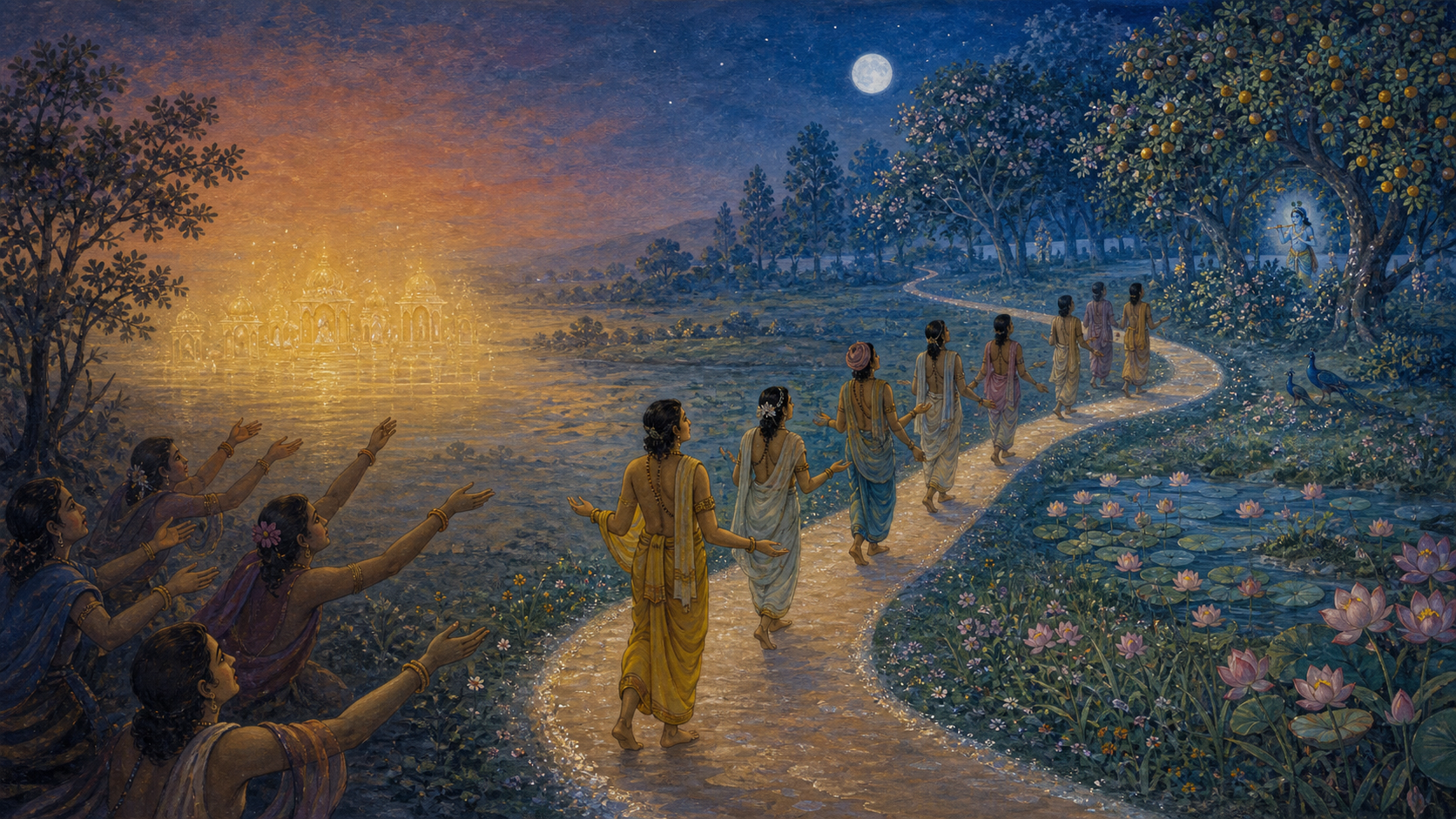
The second source considers Śrīmad-Bhāgavatam 10.30.24–25. It describes the gopīs wandering through Vṛndāvana in separation from Kṛṣṇa, remembering and enacting His pastimes, questioning the forest’s trees and creepers, and eventually recognizing His footprints. Within the Gauḍīya Vaiṣṇava interpretation reported by the article, their distress is not ordinary romantic frustration. It is viraha, separation that concentrates the whole person upon the beloved Lord.
Both episodes therefore concern overwhelming attraction, but their inner movements differ. In the Mohinī narrative, desire compresses awareness into an urgent attempt to grasp. In the gopīs’ search, longing expands into remembrance, attentive recognition, shared inquiry, and surrender. Intensity by itself is spiritually ambiguous; its direction and effects disclose its quality.
Desire can either impair or refine perception

The Mohinī article highlights the Sanskrit descriptions apahṛta-vijñānaḥ, glossed there as being deprived of clear discernment, and pramuṣitendriyaḥ, referring to senses that have been disturbed or carried away. Its central psychological point is that desire is not always a thought that calm reasoning can easily dismiss. Under pressure, body, senses, imagination, and ego can acquire a momentum that outruns settled values.
The gopīs’ absorption produces a contrasting kind of perception. According to the second source, they identify Kṛṣṇa’s footprints through such marks as the flag, lotus, thunderbolt, elephant goad, and barleycorn. Their emotion has not made observation vague. Their sustained attention to Kṛṣṇa enables them to distinguish His traces from everything around them.
This comparison complicates any simple opposition between feeling and reason. Emotion can obscure discrimination, but devotion can also educate attention. The relevant question is whether longing makes reality harder to see or trains a person to notice what self-absorption ordinarily misses. In one passage, the senses pull intelligence behind them; in the other, love makes the eyes precise.
A divine object does not sanctify every response
The theological setting makes the contrast especially important. Mohinī is not an ordinary temptress but Viṣṇu’s own manifestation. Nevertheless, the first source argues that verse 28 must not be romanticized: it describes Śiva seizing and embracing Mohinī despite her unwillingness. While preserving the episode’s status as divine līlā, the article also draws an ethical warning about consent, dignity, and the danger of impulse without self-command.
The gopīs’ love requires a different caution. The second source reports that Gauḍīya Vaiṣṇava teachers distinguish their relationship with Kṛṣṇa from mundane romance and warn against imitating it outside the guidance of scripture, guru, and devotional community. Its intimate language signifies pure devotion within that theological framework, not permission to dress ordinary appetite in sacred vocabulary.
The two cautions meet at a single principle: the divinity of the one desired does not automatically make every mode of desiring divine. Sacred attraction is not authenticated by emotional heat alone. Its credible signs are humility, discipline, service, awakened discrimination, and respect for the freedom and dignity of the other.
Elusiveness reveals what the heart is seeking

Both source accounts place longing amid elusiveness. The Mohinī article describes her smiling, moving away, passing among the trees, and refusing to remain in one place. It reads this movement as an image of craving itself: the promised satisfaction appears near, recedes, and gives the mind another form to chase.
Kṛṣṇa is also absent from the gopīs’ immediate sight, but the response reported in the second article is different. His absence intensifies remembrance, while His footprints provide orientation without ending the separation. The forest becomes a field of devotional evidence: earth, plants, animals, fragrance, and sacred marks are approached as witnesses to divine presence rather than as inert scenery.
The gopīs also search together. Their sorrow becomes shared speech, recollection, and interpretation rather than solitary fixation. This communal structure matters because not every experience of absence is spiritually fruitful. Separation becomes formative when it is held within remembrance, ethical discipline, service, and a community capable of interpreting desire rather than merely amplifying it.
Key takeaways for understanding desire spiritually
- Intensity is not proof of purity. The Bhāgavatam passages distinguish desire by its effects on judgment, conduct, and relationship.
- Loss of discrimination is an early warning. When longing narrows awareness and weakens restraint, knowledge and spiritual status offer no reason for complacency.
- Devotion makes attention more responsible. The gopīs’ longing is expressed through exact remembrance, recognition of Kṛṣṇa’s traces, shared searching, and an orientation toward Him.
- Sacred language cannot excuse possession. The Mohinī episode should not be used to romanticize disregard for consent, while the gopīs’ love should not be reduced to a model for mundane imitation.
- Humility connects the two teachings. One narrative dismantles confidence in personal mastery; the other shows longing sustained through dependence, community, and surrender.
Approached in this way, the Bhāgavatam’s goal is neither emotional numbness nor indiscriminate celebration of passion. Its continuing challenge is the education of desire: away from compulsive grasping and toward a longing whose attention, ethics, and love become increasingly centered on the Divine.
References
- DharmaRenaissance Blog — Powerful Lessons from Mohinī-Mūrti: Desire, Humility, and Śiva’s Wisdom
- DharmaRenaissance Blog — Powerful Lessons from Śrīmad-Bhāgavatam 10.30.24-25 on Divine Longing