

Sound can steady the mind, carry devotion, coordinate breath and attention, and point beyond ordinary speech. Yet the four source articles converge on a more demanding principle: mantra serves moksha only when sacred sound is joined to ethical purification, disciplined practice, right understanding and, in devotional paths, surrender.
Read together, the sources offer neither a single technique nor a uniform theology. They present complementary Vedantic, yogic, Tantric and Vaishnava accounts of how sound participates in liberation. Their synthesis clarifies what mantra can do, what it cannot replace, and why an integrated sadhana matters more than repetition alone.
Liberation determines what counts as spiritual progress
The most important measure of a sound practice is not its intensity, novelty or immediate emotional effect. The scriptural overview of moksha describes liberation as freedom from ignorance, compulsive desire, egoic identification, attachment and the sorrow produced by mistaking changing conditions for the true self. On that account, a practice advances toward moksha when it makes perception clearer and dependence on passing experiences weaker.
This criterion prevents mantra from being reduced to either phonetics or mood management. A peaceful interval can support sadhana, but it is not identical with liberation. An unusual inner sound may become an object of concentration, but attachment to the experience can reproduce the very grasping that spiritual discipline is meant to loosen. Repetition becomes liberating to the extent that it helps expose and transform the ignorance beneath habitual thought and action.
The sources describe that transformation through distinct theological languages. The moksha article emphasizes Upanishadic self-knowledge and recognition of Brahman. The Nadabindu Upanishad discussion follows sacred sound into subtle resonance and silence. The Tantra article interprets embodied existence through consciousness and energy, including the relationship of Shiva and Shakti. The study of Dhruva’s mantra centers a personal relationship with Vasudeva through humility, worship and surrender. These accounts should not be collapsed into one doctrine. Their practical convergence lies in treating sound as a means of reorienting the whole person toward ultimate reality.
From audible mantra to the silence that follows it

The Nadabindu account provides the most detailed map of sound itself. It depicts Om as a sacred bird: a and u are its wings, m is its tail, and the subtle ardhamatra is its head. The article also reports associations with Agni, Vayu, solar brilliance and the Varuna principle. The imagery presents Om as an integrated contemplative form rather than an isolated syllable.
The decisive element is the movement beyond the three audible components. The resonance or silence after m is not portrayed as an absence without meaning; it marks a subtler field that ordinary speech cannot contain. Sound gathers attention, but the practice does not end with sound. It educates consciousness to notice the stillness in which sound arises and subsides.
This movement helps explain the recurring importance of mantra across the sources. The Tantric account says that mantra engages voice, breath, hearing and inward attention, while the Dhruva article describes repetition as an interior rhythm of remembrance. Considered together, the reports suggest a functional progression rather than a rigid universal sequence: articulation interrupts distraction, repetition collects attention, meaning gives attention a sacred direction, and deepening recollection opens toward silence or sustained presence.
Meaning remains crucial within this progression. The mantra om namo bhagavate vasudevaya, as discussed in the Dhruva article, begins with Om, expresses reverential surrender through namah, and directs devotion to Bhagavan as Vasudeva. Its purpose is therefore not interchangeable with every use of Om. Nadabindu contemplation emphasizes the subtle structure of Pranava, whereas the Bhagavata mantra establishes a devotional relationship. Both employ sacred sound, but each shapes consciousness according to its own lineage and goal.
Integrated sadhana joins body, mind, conduct and devotion

The strongest shared insight is that mantra works within a larger ecology of practice. The Tantra article observes that even an inward discipline depends on embodiment: posture supports attention, breath carries recitation, the tongue articulates sound, and the ear or inner faculty receives it. Mantra can therefore bring physical action, mental focus and sacred orientation into one current. Honoring the body in this way does not mean indulging every bodily impulse; the same source stresses preparation, restraint, purity of intention and guidance in many Tantric lineages.
Mental integration is equally necessary. The moksha overview interprets Bhagavad Gita 3.40 as locating the activity of desire in the senses, mind and intellect. It also presents the Gita’s final movement of surrender in 18.66 only after teachings on duty, disciplined action, knowledge, meditation, devotion and equanimity. On this reading, mantra cannot bypass the structures through which desire operates. Repetition must be accompanied by discrimination, self-restraint and examination of the motives that repeatedly capture attention.
The Dhruva narrative gives this principle psychological force. According to the source, Dhruva approaches spiritual life while hurt by humiliation and driven by the wish for status. Narada does not merely condemn that starting point; he redirects Dhruva’s determination through mantra and disciplined worship. The episode presents sadhana as the education of desire. A wounded motive can initiate practice, but sustained contact with sacred sound, guidance and devotion is meant to transform that motive rather than spiritually decorate it.
Conduct supplies another indispensable dimension. The Nadabindu article reports that dharma and adharma appear as the two eyes of its symbolic form, linking contemplative perception with moral discernment. The Dhruva article similarly joins mantra to tangible offerings such as water, flowers, food, fragrance and lamps. In its Vaishnava framework, material objects are not discarded as obstacles; they are consecrated through service. The altar, preparation of offerings, cleanliness and attention to time turn devotion into repeatable action.
This produces a more complete account of liberation through sound. The body gives practice stability, the trained mind gives it continuity, ethical conduct prevents inward experience from becoming self-serving, knowledge clarifies its purpose, and devotion releases the ego’s claim to ownership. Different traditions assign different weight to these elements, but none of the source accounts treats an undisciplined fascination with sound as sufficient for moksha.
Spiritual access requires both adaptability and guidance
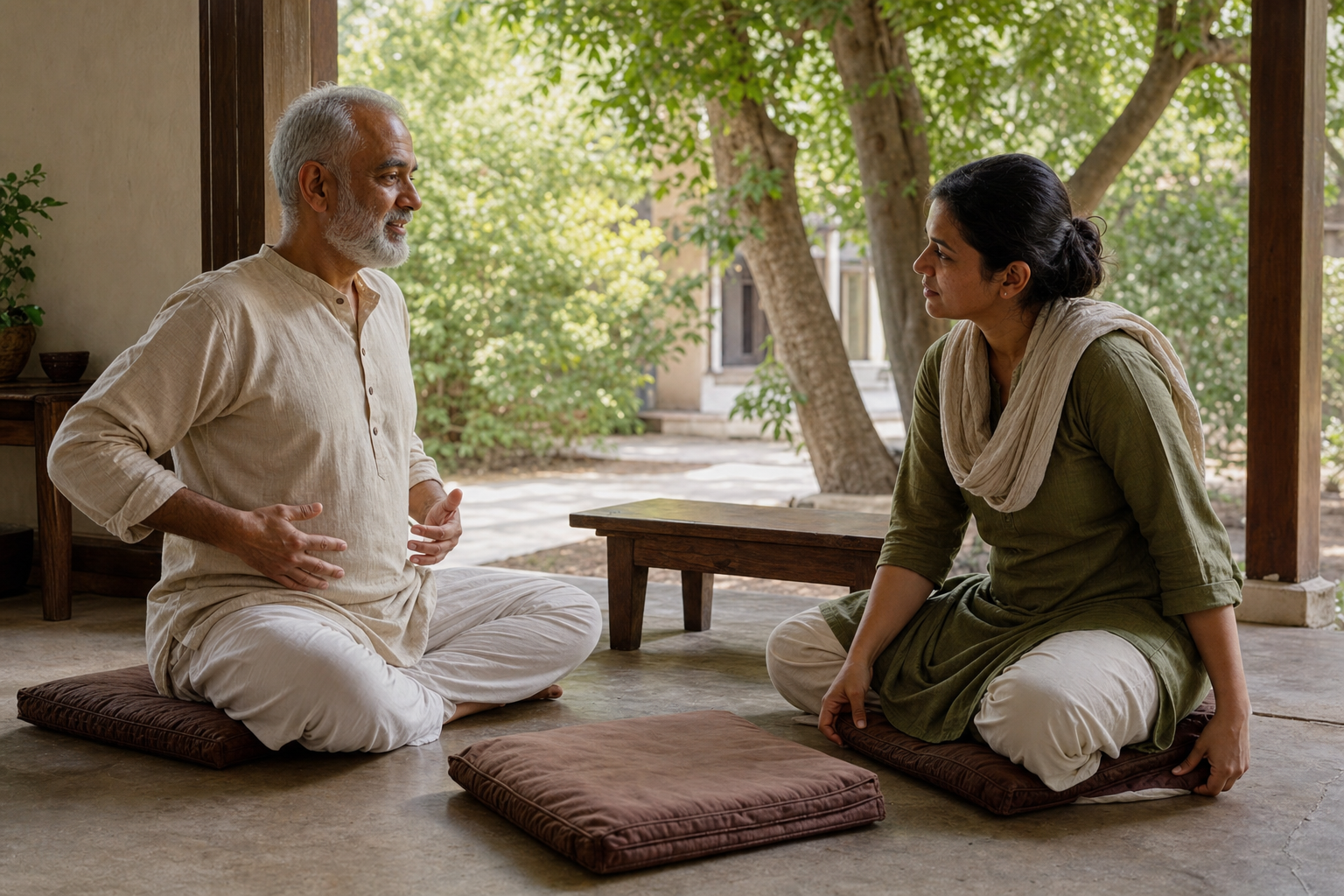
The Dhruva article places accessibility and structure side by side. It identifies om namo bhagavate vasudevaya as the twelve-syllable mantra given by Narada to a child who was neither a renounced scholar nor already free of turbulent motives. The story therefore affirms that serious devotion is not reserved for those who begin with ideal circumstances. At the same time, Dhruva receives a practice through guidance rather than treating mantra as a formula detached from relationship, correction and responsibility.
The same source interprets desa-kala-vibhagavit as intelligent attention to place, time and practical conditions. A practitioner in a distant region or a modest home may use locally available offerings without pretending that every circumstance is identical. Such adaptation preserves living practice when it remains accountable to scriptural principle, lineage and sincere intention. Flexibility is not presented as permission for arbitrary invention.
This balance also helps place the four articles in conversation. Om can serve as a broad symbol of unity, and mantra can be recognized across multiple Hindu paths as a discipline of attention. Nevertheless, a Nadabindu meditation, a Tantric mantra practice and Vaishnava worship of Vasudeva carry different symbols, commitments and understandings of realization. Respectful synthesis identifies their shared architecture without erasing their distinctions.
For practice, this means that accessibility should be paired with precision. A suitable mantra is approached according to its tradition; a sustainable time and place are established; pronunciation, meaning and intention receive attention; and conduct outside formal repetition is allowed to test the depth of the practice. Where initiation or specialized methods are important to a lineage, competent guidance protects both the practitioner and the integrity of the discipline.
Key takeaways
- Moksha, rather than an unusual sensation or temporary calm, provides the final measure of mantra practice.
- Sacred sound can coordinate embodiment, attention, meaning, devotion and remembrance, but it does not replace ethical discipline or self-knowledge.
- The Nadabindu account makes the silence after audible Om integral to contemplation, directing attention beyond sound without devaluing sound.
- Dhruva’s story shows how mantra can refine wounded or ambitious motives when practice is sustained by guidance, worship and surrender.
- Adaptation to place and circumstance can widen access while lineage and disciplined intention preserve depth.
- Vedantic, yogic, Tantric and Vaishnava paths share practical structures without becoming metaphysically identical.
A mature sadhana will therefore continue to move in two directions: inward, from utterance toward stillness, and outward, from private repetition toward clearer conduct and consecrated action. As the practice deepens, its most revealing question is not merely what was heard, but whether attachment loosens, discernment strengthens and the sense of separation yields to knowledge or devotion. That standard keeps sacred sound oriented toward freedom.
References
- DharmaRenaissance Blog — Moksha Explained: A Powerful Scriptural Path to Inner Freedom and Self-Realization
- DharmaRenaissance Blog — Nadabindu Upanishad: Powerful Om Syllables, Deities, and Inner Sound
- DharmaRenaissance Blog — Tantra’s Sacred Science of Body, Mind, and Soul: A Powerful Path to Wholeness
- DharmaRenaissance Blog — Dhruva’s Mantra of Radical Access: A Powerful Guide to Living Bhakti Today