
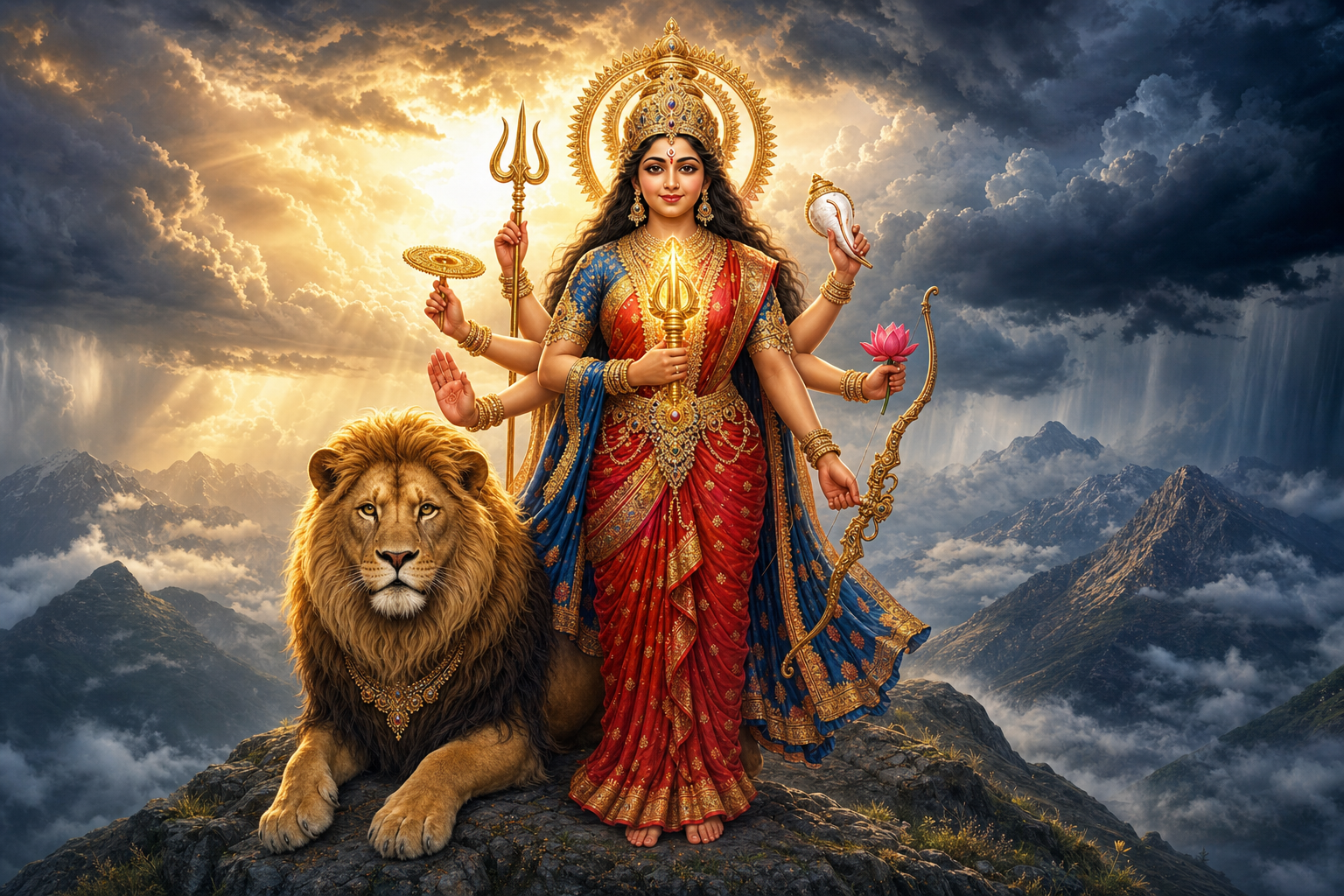
If you have stood before an image of Durga and wondered why the compassionate Mother carries a thunderbolt, the Vajra offers a precise answer: protection is not passive. Dharma can require an unyielding boundary, a clear judgment, and action taken before fear turns into surrender.
The symbol becomes useful when you stop treating it as an ornamental weapon or a religious license for anger. In Durga’s hand, power is placed under wisdom. The Vajra can therefore help you decide what to protect, what confusion to cut through, and how to act without letting hostility choose the method.
Read the Vajra as entrusted power

The setting matters. In the Devi Mahatmyam of the Markandeya Purana, the devas equip Durga for her confrontation with Mahishasura. Each offers a distinctive power or weapon, and Indra entrusts his Vajra to the Goddess. The thunderbolt is consequently part of a larger act of alignment: many divine powers are directed toward one dharmic purpose.
A useful reading of this scene does not imagine that the Divine Mother lacked power until others supplied it. The gifts dramatize recognition. When Dharma is threatened, separate powers must cease competing for prominence and become instruments of Shakti. Authority is measured by what it serves, not by who gets credit for possessing it.
- The power is entrusted. It is received for a duty, not displayed as private status.
- The task is protective. Durga is armed to confront a force that has disturbed order, not to satisfy resentment.
- The response is coordinated. The devas retain their identities while placing their capacities in the service of a shared responsibility.
- The wielder determines the moral direction. In Durga’s hand, the thunderbolt belongs to wisdom, discipline, and the defense of Dharma.
This gives you a practical test whenever a family, temple, community, or institution faces a serious conflict. Ask which abilities are needed, who holds them, and whether those people can cooperate around the thing that must be protected. The Durga principle is not that everyone must become identical. It is that distinct strengths must stop pulling in rival directions when the common good is at stake.
The Vajra moves through firmness, insight, and action

The Vajra holds several meanings together. Its diamond-like hardness signifies what cannot be broken. Its lightning signifies sudden illumination. Its thunder signifies a forceful declaration that disperses hesitation and fear. These are not three unrelated poetic associations. They form a disciplined sequence for action.
- Become firm about the principle. Decide what cannot be traded away: truthfulness, a person’s safety, a legitimate promise, a sacred responsibility, or a necessary boundary. A preference is not a principle merely because you feel strongly about it.
- Illuminate the situation. Separate what you know from what you assume. Identify the fact that would change your judgment. Vajra-like clarity cuts through avidya, but clarity is not the same as pretending to know everything.
- Declare and act. Once the principle and facts are sufficiently clear, state the boundary plainly and choose a proportionate step. Decisiveness loses its dharmic character when it becomes reckless, punitive, or theatrical.
This sequence corrects several common misreadings. Firmness is not stubbornness: you can keep the principle while changing an ineffective method. Clarity is not self-certainty: you can acknowledge missing information without abandoning judgment. Courage is not aggression: refusing provocation may demand more steadiness than striking back. Compassion is not passivity: preventing harm can require a definite refusal.
In many regional images, the Vajra appears in one of Durga’s right hands, emphasizing initiative and active protection. Its artistic form can vary, so one silhouette should not be treated as the universal standard. Look instead at the iconographic relationship: the thunderbolt is one power among many, all governed by the Goddess rather than competing with her purpose.
Dadhichi’s sacrifice places an ethical limit on force

The Vajra carried by Durga also inherits an older moral history. Indra’s thunderbolt is connected with the self-offering of the sage Dadhichi. Indra uses it against Vritra, after which the obstructed waters flow again and cosmic order is restored. The remembered sequence is therefore sacrifice, the removal of obstruction, and restoration.
That sequence prevents the Vajra from becoming a symbol of force for its own sake. Its moral weight does not come from impact alone. A cost has first been accepted, the action is directed toward a genuine obstruction, and success is visible in the return of life-giving order.
Before calling a hard response dharmic, apply four questions:
- What responsibility will you bear? If every cost is being transferred to weaker people while you gain status, the action lacks the self-accountability associated with Dadhichi.
- What exactly is the obstruction? Name the harmful conduct, falsehood, broken process, or unjust condition. Turning an entire person or community into the obstruction usually replaces discernment with hostility.
- Is the response proportionate? Use enough strength to protect and correct. Do not enlarge the action merely because anger wants a more satisfying display.
- What should flow again afterward? Look for a concrete restoration: safety, truthfulness, fair participation, responsible leadership, worship without intimidation, or trust grounded in accountability.
If the imagined victory consists mainly of humiliating an opponent, the action has failed the restoration test. Durga’s Vajra is not a trophy of domination. It is sacred power because it clears the condition preventing rightful order.
Dadhichi’s self-offering should not be misused to demand endless suffering from vulnerable people. The ethical lesson is that legitimate power begins with responsibility borne by the protector; it is not permission to praise sacrifice while assigning all of it to someone else.
Use a Vajra reflection when a decision demands courage

You can bring this symbolism into an actual decision without pretending that a personal exercise replaces formal worship. If Chandi recitation or a lineage-specific practice is already part of your life, let that remain the devotional anchor. The steps below simply translate the icon’s ethical structure into reflection.
- Describe the situation in one neutral sentence. State what happened without insults, predictions, or labels for the other person. If you cannot describe the conduct without condemning the whole person, anger is still controlling the frame.
- Name what requires protection. Choose one object of responsibility: a person, a truthful account, a vow, a boundary, a community duty, or the integrity of a sacred space. Avoid vague claims about defending everything.
- Identify the unbreakable principle. Complete the sentence: Even if the method changes, we will not abandon this. This is the diamond quality of the Vajra.
- Ask what the lightning must reveal. Write down what is known, what remains uncertain, and which missing fact could alter the decision. The Vajra does not manufacture certainty; it exposes the next point that needs illumination.
- Check the motive before speaking. Ask whether you would still take the action if nobody praised you and the opponent were never publicly embarrassed. This helps distinguish protection from performance.
- Choose one bounded next step. State a boundary, correct a specific falsehood, document what occurred, request accountable mediation, decline participation, or seek appropriate help. Select the smallest step that can genuinely protect the principle rather than the most dramatic step available.
- Review what the action restored. Afterward, ask whether confusion decreased, the vulnerable became safer, and responsible order became more possible. If not, revise the method without automatically surrendering the principle.
You can also visualize the Vajra remaining in Durga’s hand rather than imagining it as your personal possession. Let its diamond quality steady the boundary, its lightning reveal the relevant facts, and its thunder give you the courage to speak plainly. Keeping the weapon with the Goddess is a reminder that your agency remains answerable to a wisdom larger than your emotion.
Sometimes the courageous step is to confront. Sometimes it is to pause, verify, leave, or ask others to intervene. If direct confrontation would create danger, protection may require distance and qualified help. Fearlessness does not mean making yourself or another person needlessly available to harm.
Key takeaways: carry the quality, not the weapon
The Vajra also has resonances beyond Hindu iconography. In Vajrayana Buddhism, the vajra, or dorje, joins indestructible wisdom with compassionate method. Jain teachings value vajra-like firmness in vows, while Sikh reflections on righteous courage and the defense of truth parallel its ethic of principled strength. These are shared resonances across distinct Dharmic traditions, not proof that their theologies or practices are interchangeable.
When discussing this common ground, say that the traditions offer parallels rather than claiming that they all mean the same thing. Mutual respect becomes stronger when a shared value is named precisely and each tradition’s own vocabulary is preserved.
- Protect before you perform. Sacred power serves a real responsibility, not an identity display.
- Clarify before you declare. Establish the principle and the relevant facts before making the forceful statement.
- Hold the value firmly and the method intelligently. Vajra-like resolve does not require attachment to a failed tactic.
- Bear responsibility instead of exporting every cost. Dadhichi’s lineage places self-accountability before force.
- Measure success by restoration. The decisive question is not whether an opponent was defeated, but whether truth, safety, and rightful order can move again.
- Recognize unity without erasing difference. Shared Dharmic courage can support solidarity while Hindu, Buddhist, Jain, and Sikh teachings remain distinct.
The next time you see Durga’s Vajra, bring one unresolved matter to mind. Write down the principle that must not break, one fact that still needs light, and one bounded action that would protect without indulging cruelty. That is how the thunderbolt leaves the realm of decoration and becomes a discipline of Dharmic courage.
References
