
If your family follows Tamil observances while your temple publishes Malayalam dates, February and March 2026 can look like two competing sacred calendars. They are not. You simply need to separate the civil date, the regional month and the lunar condition before you schedule a puja, vrata or temple visit.
Six dates provide the structure for this period. Put those dates into your calendar first, reserve March 3 if you hope to attend Masi Magam, and then obtain the exact local timings from the temple or panchang you actually follow.
Put these six dates on your calendar first
| Date | Sacred-calendar marker | What you should do |
|---|---|---|
| February 11, 2026 | Krishna Paksha Navami continues until 9:24 AM local time, followed by Krishna Paksha Dashami. | Use this as a practical reminder that a tithi can change during a civil day. Confirm the boundary for your own location before timing a tithi-dependent observance. |
| February 13, 2026 | Maasi Masam begins in the Tamil calendar. | Begin your Maasi practice plan: Shiva worship, disciplined japa, ancestor remembrance and service according to family custom. |
| February 14, 2026 | Kumbha Masam begins in the Malayalam calendar. | Start following Kerala temple notices for Kumbha observances, especially those connected with Bharani and Attukal Pongala. |
| March 3, 2026 | Masi Magam. | Reserve the date now if you want to attend a procession or theerthavari. Obtain the actual program from the temple before arranging travel. |
| March 13, 2026 | Kumbha Masam ends. | Complete the Malayalam-month commitments you undertook, including any dana or temple service. |
| March 14, 2026 | Maasi Masam ends. | Close your Maasi sankalpa deliberately rather than letting it disappear when the calendar changes. |
The one-day difference between the beginning of Maasi and the beginning of Kumbha is not an error. Tamil and Malayalam traditions name and organize their regional months differently. From February 14 through March 13, both months are running at the same time, but each retains its own ritual and cultural setting.
March 13 and March 14 also require attention. A household following Kerala custom may finish its Kumbha commitments on March 13, while a Tamil Maasi observance continues through March 14. If your family participates in both traditions, record the two end dates separately instead of collapsing them into a single generic month-end.
Why the regional month, tithi and nakshatra must stay separate
A useful South Indian sacred calendar has three working layers. The Gregorian date tells you when to travel or take leave. The regional month places the observance inside a Tamil or Malayalam tradition. The lunar marker – such as a tithi or nakshatra – supplies the ritual condition.
- Civil date: Use February 13, February 14 and March 3 for work schedules, transport and family coordination.
- Regional month: Use Maasi for the Tamil cycle from February 13 to March 14, and Kumbha for the Malayalam cycle from February 14 to March 13.
- Lunar condition: Check the applicable tithi or nakshatra when an observance depends on it. The condition may begin or end partway through the civil date.
- Temple program: Treat the temple notice as the authority for procession, darshan and theerthavari logistics at that institution.
February 11 shows why the distinction matters. The day does not carry only one tithi: Navami gives way to Dashami at 9:24 AM local time. If you merely write “Navami” across the entire date, you lose the boundary that may matter to your sankalpa. If you merely write “Dashami,” you lose the morning period.
Do not copy that 9:24 AM boundary into a calendar for another city without checking it. Sunrise, locality and calculation tradition can affect the usable timing. This matters even more if you live outside India: your temple’s host-city calendar is more useful than an Indian time copied from a forwarded message.
Masi Magam demonstrates a different combination. Its identity comes from Magam Nakshatra occurring during Maasi, and it commonly aligns with Pournami. The festival date for 2026 is March 3, but the precise local window and temple schedule still depend on astronomical timing and local practice. March 3 therefore belongs in your diary now; the hour belongs there only after local verification.
Build a practice calendar that survives local variation
The safest method is to plan in three passes. This keeps uncertain local timings from preventing you from making the larger commitments that are already clear.
- Enter the fixed date range. Mark Maasi from February 13 to March 14, Kumbha from February 14 to March 13, and Masi Magam on March 3.
- Choose the observances that actually belong to your family or temple tradition. Do not copy every practice from a general festival list. Select a sustainable daily practice, the temple events you intend to attend and any ancestor observance your family already recognizes.
- Add local timings last. Record your city, the panchang tradition being used and the temple that confirmed the program. This prevents an unlabelled screenshot or forwarded time from becoming your working authority.
For each important entry, write five things: the civil date, your location, the relevant Tamil or Malayalam month, the required tithi or nakshatra, and whether the observance is at home or at a named temple. A line such as “March 3 – Toronto – Maasi – Magam – temple schedule pending” is far more useful than “Masi Magam” by itself.
A workable Maasi rhythm for February 13 to March 14
Maasi carries a strong emphasis on Shiva devotion and gratitude toward Pitru Devatas. Common practices include daily puja or japa, Shiva archana, Rudrabhishekam, Pradosham observance, charity and remembrance around Amavasya. You do not need to attempt all of them.
- Choose one short daily practice that you can keep through March 14, such as Shiva japa, prayer or a small portion of scriptural reading.
- If Rudrabhishekam or Shiva archana belongs to your practice, select the home or temple setting in advance.
- If you observe Pradosham, obtain the dates and fasting rules from your regional panchang or temple; no exact Pradosham dates should be inferred merely from the Maasi date range.
- Plan ancestor remembrance around Amavasya according to your family’s established procedure. The month provides the devotional frame, but it does not replace the relevant tithi.
- Attach one concrete act of dana or seva to the month. Decide what you will give, whom it will help and when you will complete it.
The decisive word here is sustainable. A daily vow that survives ordinary work and family duties is better than an elaborate opening-day plan that disappears after a few days. Write down the smallest complete form of your practice, then add temple observances where time permits.
A workable Kumbha rhythm for February 14 to March 13
Kumbha Masam in Kerala is a period of household worship, temple observance, dana and community gathering. Its prominent cultural markers include Kumbha Bharani Utsavam and Attukal Pongala. Bharani observances center on Bharani Nakshatra and devotion to the divine feminine, while Attukal Pongala brings women together to prepare the ritual pongala offering.
The available calendar frame gives Kumbha Masam as February 14 through March 13, but it does not provide the exact 2026 dates and hours for those two observances. Do not guess them or assume they coincide with March 3. Watch the relevant temple’s notices and verify the program before booking travel.
- Refresh the household sacred space at the beginning of Kumbha rather than waiting until a major festival morning.
- Identify which Kerala temple calendar you are following and subscribe to its notices if possible.
- Decide in advance whether your participation will be devotional, logistical or both. Helping elders, supporting orderly access and reducing waste are legitimate forms of seva.
- If you cannot attend a large gathering, keep the month’s ethical center through home worship, dana and a local act of community care.
In a family drawing from more than one Dharmic path, shared values can support cooperation without making every rite interchangeable. Hindu tithi and nakshatra rules should remain attached to the Hindu observance for which they are used. Ahimsa, disciplined practice, gratitude toward ancestors and teachers, compassion and seva can form the common household ground.
Make March 3 meaningful at a temple or at home
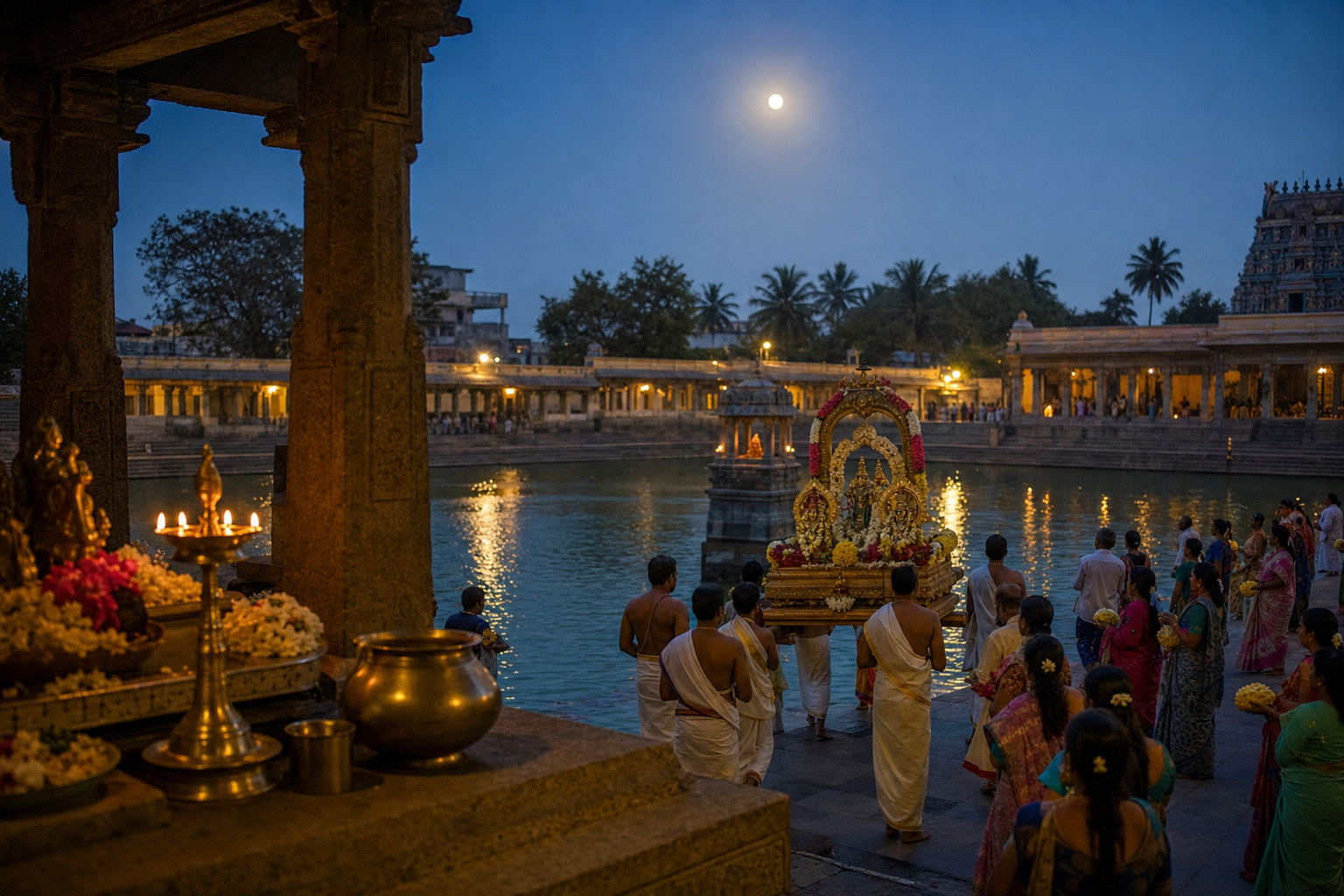
Masi Magam is the clearest single festival anchor in this period. Tamil temples may take utsava murthis in procession to a temple tank, river or sea for theerthavari, the ritual immersion associated with renewal and purification. Theerthavari refers specifically to the ceremonial immersion of the deity’s processional form; it should not be reduced to a vague claim that every attendee must enter the water.
If you are going to a temple
- Confirm whether the temple is holding a procession, theerthavari or only special puja. Masi Magam programs are not identical everywhere.
- Ask for the assembly time and the expected location of the water-side rite. Do not treat a general puja time as the procession time.
- Arrive early. Processions and waterfront access can make late arrival more difficult, especially for families accompanying elders.
- Carry water, follow the temple’s safety directions and offer practical help to elders or others who need assistance.
- Minimize disposable waste and avoid leaving offerings or packaging at the water site. Eco-conscious conduct belongs to the observance rather than sitting outside it.
- Support local artisans or temple services where appropriate, but keep pathways and ritual areas clear.
If you are observing at home
A home observance can remain simple. Worship Shiva, Vishnu, Devi or Murugan according to your family’s Ishta Devata tradition. Offer flowers and naivedyam, light a lamp, chant the mantra already used in your lineage or household, and read a short passage from a sacred text. A satvik meal can keep the day coherent without turning preparation into the main event.
Because Masi Magam commonly carries the atmosphere of Pournami, quiet reflection in the moonlight may accompany the evening where local conditions allow. Complete the observance with something outward-facing: share food with a neighbor, make a charitable gift or undertake a small act of service. This prevents purification from becoming only a private feeling.
If the exact Magam or Pournami interval matters to your sankalpa, check your city’s panchang before setting the puja hour. If it does not, keep March 3 as the festival date and follow the time announced by your temple or family priest.
Key takeaways
- Maasi Masam runs from February 13 through March 14, 2026; Kumbha Masam runs from February 14 through March 13.
- Masi Magam falls on March 3, but its local ritual window and each temple’s procession schedule still need verification.
- A civil date can contain more than one tithi. On February 11, Navami changes to Dashami at 9:24 AM local time in the cited calendar, so do not copy that boundary blindly to another location.
- Use a regional month to frame your practice, and use the applicable tithi or nakshatra to time an observance that depends on it.
- Do not invent dates for Kumbha Bharani or Attukal Pongala from the month’s boundaries. Obtain them from the relevant Kerala temple calendar.
- A practical month plan needs only three commitments: one sustainable home practice, the temple dates you will genuinely attend and one specific act of dana or seva.
Enter the six anchor dates now. Next, contact the temple you plan to visit and label every timing with its city and calendar tradition. Then choose the smallest daily practice you can honestly sustain until your regional month closes. That turns February and March from a crowded list of observances into a lived sacred rhythm.
References
- DharmaRenaissance Blog – February 11, 2026 Panchang Guide: Navami to Dashami Transition, Timings and Insights
- DharmaRenaissance Blog – Masi Month 2026 (Maasi Masam): Dates, Rituals, and Shiva Devotion in the Tamil Calendar
- DharmaRenaissance Blog – Masi Magam 2026 (Masi Makam/Masi Maham): Sacred Date, Rituals, and How to Celebrate Meaningfully
- DharmaRenaissance Blog – Kumbha Masam 2026 in Kerala: Dates, Key Festivals, and Timeless Traditions to Cherish
