
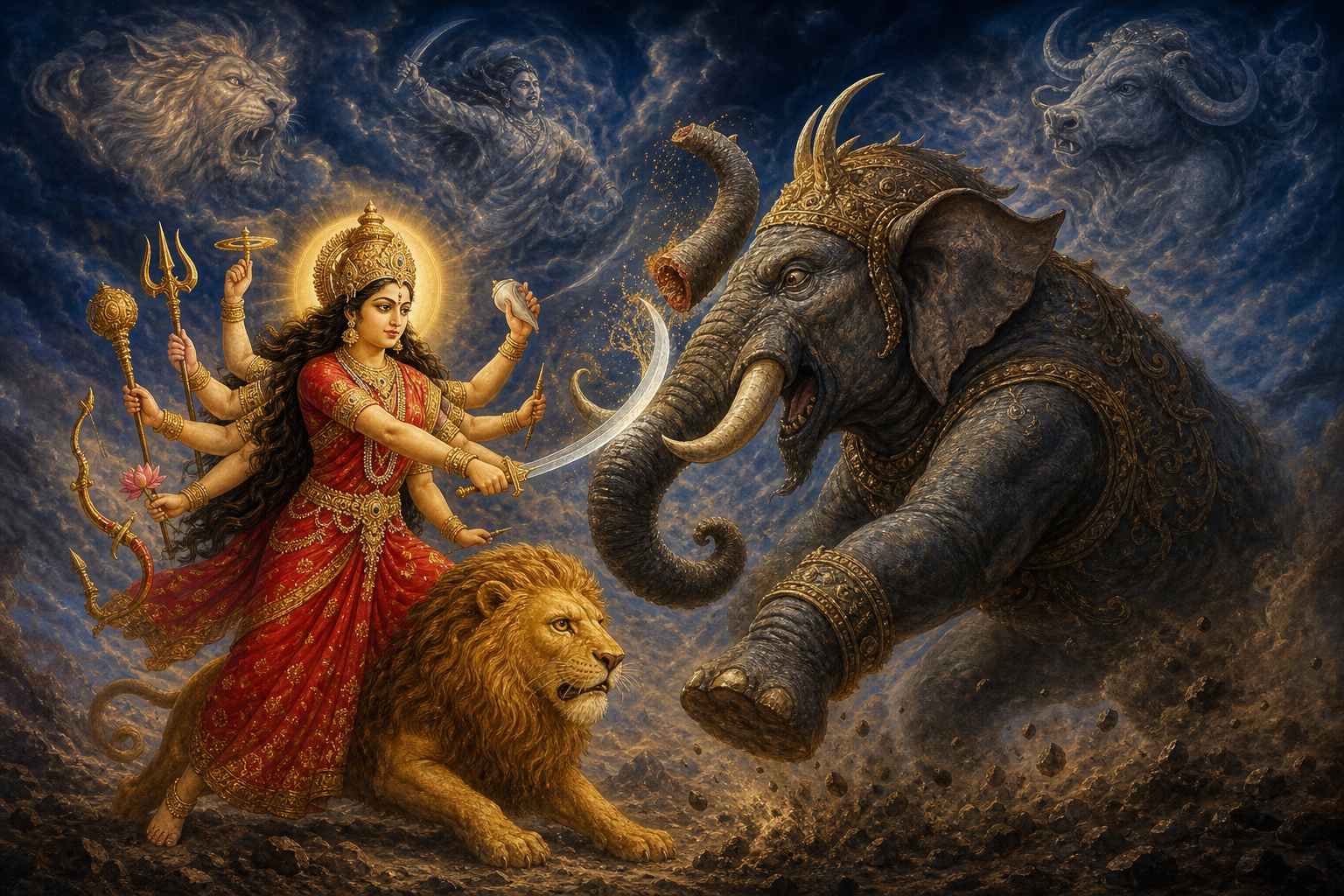
You may have found an image in which Durga confronts an elephant, or encountered the name Karindrasuranisudini during worship, and wondered whether this is a different demon from Mahishasura. That small question matters. If you identify the scene incorrectly, you miss the reason the elephant appears and the significance of Durga striking its trunk.
The crucial detail is that the elephant is not necessarily a separate adversary. In the climactic combat of the Devi Mahatmya, Mahishasura shifts through lion, human, elephant, and buffalo forms; when he charges as an elephant, Durga severs the trunk and forces another change before his final defeat. The iconography therefore presents one stage in a moving battle, not merely a goddess standing over an animal.
First identify the episode, not just the elephant
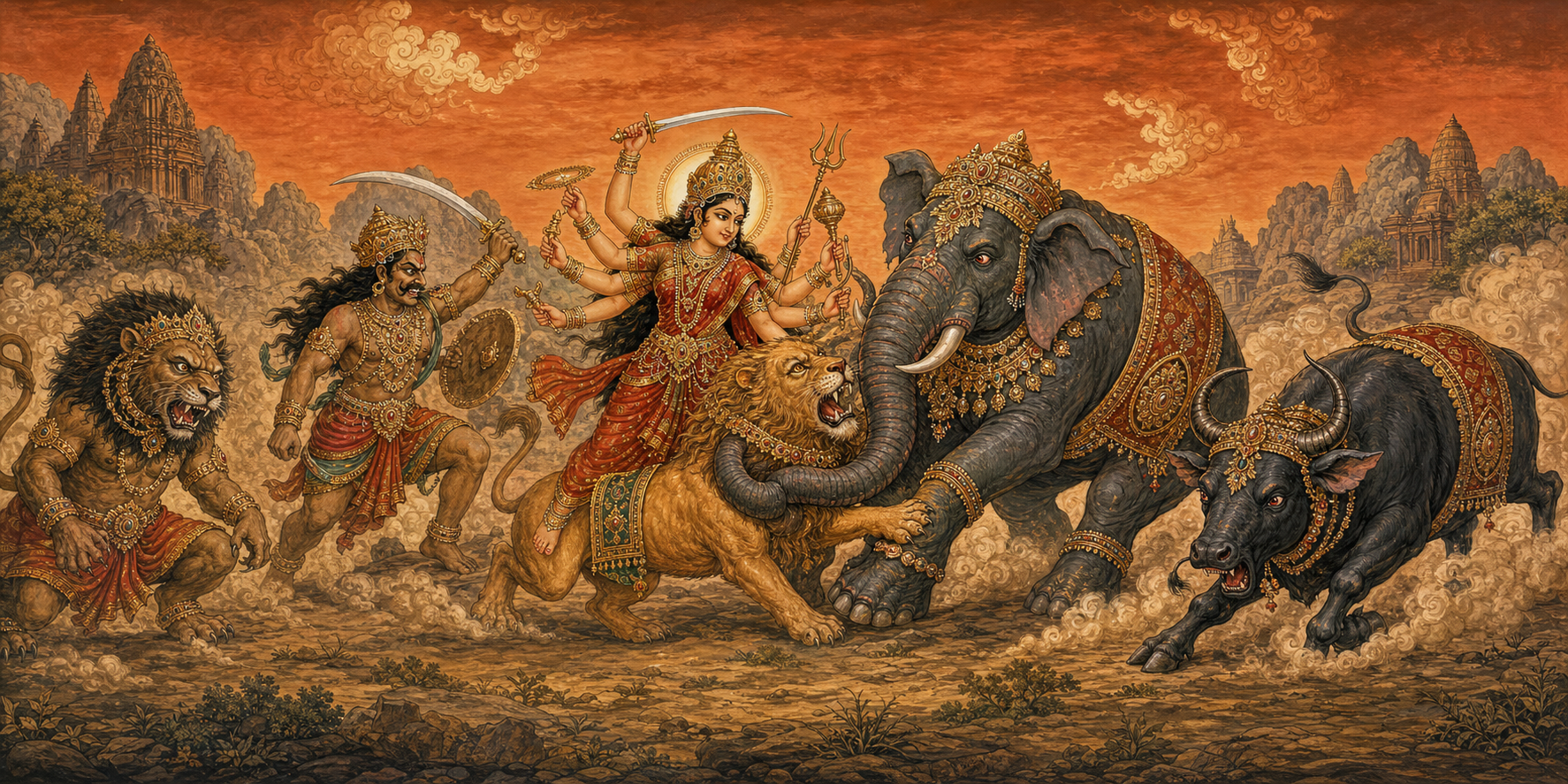
This scene is part of the Mahishasura Mardini narrative. The adversary’s identity remains Mahishasura even while his appearance changes. His transformations are attempts to unsettle the Goddess by changing the kind of power she must face: ferocity, human agency, massive force, and finally the buffalo form associated with his name.
Karindrasuranisudini gives you a verbal key to the elephant episode. The name can be parsed as karindra, lord of elephants; asura, demon; and nisudini, she who destroys. A practical rendering is “she who destroys the elephant-form demon.” The epithet identifies Durga through a particular act: she remains clear and effective when threatening power assumes its most imposing shape.
When you examine an image, look for three narrative clues. Ask whether the elephant is the attacking figure, whether Durga’s action is directed at its trunk, and whether a buffalo form or the larger Mahishasura battle appears elsewhere in the composition. A caption naming Mahishasura Mardini or Karindrasuranisudini can settle the identification even when the artwork compresses several moments into one frame.
Regional retellings and artistic traditions do not always show every stage. Some emphasize the elephant charge; others center the final buffalo encounter. Treat a missing detail as an artistic choice, not as proof of a different theology. If the context is incomplete, describe the identification as possible rather than certain.
The elephant represents force that has lost its direction
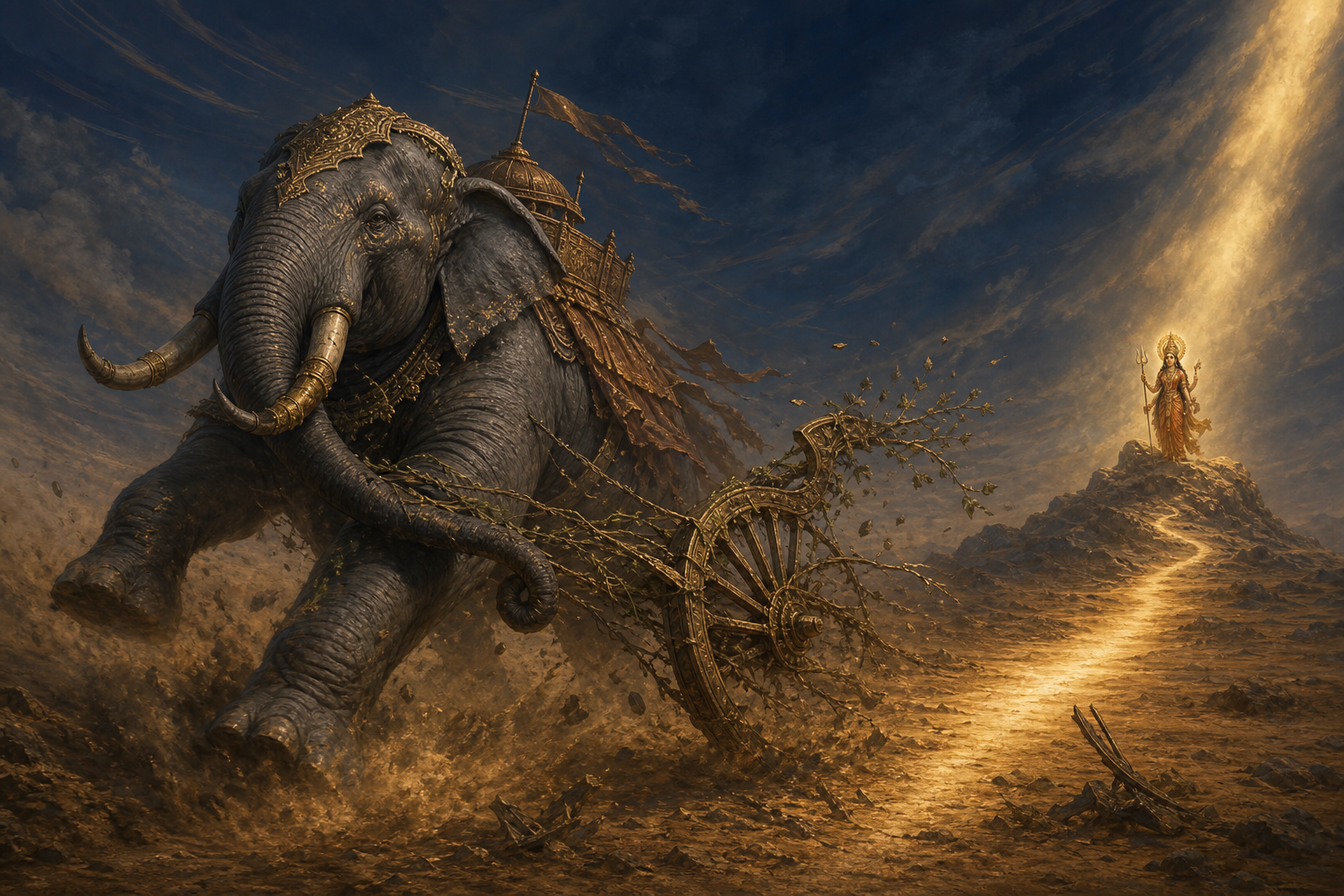
Do not turn the elephant into a universal symbol of evil. The animal acquires its meaning here because Mahishasura has assumed its form as a weapon. Context, not species, gives the image its moral charge.
Within this episode, the elephant conveys magnitude, momentum, and the confidence of something that expects resistance to collapse. It can be read as a form of tamas: not merely tiredness, but the weight of entrenched habit, inertia, and obscured perception. It also evokes ahamkara, the ego that mistakes size for rightful authority, and moha, the delusion that overwhelming force must be invincible.
That distinction keeps the symbolism ethically useful. Power itself is not the enemy. Power without discipline is. Durga does not destroy strength because strength is impure; she prevents strength from serving adharma. Her victory places energy back under moral direction, where it can protect rather than intimidate.
The severed trunk is the strategic center of the scene. Durga does not try to outmatch the elephant’s entire mass. She interrupts the instrument through which the charge is being driven. Symbolically, the trunk can represent unchecked appetite, grasping, or impulse. Its severing depicts the removal of the mechanism that lets delusion turn latent power into immediate harm.
This is why the image communicates precision rather than frenzy. The elephant form collapses, but the conflict is not yet over; Mahishasura changes again. The sequence warns you that a defeated pattern may return under another appearance. Pride can become defensiveness, defensiveness can become inertia, and inertia can present itself as helplessness. Discernment must follow the movement rather than becoming attached to a single label.
How to read Durga’s action without flattening the symbolism
A devotional image can operate simultaneously as narrative, theology, and instruction. Use the following reading sequence when you encounter this form in a temple, festival display, printed image, or personal shrine.
- Establish who has taken the elephant form. Begin with the Mahishasura narrative rather than assuming that every elephant opponent represents the same being. This protects the image from being detached from its scriptural setting.
- Locate the exact moment of action. The strike to the trunk belongs before the final buffalo defeat. Reading the sequence correctly reveals that Durga first stops the charge and then continues responding as the threat changes.
- Notice the quality of Durga’s power. Where the Goddess is rendered poised amid disorder, read that composure as part of the teaching. Her effectiveness comes from clarity, timing, and fearlessness, not from becoming as uncontrolled as her opponent.
- Read the weapons as disciplined capacities. The trident, chakra, and bow can be contemplated as emblems of discernment, order, and directed energy. Their significance lies in power being used with purpose.
- Keep the symbol tied to the scene. The elephant signifies tamasic weight and intimidating force in this encounter. Do not convert that contextual meaning into a blanket judgment about elephants or every elephant image in Dharmic art.
This method also prevents a common mistake: treating the scene as a simple contest of physical strength. Durga’s response is surgical. She identifies what makes the attack effective, disables it, and remains prepared for the next manifestation. The theological point is not that the Divine Mother possesses a larger quantity of violence. It is that Shakti joins power to intelligence and dharma.
Key takeaways
- The elephant in this episode is a form assumed by Mahishasura, not automatically a separate elephant demon.
- Karindrasuranisudini names Durga as the destroyer of the elephant-form asura and directs attention to a specific phase of the battle.
- Severing the trunk stops the charge before the final victory, making precision central to the iconography.
- The elephant signifies massive tamasic force, pride, habit, and delusion in this narrative context; it is not a universal condemnation of the animal.
- Durga’s composure teaches that dharmic strength is force governed by discernment, timing, and moral purpose.
Turn the image into a practice of precise action
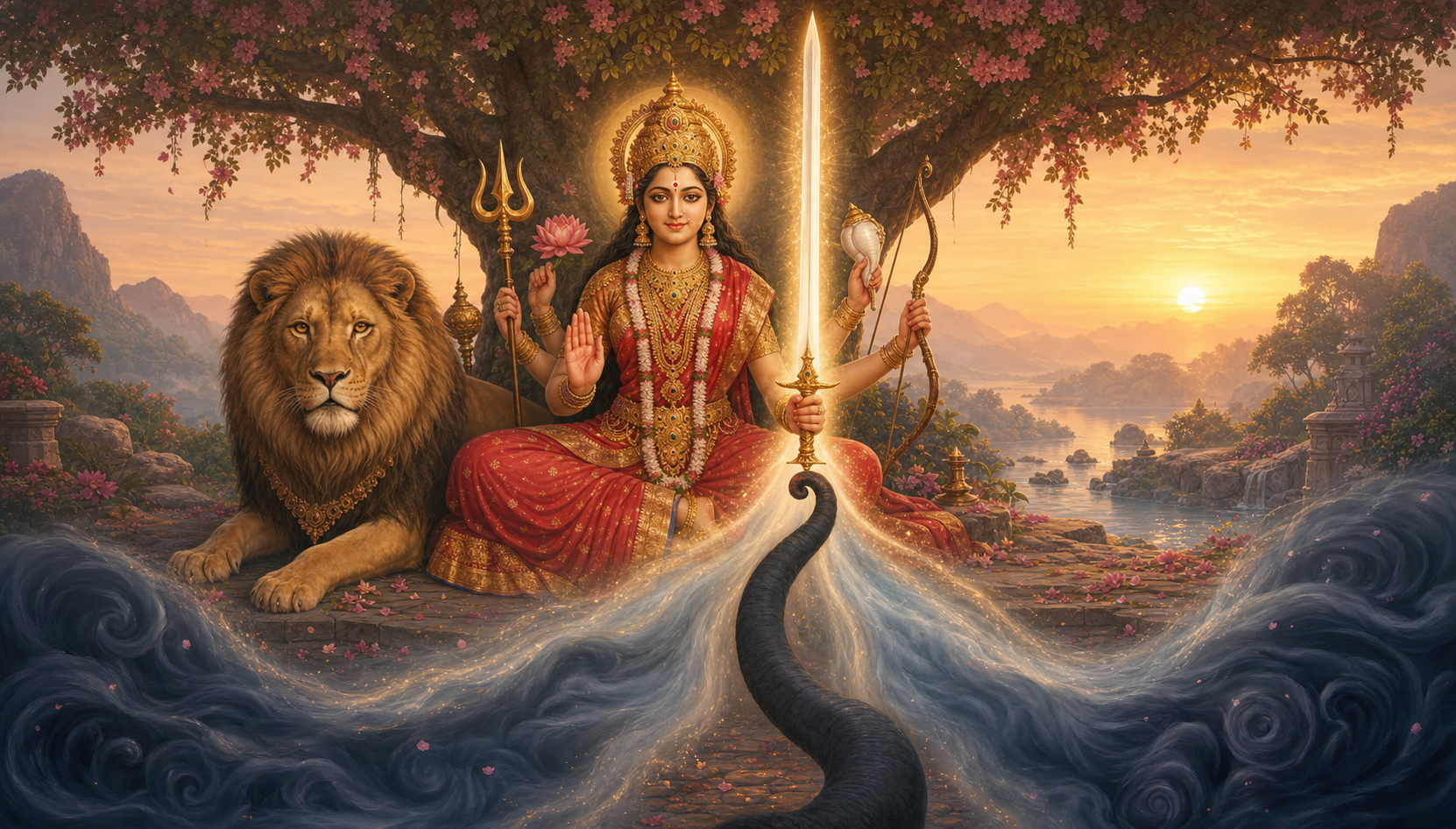
You can contemplate Karindrasuranisudini during Navaratri, Durga Puja, Chandi Path, or an ordinary moment of pressure. Begin by naming the “elephant” in front of you without exaggerating it. Define the obstacle as a behavior, habit, commitment, or system rather than turning another person—or yourself—into the demon.
Then find the “trunk”: the particular mechanism that gives the obstacle its momentum. A recurring distraction may be sustained by unrestricted notifications. An exhausting obligation may persist because no boundary has been stated. A conflict may keep expanding because every message receives an immediate reply. The whole situation can feel enormous while depending on one repeatable channel.
Make the smallest decisive interruption that serves dharma. Silence the channel during focused work. State the boundary plainly. Delay the reactive reply until you can answer with clarity. The metaphor points to disciplined interruption, not aggression toward a person. Durga’s action is useful precisely because it separates firmness from uncontrolled retaliation.
After acting, look again. Mahishasura’s change of form is a reminder that an entrenched problem may not disappear when its first mechanism is removed. It may present a new excuse, emotion, or demand. Do not repeat the same response automatically; identify the new form and choose the next proportionate action.
Use one final test: does your response protect truth, responsibility, and legitimate wellbeing without feeding humiliation or revenge? If it does, force is being placed under dharmic direction. If it merely gives anger a sacred vocabulary, the elephantine momentum has entered your own response.
The next time you see Durga meeting the elephant charge, pause at the trunk rather than rushing to the final victory. Ask what gives the difficulty before you its momentum, and cut that mechanism with the calmest effective action available to you.
References
