
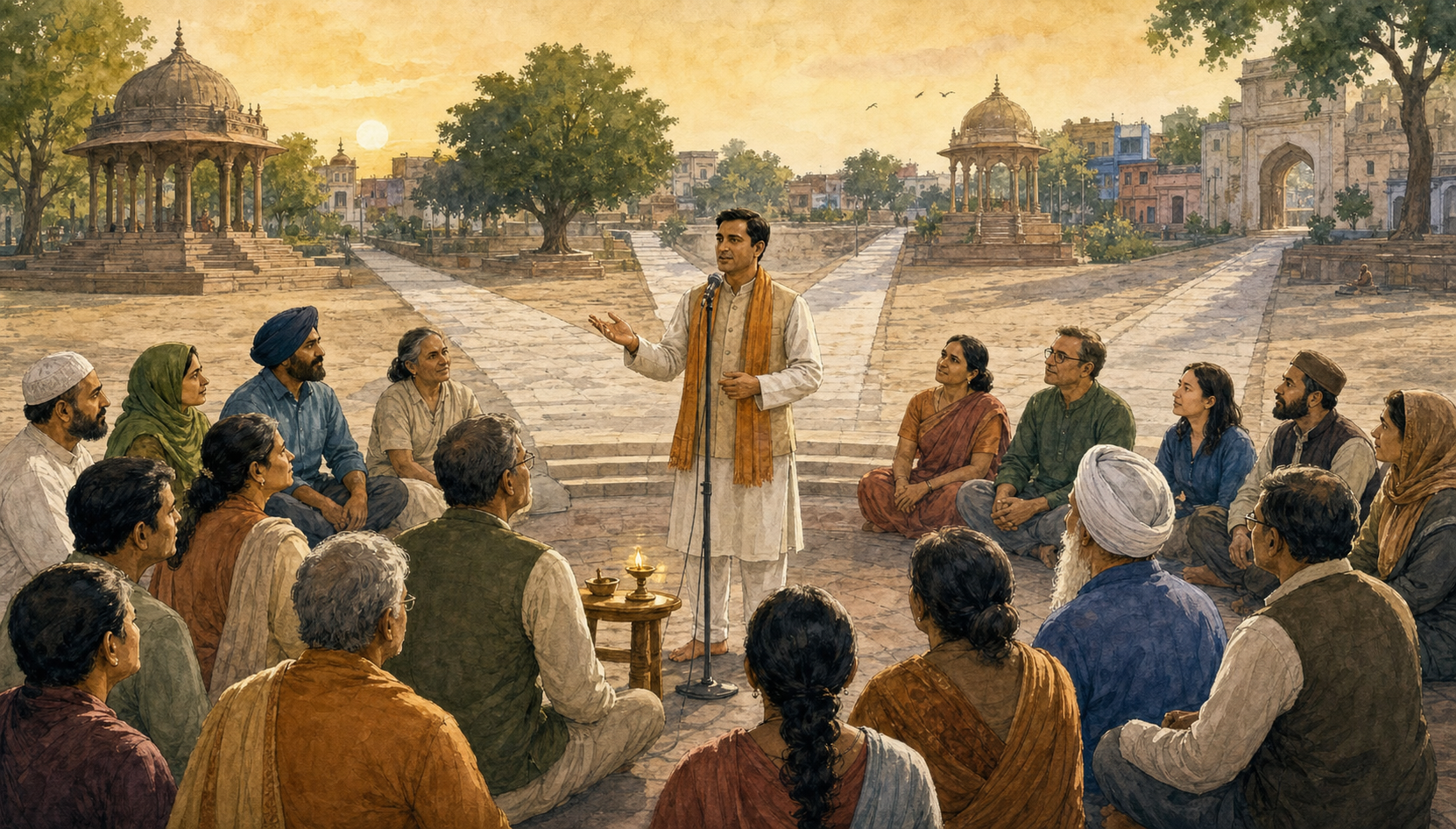
You see your tradition misrepresented, mocked, or pushed out of a public conversation. You want to answer, but you don’t want righteous anger to turn into collective blame, spectacle, or language you would reject if it were aimed at your own community.
You do not have to choose between silence and outrage. Dharmic pluralism offers a harder and more durable standard: defend truth without claiming a monopoly on truth, defend dignity without denying another person’s dignity, and ask for a concrete correction instead of merely displaying anger.
Key takeaways
- Pluralism protects your right to make a clear Hindu, Buddhist, Jain, or Sikh case; it does not require you to pretend that all teachings are identical.
- Before speaking, separate the disputed fact, the interpretation placed on it, and the moral judgement being made. Answer each at the right level.
- Use satya to check accuracy, ahimsa to govern language, proportionality to choose the response, and seva to identify the public good you want to produce.
- Ask for a remedy people can actually provide: a correction, apology, restored access, changed policy, moderated dialogue, or better education.
- Build habits of self-study, community review, service, and media literacy before controversy arrives.
Pluralism does not ask you to surrender conviction
Pluralism is often misread as a demand to soften every disagreement. That is not the dharmic idea. Within Hindu thought, the recognition of bhakti, jnana, karma, and raja yoga as different margas begins with a realistic observation: seekers differ in temperament, capacity, circumstance, and stage of development. Diversity of approach is therefore built into spiritual life rather than reluctantly permitted at its edge.
This does not mean every proposition is equally true, every practice is interchangeable, or criticism is forbidden. A Hindu can defend murti puja without demanding that everyone adopt it. A Jain can argue rigorously for ahimsa without claiming that all traditions formulate non-harm in the same way. A Buddhist can explain anicca without dissolving it into a generic slogan about change. A Sikh can speak from the disciplines of hukam, sangat, and seva without having that distinct inheritance absorbed into a vague civilizational blend.
The wider dharmic family contains real differences. Its resources for plural life are also distinct: Buddhist reflection on impermanence, Jain anekantavada, and Sikh emphasis on hukam and the sangat do not make the same philosophical claim. They do, however, give their practitioners reasons to resist arrogance, attachment to rigid forms, and the assumption that one person’s angle exhausts a many-sided reality.
In public advocacy, hold three distinctions firmly:
- Respect for a person is not agreement with a claim. You can reject an argument while refusing to humiliate its speaker.
- Freedom to criticise is not freedom from correction. Religious ideas can be examined, but factual errors, selective standards, and contemptuous generalisations can be challenged directly.
- Cooperation is not theological merger. Hindus, Buddhists, Jains, and Sikhs can defend fair treatment or serve a community together while retaining their own doctrines, authorities, and practices.
This standard must be mutual. Pluralism cannot mean that Hindu self-assertion is automatically labelled aggressive while anti-Hindu contempt is excused as critique. Nor can it mean that a Hindu advocate gets to treat every disagreement as hatred. Apply the same test to all sides: Is the claim accurate? Is the person being treated with dignity? Is the rule being applied consistently? Is the requested remedy fair?
Put every public response through four dharmic tests

Before you publish a statement, give a speech, organise a protest, or confront an institution, write the disputed claim in one plain sentence. If you cannot do that, you probably do not yet know what you are answering. Then use the following working test.
Satya: Are you correcting what was actually said or done?
Begin with verifiable particulars. Identify the exact words, image, decision, policy, or exclusion at issue. Find the complete available context before assigning motive. A clipped video, screenshot, translated phrase, commentary caption, and original statement are different pieces of evidence; do not treat them as one thing.
Next, separate three layers:
- Fact: What happened, who did it, and in what setting?
- Interpretation: What meaning is being attached to the act or words?
- Judgement: Why is it inaccurate, unfair, discriminatory, degrading, or otherwise unacceptable?
This prevents a common failure. If the factual layer is weak, moral intensity will not repair it. If the facts are sound but the dispute concerns interpretation, present your reading as an argument rather than disguising it as an uncontested fact. Correct your own error visibly if better evidence appears. Satya loses its force when it is demanded from opponents but treated as optional within one’s own camp.
Ahimsa: Does the language confront harm without creating another target?
Ahimsa does not require timid speech. You may call a falsehood false, a double standard a double standard, or an exclusion unjust. The discipline concerns where you direct the force of your words.
Name the conduct instead of degrading a population. Replace claims about what an entire religious, ethnic, professional, or political group supposedly is with the specific action for which a specific actor is responsible. Remove threats, fantasies of punishment, mockery of sacred identity, and invitations to mob a private individual. A stern factual sentence can be non-violent; a polite sentence that insinuates collective guilt can still be corrosive.
Use this editing question: if the names of the communities were reversed, would you still defend the sentence as fair? If not, rewrite it.
Proportionality: Does the response fit the act?
Not every problem needs the largest available platform. An honest factual mistake may need a private correction. A published falsehood may need a public reply. A recurring institutional rule may require documentation, coalition-building, and a formal policy request. A credible threat is not a debate prompt; preserve the evidence and use the appropriate safety or legal channel rather than summoning an online pile-on.
Proportionality protects your credibility. When every slight is described as an existential attack, the language available for serious discrimination becomes exhausted. When serious hostility is dismissed as a misunderstanding, trust also collapses. Describe the scale of the problem accurately, then choose the smallest response capable of obtaining the necessary remedy.
Seva: What useful condition will exist if you succeed?
Anger identifies a wound; it does not automatically identify a solution. Before launching advocacy, finish this sentence: “We want the responsible person or institution to…”
The answer might be to correct a false description, restore equal access, remove a discriminatory restriction, apologise for degrading language, include an informed dharmic voice, protect a place of worship, or establish a fair rule for everyone. If you cannot name a feasible remedy, you are preparing an expression of grievance rather than a campaign.
Seva also asks who bears the cost of your method. Will students, families, temple volunteers, monks, or neighbours have to repair relationships after the loudest advocates move on? Does the action help the people whose dignity is supposedly being defended, or merely increase the advocate’s visibility? Public advocacy becomes dharmic when its method serves something beyond the advocate’s own status.
When a controversy is already moving, narrow it

Viral debate rewards the phrase that creates the sharpest reaction, not the argument that creates the clearest understanding. During The Great Khali’s Vrindavan appearance on January 18, 2026, supporters praised a forceful defence of Sanatan Dharma while critics worried that heated language would overshadow respectful engagement. That split reveals the practical burden carried by any prominent advocate: the most provocative formulation can become the whole public memory of a longer message.
If you are responding after a dispute has already become heated, use this sequence:
- State the narrow issue. Do not begin with the entire history of civilizational injury. Name the sentence, decision, or act being challenged.
- State what you are not claiming. If you are criticising one speaker, say that you are not assigning guilt to a whole community. If you are defending a practice, say that you are not demanding theological agreement.
- Give the correction. Supply the relevant context, principle, or evidence in language a neutral reader can follow.
- Set the boundary. Explain which form of criticism is legitimate and which conduct crosses into falsehood, degradation, exclusion, or incitement.
- Request the remedy. Ask for the correction, apology, policy change, dialogue, or other concrete action.
- Stop when the useful case is complete. Repetition, taunting, and victory performances often reopen the injury after the substantive objective has been met.
A compact public statement can follow this form: “The claim is ___. It is inaccurate or unfair because ___. The principle at stake is ___. We are asking for ___.” Add background only when it helps the audience assess one of those lines.
If you are preparing a public figure, draft at least one sentence that remains responsible when separated from the rest of the speech. Avoid metaphors of eradication, collective punishment, or physical domination; they travel farther than qualifications. Put the correction and requested remedy in the strongest memorable sentence, not the insult.
Make advocacy a practice before it becomes a crisis
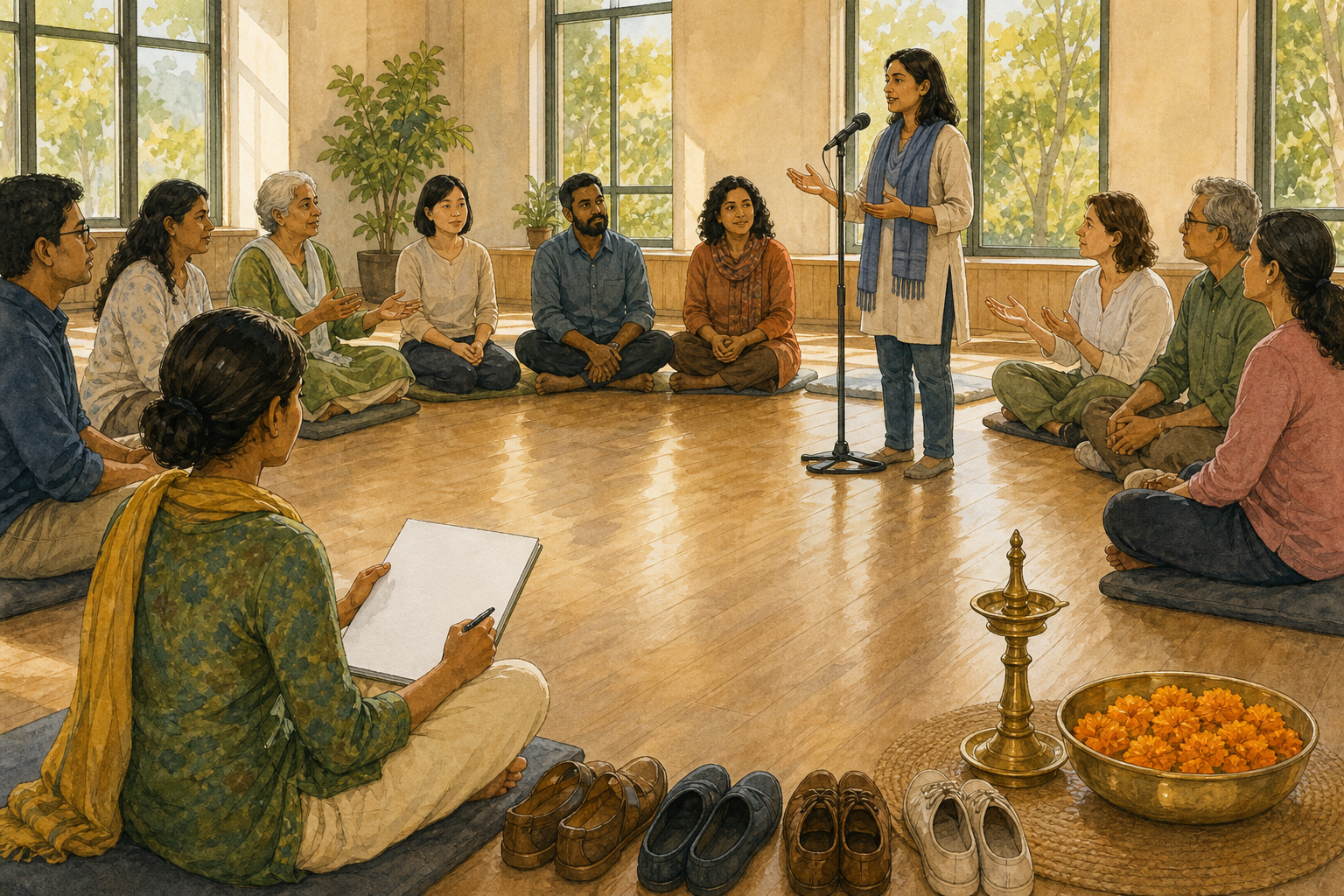
A community that speaks only when provoked will usually speak from accumulated frustration. Preparation changes the quality of the response. Dharmic life already supplies three useful disciplines: svadhyaya for honest study, satsang for correction in community, and seva for grounding conviction in service.
- Use svadhyaya to build a fact base. Keep accurate explanations of commonly misrepresented beliefs and practices. Distinguish scriptural teaching, philosophical interpretation, regional custom, and the conduct of an individual practitioner. Do not make one stand in for all the others.
- Use satsang to review advocacy. Before releasing a major statement, ask people with knowledge of the tradition, public communication, and the affected community to test it. Their job is to identify factual weakness, ambiguous language, collective blame, and remedies that cannot be implemented.
- Use seva to establish public credibility. Pair cultural defence with education, heritage care, compassionate service, and cooperation on shared civic needs. Service does not replace advocacy; it shows what the advocated values produce in practice.
- Teach media literacy. Train young participants to locate original material, compare a caption with the underlying statement, identify missing context, and delay judgement when provenance is unclear. Community dialogue and youth media literacy can turn a passing controversy into durable civic learning.
- Adopt a public code. Reject fabricated claims, threats, collective guilt, contempt for sacred identity, and refusal to correct known errors. Apply the code to allies as well as opponents.
This is how a living tradition avoids both stagnation and reckless reaction. It can preserve inherited forms while examining how they are understood and communicated. It can welcome internal criticism without making self-erasure the price of appearing tolerant. It can cooperate across traditions without pretending their differences are unreal.
The next time Dharma is misrepresented, begin with four lines: name the claim, give the correction, state the boundary, and request the remedy. Then read the words once for satya and once for ahimsa. If both survive, speak clearly. Let younger people see that dharmic confidence can be firm without borrowing the habits of intolerance.
References
- DharmaRenaissance Blog – From Flow to Stagnation: Hindu Wisdom on Renewal, Dharma, and Spiritual Pluralism
- DharmaRenaissance Blog – Great Khali’s Vrindavan Remarks on Sanatan Dharma Spark Debate, Reinforce Dharmic Unity
