
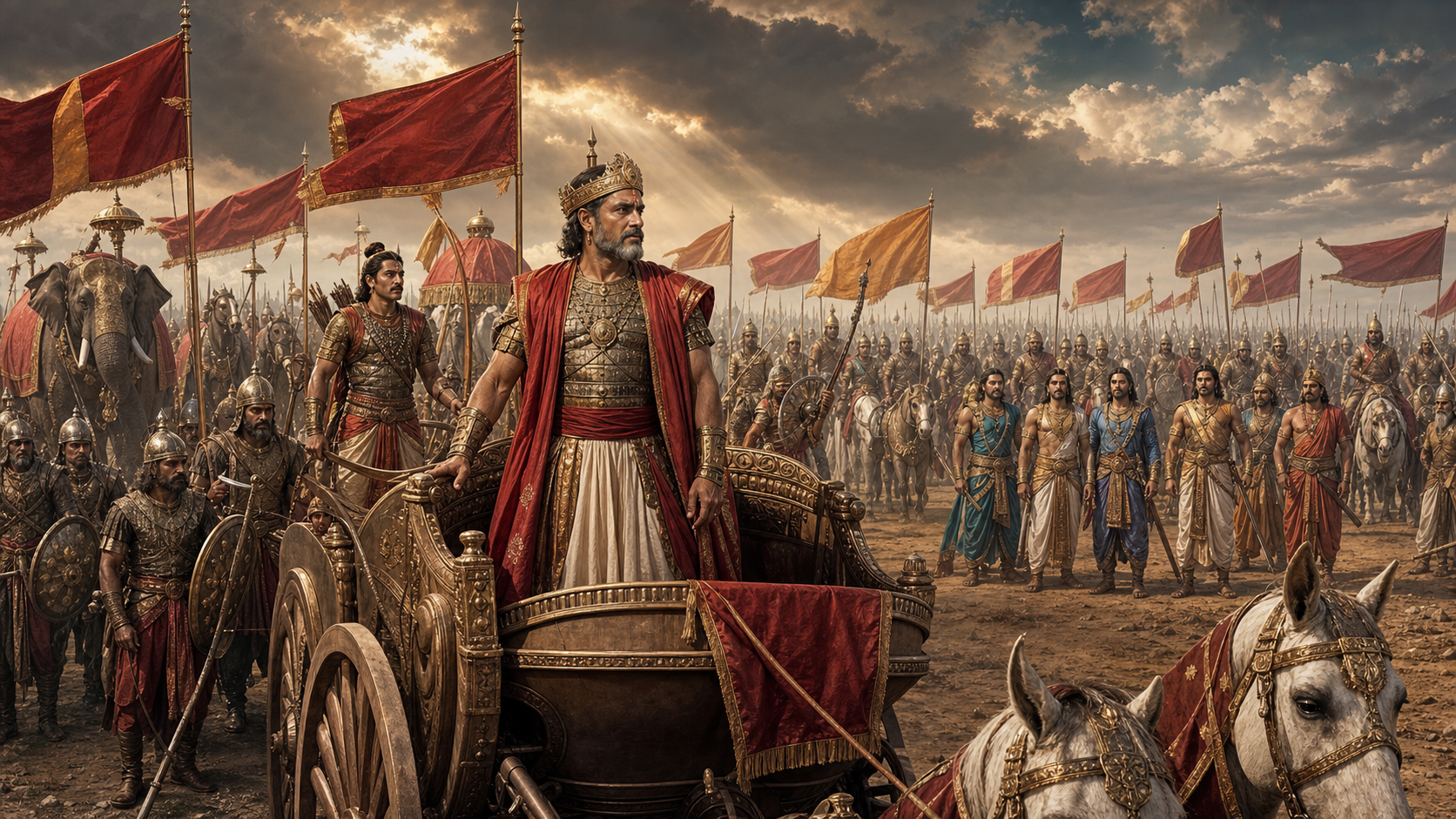
If you remember Drupada only as Draupadi’s father, you miss the scale of his role in the Kurukshetra War. He was the king who made Panchala the Pandavas’ political anchor, supplied the coalition with commanders and troops, fought on its front lines, and turned a private conflict with Drona into one of the epic’s decisive public struggles.
You can understand Drupada clearly only by separating three things: what he personally did, what Panchala contributed under his authority, and what his children accomplished after his plans had outlived him. That distinction also reveals the harder question in his story: when does a rightful demand for justice become inseparable from vengeance?
The short answer: Drupada made Panchala indispensable
Drupada was not the supreme commander of the Pandava army; Yudhishthira gave that position to Drupada’s son Dhrishtadyumna. Nor was Drupada the warrior who personally brought down Bhishma or Drona. His importance was more structural. He brought a kingdom, an experienced army, a durable dynastic alliance, and three pivotal members of his household into the Pandava cause.
That is why measuring him only by his individual duels gives the wrong answer. Drupada’s greatest contribution was converting Panchala’s political power into a coalition capable of surviving against a larger Kaurava force. The Pandavas fielded seven akshauhinis against the Kauravas’ eleven, so the discipline, leadership, and staying power of allies such as Panchala mattered as much as individual heroism.
Key takeaways
- Drupada made Panchala one of the principal political and military foundations of the Pandava coalition.
- His conflict with Drona began as a broken friendship, but it eventually divided a kingdom and shaped the leadership of both armies.
- Draupadi secured the Panchala-Pandava family alliance; Dhrishtadyumna commanded the Pandava army; Shikhandi helped make Bhishma’s fall possible.
- Drupada personally commanded a major division and kept Panchala forces engaged through the destructive opening phase of the war.
- Drona killed Drupada, but Drupada’s strategy continued through Dhrishtadyumna and culminated in Drona’s own death.
- His legacy cannot be reduced either to righteous resistance or personal revenge. The Mahabharata makes the tension between them part of the lesson.
Before the first arrow: how Drupada built war-making power
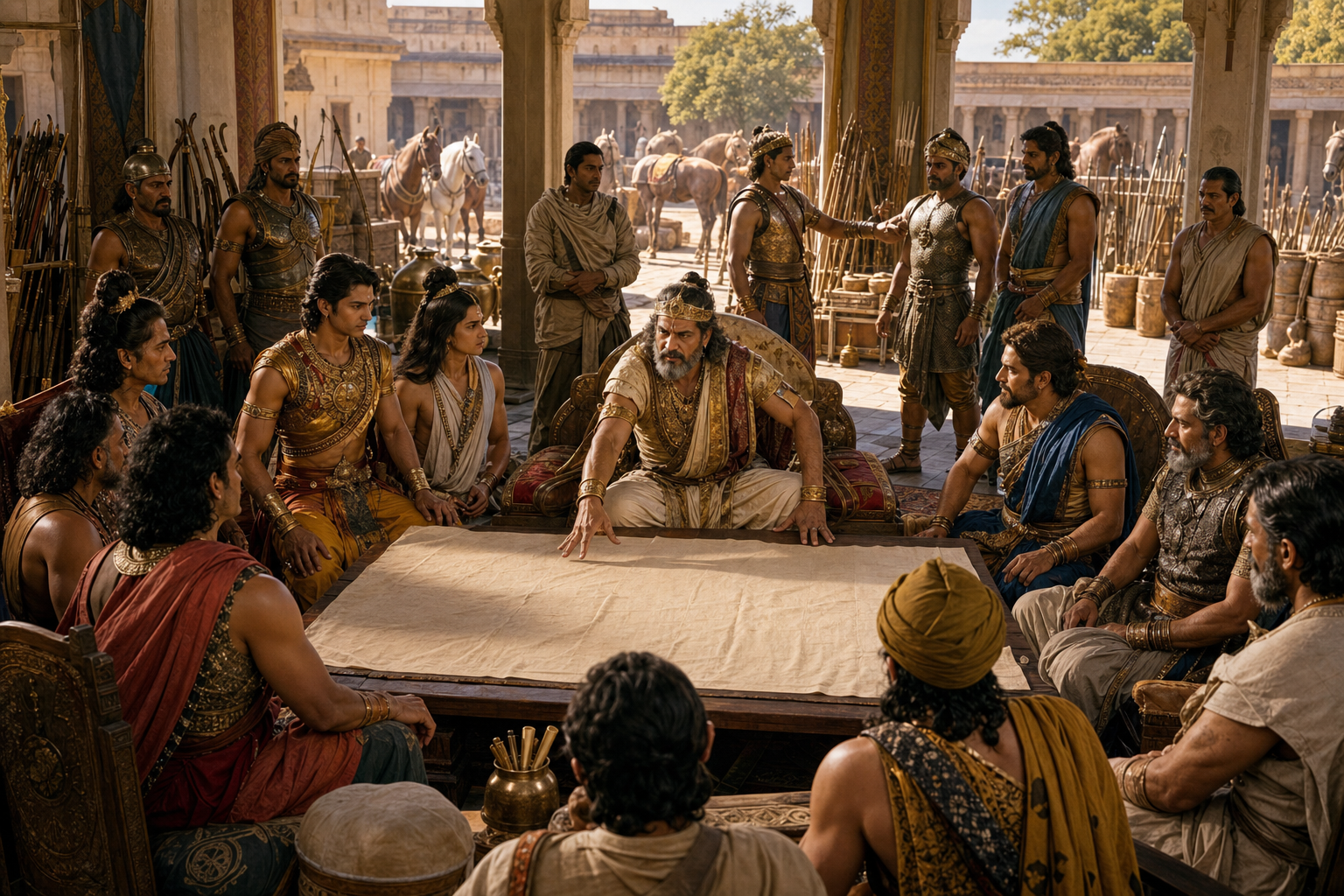
A broken friendship became a conflict between states
Drupada and Drona had studied together in a gurukula. In their youth, Drupada promised that their friendship and his generosity would endure after he became king. When the impoverished Drona later approached him, however, Drupada rejected the idea that a sovereign and a poor supplicant could meet as equals.
The insult did not remain private. Drona became the teacher of the Kuru princes and eventually sent his pupils to capture Drupada as their gurudakshina. Arjuna defeated the Panchala king and delivered him alive. Drona then retained half of Panchala and returned the other half to Drupada, declaring that the division had finally made them equals.
This episode explains more than their mutual hatred. It shows how quickly an injury involving rulers can become an institutional crisis. Drona used the military excellence of the Kuru princes to answer humiliation; Drupada lost territory and political unity as a result. When you assess his later decisions, keep that sequence in view. He was not reacting to a harsh word alone. He had been captured, publicly subordinated, and forced to rule a divided Panchala.
Drupada answered defeat through succession and alliance
Drupada’s response combined ritual purpose with statecraft. Through a putrakameshti rite assisted by Yaja and Upayaja, he sought a son capable of killing Drona. Dhrishtadyumna arose from the sacrificial fire with that destiny, while Draupadi emerged as the daughter whose marriage would transform the balance of power. Drupada was also the father of Shikhandi, whose presence would become decisive against Bhishma.
The three children did not merely repeat one another’s function. Draupadi’s svayamvara brought Arjuna to Panchala and her marriage joined the Pandavas to Drupada’s house. Dhrishtadyumna supplied coalition command and embodied the promised reckoning with Drona. Shikhandi created the battlefield condition through which Arjuna could overcome Bhishma. In practical terms, Drupada’s household supplied the Pandava cause with alliance, command, and a tactical answer to two formidable Kaurava leaders.
This is the first key to Drupada’s importance: he planned beyond his own lifespan and personal fighting strength. His answer to an adversary was not simply to seek another duel. He created a succession structure in which different members of his family carried political, military, and vowed responsibilities. That structure helped determine who could lead the Pandava host and how Bhishma and Drona could eventually be defeated.
On the battlefield: what Drupada and Panchala actually did
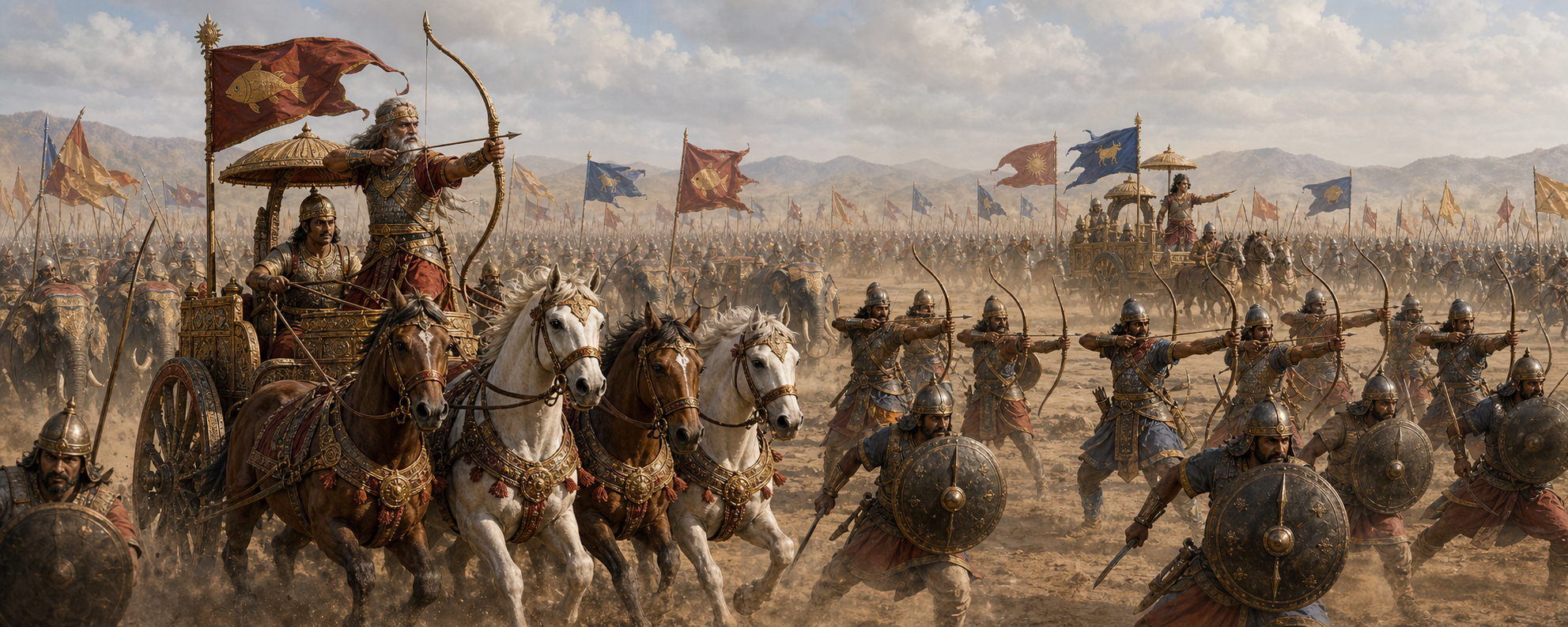
Once war became unavoidable, Yudhishthira appointed Dhrishtadyumna supreme commander of the Pandava coalition. The decision placed a Panchala prince, born with a destiny tied to Drona, above the many kings and renowned warriors assembled on the Pandava side. It also showed that Panchala was not a ceremonial ally attached through marriage. It stood at the center of operational command.
Drupada himself commanded a prominent division containing chariot-warriors, cavalry, elephants, and infantry. Panchala formations held important sectors of the Pandava line and repeatedly met experienced Kaurava forces. During Bhishma’s command on Days 1-10, they absorbed severe pressure rather than remaining behind the warriors whose names dominate popular retellings.
The distinction matters. A coalition with fewer forces cannot depend only on spectacular attacks by a handful of maharathas. It must keep formations intact, reinforce threatened sectors, replace losses, and prevent local defeats from becoming a general collapse. Drupada’s forces performed that sustaining role. Their losses were especially heavy during Bhishma’s onslaught on Days 5-7, yet Panchala remained part of the line through the crucial tenth day.
On Day 10, Shikhandi was positioned with Arjuna in the confrontation that brought Bhishma down. Shikhandi did not replace Arjuna’s martial power; Shikhandi made Bhishma’s pledged restraint militarily decisive, allowing Arjuna’s arrows to do what ordinary attacks had failed to accomplish. Drupada’s contribution therefore appeared at two levels at once: Panchala troops helped endure Bhishma’s offensive, while Drupada’s own child helped create the opening that ended his command.
If you want a precise description of Drupada’s battlefield role, use three verbs: he commanded, he held, and he enabled. He commanded his division, held the alliance through a punishing phase, and enabled larger strategic results through the people and resources Panchala had placed in the war. That is less dramatic than assigning every turning point to one hero, but it is a more accurate picture of how coalitions fight.
Death, fulfilled vows, and the cost hidden inside victory
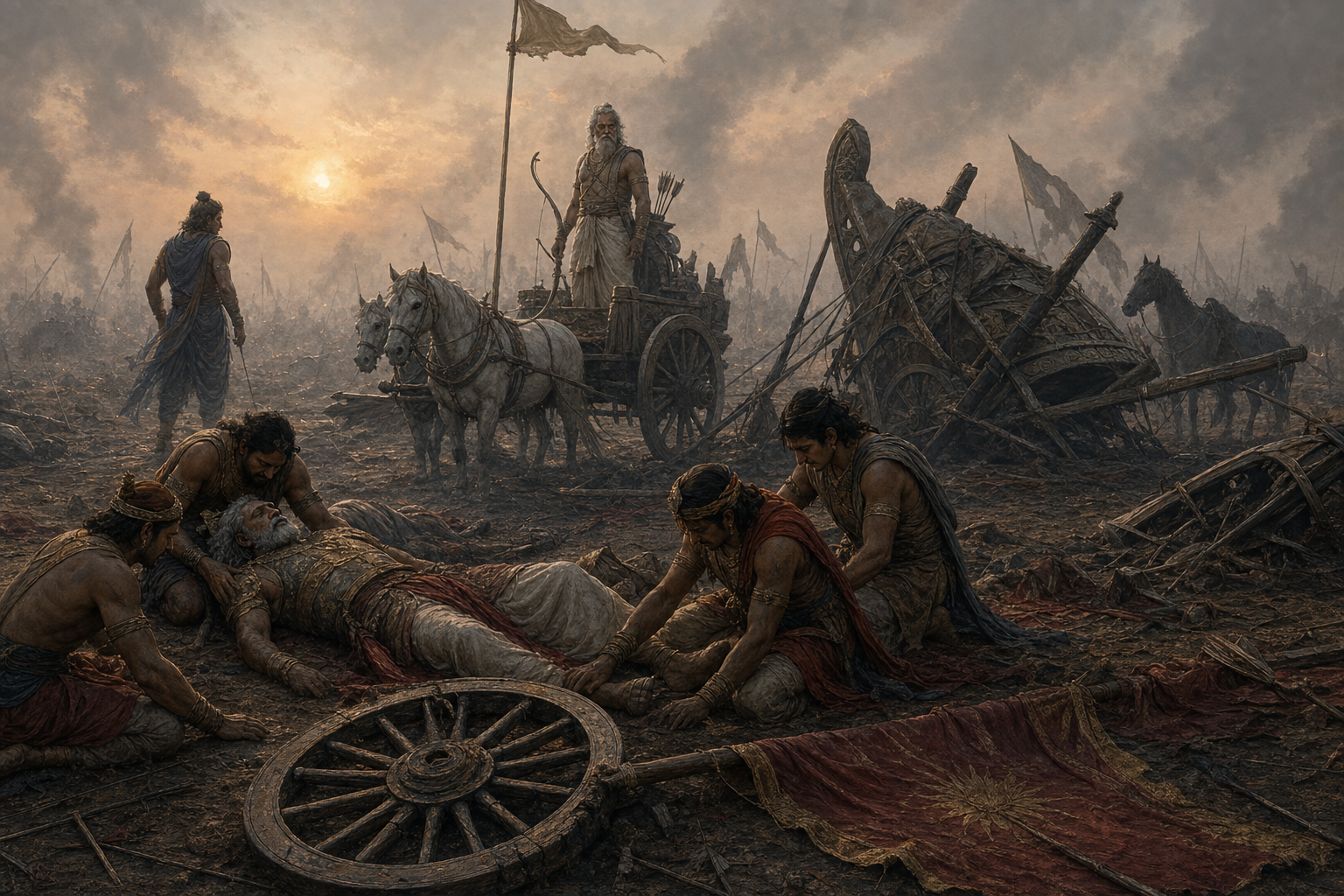
Bhishma’s fall did not end Panchala’s ordeal. Drona assumed command of the Kaurava army on Day 11 and sought to capture Yudhishthira. He also confronted the Panchala leadership deliberately positioned at the heart of the Pandava formation. The old conflict between teacher and king was no longer background; it had become part of the two armies’ command struggle.
In the opening fighting under Drona’s command, the long-delayed encounter ended with Drona killing Drupada in direct battle. King Virata of Matsya also fell amid the surrounding violence. Drupada therefore did not live to see the vow directed against his former friend reach its conclusion.
His death did not dismantle the plan he had set in motion. On Day 15, after Drona accepted the news that Ashvatthama had been slain, he put down his weapons and entered yogic withdrawal. Dhrishtadyumna then beheaded him. The act fulfilled the purpose attached to Dhrishtadyumna’s birth, but its circumstances make it one of the war’s most difficult moral episodes. A commander had destroyed a central enemy leader; he had also struck a man who was no longer defending himself.
You do not have to force that moment into a clean moral category. From one angle, Dhrishtadyumna completed a kshatriya obligation and removed a commander whose offensive had been devastating the Pandava army. From another, the manner of Drona’s death reveals how a legitimate military necessity can become entangled with inherited retaliation. The discomfort is not an obstacle to understanding Drupada’s story. It is part of the understanding.
Nor did the cost stop when the armies’ formal contest ended. In the nocturnal massacre led by Ashvatthama, Dhrishtadyumna and Draupadi’s sons, the Upapandavas, were killed in their sleep. The house that had invested so much in the Pandava victory was struck after victory could no longer protect it. Panchala had helped remove Bhishma and Drona, but those achievements did not restore Drupada’s family or undo the cycle begun by humiliation.
This is why it is misleading to call Drupada’s outcome either simple vindication or simple failure. His alliance succeeded. His forces mattered. His children altered the war. His vow against Drona was fulfilled. Yet the destruction of Dhrishtadyumna and the Upapandavas after the formal war exposed the distance between winning an objective and securing a just peace.
How to judge Drupada without confusing dharma with revenge
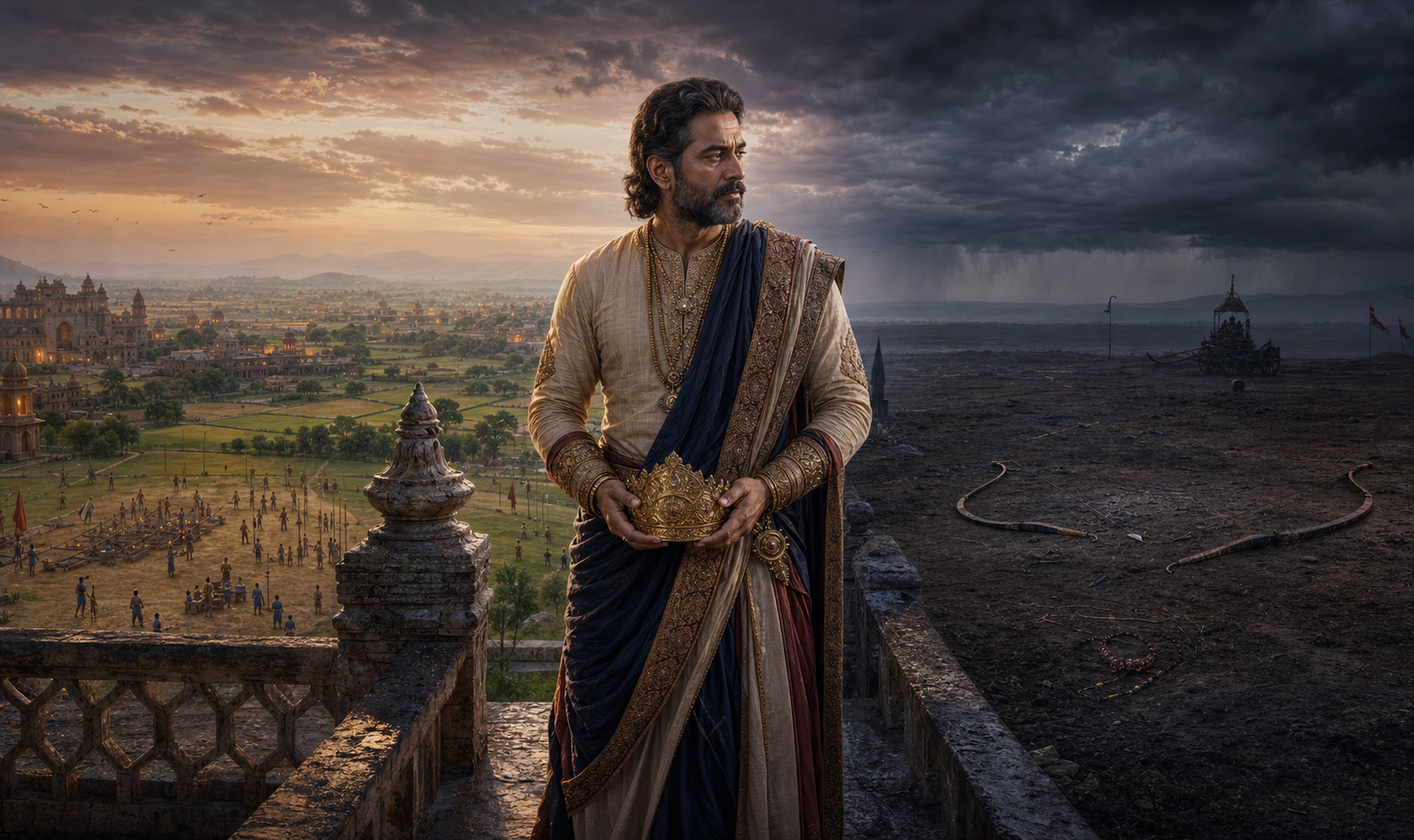
Drupada is often flattened into one of two convenient figures: a humiliated king justified in seeking redress, or a proud ruler whose vengeance eventually consumed his house. Neither reading is sufficient. To judge him more carefully, separate the justice of his cause, the motives behind his choices, the means used to pursue them, and the consequences that followed.
First, a compromised motive does not automatically make every associated cause unjust. Drupada carried a personal grievance against Drona, but Panchala’s alliance with the Pandavas was larger than that grievance. It supported Draupadi’s husbands, opposed the Kaurava order ranged against them, and supplied a disciplined coalition with essential military capacity. Reducing the alliance to Drupada’s anger erases the duties binding the two houses.
Second, a just cause does not purify every motive or method used in its service. Drupada’s search for a son destined to kill Drona shows how deeply retaliation had entered his plans. Dhrishtadyumna’s eventual killing of the disarmed Drona keeps the moral problem open. Dharma-yuddha cannot be assessed only by asking which side possessed the stronger claim; conduct under pressure also matters.
Third, distinguish personal heroism from responsible kingship. Drupada’s main achievement was not an undefeated record in single combat. It was the creation and commitment of durable political capacity: an alliance, a command structure, a field army, and successors able to continue after his death. When you read other rulers in the Mahabharata, ask the same question. Did the king merely fight bravely, or did he build the institutions and relationships that allowed others to act?
Finally, test victory by what it leaves behind. The Buddhist emphasis on kshanti warns that the craving for redress can perpetuate suffering. Jain anekantavada encourages humility when enemies each possess only a partial view of justice, while ahimsa keeps the human cost visible. The Sikh ideal of the sant-sipahi affirms disciplined resistance in defense of what is right without making hatred a virtue. These perspectives do not erase the kshatriya’s obligation to confront adharma; they sharpen the question of whether force remains governed by inner restraint.
When you next follow the Kurukshetra narrative, track Panchala across four transitions: the partition imposed by Drona, Draupadi’s alliance with the Pandavas, Shikhandi’s role on Day 10, and the shift to Drona’s command. Drupada then becomes visible not as a supporting name in another family’s war, but as the ruler whose wounded past, political judgment, army, and heirs helped determine the conflict’s course. Read him with sympathy, but also with the moral vigilance the Mahabharata demands whenever justice begins to carry the language of revenge.