
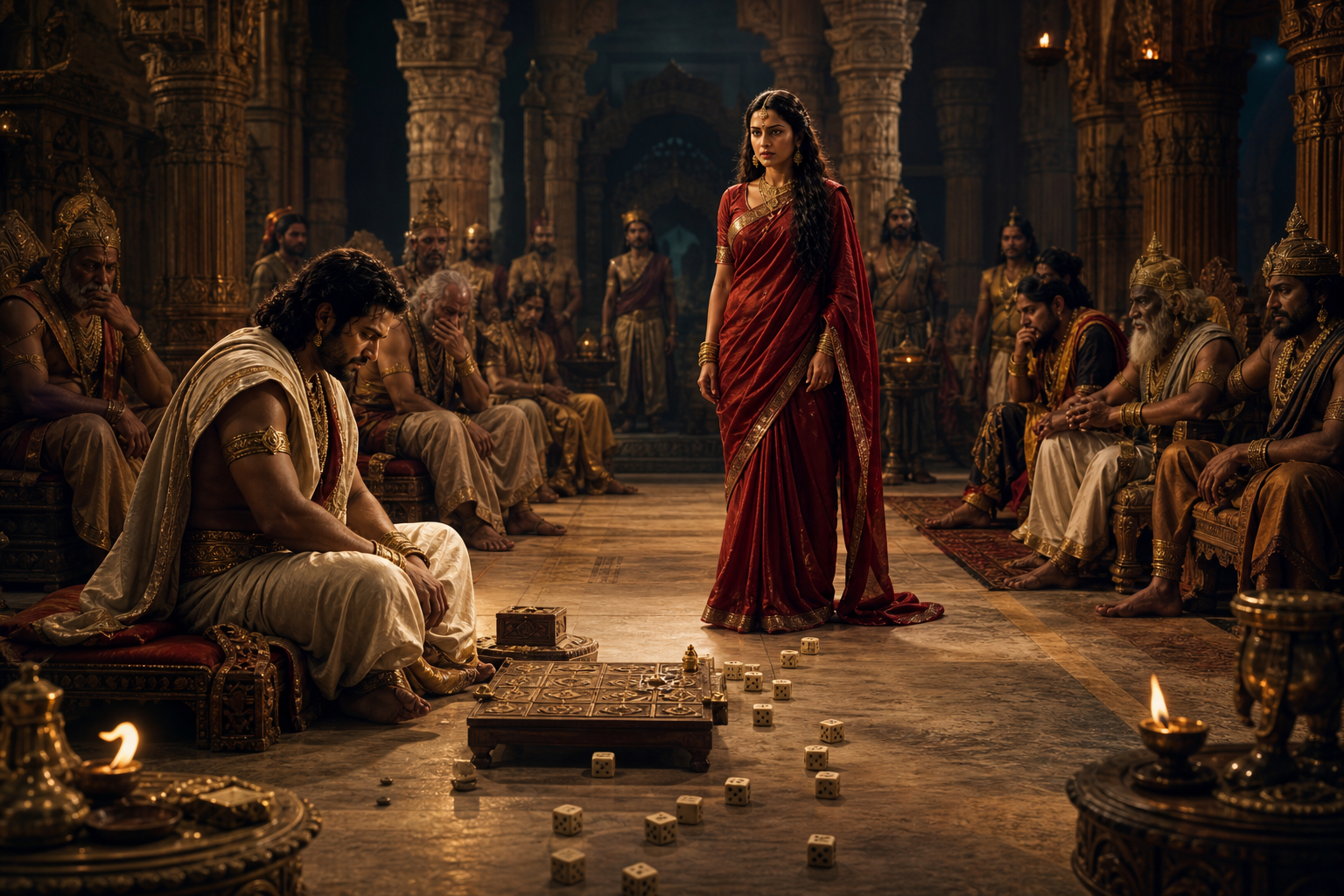
If you came to this episode wondering whether Draupadi was wrong to speak to Yudhishthira so fiercely, begin one step earlier. Ask what had to happen before she was forced to speak.
Her anger does not become adharmic merely because it disturbs a husband, a king, or a man respected for his commitment to dharma. It exposes a chain of decisions in which one person’s failure of self-command became another person’s humiliation, exile, dependence, and danger. Read that chain carefully and the episode gives you a practical way to distinguish righteous anger from uncontrolled rage.
The first wrong happened before Draupadi became angry
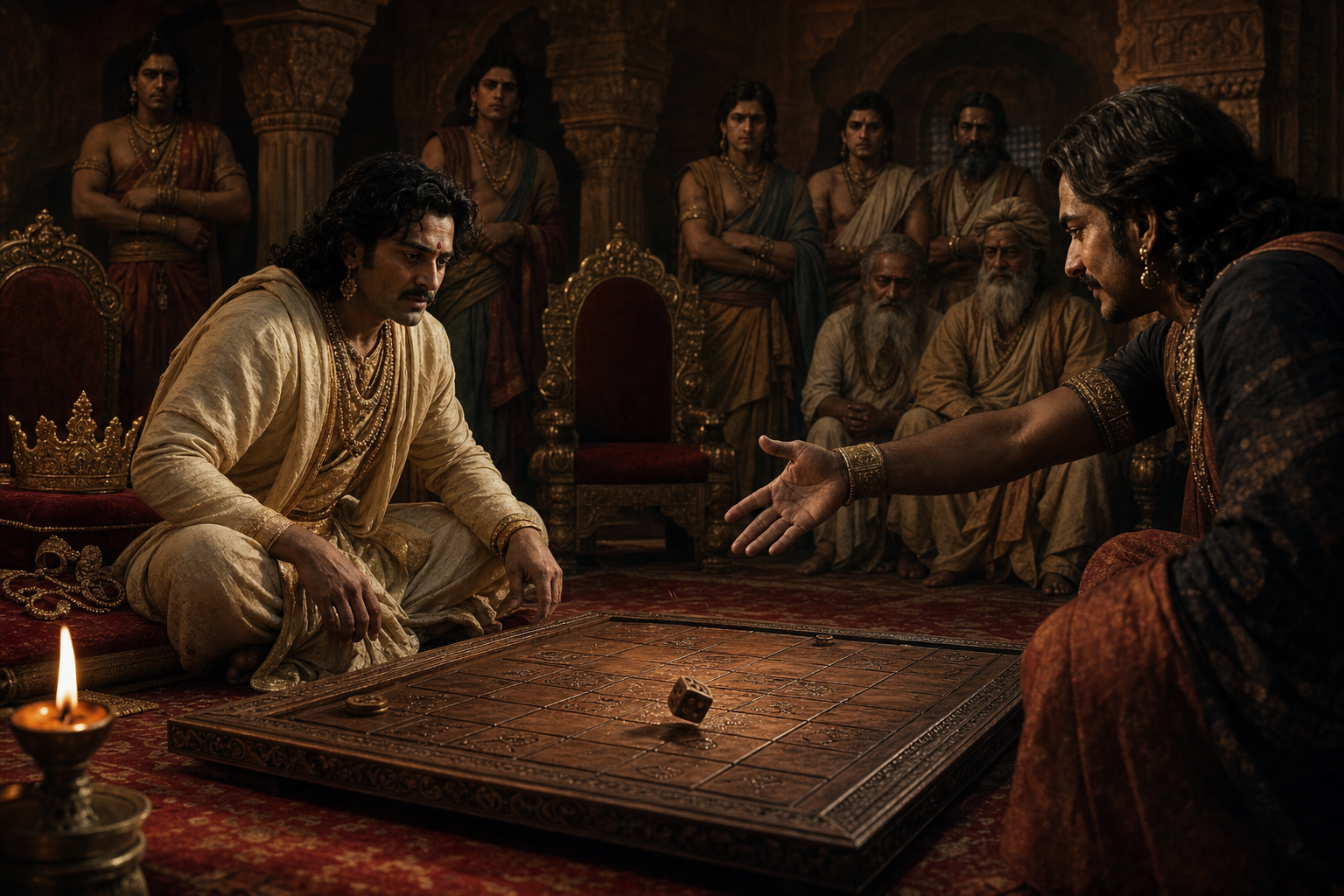
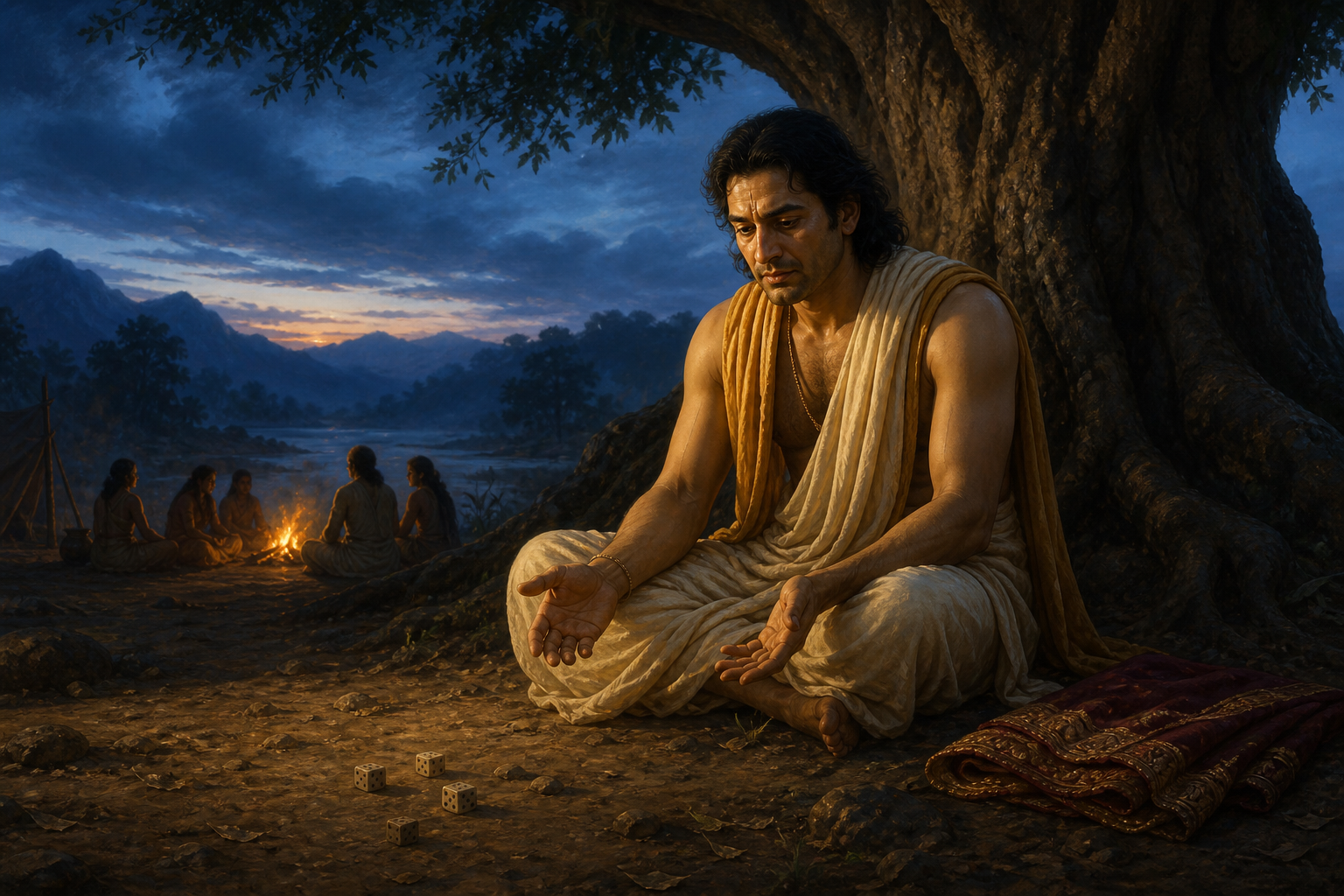
Discussions of the dice hall can become so focused on the cruelty that followed that Yudhishthira’s original agency recedes from view. That is a mistake. The wrongdoing of the Kauravas does not cancel his responsibility for choosing to gamble, continuing after grave losses, and allowing people over whom he had no rightful ownership to be treated as stakes.
Draupadi’s central challenge goes directly to authority: if Yudhishthira had already lost himself, what power remained in him to wager her? This is more than a technical puzzle about the order of bets. It exposes the contradiction of a man claiming authority over another person after surrendering authority over himself.
That distinction matters whenever you judge a respected person’s failure. Good intentions, social standing, past virtue, and pressure from others may explain a decision. They do not make every consequence morally transferable. A person can risk what is properly his to risk; he cannot convert another human being’s freedom and dignity into extensions of his own stake.
Use four questions when someone excuses the gambling as fate, weakness, etiquette, or political compulsion:
- What did he choose? Separate the invitation from the decision to participate and the first wager from the decision to continue.
- What was actually his to risk? Wealth and office already carry duties to others; another person can never be reduced to disposable property.
- Who absorbed the consequences? Draupadi bore public degradation and later vulnerability without having chosen the game.
- What would accountability require? Regret over losing is not enough. The deeper failure was claiming the power to expose others to that loss.
This is why calling gambling merely Yudhishthira’s weakness is incomplete. A private weakness becomes a public moral failure when authority magnifies it and dependants are made to pay for it.
Draupadi’s anger acts as moral intelligence
Dharmic teaching warns us that anger can cloud judgment. It does not follow that every forceful expression is morally blind. A calm falsehood does not become dharmic because it is spoken softly, and an uncomfortable truth does not become adharma because it is spoken with heat.
The useful question is not simply whether Draupadi was angry. Ask what her anger perceived, whom it held responsible, and what it sought to restore.
- Its object is a real violation. She is not enraged over wounded vanity or a minor preference. Her personhood, safety, and dignity have been placed in jeopardy.
- Its target is morally relevant. She challenges the men who acted, consented, remained silent, or failed in their duty to protect.
- Its language remains reasoned. She asks questions about ownership, authority, duty, and the validity of the wager. Anger supplies force without replacing thought.
- Its purpose is larger than emotional release. Her words demand that a court and a family confront the adharma they would rather normalize.
These tests also prevent a sentimental mistake. Anger is not automatically righteous because the angry person has suffered. It becomes morally instructive when it remains answerable to truth, directs attention toward the responsible choices, and protects a violated boundary rather than seeking indiscriminate harm.
Draupadi’s questions therefore do something that passive endurance cannot. They stop powerful people from using silence as evidence that no serious wrong occurred. Her anger restores the moral facts to a room determined to obscure them.
Virata reveals the long tail of Yudhishthira’s decision
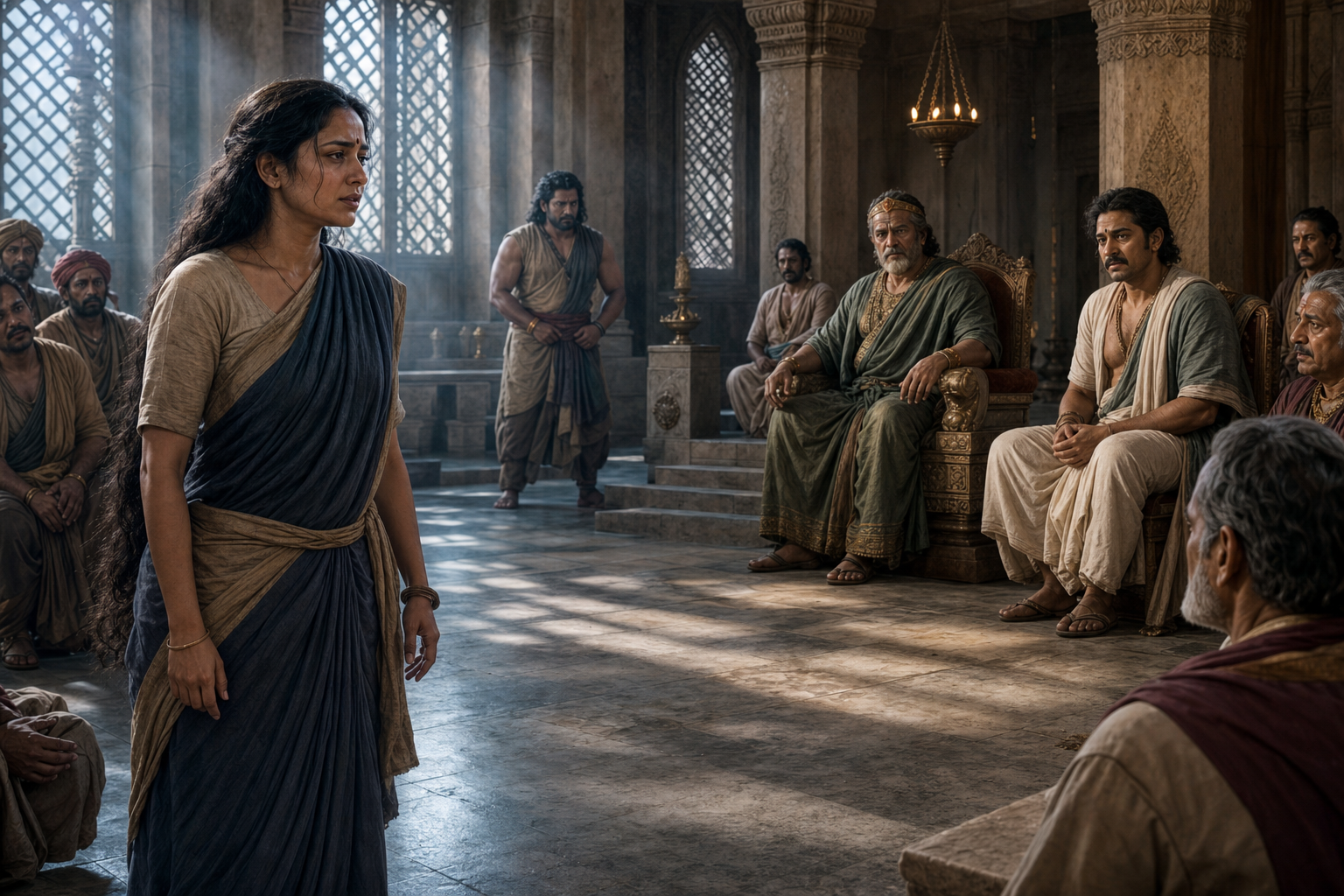
The consequences of the dice game do not end when the assembly disperses. During the thirteenth year of exile, the Pandavas live incognito in King Virata’s realm while Draupadi serves Queen Sudeshna as a sairandhri and Kichaka holds power as the queen’s brother and military commander. Draupadi’s vulnerable position is not an isolated misfortune. It lies downstream from the gambling that produced exile and concealment.
This is why her anger toward Yudhishthira has such force when Kichaka’s pursuit places her in danger. She is not dragging up an irrelevant past error. She is identifying the past decision that created her present exposure. What may look finished to the person who made a reckless choice can remain painfully current for the person still living inside its consequences.
Yudhishthira’s restraint during the incognito year has a strategic reason: the Pandavas must protect their concealment. But a strategic reason is not a complete moral answer when one vulnerable person is expected to absorb the danger created by everyone else’s plan. Draupadi’s protest forces that hidden cost into view.
When restraint is praised as patience, prudence, or peace, test it with five questions:
- Is the restraint protecting dharma, or merely protecting the decision-maker from embarrassment and responsibility?
- Who is paying for the delay?
- Has the endangered person been heard, or has strategy been decided over her head?
- Is there a concrete plan for protection, or only a demand that she endure longer?
- Has the person responsible acknowledged how his earlier choice created the present constraint?
A delay may sometimes be necessary. If so, the burden cannot simply be assigned to the least powerful person and then renamed patience. Dharma requires decision-makers to see the cost, minimize it, protect the person carrying it, and remain accountable for the conditions they created.
Accountability does not end where kinship begins
Draupadi’s confrontation is especially significant because it occurs within a family. She does not accept the idea that loyalty requires her to hide Yudhishthira’s failure. Nor does she treat his virtues as immunity from judgment.
This gives us a more demanding picture of Dharmic loyalty. Loyalty is not the suppression of truth for the comfort of a husband, elder, ruler, teacher, or community. It is a commitment to the person’s moral restoration, which sometimes requires refusing his preferred account of what happened.
That does not require flattening Yudhishthira into a villain. The Mahabharata’s moral seriousness depends on the opposite insight: a person capable of virtue can commit a devastating wrong. If we erase all his virtues, accountability becomes easy but shallow. If we use those virtues to excuse the wager, dharma becomes a privilege granted to the reputable. Draupadi allows neither escape.
If you need to confront a harmful decision in your own family, institution, or community, imitate the structure of her challenge rather than merely its intensity:
- Name the voluntary choice. Identify the decision, not the person’s entire character.
- Name the limit that was crossed. State what the person had no authority to risk, promise, disclose, surrender, or decide for someone else.
- Name the transferred cost. Explain who bore the danger, shame, debt, labour, or loss produced by the choice.
- Ask for repair at the level of the wrong. An apology for hurt feelings is inadequate if the real violation concerned consent, authority, or safety.
This method leaves room for repentance without making forgiveness a substitute for change. It also prevents a familiar diversion: debating the injured person’s tone while leaving the original abuse of power untouched.
Key takeaways
- Draupadi’s anger should be judged by the truth it identifies and the boundary it defends, not by the discomfort it causes powerful men.
- Yudhishthira’s gambling becomes more than a private weakness when he exposes other people to losses they did not choose.
- Her question about whether he could wager her after losing himself challenges both his self-mastery and his claimed authority over her.
- The danger she faces during the incognito year is a continuing consequence of the dice game, not a disconnected episode.
- Strategic restraint must be examined whenever its cost falls mainly on the vulnerable person asking for protection.
- Dharmic loyalty permits, and sometimes requires, direct accountability within a family or community.
When you return to this part of the Mahabharata, do not ask only whether Draupadi controlled her anger. Ask whether those with power controlled their appetite, their claims of authority, and their willingness to make her bear the consequences.
Carry the same discipline into your next conflict. Before criticizing the force of an injured person’s response, trace the decision that preceded it, identify who was entitled to decide, and see who is still paying. That is where accountable action begins.
References
