
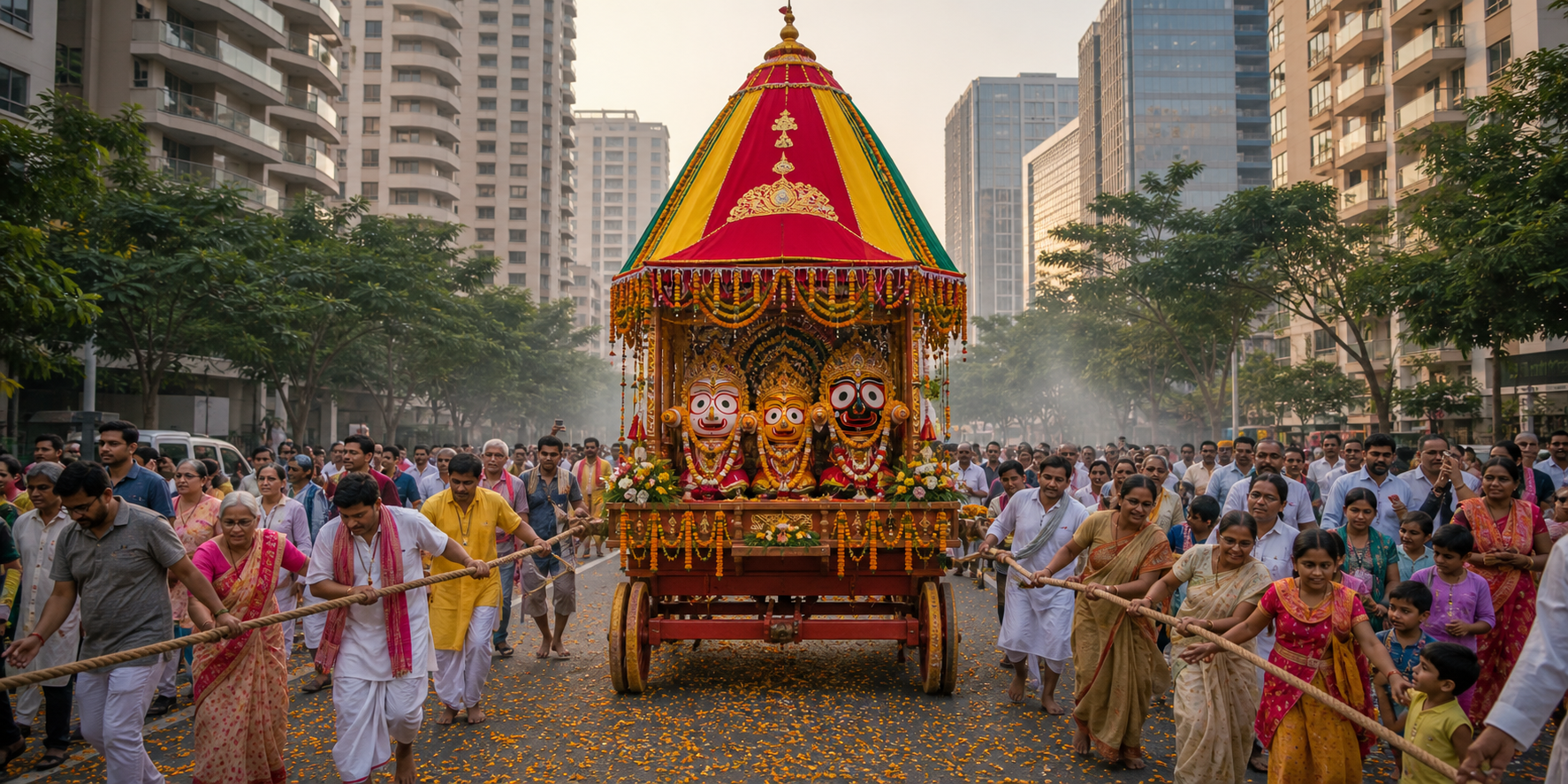
If you live in Gurugram, Rath Yatra can sound like a festival that requires a long trip to a large temple or a central procession. ISKCON Gurugram has demonstrated another model: bring Lord Jagannath into residential societies, sectors, schools, university grounds and surrounding towns so that the city’s ordinary routines become points of contact with the sacred.
That changes the question for you. Instead of asking whether you can spare an entire day, you can ask which nearby procession you can visit, what form of seva fits your circumstances and whom you can bring with you.
Twenty-five processions changed the meaning of access
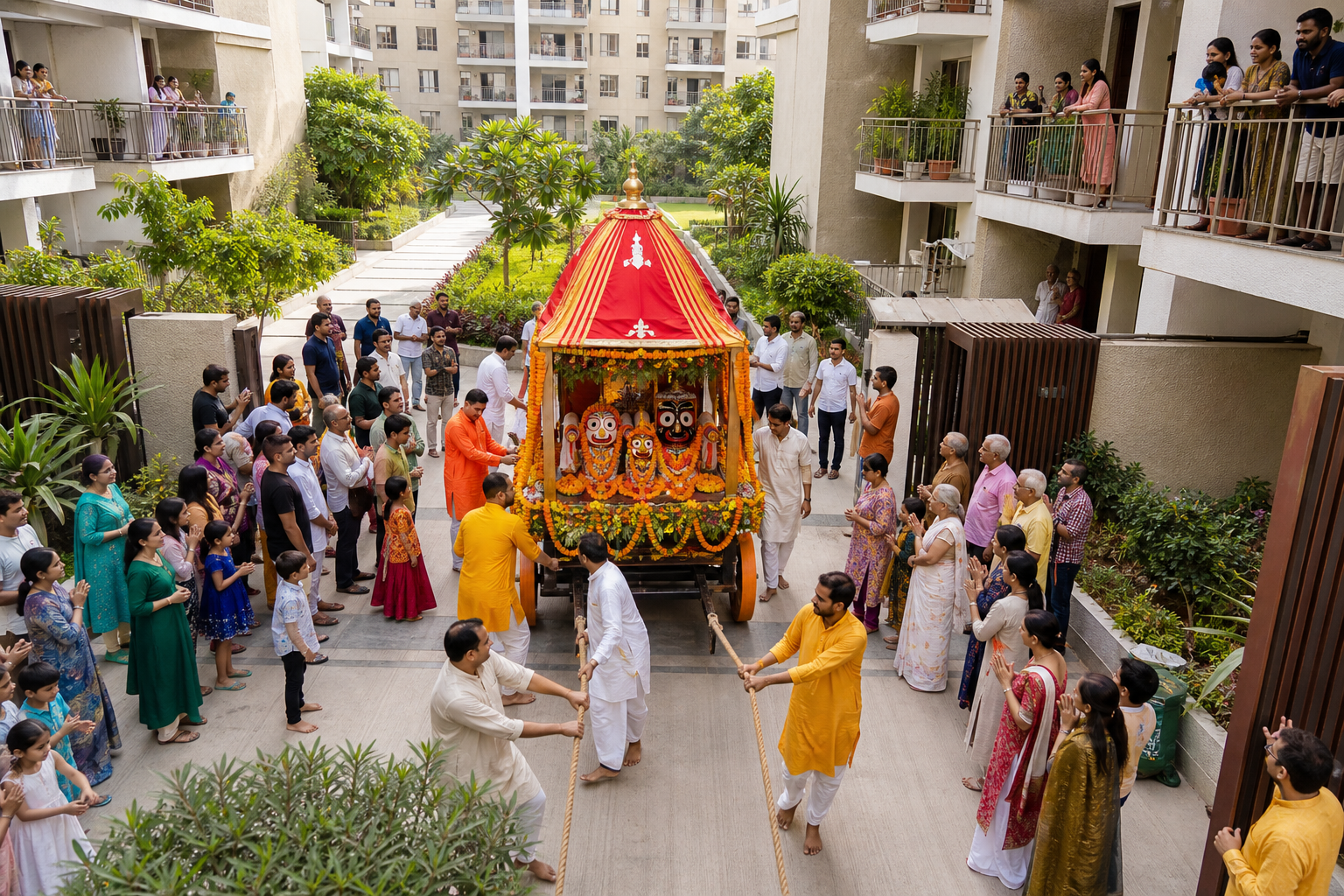
Between July 15 and 25, ISKCON Gurugram expanded its Rath Yatra Carnival from 11 processions to 25 processions across the Gurugram region. Those dates identify that edition of the carnival; they should not be assumed to be the permanent dates of every future celebration.
The routes reached Pataudi, Sohna, Farrukhnagar and Manesar as well as Gurugram sectors and residential communities. Essel Towers, Tata Primanti, JMD Gardens, AIPL Essencia, Monsoon Breeze Society, Nirvana Fresca, M3M Golf Estate, Orchid Avenue, Orchid Petals and Central Park were among the named locations. The programme also entered SGT University and Pranavananda International School in Sector 92.
The important feature is not merely the number 25. It is the distribution of the festival. A single grand procession asks the entire city to travel to one point. A network of smaller yatras takes darshan, kirtan and prasadam closer to the places where people already live and study. That is particularly valuable in a city where a demanding workday can make even a meaningful spiritual outing difficult to organise.
This approach also restores a traditional relationship between a procession and its locality. Rath Yatra is not meant to be watched only as a distant spectacle. The deity comes out from the temple, the street becomes a sacred route and residents help receive Lord Jagannath. When the yatra enters your neighbourhood, participation no longer depends on your familiarity with temple routines.
Darshan is the beginning, not the only way to join
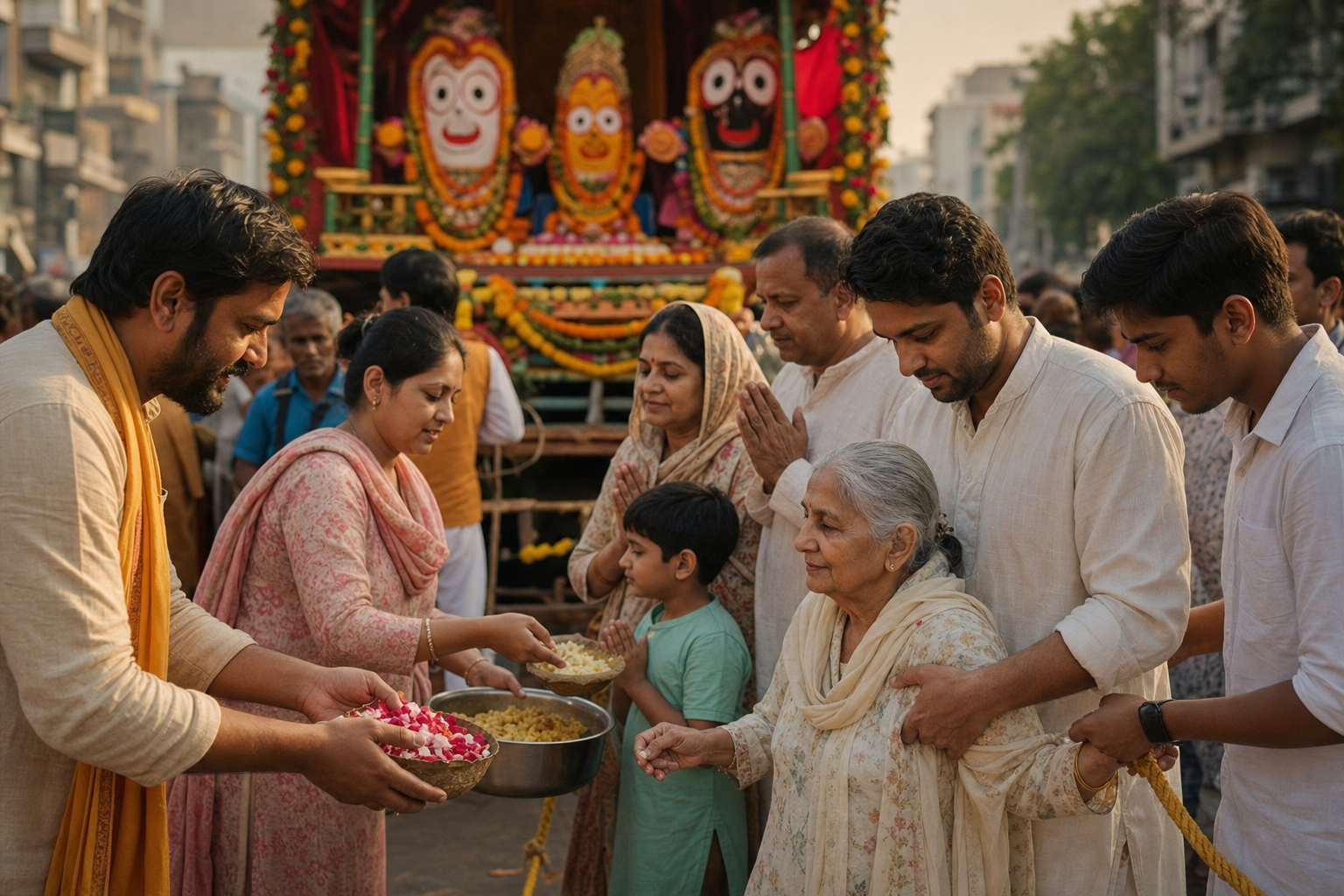
A Gurugram Rath Yatra brought together devotional dancing, congregational kirtan, drama, cultural performances and the distribution of prasadam, or food offered to the Lord. You did not need one prescribed level of commitment to belong. The festivities supported several forms of participation:
- If you had only a few minutes, you could receive darshan as the chariot passed.
- If you wanted to join publicly, you could walk with the procession, sing in the kirtan or dance before Lord Jagannath.
- Families could help children distribute flower petals or prasadam and take part in cultural presentations. Odissi dance was among the performances presented by children.
- People with cooking or decorative skills could assist with bhog preparations, rangoli or the decoration of the Lord’s route.
- Senior residents and experienced society members could help secure permissions and coordinate with residential management.
- Anyone seeking a deeper engagement could receive and read one of Srila Prabhupada’s books rather than allowing the encounter to end with the procession.
Even a balcony could become a place of participation. Hundreds of residents watched from their homes, and prasadam was passed upward to people on third- and fourth-floor balconies. That detail carries an important lesson for organisers: do not measure devotion only by who can walk beside the chariot. Older people, residents with limited mobility, parents supervising young children and people unable to leave home should still be noticed and included.
If a yatra passes near you, choose the form of participation that is actually possible. A brief darshan is not a failed attempt at joining the festival. If you have more time, convert attendance into seva by asking what practical task is still uncovered.
Why neighbourhood Rath Yatra belongs in a corporate city
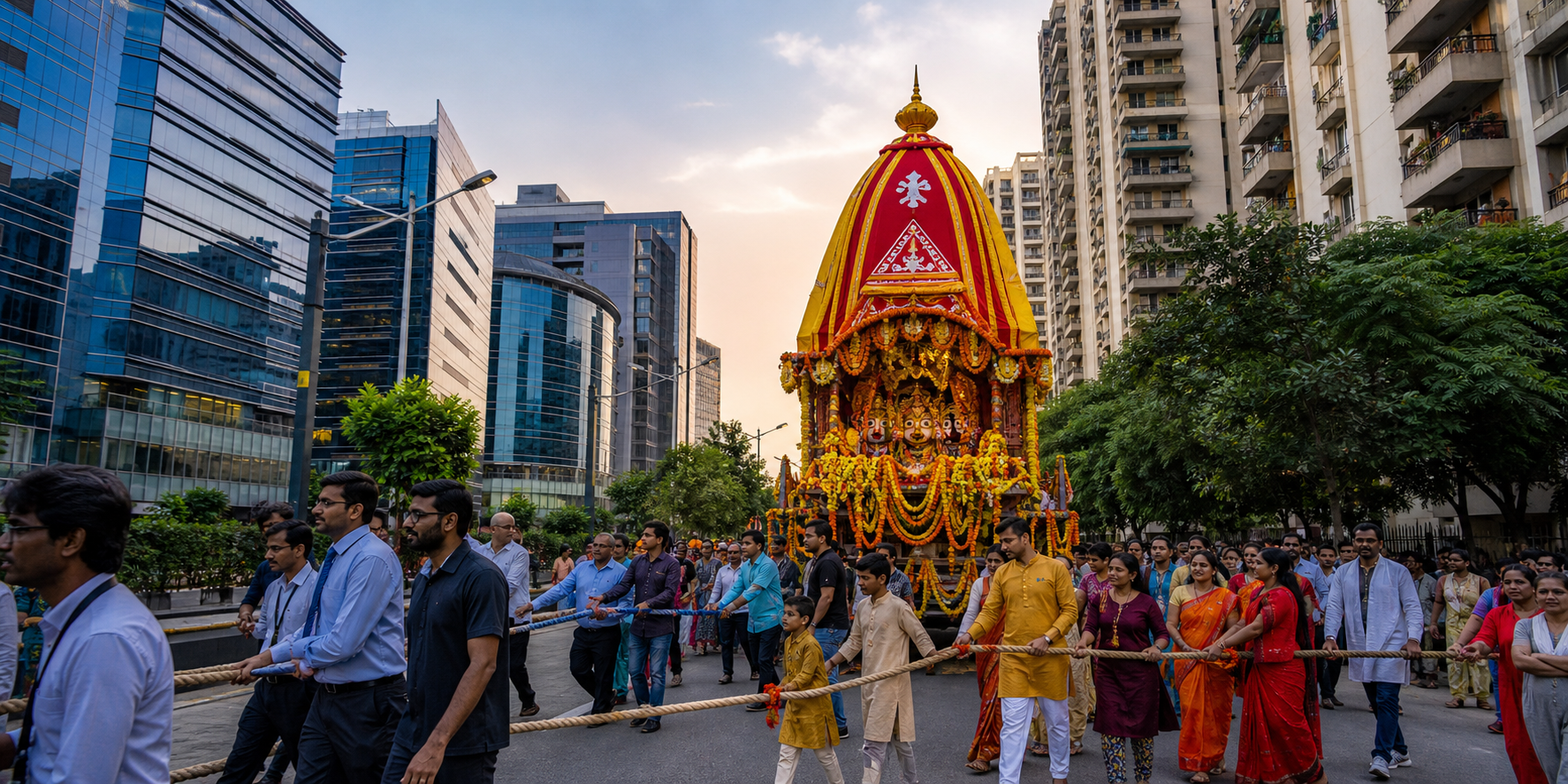
Gurugram is a recently developed corporate centre with large companies, thousands of startups and local offices belonging to more than 250 Fortune 500 companies. Its economic energy is obvious. Its cultural infrastructure is less evenly distributed, especially for residents who have little free time or no established religious community nearby.
Nuclear households and professional pressure can also leave people socially isolated even when they live in a densely populated society. A festival cannot cure loneliness or anxiety, and it should not be presented as a replacement for personal or professional support. It can, however, create a low-friction first meeting: neighbours sing together, children receive visible responsibilities, older residents contribute organisational knowledge and families share prasadam.
The durable value appears when those encounters continue after the chariot has moved on. If you meet another devotee in your society, exchange contact details. If your child enjoys a performance, find out whether the local group meets again. If you accept a book, set aside time to read it. A procession can open a door, but a recurring satsanga or seva relationship is what turns one evening of celebration into community.
The scale of the carnival shows how hospitality and teaching can work together. Across the 25 yatras, around 50,000 people received Jagannath prasadam and about 5,300 books by Srila Prabhupada were distributed. Prasadam offered an immediate, welcoming encounter; the books gave interested participants a path toward sustained study. Neither required a newcomer to prove prior knowledge before being included.
This neighbourhood model follows a longer ISKCON history. Srila Prabhupada introduced an ISKCON Rath Yatra outside India in San Francisco in 1967, after which the celebration spread to major cities around the world. In ISKCON’s theological understanding, taking Lord Jagannath beyond temple walls expresses divine mercy offered without waiting for every person to enter a temple first. Gurugram applies that principle at the scale of a sector, housing society, school or nearby town.
Key takeaways for residents and local organisers
- Do not assume Rath Yatra requires travelling to one central venue. ISKCON Gurugram has used multiple local routes across sectors, societies, institutions and neighbouring towns.
- Participation can mean darshan, kirtan, dancing, prasadam distribution, rangoli, bhog preparation, cultural performance or administrative coordination.
- Design the yatra for people at different life stages. Children, working adults, senior citizens and residents watching from balconies can all have a meaningful place.
- Use prasadam as hospitality and spiritual literature as an invitation to go deeper; the two serve different but complementary purposes.
- Verify the next procession’s date and route through ISKCON Gurugram’s official channels. Do not treat the July 15-25 period as a fixed annual schedule.
How to prepare for the next procession near you
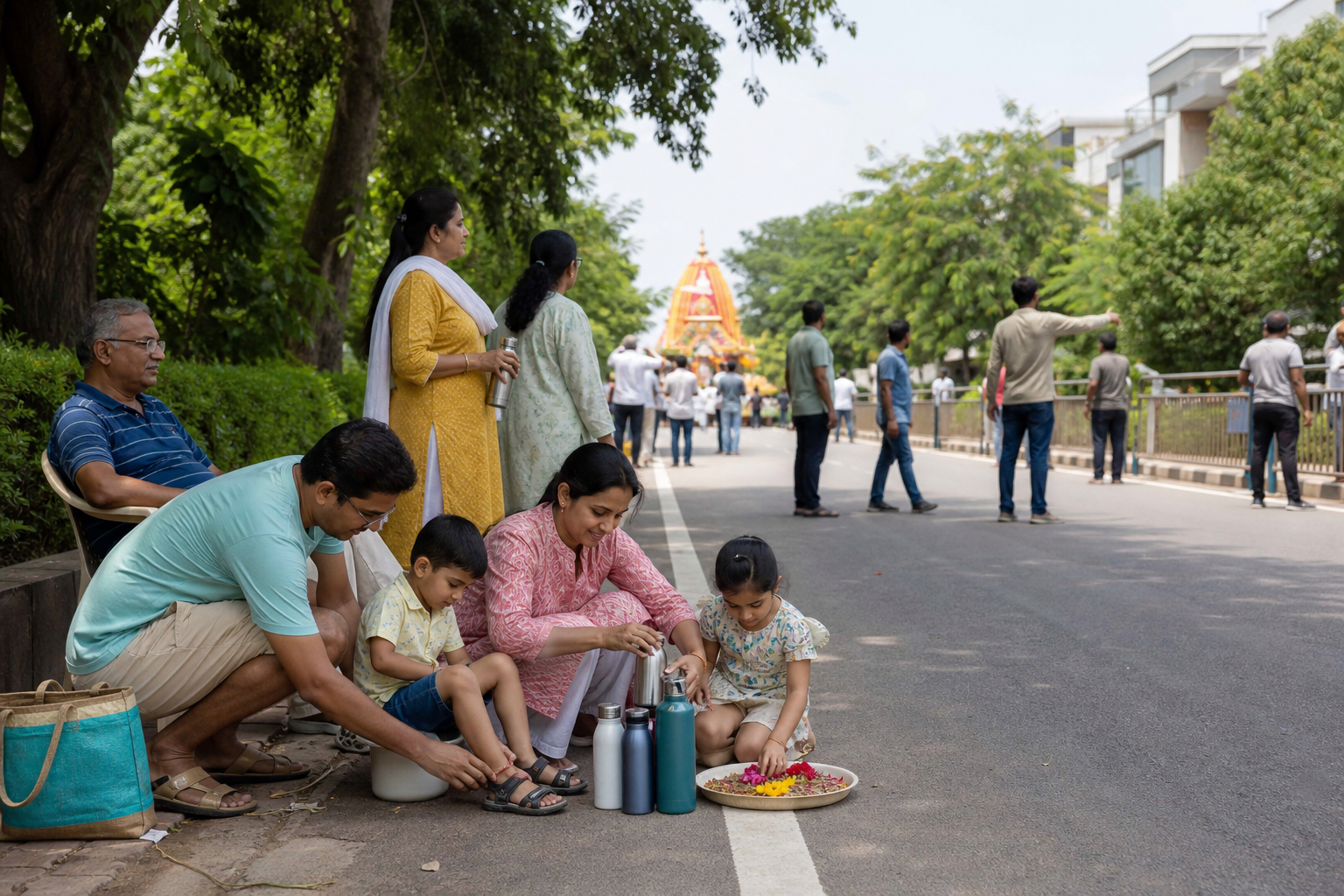
Start by checking ISKCON Gurugram’s current announcements through Instagram at @iskcongurugram, YouTube at @ISKCONGurugram or the organisation’s website, iskcongurugram.com. Confirm the exact location, date and route before making plans, because a past carnival’s itinerary is not a future schedule.
Then decide in advance how you want to take part. That small decision prevents the yatra from becoming something you simply watch and forget:
- For a first visit, arrive for darshan, stay through one period of kirtan and receive prasadam respectfully.
- For family participation, ask whether children can offer petals, help distribute prasadam or join an appropriate cultural presentation.
- For personal seva, offer one concrete skill such as rangoli, bhog preparation, route decoration or guest assistance.
- For residents with limited mobility, identify a safe balcony or accessible viewing point and tell organisers where assistance may be needed.
- For a society that hopes to host a future yatra, begin with management permission and civic coordination. The Gurugram processions depended on residents who took responsibility for precisely that work.
Finally, bring one neighbour who might not attend alone. Rath Yatra becomes part of the city’s living dharmic culture when darshan leads to a relationship, seva leads to responsibility and a residential address becomes a place where people can gather again.
References
