
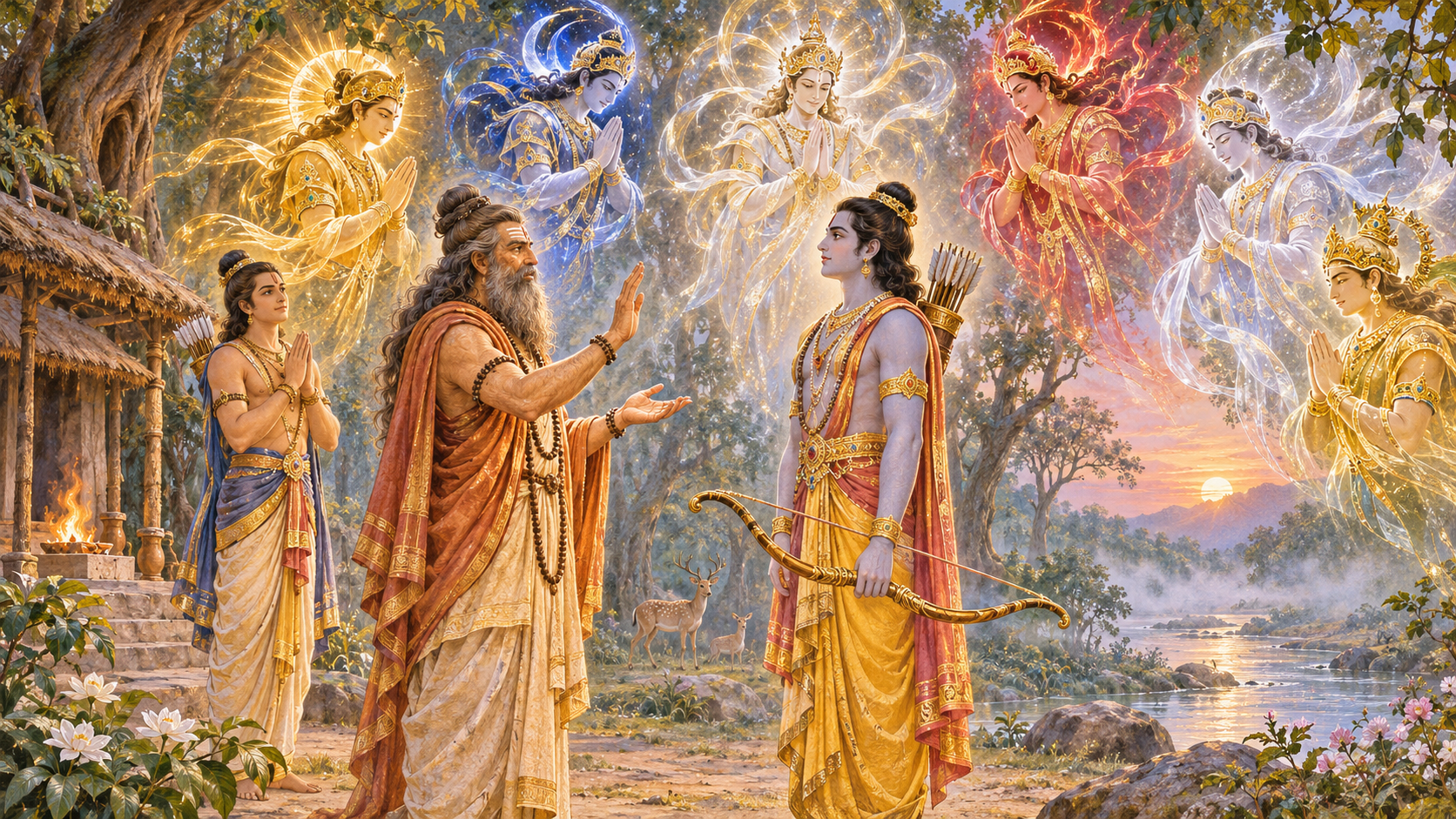
If you have been told that the astras of the Ramayana must be either ancient missiles or imaginary ornaments, you have been handed a false choice. The episode in which Vishwamitra gives divine weapons to Rama offers a more faithful starting point: ask who entrusts the power, how it becomes available, and what duty it is meant to serve.
This approach lets you take the sacred narrative seriously without forcing it into a modern weapons catalogue. It also reveals the central lesson of the episode: in the Ramayana, extraordinary power becomes meaningful only when it is joined to mantra, rightful transmission, disciplined agency, and dharma.
Begin with the sequence, not the spectacle
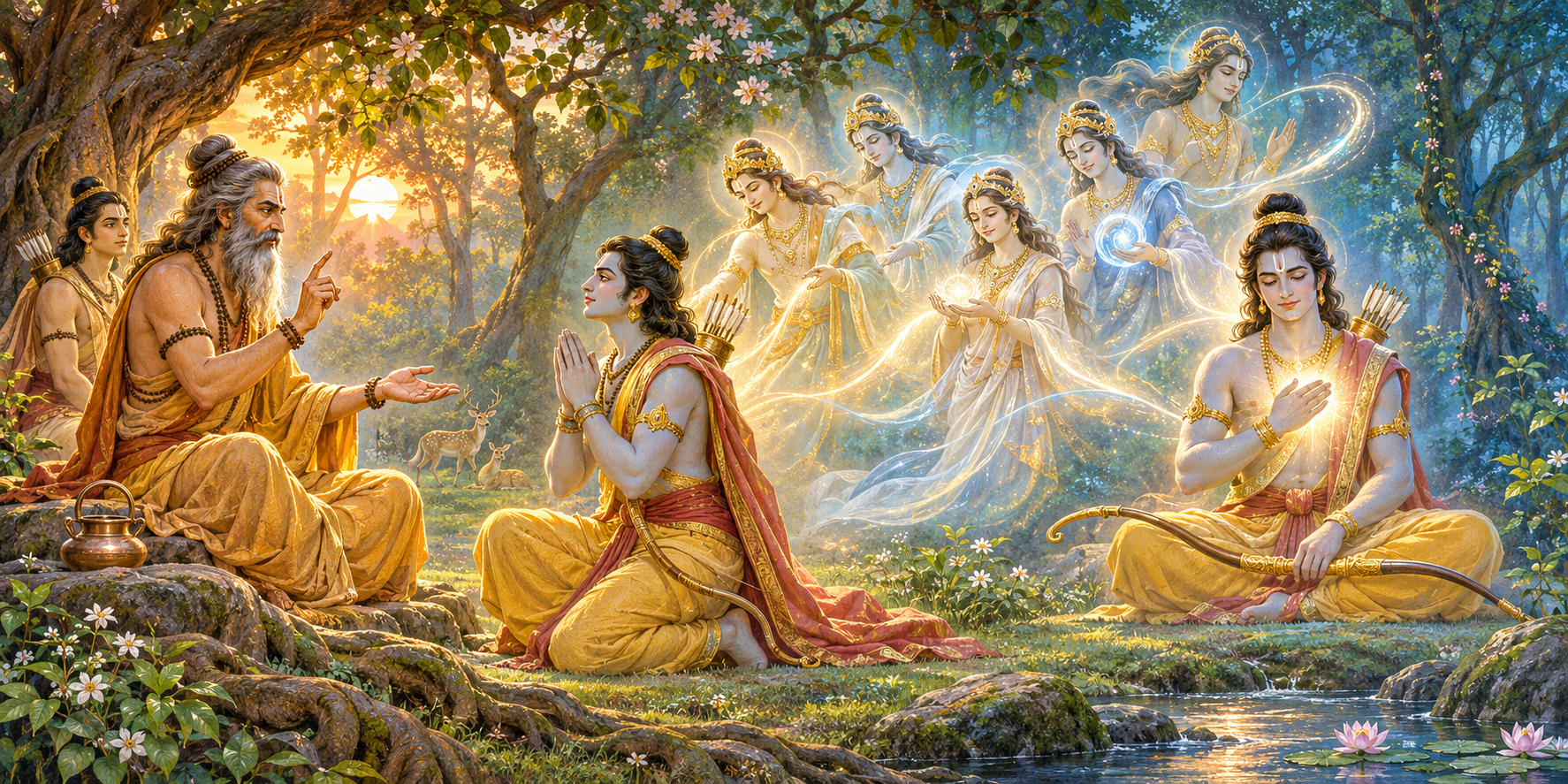
The setting tells you how to read the gift. Vishwamitra takes Rama and Lakshmana to his ashrama so that the princes can protect a yajna from rakshasas. In Bala Kanda, chapter 26, the sage gives Rama many divine astras that manifest in human form when their mantras are chanted.
Notice the order. A sacred undertaking must be protected. A sage calls the princes into service. Rama receives power through that relationship. Mantra mediates its manifestation. Only then do the weapons stand before him.
That order is the ethical grammar of the scene. Rama is not collecting impressive objects for private ambition. The astras enter a defined relationship involving a teacher, a recipient, a sacred responsibility, and an immediate threat to that responsibility. If you detach the weapons from this setting, you remove the very details that explain why Rama is entrusted with them.
When you read this passage, write its sequence in the margin: duty, teacher, mantra, manifestation, entrusted power. This simple exercise prevents the dazzling element from swallowing the moral structure around it.
Why “ancient missile or mere metaphor” is the wrong question
Modern discussions often begin by asking which present-day weapon an astra resembles. Others react by treating every supernatural element as a symbol with no reality inside the narrative. Neither approach is sufficient on its own.
- At the narrative level, the astras are real powers received by Rama. The story does not present them as figures of speech used by a commentator outside the action.
- At the symbolic level, their mode of appearance carries meaning. A power that assumes human form is represented differently from an inert object lying in an armoury.
- At the technological level, a comparison with modern missiles would require details about physical construction and operation. The scene described here instead emphasises Vishwamitra, mantra, manifestation, and the fitness of the recipient.
You do not have to deny the reality of the astras within the Ramayana in order to recognise their philosophical meaning. Nor do you have to convert them into modern machinery to defend the sophistication of Bharatiya civilisation. A sacred narrative can describe effective power through categories that are neither childish fantasy nor disguised contemporary engineering.
The disciplined course is to preserve the categories the episode actually gives you. Call the weapons astras. Retain the role of mantra. Retain their human manifestation. Retain the authority of Vishwamitra and the protection of the yajna. A modern analogy may help you think, but it must not replace these elements.
Human form and mantra make the astras relational
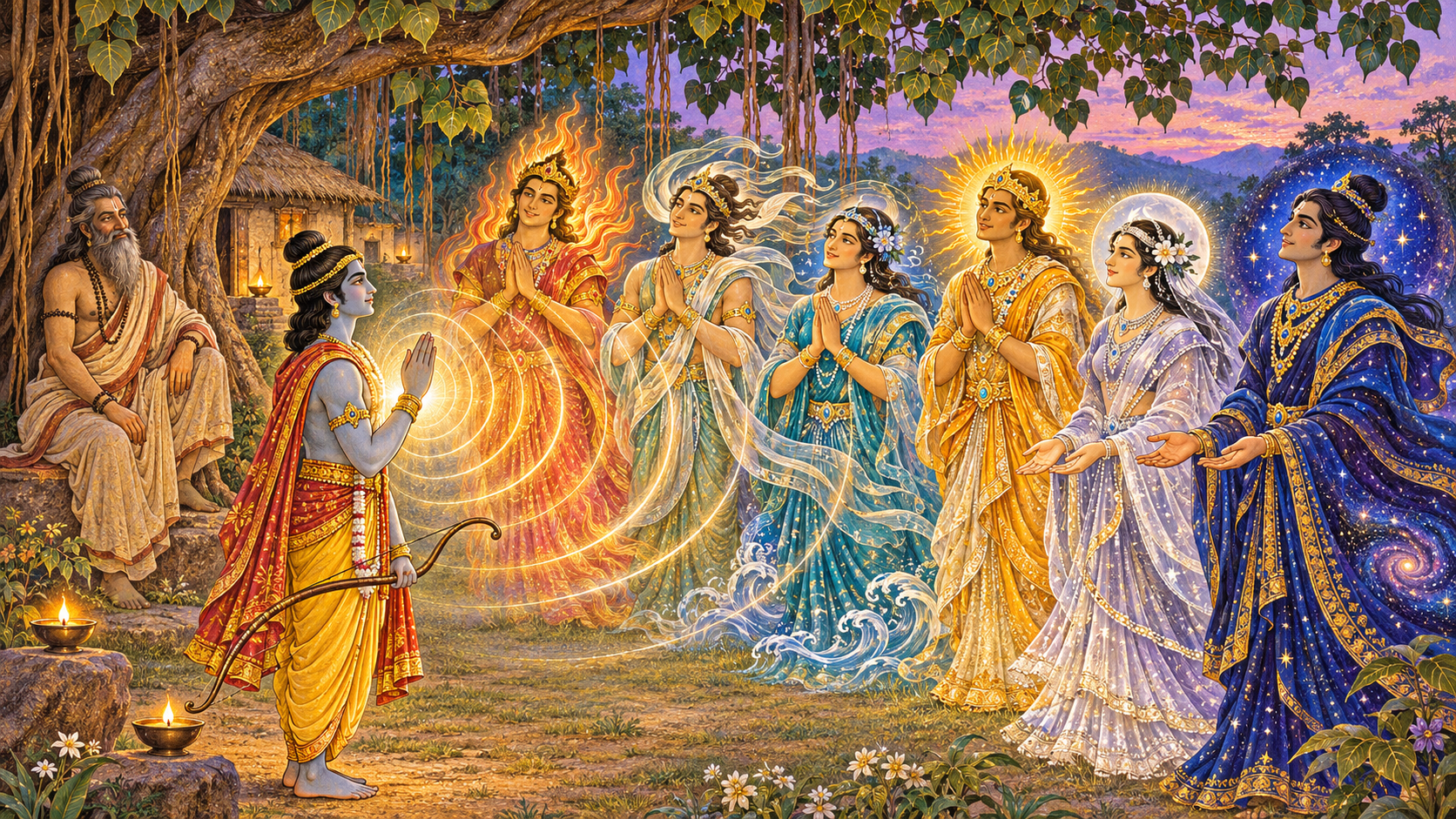
An ordinary object can be picked up without acknowledging it. A being that stands before you must be encountered. By making the astras appear in human form, the narrative presents power as an addressable presence within a relationship.
This does not mean that every weapon must be reduced to a separate psychological faculty, deity, or allegory. The safer conclusion is narrower and stronger: the episode refuses to portray divine power as lifeless equipment. Its personified appearance makes Rama’s relation to that power visible.
Mantra reinforces the same point. In this scene, manifestation is connected to sacred utterance rather than mere physical possession. That distinction matters. A launch code belongs to a machine that is already available to whoever controls the hardware. Mantra in a Dharmic setting carries associations of transmitted knowledge, disciplined recitation, and fitness to receive what is invoked. Treating it as nothing more than a password removes the spiritual discipline from the event.
Vishwamitra’s role is therefore as important as the weapons themselves. Rama does not stumble upon an abandoned arsenal. He receives the astras from a rishi while carrying out a duty assigned by that rishi. The gift joins capability to instruction and authority.
This gives you a useful test for any interpretation: does it explain why the weapons manifest through mantra and why a sage transmits them to Rama? If an explanation could remain unchanged after removing both facts, it is probably explaining a modern idea of weaponry rather than this Ramayana episode.
A five-step method for reading every astra episode
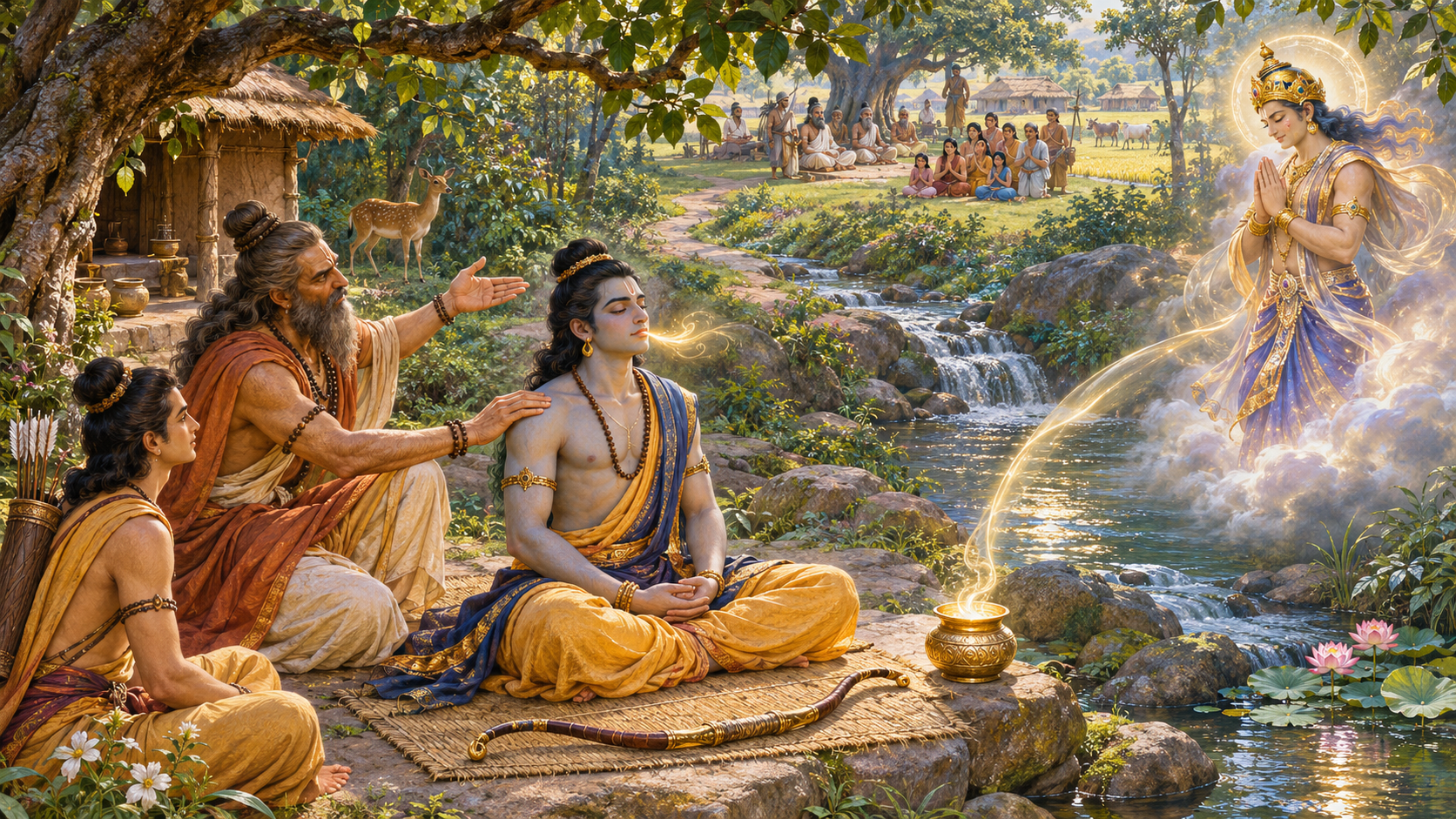
You can apply the following method whenever you encounter a divine weapon in an epic retelling, translation, discourse, or online debate.
- Fix the narrative setting. Ask what duty, conflict, or sacred purpose is already present before the astra appears. Here, the governing purpose is the protection of a yajna.
- Identify the chain of entrustment. Note who gives the power and who receives it. In this episode, Vishwamitra gives the astras to Rama. That relationship is part of the meaning, not incidental scenery.
- Preserve the stated mode of access. If mantra is involved, do not silently replace it with a mechanical trigger. If the weapons manifest in human form, do not rewrite them as anonymous pieces of equipment.
- Separate description from inference. “The astras appear in human form” belongs to the narrated event. “They were nuclear warheads” or “they were only mental symbols” adds a theory. A theory may be discussed, but it should never be passed off as the scene’s own wording.
- Test the reading against dharma. Ask whether the interpretation accounts for purpose, responsibility, and restraint, or whether it celebrates destructive capacity by itself. The episode begins with sacred duty, so an interpretation centred only on firepower is incomplete.
This method is especially useful when a summary says that Rama simply “acquired superweapons.” Ask what has disappeared from that sentence. Usually it is the sage, the mantra, the human manifestation, or the yajna. Restoring those elements transforms the passage from an arms-acquisition story into an account of power placed under sacred discipline.
The same method protects you from exaggerated claims in either direction. If someone calls the astras mere fantasy, ask whether that label explains the carefully presented relationship between the rishi, Rama, mantra, and duty. If someone claims the scene proves a specific modern technology, ask for the textual mechanism that justifies that precise identification. Respect for the Ramayana does not require careless certainty.
Key takeaways
- Rama receives the astras within a mission to protect a yajna, so duty comes before weaponry.
- Vishwamitra’s gift represents entrusted power, not power seized for personal ambition.
- The astras’ human manifestation keeps them from being reduced to inert equipment.
- Mantra is part of how the power becomes present; removing it changes the character of the episode.
- A sound reading distinguishes what the Ramayana narrates from modern technological or purely allegorical theories imposed upon it.
The next time you meet an astra in the Ramayana, pause before asking what modern weapon it resembles. First mark the duty, the giver, the mantra, the recipient, and the purpose. You will see more than a spectacular weapon: you will see the demanding Dharmic question of who may hold power, under whose guidance, and in service of what.
References

Leave a Reply
You must be logged in to post a comment.