If you have found Dhata in a list of the twelve Adityas, you may be wondering what distinguishes him from the other solar deities. You may also have encountered apparently different descriptions: creator, supporter of the world, guardian of order, or giver of health and prosperity.
These descriptions become coherent once you read Dhata through one central idea: establishment. Dhata represents the power by which life is placed on a sound foundation, kept within order, and made capable of enduring. That meaning also gives you a practical test for Dhata worship: it should establish better conduct and steadier rhythms, not merely express a wish for favourable results.
Begin with Dhata’s name, not a narrow divine portfolio
The name Dhata comes from the Sanskrit verbal root dha, carrying senses such as placing, upholding, and establishing. Dhata is therefore better understood as the establisher or supporter than as the deity of one isolated benefit.
This distinction matters. If you approach Dhata only as a giver of wealth, you miss the order that makes wealth beneficial and durable. If you approach him only for relief from illness or worry, you miss the habits, relationships, and responsibilities that support well-being. His three commonly associated blessings—health, prosperity, and peace—belong together because all three depend upon a life that has been properly ordered.
Dhata belongs to the lineage of the Adityas and is described as a son of Aditi and Kashyapa. The solar character of an Aditya is not limited to visible sunlight. It also signifies clarity, vitality, regularity, and the moral illumination by which human action can be aligned with rta, the order that sustains both nature and society.
Key takeaways
- Dhata’s defining function is establishment: placing life, conduct, and prosperity on a stable foundation.
- The Vedic emphasis falls on the Adityas as guardians of rta; Puranic tradition gives Dhata a clearer individual place among twelve Adityas.
- Dhata’s association with health, wealth, and peace does not promise a shortcut. It joins desired outcomes to disciplined, ethical conduct.
- A practical observance can be simple: sunrise arghya, a sincere sankalpa, mantra recitation, and one concrete act of service.
- Devotion should complement medical care and responsible financial planning, never replace them.
Keep the Vedic and Puranic layers distinct
The Vedic and Puranic presentations are related, but they do not organize the divine world in exactly the same way. Keeping their emphases distinct prevents two common mistakes: forcing a later system into every Vedic passage, or treating theological development as if it were a contradiction.
In the Rigveda, the Adityas are often praised collectively. Their shared work is the protection of rta, including the lawful, moral, and cosmic conditions under which life can flourish. When you meet an Aditya in this setting, begin with the collective function: vigilance over truth, right relation, and sustaining order.
Puranic tradition presents a more formal group of twelve Adityas and gives individual members more definite identities. The exact enumerations can differ modestly, so a variation between lists need not be treated as a theological crisis. Dhata’s inclusion is notably stable across those varying enumerations, and his connection with support and establishment remains the interpretive anchor.
Some Puranic treatments bring Dhata’s function conceptually close to Brahma and creative activity. Others present Dhata as a distinct solar principle responsible for continuity, well-being, and social balance. You do not have to erase either presentation. Creation requires more than an initial act of bringing forth; it also requires the placement, structure, and continuity by which what has arisen can remain viable. Dhata names that establishing power.
Use three questions when a passage about Dhata seems unclear:
- Is the passage speaking about the Adityas collectively as guardians of rta?
- Is it naming Dhata individually within the Puranic group of twelve?
- Is it emphasizing a creative function, a sustaining function, or both?
Those questions usually reveal why one passage sounds more cosmic, another more genealogical, and another more devotional. They also stop conceptual closeness to Brahma from being turned into a universal equation that every passage must follow.
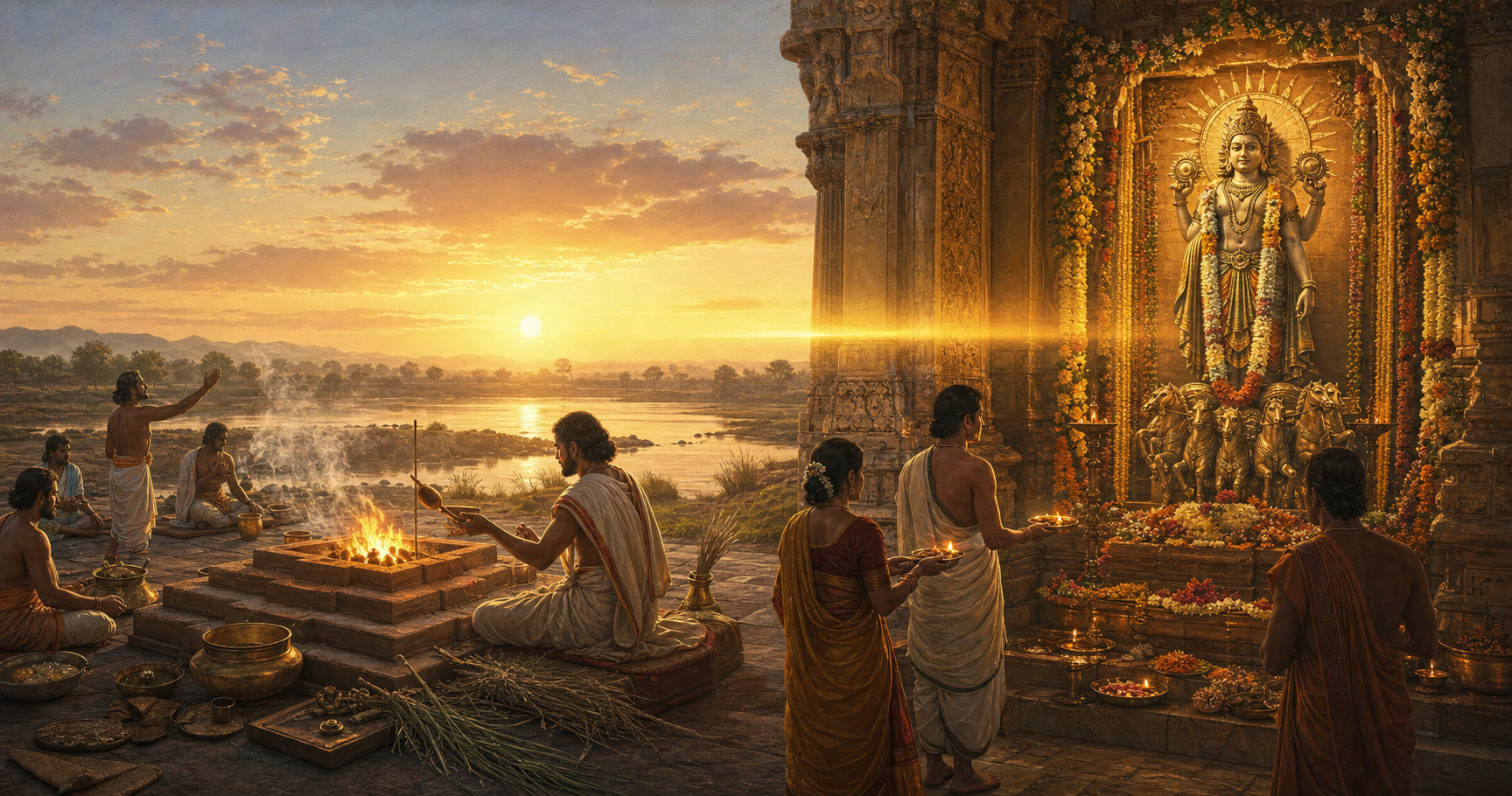
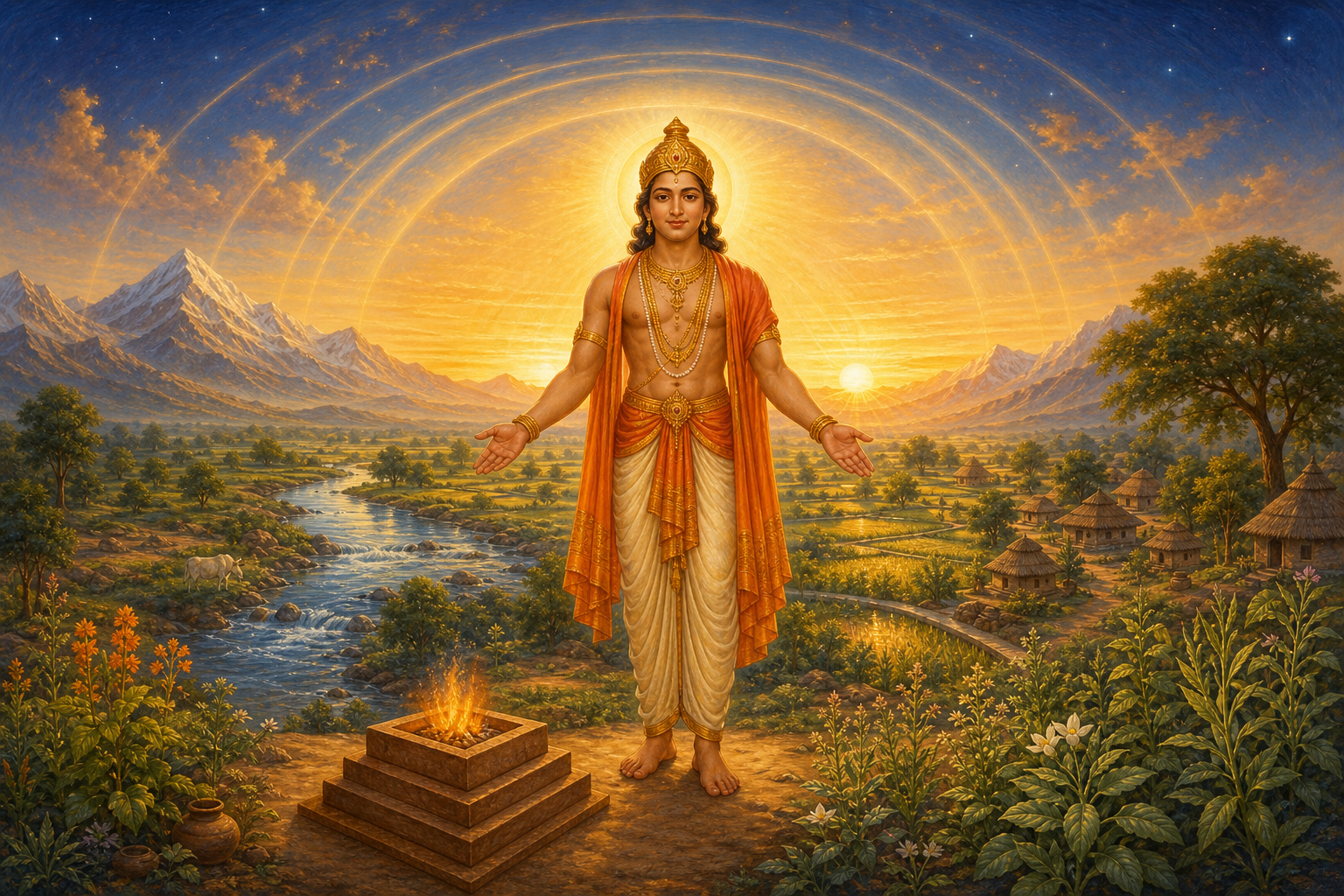
Dhata’s imagery should be read with similar care. Adityas commonly share a luminous appearance and solar symbols. Lotuses and water vessels can signify purity, nourishment, and sustaining life; the sun’s chariot and seven horses evoke light and recurring rhythm. A regional image need not contain every attribute to express Dhata’s function. Look first for the visual language of light, life, order, and support.
Health, prosperity, and peace are one dharmic project
Dhata’s blessings are sometimes reduced to a devotional shopping list: health, money, and a quiet mind. The deeper pattern is more demanding. Each blessing must be established within dharma, because an apparent gain that damages truth, responsibility, or another person’s welfare is not peaceful prosperity.
Health means vitality and resilience within an ordered life. A prayer for health should therefore be accompanied by an honest look at the routines you can govern: when you rise, how consistently you care for the body, whether agitation dominates the day, and whether you seek appropriate care when it is needed. Mantra, breath awareness, and a daylight-aligned routine may support attention and steadiness, but worship is not a diagnosis or a cure. Do not delay medical evaluation or replace prescribed care with ritual.
Prosperity means resourcefulness that can be sustained without violating dharma. Dhata’s perspective asks more than, “Did I acquire this?” It asks, “Was it gained truthfully, can it be maintained responsibly, and whom does it serve?” This is measured abundance rather than accumulation without limit. Devotion does not guarantee income or remove financial risk, so decisions involving debt, investment, or livelihood still require responsible planning and qualified advice where appropriate.
Peace means more than temporary relief from uncomfortable thoughts. It includes inner composure and social harmony produced by bringing action into line with values. Sometimes the dharmic route to peace is not withdrawal but a needed conversation, a repaired obligation, or an end to a habit that repeatedly creates disorder.
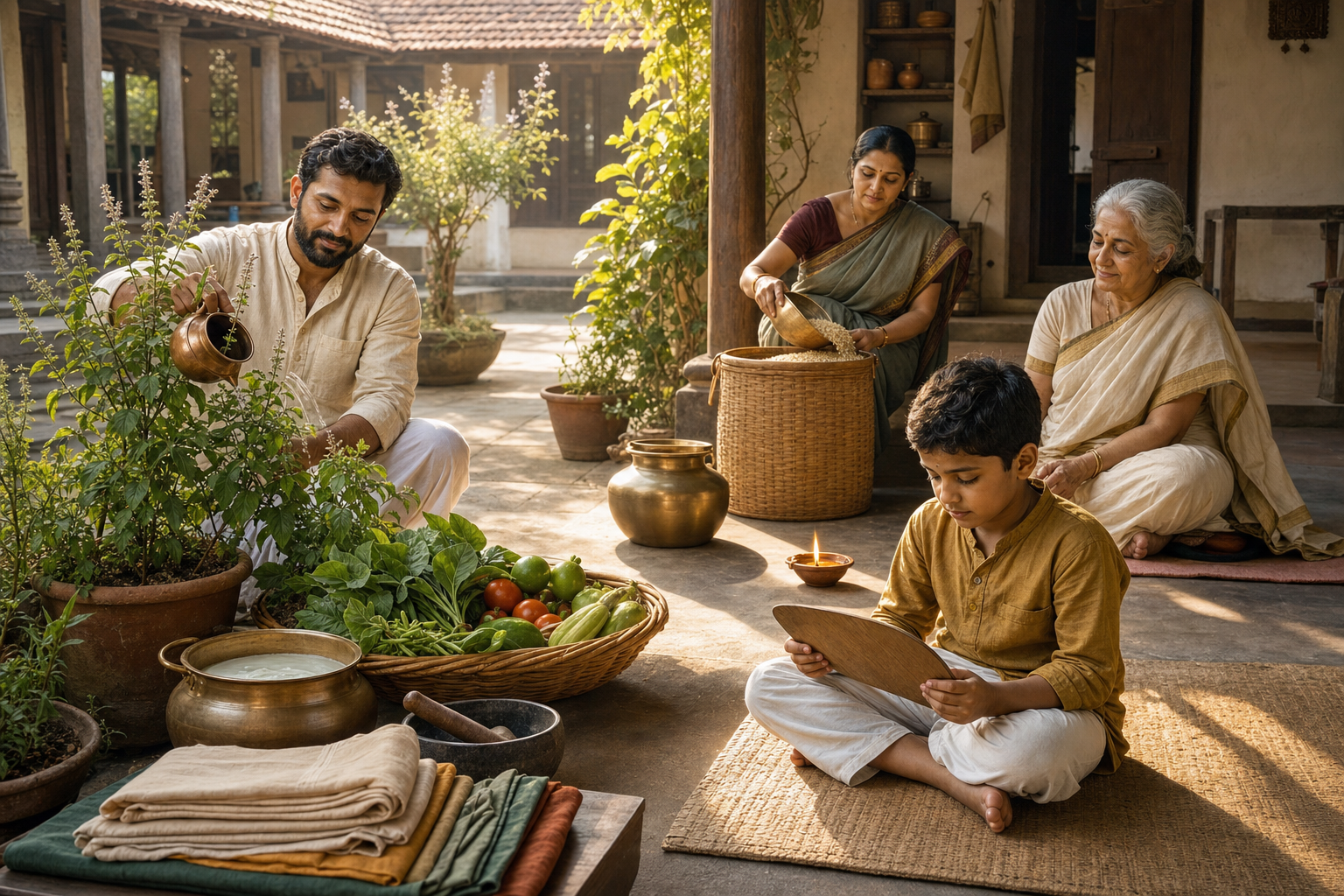
This is why Dhata can be worshipped alongside Mata Lakshmi Devi without collapsing the two into one role. Dhata signifies the order and sustaining foundation upon which prosperity can rest; Lakshmi signifies auspicious abundance. A household rhythm of solar remembrance at dawn and Lakshmi remembrance in the evening gives this theology a practical form: establish the day’s conduct first, then receive and honour its fruits with gratitude.
Build a sunrise observance you can actually sustain
A Dhata observance does not require an elaborate installation. Sunrise is the natural center because the practice belongs to the solar rhythm. Cleanliness, attention, and continuity carry more weight than the cost or number of offerings.
- Prepare before sunrise. Place clean water for arghya in a suitable vessel. If it is safe to do so, light a clean ghee lamp. Fresh warm-hued flowers, seasonal fruit, or cooked grains may be offered, but none is necessary for turning a simple practice into sincere worship.
- Face east and offer water. At sunrise, offer arghya to the rising sun with an unhurried mind. Let the physical act express the inner intention to place the day under clarity, lawful conduct, and gratitude.
- State one precise sankalpa. Avoid asking vaguely for “everything to improve.” Name one dharmic intention you can participate in: “May I establish steadiness in caring for my health,” or “May today’s work create honest prosperity and benefit others.” A useful sankalpa identifies both the desired condition and your responsibility within it.
- Recite the invocation. Use OM SRI DHATA DEVAYA NAMAHA. If you undertake mala practice, recite one or more rounds of 108 beads. Keep the breathing natural and the attention on the sound and meaning. The mantra is an act of reverence and orientation, not a formula that compels a particular material result.
- Join prayer to embodied discipline. Where suitable for your body and health, Surya Namaskar or basic pranayama can connect solar awareness with movement and breath. Modify or omit practices that are unsafe for you, and seek appropriate professional instruction if a health condition makes breathwork or movement uncertain.
- Choose one act that establishes order. Complete a neglected duty, prepare nourishing food, correct an avoidable disorder in your work, speak truthfully in a difficult matter, or help someone without seeking recognition. This step keeps worship from ending at the altar.
At evening, take a brief account of the sankalpa. Ask whether your choices supported it, where disorder entered, and what should be corrected tomorrow. If Lakshmi is part of your household practice, conclude with a simple remembrance of her and gratitude for the resources that sustained the day.
Sundays offer a natural occasion for a longer observance, while Ratha Saptami provides a solar festival setting in which to renew commitments to right conduct. Intensifying a practice should mean greater attention and ethical seriousness, not anxiety about ceremonial complexity.
Judge the practice by what it establishes in you
The clearest signs of Dhata worship are usually ordinary. You become more consistent in necessary routines. Worry is less likely to dictate the next action. Work gains direction without becoming ruthless. Family responsibilities are handled with fewer avoidable disruptions. These changes do not prove supernatural causation, but they are appropriate fruits of a discipline centered on order, clarity, and continuity.
Review the practice periodically with four tests:
- Continuity: Is the observance making your daily conduct steadier, or is it another burst of enthusiasm followed by neglect?
- Integrity: Are the gains you seek compatible with truthfulness, non-harming, generosity, and responsibility?
- Service: Does increasing strength or prosperity enlarge your capacity to care for others?
- Clarity: Are you making more deliberate decisions, or using ritual to avoid decisions that still require practical action?
Jyotisha may provide another doorway into Dhata worship through the solar principle, or surya tattva. The productive use of that doorway is to cultivate purposeful energy, discipline, clear judgment, and service. A deterministic reading—assuming that worship removes every difficulty or guarantees an outcome—works against Dhata’s own symbolism. Establishment requires participation: prayer clarifies the orientation, while conduct builds the foundation.
Dhata also offers a point of reflection across the wider dharmic family. A Buddhist, Jain, or Sikh practitioner need not adopt a Hindu deity or ritual in order to recognize the value being expressed. Japa, metta-bhavana, samayika, and naam simran belong to distinct traditions, yet each can discipline attention and direct inner cultivation toward compassion, restraint, and care for others. Shared ethical resonances should deepen mutual respect without erasing theological differences.
If you want to begin, do it at the next dawn rather than waiting to assemble a perfect ritual. Offer clean water, recite the mantra with attention, and make one sankalpa that can be verified by your conduct before evening. Let the first blessing you ask from Dhata be the strength to establish what you already know is right.