
If you want to observe late March 2026 properly without turning your home into a calendrical puzzle, two anchors deserve your attention: Skandamata worship on March 23 and the Ekadashi-to-Dwadashi transition on March 29. The main planning mistake is treating either observance as an event that begins and ends with the civil date.
You need two things before choosing a ritual: a Panchang calculated for your location and a level of practice that you can complete with attention. Once those are settled, the week becomes manageable even if work, school, caregiving, or health prevents an elaborate observance.
Let the civil date identify the observance, not its exact clock
A tithi does not change at midnight. It advances when the angular separation between the Moon and Sun crosses another 12-degree interval. That is why a Hindu observance can occupy part of one civil day, extend into another, or be described differently by calendars using different locations and conventions.
March 23 is associated with the fifth day of Chaitra Navratri and the worship of Skandamata, ordinarily aligned with Chaitra Shukla Panchami. For Sunday, March 29, Ekadashi remains until 8:31 AM in most regions, with Dwadashi following. The first statement tells you what to prepare for March 23. The second alerts you that March 29 contains a ritual transition rather than one uniform tithi.
| Planning anchor | What you can prepare now | What must be checked locally |
|---|---|---|
| March 23 | Skandamata image or murti, puja materials, mantra count, fasting choice, and seva | Panchami timing, sunrise, and the most suitable puja window |
| March 29 before the transition | Ekadashi japa, quiet study, and continuation of an already undertaken vrata | Whether Ekadashi and the stated 8:31 AM transition agree with your city’s Panchang |
| March 29 after the transition | Dwadashi parana arrangements | Hari Vasara, the valid parana interval, and the rule followed by your sampradaya |
Before fixing a meal, temple visit, or family puja, check the local sunrise and sunset, the tithi start and end, and any prescribed parana interval. Amanta and purnimanta month-reckoning can also affect how a regional calendar labels the surrounding month, even when the underlying lunar motion is the same.
If your tradition does not prescribe a narrower muhurta, established devotional windows include Brahma muhurta, approximately 96 minutes before sunrise, morning sandhya, Abhijit around local solar noon, and evening Pradosh kala. Use these as practical windows for prayer and japa, not as replacements for checking the relevant tithi.
Build a complete March 23 Skandamata puja around one clear sankalpa
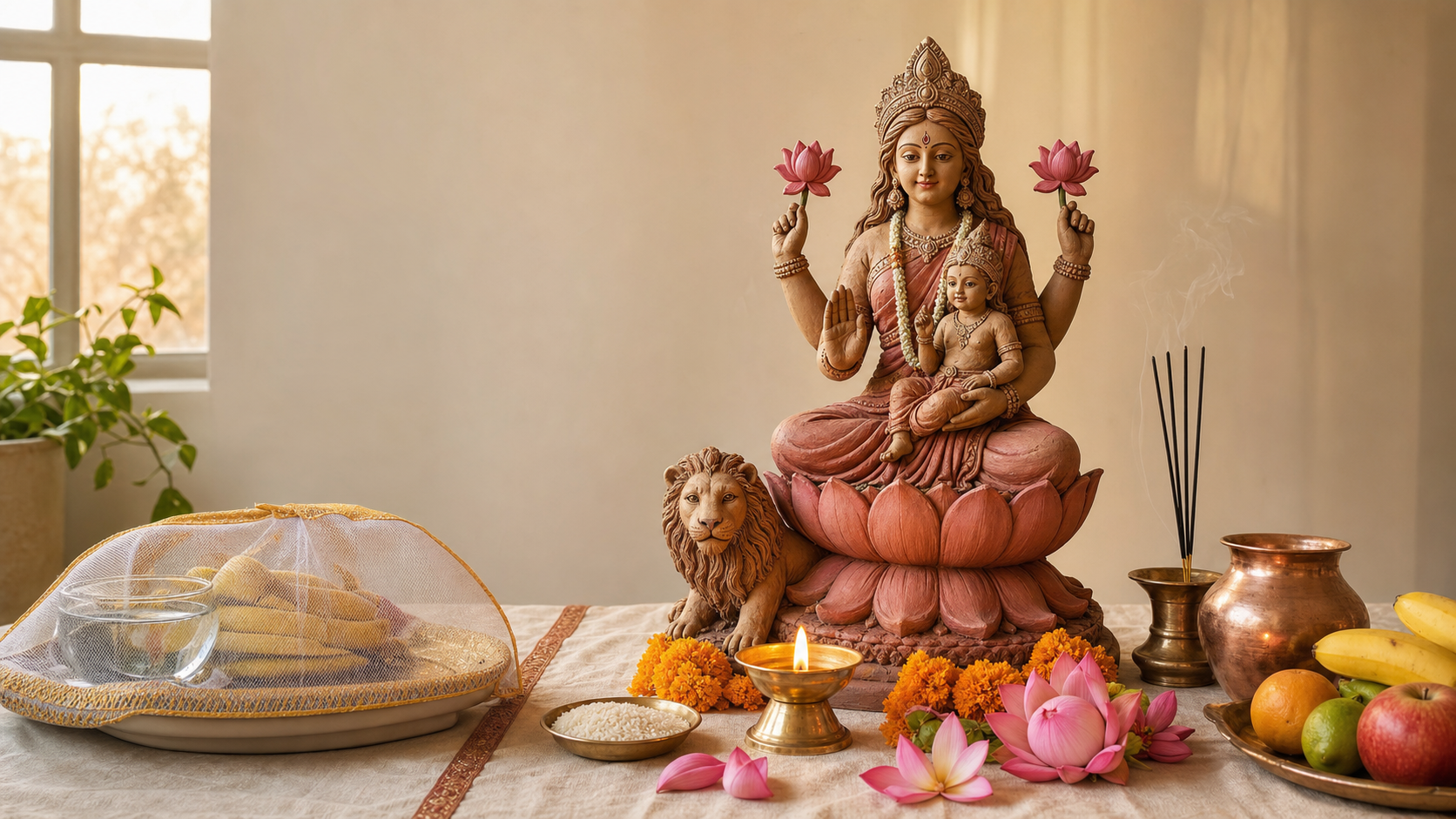
Skandamata holds the child Skanda while seated upon a lotus, with the lion associated with her iconography. The image brings tenderness and strength into the same frame. For a householder, that makes the day’s question concrete: can you protect without becoming harsh, guide without dominating, and care without turning love into possession?
You do not need a large installation to answer that question through worship. Prepare a clean yellow or white altar cloth, an image or murti, clean water in a kalasha or copper vessel, a secure ghee diya, incense if suitable for the household, flowers, chandan, kumkum, akshata, a banana or other sattvic naivedya, and a mala. Lotus, rose, and marigold are suitable flowers; regional colour associations vary, so do not treat a particular colour as more important than cleanliness and attention.
- Set the altar. Face it east or north if your space allows. Place the Devi image, water vessel, lamp, flowers, and naivedya so that you will not need to interrupt the puja to find missing items.
- Steady yourself. Perform your customary achamana, take a few measured breaths, and begin with Ganesha vandana.
- State the sankalpa. Name the date, place, Skandamata, and the purpose of the vrata. Suitable intentions include peace, health, forgiveness, truthful conduct, the welfare of children, and gratitude toward mothers, teachers, and guardians. Choose one intention you can carry into conduct after the lamp is extinguished.
- Make the offerings. A concise sequence can include avahana, asana, padya, arghya, achamaniya, gandha, akshata, pushpa, dhoopa, deepa, naivedya, stuti, and kshamapana. If you established a kalasha on the first day of Navratri, continue its daily upacharas as well.
- Complete the japa you chose in advance. Recite Om Devi Skandamatayai Namah 9, 27, or 108 times. A traditional dhyana is Simhasanagata nityam, padmasritakaradvaya; shubhadastu sada devi, Skandamata yashasvini. Select the count you can finish without rushing.
- Move from sound into attention. Spend 5 to 10 minutes with diaphragmatic breathing or gentle ujjayi if it is already comfortable for you. Keep the spine upright, soften the jaw and throat, and rest attention between the heart and throat before returning to silent mantra.
- Offer and receive prasada. Ripe bananas, kheer prepared with jaggery, honey, dry fruits, fruit, or a milk-based sweet are appropriate options. Offer water after naivedya, perform aarti and pradakshina according to your custom, ask forgiveness for mistakes, and distribute the prasada respectfully.
If you maintain a fuller Shakta practice, you may add Durga Saptashati recitation, Narayani Stuti, Devi Kavacham, Argala, Keelakam, or a Skandamata katha. Do not add several recitations merely to make the observance appear substantial. One text read attentively is more useful to your sadhana than a long programme completed in agitation.
Abhishekam is optional and should be appropriate to the murti material and your tradition. A homa is also optional; undertake it only where you have the necessary guidance, a contained fire, ventilation, supervision, and permission. If those conditions are absent, a safely placed diya or brief camphor aarti gives you a focused fire offering without creating an avoidable hazard. Never leave a flame or burning incense unattended.
Carry Skandamata’s teaching through the remaining Navratri days
Finishing the puja is not the same as completing its purpose. Skandamata’s lotus, lion, and child give you a practical discipline for the rest of Navratri: remain inwardly clean while meeting worldly duties, use strength in the service of protection, and let care produce courage rather than fear.
Turn that theology into one visible action each day. Listen to a child without checking your phone. Correct someone without humiliation. Thank a parent, teacher, or caregiver while they can hear it. Support children’s education, maternal health, family meals, lactation assistance, or a temple or community kitchen. These actions keep the sankalpa from remaining only a sentence recited before the altar.
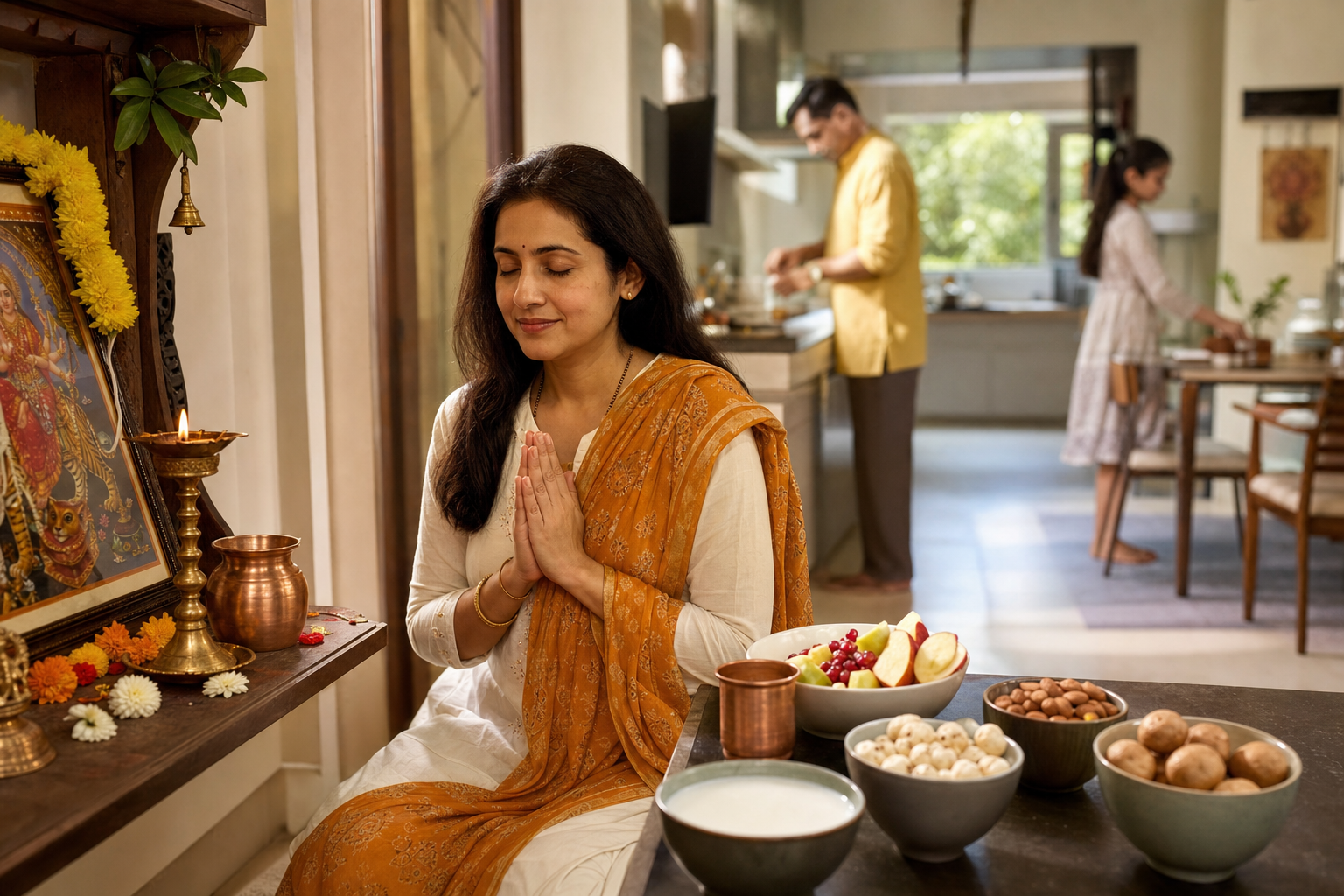
Apply the same realism to fasting. Navratri vrata can range from nirjala fasting to fruit and milk, or one sattvic meal using ingredients accepted by the household’s tradition. Many devotees avoid grains, processed foods, onion, garlic, and stimulants, and use sendha namak where salt is permitted. Choose your rule before hunger begins; repeatedly changing it according to appetite makes the vrata harder to understand and easier to turn into self-punishment.
Severity is not the measure of sincerity. Children, elders, pregnant people, and anyone with a health condition should put nourishment and appropriate medical guidance first. A modified fast, disciplined speech, reduced sensory indulgence, japa, or seva can preserve the inner vrata when food restriction is unsafe. Do not use religious fasting as a substitute for medical care.
This is also a good place to recognise kinship without erasing difference. Hindu vrata, Jain poshad or uposadha, Buddhist uposatha discipline, and Sikh emphasis on simran and seva are not interchangeable rites. Yet ahimsa, compassion, remembrance, self-restraint, and service allow families and communities to meet on shared dharmic ground while preserving the integrity of each path.
Handle the March 29 Ekadashi-to-Dwadashi handoff carefully
March 29 requires a different kind of preparation. Ekadashi is the eleventh tithi of the bright fortnight, while Dwadashi is the twelfth. Because the transition occurs during the morning in the supplied calendar, you cannot safely infer the parana time merely from the word Dwadashi or from the clock striking 8:31.
- Confirm the local calculation before Sunday. Check whether your city’s Panchang agrees that Ekadashi ends at 8:31 AM, then record the locally prescribed Dwadashi parana window.
- Follow the vrata rule you actually undertook. If you began Ekadashi observance according to your sampradaya, continue it through the required interval. If you did not begin it properly, do not impose a severe retrospective fast simply to feel caught up.
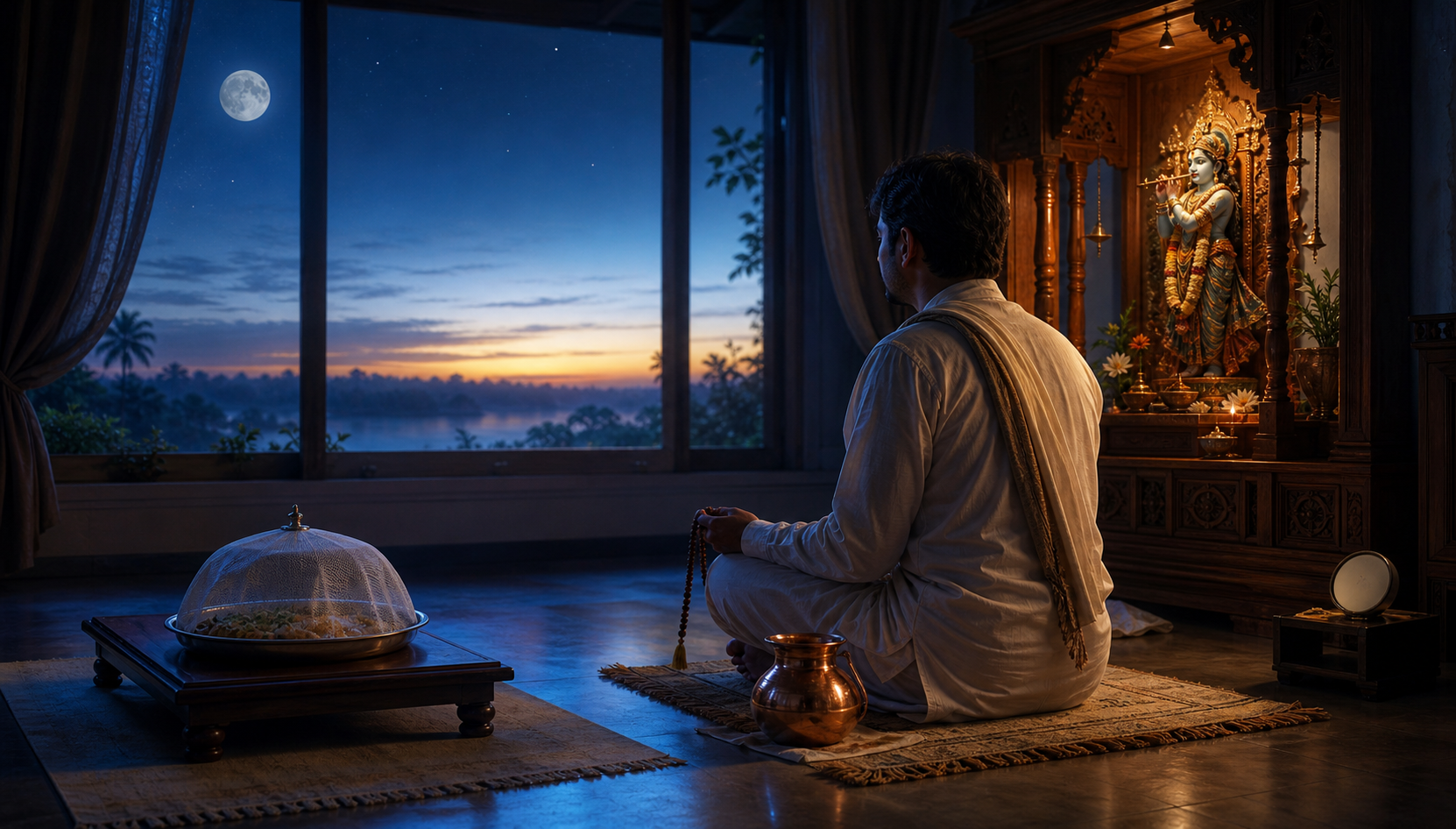
- Give the early morning to sattvic practice. Vishnu Sahasranama, Vishnu-oriented japa, or study from the Bhagavad-Gita or Srimad-Bhagavatam can keep the transition unhurried. Dana and quiet seva are also fitting.
- Do not treat the tithi transition as an automatic permission to eat. Traditional parana guidance avoids Hari Vasara, the initial portion of Dwadashi, and some lineages retain additional sunrise or daylight requirements. Follow the valid local interval and the rule of your lineage.
- Complete parana deliberately. Break the fast in the manner allowed by your tradition and health needs. Parana completes the vrata; it is not an administrative detail to be fitted in whenever convenient.
The need for local calculation is not a defect in Hindu timekeeping. Panchang joins five calendrical limbs: tithi, weekday, nakshatra, yoga, and karana. Nakshatra is determined from the Moon’s sidereal position within 27 divisions of 13 degrees and 20 minutes each, while local sunrise and seasonal day length affect practical intervals. Precision therefore belongs to the tradition itself.
If your family receives two different parana times, first check whether the calendars use the same city, ayanamsha, month convention, and sampradaya rule. Do not settle the disagreement by selecting whichever time is more convenient. When uncertainty remains, use the calendar consistently followed by your temple or lineage and ask a qualified priest or teacher for the applicable rule.
Key takeaways for your late-March plan
- Use March 23 to identify Skandamata worship, then use a local Panchang to establish the Panchami timing and puja window.
- A complete home puja can remain simple: sankalpa, a concise offering sequence, 9, 27, or 108 mantra repetitions, naivedya, aarti, kshamapana, and one act of seva.
- Let the vrata regulate conduct as well as food. Patient speech, responsible care, and service express Skandamata’s union of tenderness and courage.
- Choose a fasting form that your body and responsibilities can safely sustain. Nourishment and medical guidance take priority for children, elders, pregnant people, and those with health conditions.
- On March 29, distinguish the Dwadashi transition from the valid parana time. Confirm the local clock, avoid Hari Vasara, and follow your sampradaya.
Your next step is small: write down your city’s tithi timings, choose the Skandamata mantra count you will actually complete, and gather the altar materials before March 23. Leave the March 29 parana time unfilled until a locality-specific Panchang confirms it. That is not hesitation; it is the disciplined way to honour lunar time.


References
- DharmaRenaissance Blog – 5th Day of Navratri (23 March 2026): Skandamata Puja Guide, Mantras, Fasting Rules, and Ritual Steps
- DharmaRenaissance Blog – March 29, 2026 Panchang: Ekadashi till 8:31 AM, then Dwadashi – Auspicious Rituals, Muhurta, Rashi