
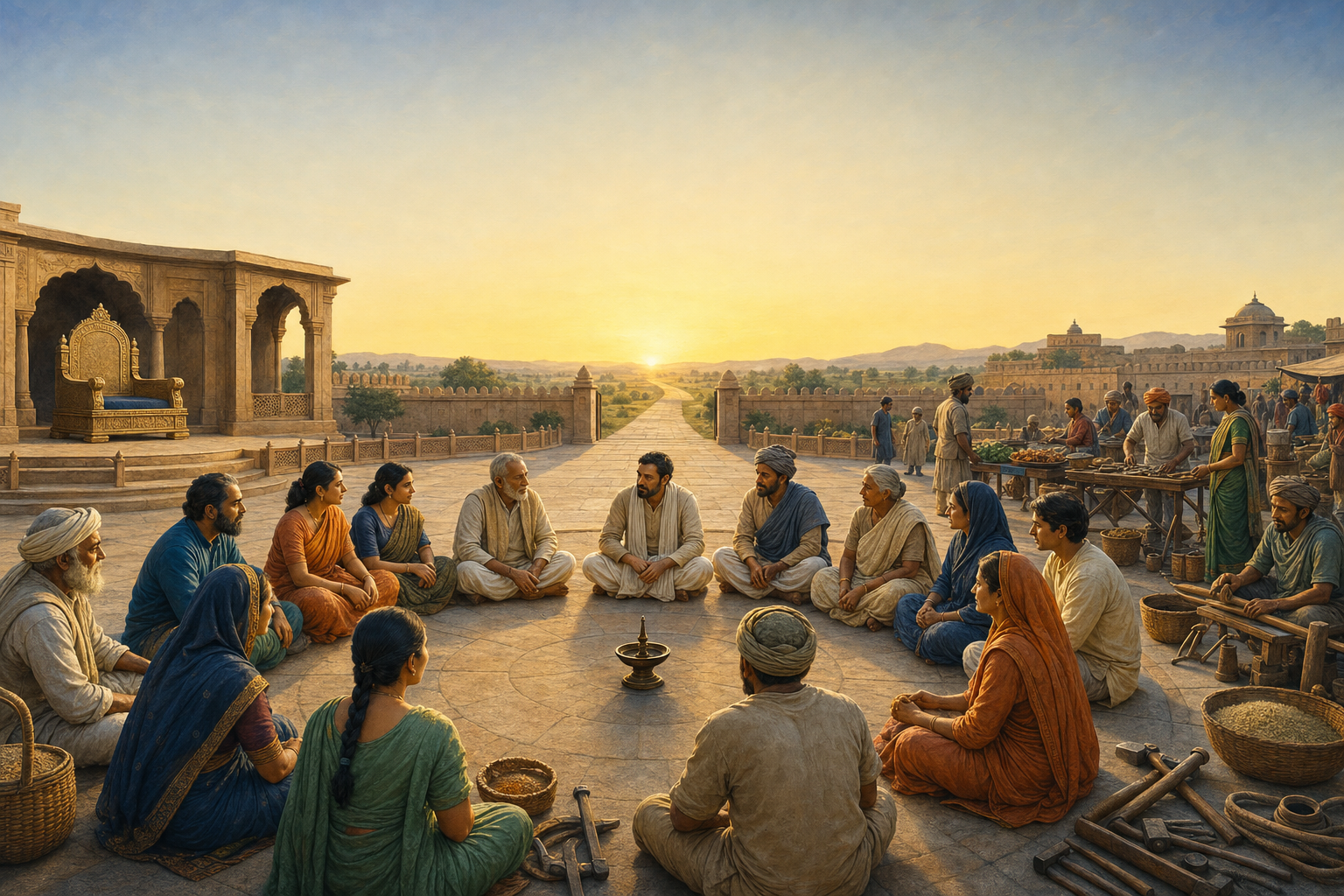
You may be deciding whether a leader, policy, temple board, or community institution deserves to be called dharmic. Religious language will not settle that question. Neither will visible prosperity. The harder test is what power does when duty becomes costly.
Scriptural models give you a disciplined way to judge: examine whether leaders accept limits, preserve a just common order, turn wealth into everyday flourishing, and remain accountable to a moral horizon beyond their own tenure. Those tests are useful whether you are evaluating a government, voting in an association, serving on a trust, or deciding whom to support.
Dharmic power preserves order even when privilege is available
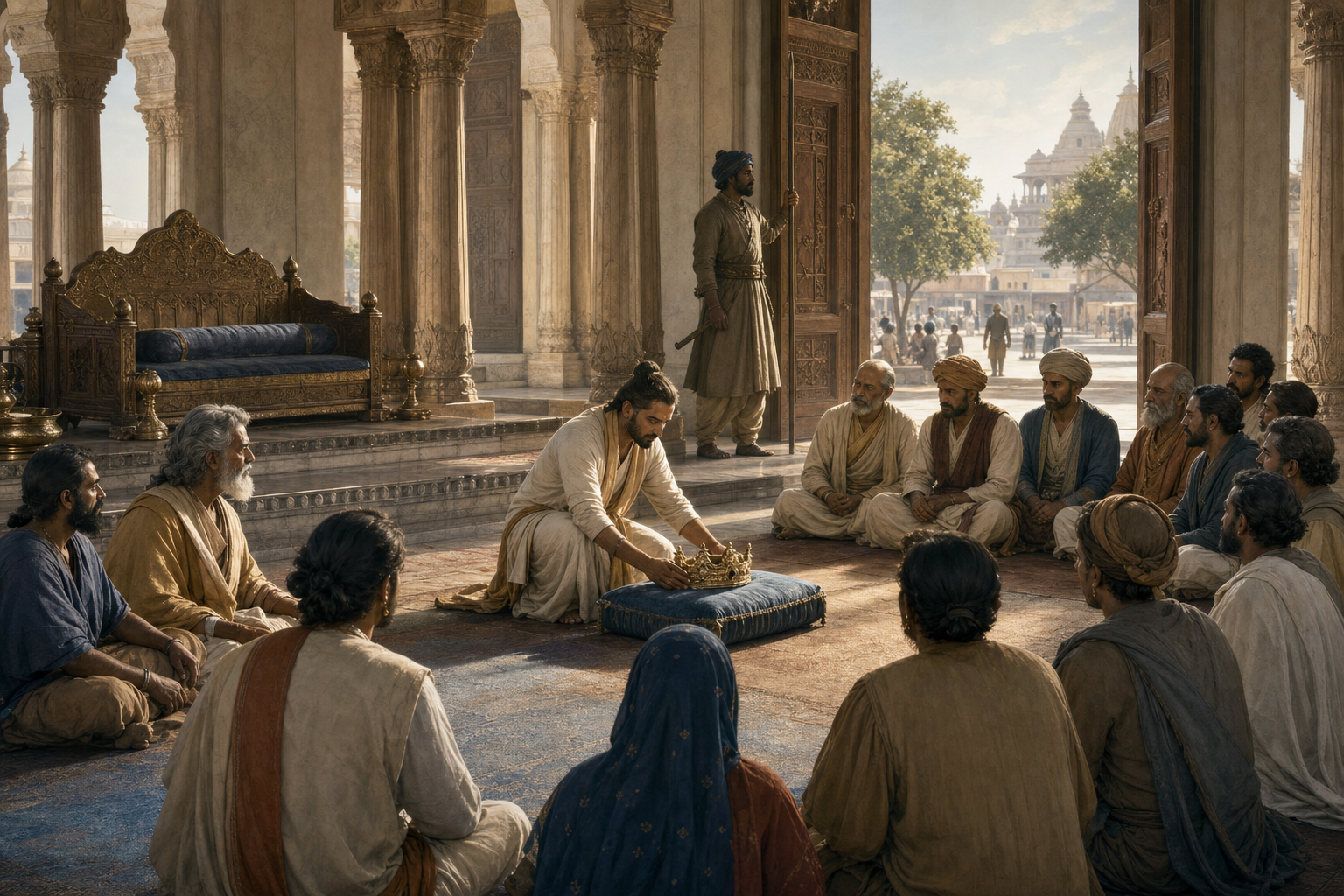
Rajadharma is not a licence to decorate authority with sacred symbols. It is a discipline that binds the ruler to protection, proportion, responsibility, and the welfare of the whole. The ruler stands within dharma; he does not become its owner merely by occupying office.
King Shveta supplies one of the sharpest tests of this principle. Within the Kedara Khanda of the Skanda Purana, Shiva protects his devotee by subduing Kala at the moment appointed for the king’s death. Shveta then confronts a privilege that almost anyone would be tempted to accept: a divine exception from mortality. Yet he asks Shiva to restore Time.
His reason matters more for governance than the miracle itself. Without Time, seasons cannot turn normally, vows cannot reach completion, learning cannot mature, duties lose their cadence, and karma cannot bear fruit through an intelligible sequence of action and consequence. Shveta recognises that his private rescue would damage the shared conditions under which everyone else must live.
He therefore refuses to convert grace into impunity. Devotion brings him near divine power, but discernment prevents him from misusing that nearness. He chooses a lawful cosmos in which he must bear the cost over a disordered one arranged around his survival.
The distinction between Kala, Yama, and karma makes the lesson more precise. Kala is the principle of temporality and change. Yama concerns ethical judgment and the destination of beings after death. Karma is the moral pattern connecting action and consequence. Power may transcend an ordinary limit in the moment, but moral governance still has to preserve continuity among rules, actions, consequences, and the lives of other people.
Kala is not a modern statute book, so the comparison should not be forced. The usable analogy is narrower: a stable common order is a public good, and a leader’s personal exemption can damage it. Whenever an office-holder seeks exceptional treatment, ask four concrete questions:
- Which rule, process, or obligation is being suspended?
- Does the exception correct an injustice, or mainly protect the person who already holds power?
- Who will carry the cost if the ordinary process no longer applies?
- Can the same principle be offered openly to every comparable case, including a rival’s case?
This is the first governance test: does power remain answerable to an order that does not bend around the powerful?
Do not turn that test into blind proceduralism. Dharma is deeper than bureaucratic regularity. A predictable system can still be adharmic if it institutionalises cruelty, corruption, exclusion, or arbitrary domination. An exception may be justified when it repairs a genuine wrong or meets an urgent need. But the justification should be public, proportionate, reviewable, and capable of becoming a fair rule for comparable cases. Shveta’s choice teaches fidelity to rightful order, not worship of every rule merely because someone has written it down.
Prosperity becomes legitimate when ordinary life can flourish
Self-limitation is only half of dharmic governance. A ruler who obeys procedures but leaves society fearful, degraded, or needlessly impoverished has not completed rajadharma. Order must create the conditions for a good life.
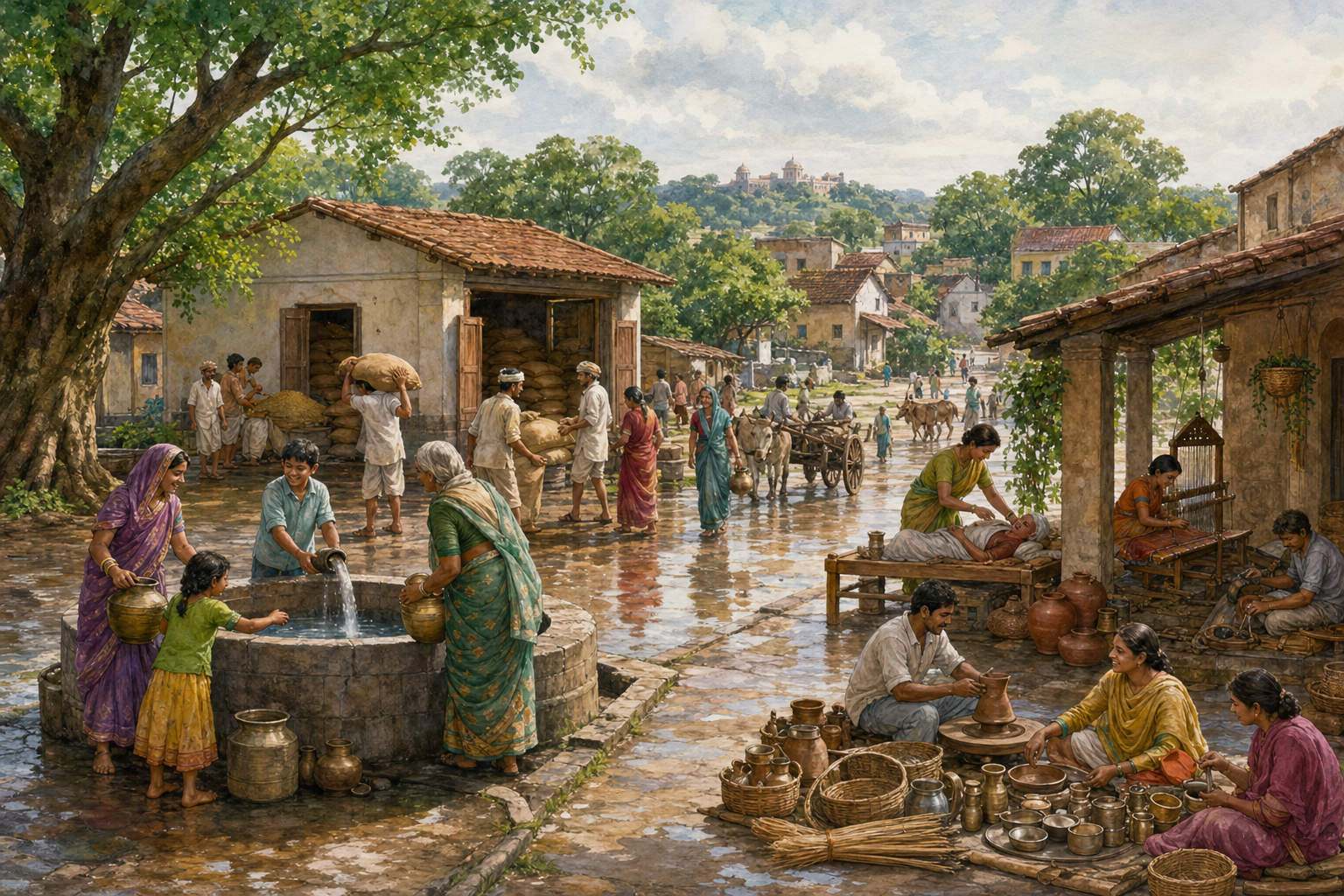
In Srimad Bhagavatam 10.90.18-20, Dvaraka appears as a prosperous city whose refinement is visible in daily civic life. The eminent Vrishnis inhabit it; graceful dress, rooftop recreation, beauty, and social ease belong to its atmosphere. Krishna’s presence as the master of Sri, the goddess of fortune, places wealth within a theological field of auspiciousness, responsibility, and devotion.
The important measure is not accumulation alone. Dvaraka’s opulence reaches the texture of ordinary life: households, recreation, public confidence, cultivated taste, and spaces in which people can gather and play. Prosperity is not locked inside a treasury or displayed only through the ruler’s grandeur. It becomes recognisable in the city’s social vitality.
This gives you a second practical distinction: wealth and flourishing are not synonyms. A government, trust, or religious institution may possess impressive buildings, large donations, or highly visible patrons while its people lack safety, fairness, cultural confidence, or a meaningful voice. In that case, display has outpaced dharmic purpose.
The four purusharthas help organise the audit. Artha is legitimate material capacity. Kama includes enjoyment, affection, beauty, and cultivated pleasure. Dharma sets their moral limits and directs them toward responsible life. Moksha prevents material success from becoming the final definition of the human person. Applied to governance, this hierarchy asks whether wealth supports life without claiming ownership of life’s highest purpose.
- Test artha: Are resources administered fairly, preserved responsibly, and directed toward durable public or community benefit?
- Test kama: Can people enjoy beauty, recreation, celebration, and family life without being pushed toward degradation or excess?
- Test dharma: Are prosperity and pleasure restrained by duty, honesty, protection, and concern for those with less power?
- Test moksha: Does public life leave room for worship, contemplation, study, service, and freedom from the claim that consumption is life’s ultimate end?
The rooftop scene should not be mistaken for an archaeological plan or a technical manual for urban design. Its value is normative. It trains you to look beyond revenue and monuments toward lived outcomes. When assessing a development project, cultural institution, or civic budget, ask what will become possible in daily life. Will families have usable common spaces? Will art and celebration become accessible? Will prosperity circulate through fair work and service? Will vulnerable people become more secure, or merely less visible?
The third governance test emerges here: does material success become shared civic grace, or does it remain concentrated spectacle?
Four tests create a usable Dharmic governance standard
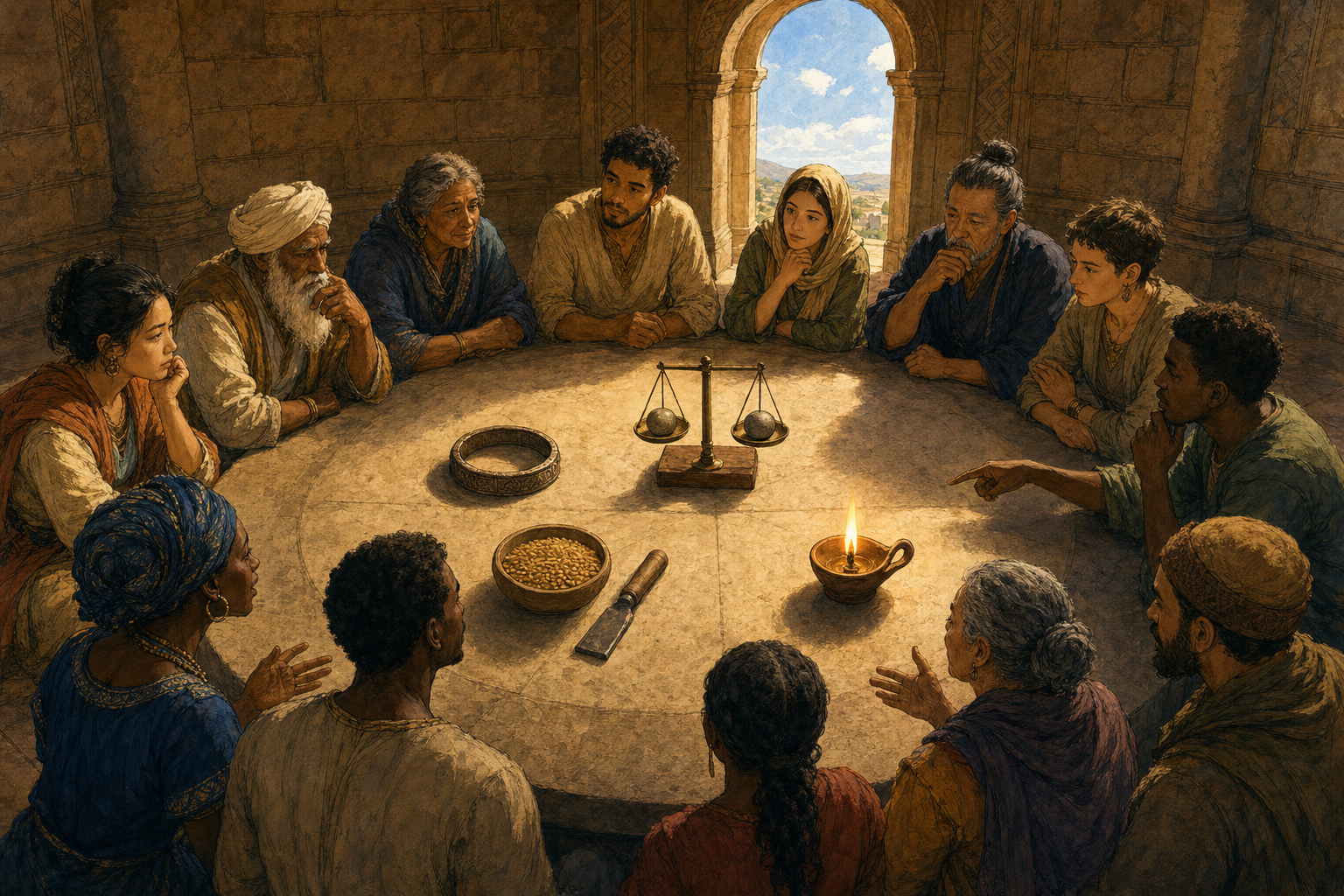
You will not find a modern constitution, procurement code, or municipal budget in these scriptural settings. Their practical value lies in moral diagnosis. They expose the questions that technical administration can evade: who receives the exception, who bears the burden, what wealth is for, and what kind of person public life encourages us to become.
The following framework turns those questions into an audit you can use. It is an editorial synthesis, not a claim that a single scripture presents an official four-part checklist.
| Test | Evidence to seek | Warning sign |
|---|---|---|
| Order over exemption | Rules and review procedures apply to allies, rivals, donors, and office-holders on comparable terms. | Sacred status, emergency language, or personal loyalty is used to escape an ordinary obligation. |
| Guardianship over possession | Leaders accept scrutiny, bear a fair share of sacrifice, and protect institutional continuity beyond their tenure. | The office is treated as personal property, and criticism is recast as disloyalty to the tradition. |
| Flourishing over display | Resources improve safety, fairness, cultural life, family life, service, and access to meaningful communal spaces. | Prestige projects multiply while everyday conditions, trust, or access deteriorate. |
| Moral purpose over appetite | Artha and kama remain bounded by dharma and leave room for spiritual discipline, restraint, and liberation. | Wealth, victory, or expansion becomes self-justifying, regardless of harm or corruption. |
The first two tests grow especially clear in King Shveta’s refusal of a privilege that would compromise the whole. The latter two become visible in Dvaraka’s union of opulence, cultured enjoyment, social confidence, and devotion. Together they prevent two common errors: calling austerity virtuous when it merely neglects people, and calling prosperity righteous when it merely flatters power.
The Hindu term lokasangraha adds another dimension. Responsible action should help hold the world together. That does not mean preserving every institution unchanged. It means considering whether an action sustains the relationships, duties, trust, and moral intelligibility on which collective life depends.
Related Dharmic traditions sharpen different parts of the same examination without becoming interchangeable. Buddhist reflection on impermanence warns a ruler not to confuse temporary office with permanent selfhood, while the cakkavatti ideal joins authority to ethical responsibility. Jain ahimsa and aparigraha test whether power reduces harm and resists possessiveness. Sikh miri-piri holds temporal responsibility and spiritual authority in relationship, while remembrance of Akal Purakh and life within hukam place worldly power beneath the Timeless and the divine order.
These differences should be respected. Buddhism, Jainism, Sikhism, and the Hindu sampradayas do not use identical metaphysics or prescribe one uniform political system. Their convergence is more useful as an ethical floor: power is not absolute, possession is not the highest good, violence and appetite require restraint, and public responsibility cannot be separated from the formation of character.
This supplies the fourth governance test: does authority answer to a moral reality higher than victory, wealth, lineage, party, or personality?
Apply the tests before accepting a Dharmic label
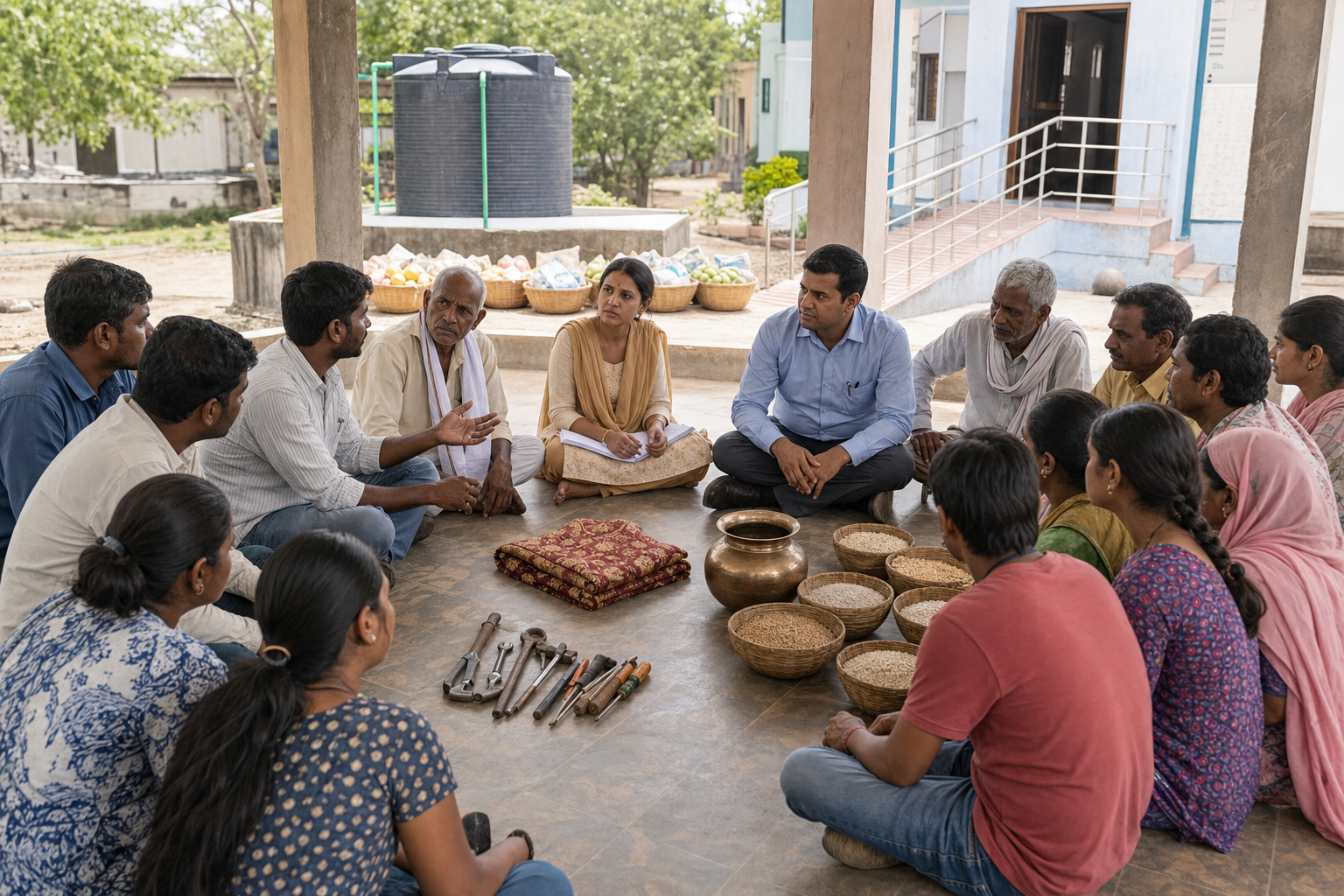
A sacred vocabulary can clarify conduct, but it can also conceal it. Words such as dharma, seva, tradition, unity, and sacrifice should therefore begin an inquiry rather than end one. Use this sequence when a leader or institution asks for your support:
- State the decision without devotional decoration. Replace slogans with a plain sentence naming the action, the resources involved, the affected people, and the authority being used.
- Name the ordinary rule. Identify the procedure that would apply without the leader’s status, the donor’s influence, the institution’s prestige, or the declared emergency.
- Trace burdens as carefully as benefits. Record who gains first, who pays, who loses a voice, and whether the decision-maker bears any comparable cost.
- Follow prosperity into daily life. Look for concrete effects on protection, access, cultural activity, family and community life, fair administration, and opportunities for service.
- Inspect the time horizon. Ask when an exceptional power ends, when results will be reviewed, and whether the institution will remain trustworthy after the current leader leaves.
- Withhold the label when evidence is missing. A proposal can be promising, uncertain, competent, or flawed without immediately becoming dharmic or adharmic. Moral language should follow demonstrated conduct.
Consider a community trust that wants to bypass its normal selection process for a prestigious project because an influential patron is devoted and generous. Devotion may explain the patron’s motivation, but it does not establish administrative fairness. Ask whether comparable bidders or community members receive the same opportunity, whether conflicts are disclosed, whether the project’s benefits reach ordinary participants, and whether independent review remains intact.
If public funds, employment obligations, contracts, or fiduciary duties are involved, applicable law and qualified professional review come first. Scriptural reasoning can deepen the ethical test; it cannot cancel a legal duty or substitute for a competent audit.
The same discipline applies to political leadership. Public worship, temple patronage, cultural advocacy, or reverence for Bharat may be worthy actions. None automatically proves rajadharma. Look at conduct when an ally is accused, when a rule imposes inconvenience, when criticism arrives, when resources must be distributed, and when surrendering a power would protect institutional trust. Costly moments reveal the governing principle more reliably than ceremonial ones.
King Shveta’s choice is especially demanding because he does not merely give something away; he gives up an exception from the fate shared by other beings. Dvaraka’s splendour is equally demanding because wealth becomes meaningful through an ordered and graceful common life. One model tests what the ruler is willing to relinquish. The other tests what society is enabled to enjoy.
Key takeaways for voters and community leaders
- Dharmic power accepts limits even when personal privilege is available.
- Rightful order is not blind obedience to procedure; it joins consistency with justice, protection, and review.
- Prosperity should be judged by everyday flourishing, not only by revenue, donations, monuments, or elite display.
- Artha and kama remain legitimate when governed by dharma and oriented beyond material appetite.
- Hindu, Buddhist, Jain, and Sikh models differ, but each offers reasons to restrain possessiveness and hold temporal power morally accountable.
- A sacred label is a conclusion to be earned by conduct, not evidence in the leader’s favour.
Before you endorse the next leader or proposal presented as dharmic, write down four things: the common rule at stake, the cost borne by the powerful, the benefit reaching ordinary people, and the authority that will review the result. If those answers remain vague, keep the sacred label in reserve. Dharma deserves a standard strong enough to govern its own champions.
References
- DharmaRenaissance Blog – When Shiva Halted Time for King Shveta and Why the Wise King Chose Order Over Immortality
- DharmaRenaissance Blog – Dvaraka’s Radiant Splendor (SB 10.90.18-20): Divine Opulence, Social Grace, and Harmony