
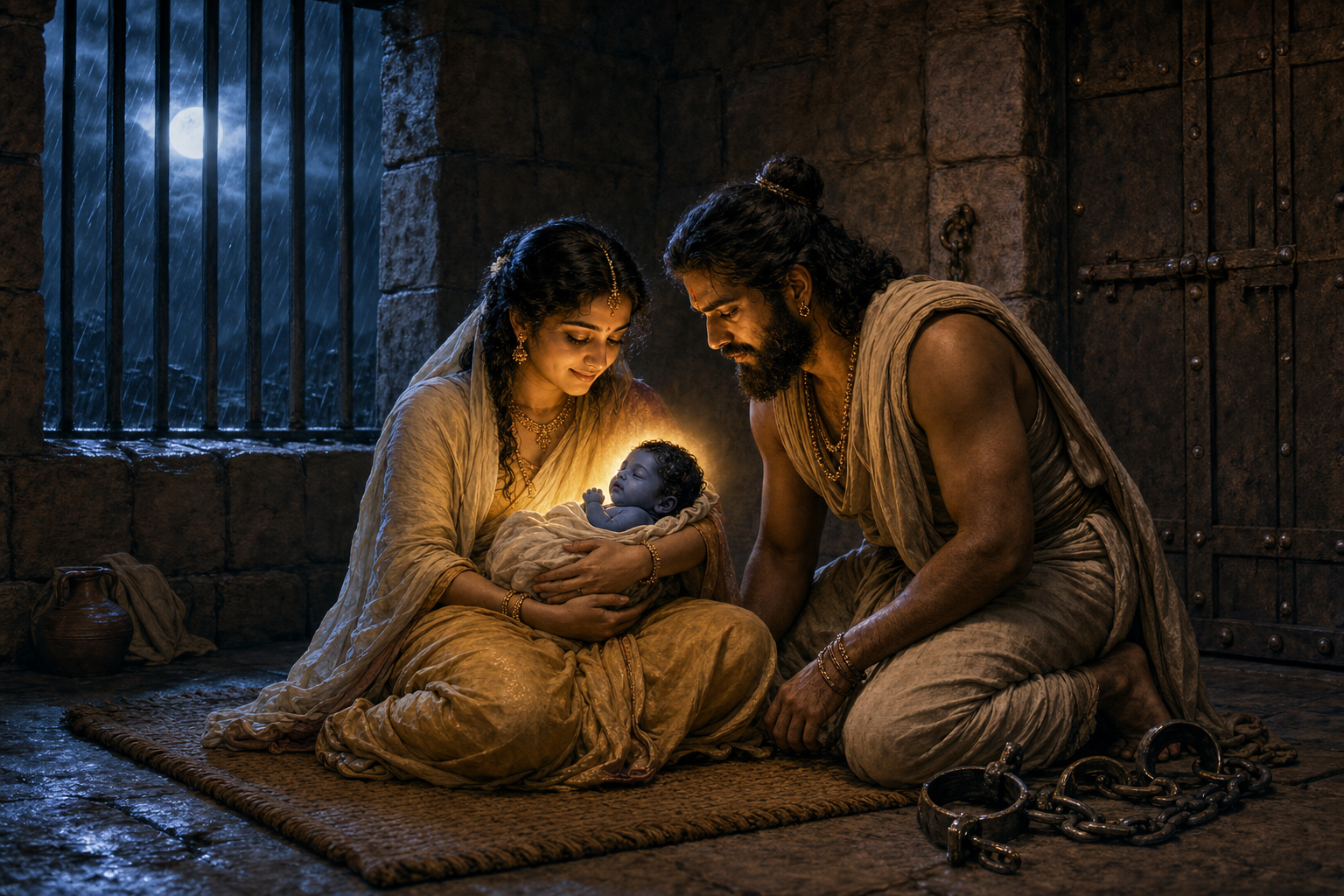
If Krishna’s infancy comes to mind through Gokul and Yashoda, you may wonder where Devaki belongs in the story. Why is she revered as Krishna’s mother when she could neither keep him beside her nor share his protected childhood?
You do not have to choose between the two mothers. Devaki’s place becomes clear when you follow the births in their proper order, resist rushing past the prison, and notice what Vasudeva’s journey turns devotion into: the protection of life under threat.
Devaki’s motherhood begins before Krishna appears
In the Bhagavata Purana and related Vaishnava narratives, Devaki is the daughter of Devaka, the sister of Kamsa, the wife of Vasudeva, and the birth mother of Sri Krishna. Those relationships matter because the danger does not arrive from a distant enemy. It enters through her own family.
A divine proclamation warns that Devaki’s eighth child will bring about Kamsa’s end. Kamsa answers that warning by imprisoning Devaki and Vasudeva in Mathura. Fear of a future loss of power becomes surveillance, confinement, and violence against newborn children.
This is the first moral distinction to keep in view: the proclamation does not compel Kamsa to become cruel. His attachment to control shapes his response. He treats innocent lives as threats because he cannot accept that power has limits. When you encounter Kamsa in the narrative, look beyond the familiar label of villain. Notice the mechanism of adharma: fear is allowed to decide who may live.
Devaki’s courage takes a different form. She has no army, secure home, or ordinary freedom to protect her children. Her strength is fidelity to dharma while another person controls her circumstances. That fidelity should not be mistaken for approval of injustice or passive indifference. Bhakti here is the refusal to let terror determine what is worthy of love, reverence, and hope.
Follow the eight children in the correct order
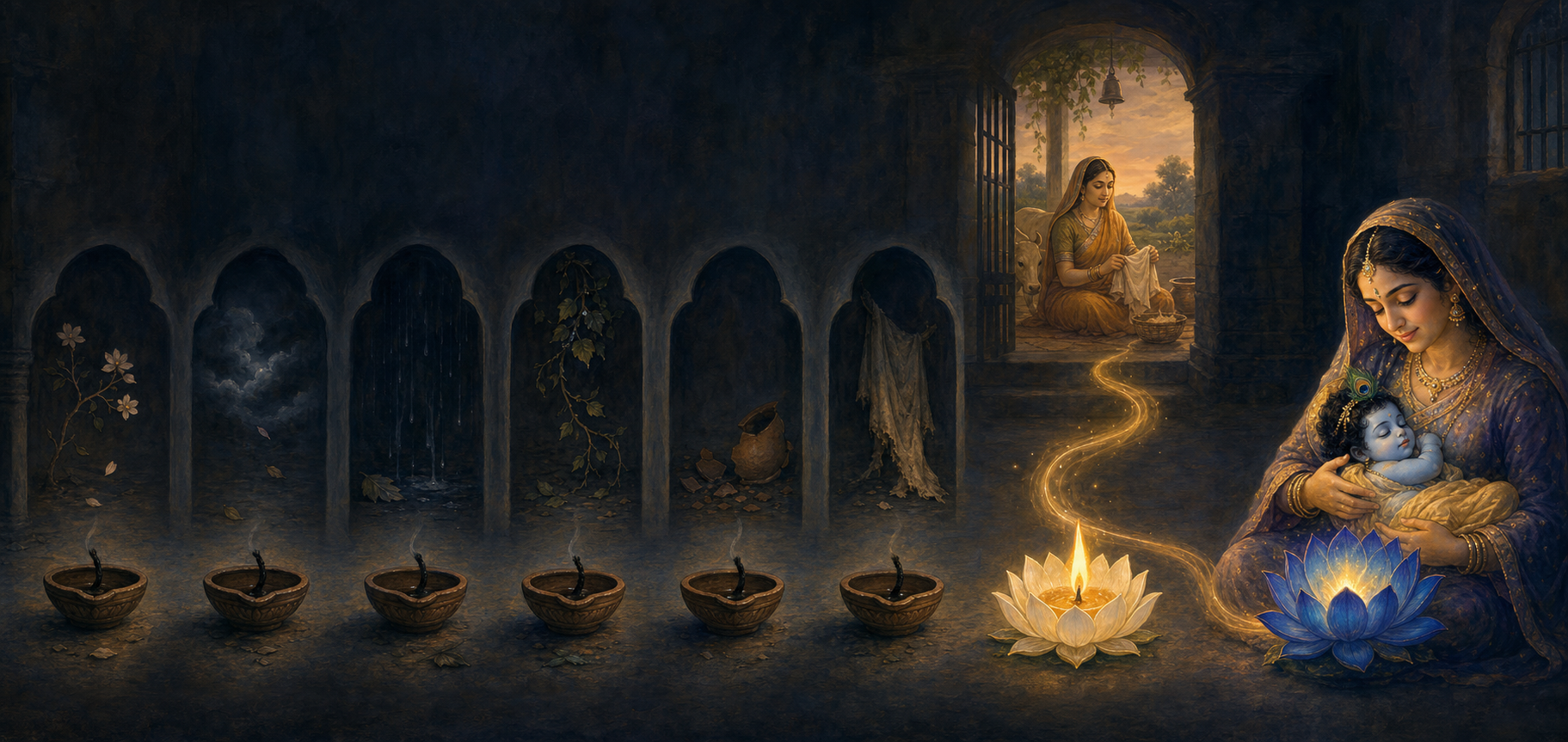
The numbering is easy to blur in a shortened retelling, especially because the seventh child is moved from one womb to another. Keep these six movements together:
- The warning: Kamsa learns that Devaki’s eighth child will be the cause of his downfall.
- The imprisonment: He confines Devaki and Vasudeva in Mathura so that every birth can be controlled.
- The first six births: Kamsa kills the first six newborn children. The suffering that precedes Krishna’s arrival is part of the narrative, not disposable background.
- The seventh child: Balarama is mystically transferred from Devaki’s womb to Rohini’s, preserving his life.
- The eighth child: Sri Krishna is born to Devaki in captivity.
- The passage to safety: Vasudeva carries the infant across the Yamuna to Gokul and exchanges him with Yashoda’s newborn.
If someone asks how Krishna can be the eighth child when Balarama is born to Rohini, the answer is in the fourth movement. The seventh pregnancy begins with Devaki, but the embryo is transferred to Rohini. Krishna then comes as Devaki’s eighth child.
The order also prevents two common misreadings. First, Krishna does not simply appear in an untouched household; his birth comes after repeated bereavement and under continuing danger. Second, divine purpose does not make human responsibility unnecessary. Vasudeva must carry the child away from the place where Kamsa can reach him.
That last movement gives the story practical force. Devotion is not confined to recognizing that the child is divine. In the decisive hour, devotion becomes a task: lift the vulnerable child, undertake the dangerous passage, and place life beyond the tyrant’s immediate grasp. Faith and protective action belong together.
Read the prison literally before reading it symbolically
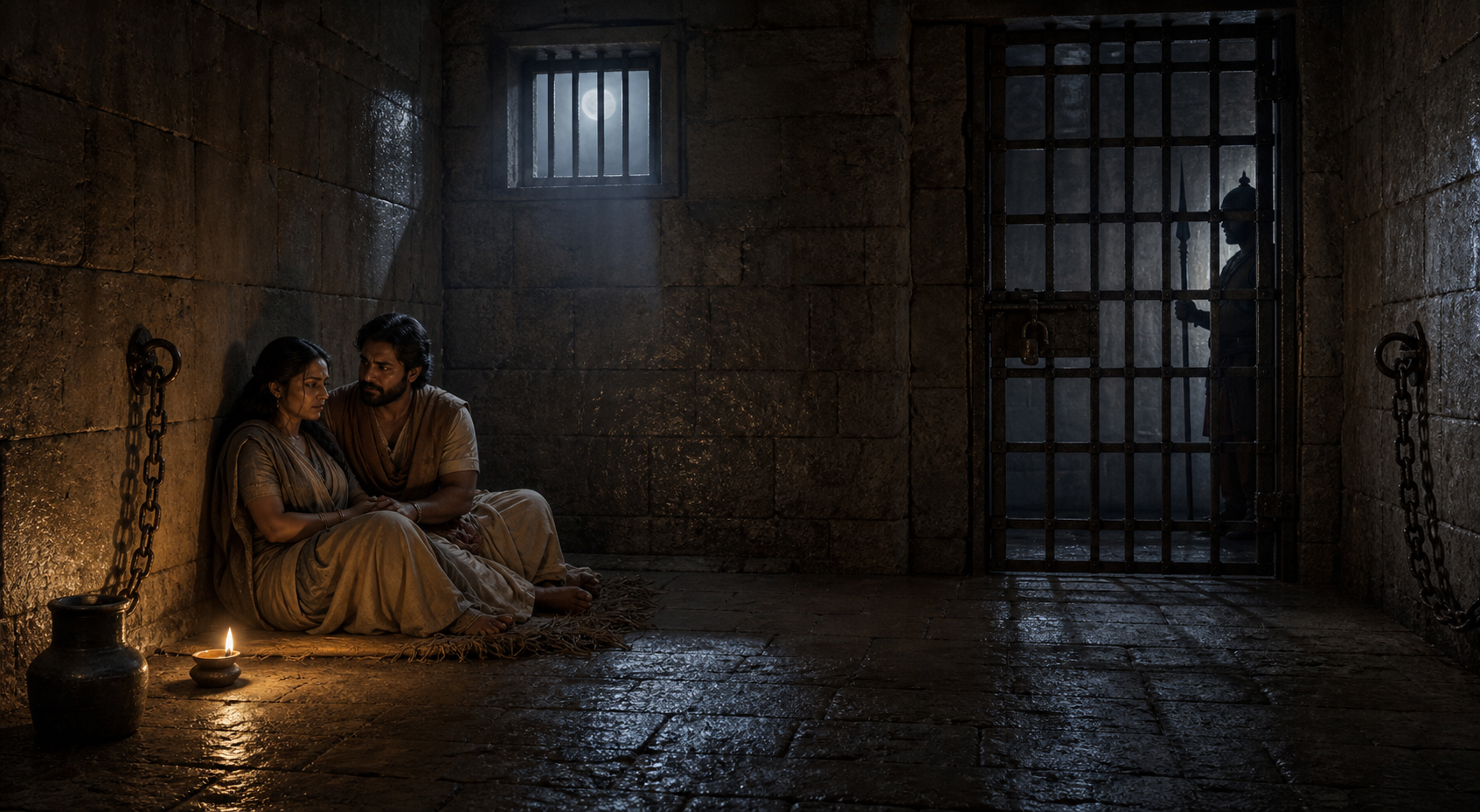
Devaki’s prison can be contemplated as a spiritual image, but it must first be allowed to remain a prison. A mother is confined. Her first six newborns are killed. Her next child survives through a mysterious transfer, and her eighth must be separated from her immediately after birth. If you turn all of that into metaphor too quickly, you erase the very suffering that makes her courage intelligible.
Devaki and Yashoda are not rivals
The exchange in Gokul does not make Devaki an incidental mother, nor does honoring Devaki diminish Yashoda. They reveal different dimensions of motherhood within Krishna’s life. Devaki bears him under captivity and relinquishes his physical nearness so that he may live. Yashoda is associated with the shelter and maternal care of his childhood in Gokul.
Calling the exchange abandonment reverses its moral meaning. Devaki and Vasudeva do not send Krishna away because they value him less. Separation is forced upon them by danger, and Vasudeva’s journey is an act of preservation. The narrative has room for the mother who gives birth under threat and the mother through whom protected childhood becomes possible.
The contemplative reading adds a second layer
Once the human cost is kept in view, the traditional contemplative reading becomes more—not less—powerful. Devaki can represent a heart held steady by faith, the prison can represent the constraints of fear and ignorance, and Krishna can represent the light of consciousness entering those confines.
This does not mean that every narrative detail has one fixed symbolic code. Use the symbols as questions rather than slogans. What fear has become a prison in your own judgment? Where are you trying to control life so completely that another person’s dignity becomes secondary? What truth have you recognized inwardly but not yet protected through action?
The ethical test is protection of the vulnerable
Kamsa hears danger and attacks those without power. Devaki endures without surrendering her allegiance to the Divine. Vasudeva receives a vulnerable life and acts to safeguard it. Those contrasts give you a practical test for reading the story: does your interpretation make you more attentive to threatened life, or does it merely make the miracle sound impressive?
Courage, compassion, self-sacrifice, and protection of the innocent also make Devaki’s example intelligible beyond Vaishnava devotion. Hindu, Buddhist, Jain, and Sikh teachings are not interchangeable, and their theological differences should not be flattened. Yet people formed by these Dharmic paths can still recognize the moral gravity of refusing to sacrifice the vulnerable to fear.
Make Devaki present in your Janmashtami observance
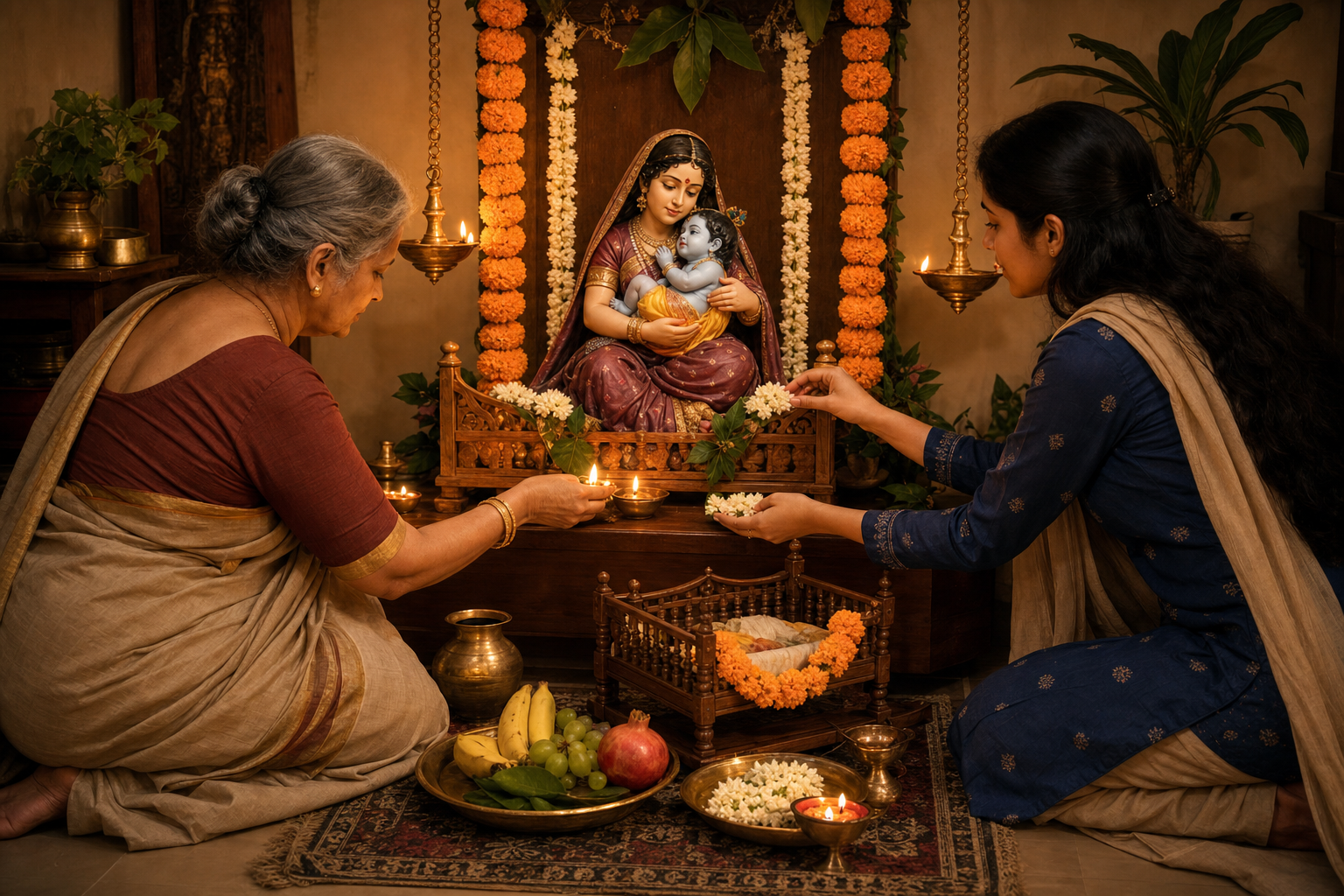
Janmashtami celebrations naturally move toward Krishna’s birth, kirtan, joy, and the passage to Gokul. A Devaki-centered observance asks you to slow down before that release. You need not invent an elaborate new ritual. Give the prison vigil, the losses, and the act of protection their proper place within practices you already follow.
- Read the sequence without compressing it. Name the warning, imprisonment, first six deaths, Balarama’s transfer, Krishna’s birth, and Vasudeva’s crossing. This keeps the celebration attached to the cost that precedes it.
- Pause before the journey to Gokul. Leave a short period of silence after recalling Krishna’s birth. Do not rush from captivity to festivity as though suffering becomes irrelevant once deliverance begins.
- Examine fear through Kamsa’s response. Ask: Where am I mistaking control for safety? Whose needs become easier to dismiss when I feel threatened? Do not answer with a general word such as society; name one relationship or situation you can actually influence.
- Examine duty through Vasudeva’s response. Complete this sentence: “Someone vulnerable to ___ needs me to ___ by ___.” Fill in the person or group, the concrete action, and a real occasion for doing it. If one blank remains vague, the intention is not yet actionable.
- Remember Devaki during the kirtan or reading. Hold together her grief, courage, and willingness to accept separation for Krishna’s safety. This prevents her from disappearing once the narrative moves to Gokul.
If you are observing with children or a family group, ask each person to complete three short statements: “Kamsa’s mistake was…,” “Devaki’s strength was…,” and “Vasudeva’s duty was….” The answers quickly show whether everyone has understood the ethical movement of the birth story rather than only its sequence of wonders.
Key takeaways
- Devaki is Krishna’s birth mother; Yashoda’s maternal place in Gokul does not cancel Devaki’s.
- Krishna is counted as the eighth child because the seventh embryo, Balarama, is transferred from Devaki to Rohini.
- Kamsa shows how fear joined to power becomes adharma directed at innocent life.
- Vasudeva’s crossing shows that devotion must sometimes become immediate protective action.
- The prison may symbolize fear and ignorance, but its spiritual meaning should never erase Devaki’s concrete suffering.
- A meaningful Janmashtami remembrance should lead from contemplation to one duty you can name and perform.
At your next reading or Janmashtami vigil, pause before Krishna leaves Mathura and speak Devaki’s name with attention. Then carry the remembrance beyond the celebration: identify one vulnerable life within your reach, name the protection it requires, and make that duty your offering.
References
