
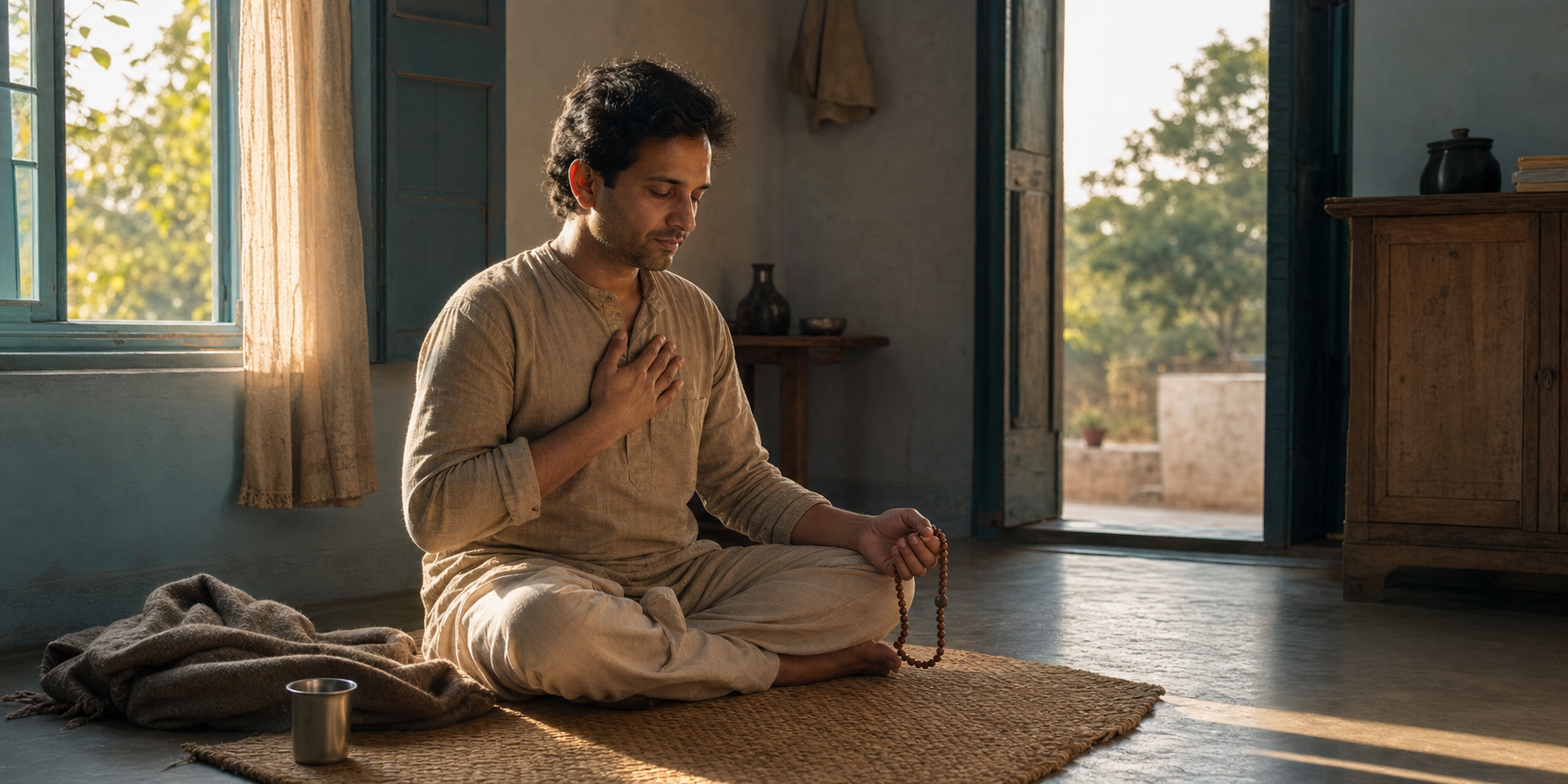
When a journey, examination, conflict, or stretch of low spirits unsettles you, a long ritual may be more than you can hold. Sacred sound offers a smaller doorway: a remembered utterance, an easy breath, a moment of listening, and then the next right action.
Used carefully, this is neither magical insurance nor mere positive thinking. A mantra or sacred name can gather scattered attention, join breath to intention, and return the mind to a sacred meaning. The aim is not to become untouchable. It is to meet uncertainty without surrendering your clarity, devotion, or practical responsibility.
Let protection mean steadiness, relationship, and right action
Before choosing a sound, decide what you mean by protection. If it means a guarantee that nothing painful will happen, no responsible spiritual practice can offer it. If it means invoking divine care while becoming less governed by panic, sacred sound has a clear place in daily life.
It helps to hold protection in three connected layers:
- Devotional protection: you invoke the Divine, take refuge, or remember the reality your tradition regards as ultimate.
- Inner protection: you interrupt fearful rumination long enough to recover discernment. This is a practical movement toward abhaya, or fearlessness, without pretending that danger does not exist.
- Practical protection: you do what the situation requires: follow safety instructions, prepare properly, seek help, speak carefully, or leave an unsafe setting.
The third layer cannot be outsourced to the first. A recitation before travel must be followed by ordinary precautions. A mantra before an examination must be followed by reading the questions and managing your attention. Sacred remembrance should make responsible action clearer, not seem unnecessary.
Resilience also needs a precise definition. It is not an uninterrupted spiritual mood. It is the capacity to notice that you have been shaken and return without turning the setback into a verdict on your worth. Dharmic practice recognizes doubt, low energy, old samskaras, comparison, and loneliness as workable conditions. Abhyasa, consistent practice, builds the path back; vairagya prevents every passing mood from becoming your identity.
After recitation, ask three plain questions. Can you name what you are feeling more accurately? Can you see the next dharmic action? Can you distinguish what you are entrusting to grace from what remains your responsibility? Those are more useful signs of protection than an unusual sensation during chanting.
Choose a sound you can honor, not one that merely sounds powerful

Sacred sounds are not interchangeable audio techniques. Their meanings arise within particular paths, texts, communities, and relationships with the Divine. The shared use of sound across dharmic traditions is real, but it does not make their teachings identical.
| Tradition or setting | Sacred form | Meaning that governs its use |
|---|---|---|
| Vedic and Upanishadic Hindu practice | Om, the Pranava | A sound-symbol of Brahman; A-U-M can be contemplated through waking, dreaming, and deep sleep, with the ensuing silence pointing beyond them. |
| Bengali Shakta household practice | Dugga Dugga | An invocation of Goddess Durga at departures and other uncertain thresholds, joining family blessing with trust in the Divine Mother. |
| Buddhist mantra traditions in which it is used | Om Mani Padme Hum | An orientation toward compassion and wisdom, not simply the Hindu use of Om transferred unchanged. |
| Jain practice | Om | A concentrated homage to the five supreme beings. |
| Sikh practice | Ik Onkar, Shabad, and Naam Simran | Remembrance of the Divine through the sacred Word and Name. |
Choose in the following order. Begin with the practice you have inherited or received from your family, sampradaya, sangha, or teacher. If you are still finding your path, choose a form whose meaning you sincerely accept. Then ask whether you can repeat it steadily without turning the practice into a performance.
Your Ishta or primary spiritual orientation matters here. Someone formed by devotion to Durga may find Dugga Dugga more truthful at a doorway than a mantra selected from a list. Someone undertaking contemplation of Brahman may remain with Om. A Sikh practitioner may return to Naam rather than borrowing a Sanskrit formula. Depth comes from relationship and continuity, not from collecting the largest number of sacred phrases.
If a competent teacher or community has given you a pronunciation, cadence, count, or discipline, follow that guidance. Otherwise, keep the practice simple. Do not combine unrelated invocations into a homemade protective formula merely because each sounds potent on its own.
Build a practice that still works on a difficult day

A resilience practice must survive the days when motivation is low. That makes regularity more important than intensity. Short, consistent practice without strain is more dependable than an ambitious routine repeatedly abandoned.
- Use a stable cue. Begin after an ordinary event that already happens: waking, washing, sitting at your place of practice, opening the front door, or preparing for sleep. The cue removes the need to negotiate with your mood.
- Name the immediate need. Use one honest sentence of sankalpa. It might be a wish to meet the journey with courage, speak without harm, or remain steady while completing a duty. Do not ask the sound to erase a feeling you have refused to acknowledge.
- Settle without forcing the breath. Sit or stand in a stable, unstrained posture. Let breathing remain comfortable. In a traditional vocal practice of Om, A may be allowed to rise from the navel area, U to resonate through the chest, and M to close at the lips. Treat this as attentive recitation, not a contest to produce the longest exhalation.
- Repeat with full attention. Recite aloud when the setting permits or repeat silently when privacy and circumstances require it. When attention wanders, return to the sound without scolding yourself. That return is the exercise.
- Listen after the sound. Leave an unforced pause before beginning again. With Om, the silence is part of the contemplation rather than unused space. With Naam or another sacred form, listening prevents remembrance from becoming hurried verbal momentum.
- Complete one protective action. Check the route, send the necessary message, resume the neglected duty, apologize, rest, or ask for help. This step joins sacred resolve to conduct.
There is no need to invent a severe count to prove sincerity. If your tradition supplies a count, observe it. Without such instruction, continue only while your breath, throat, posture, and attention remain at ease. If vocal repetition makes you light-headed, breathless, or painful, stop, return to normal breathing, and use quiet remembrance instead.
On a settled day, use the full sequence: cue, sankalpa, sound, listening, and action. At an unexpected threshold, keep its essential shape: remember, listen, act. The shorter form is not spiritually inferior. It is what makes the discipline available when life does not pause for a formal sitting.
Measure the practice by its effects on conduct. Useful signs include greater patience during conflict, gentler inner speech, and a quicker return to center after a setback. If you are mostly chasing vibrations, visions, or a dramatic mood, return your attention to meaning and the next action.
Carry sacred sound through thresholds, setbacks, and service

At the doorway
A threshold practice should be brief enough that you actually use it. In Bengali homes, Dugga Dugga accompanies departures for work, school, examinations, travel, and new beginnings. The words may be spoken by the traveler, offered by an elder, or sent in a message when the family is far apart.
You can preserve the integrity of that pattern by keeping three elements together: invoke protection sincerely, receive or express relational care, and perform the practical check the journey demands. No elaborate ceremony is required. The sacred pause matters because it prevents departure from becoming a rush of unexamined fear.
Complete vocal practice before driving. Once a vehicle is moving, the driver should keep eyes and attention on the road and should not attempt breath control. Use uncomplicated silent remembrance only if it does not divide attention; otherwise wait until safely parked.
During emotional turbulence
When anger, fear, or despondency is already present, do not chant over it as though devotion requires you to deny it. Name the feeling, feel your feet or seated posture, and begin gently. Let the sound create enough space to witness the state rather than obey it immediately. Then decide whether the dharmic response is to speak, wait, withdraw, repair, or seek support.
If audible chanting increases agitation, shift to silent japa or simple listening. If the practice continues to intensify distress, stop. Sacred discipline includes discernment; persistence does not mean forcing one method through every condition.
After the mind steadies
If repetition leaves you circling your own condition, give it an outward completion. Karma Yoga and Sewa can turn recovered steadiness into a concrete act of listening, giving time, sharing a skill, or helping someone carry a burden. This protects you from another danger: making spiritual self-monitoring the center of spiritual life.
Sound, silence, and service form a sound ethical sequence. You remember what is sacred, become less captive to reaction, and act with greater ahimsa. The protection sought for yourself then widens into care for other beings.
FAQ: questions that prevent common mistakes
Is Om a universal sound that can be detached from its origins?
No. Om has a specific Vedic identity as the Pranava and a sound-symbol of Brahman. Its presence in some Buddhist and Jain practices shows a wider dharmic history of sacred sound, but the meanings are not interchangeable. In an inter-tradition setting, acknowledge its Vedic origin and the distinct interpretation each path gives it. Respectful sharing begins with accurate naming.
Should you change sounds whenever the practice feels flat?
Not automatically. A quiet or distracted session does not prove that the practice has failed. Abhyasa trains the return itself, while vairagya keeps you from demanding a particular feeling on command. Stay with the sound unless you no longer accept its meaning, competent guidance points elsewhere, or the method consistently causes strain. Mood alone is a poor teacher of continuity.
When is sacred sound not enough?
When low spirits persist, worsen, or disrupt your ability to sleep, work, maintain relationships, or carry out ordinary responsibilities, seek a qualified mental-health professional. Mental-health care and sadhana can support each other; a mantra is not a substitute for assessment or treatment. If you may harm yourself or someone else, contact local emergency or crisis support immediately and stay with a trusted person if possible.
Begin at the next real threshold. Choose one sound you genuinely honor. Pause, breathe naturally, recite, listen, and complete one protective action. Let repetition become a way of returning to dharma, not a bargain for certainty.
References
- DharmaRenaissance Blog — Overcoming Early Spiritual Despondency: Dharmic Wisdom to Steady the Heart and Mind
- DharmaRenaissance Blog — Yajurveda on Om: The Pranava’s Transformative Power for Realizing Brahman
- DharmaRenaissance Blog — ‘Dugga Dugga’ Explained: The Heartfelt Bengali Blessing for Protection and Safe Journeys
