
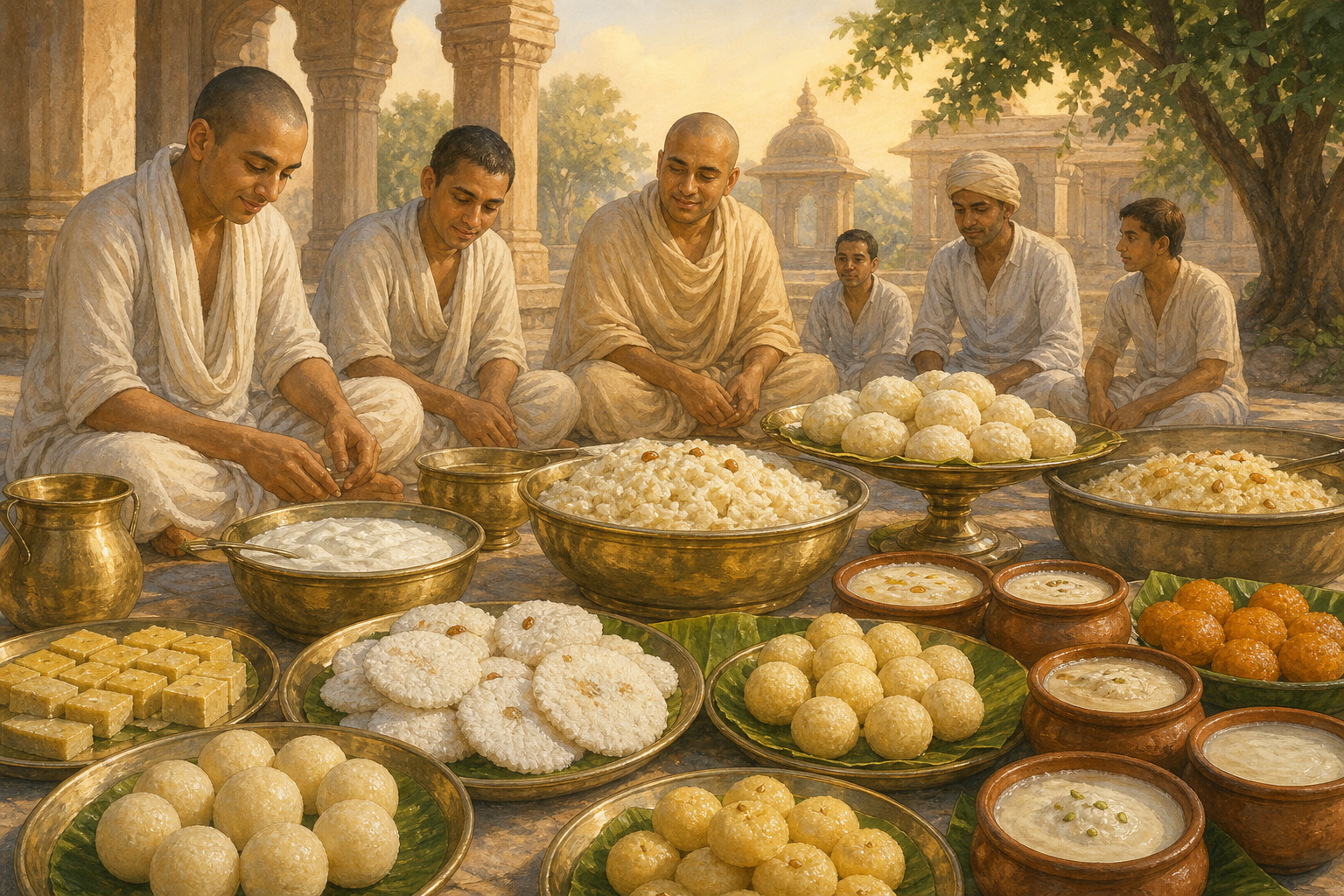
C.C. Madhya 14.28 is a compact description of an extensive assortment of sweets and milk preparations. Read within its narrative setting, the verse is more than a menu: it depicts food that has entered a devotional relationship through offering, reception and sharing.
The available notice identifies a discourse on this text, but supplies no transcript from which to reconstruct the speaker’s arguments. A responsible guide must therefore distinguish what the notice reports, what the cited verse says and what may reasonably be drawn from its context.
What the available discourse notice establishes
The Dandavats notice attributes the discourse to H.G. Rasamaya Nitrananda Das and identifies its subject as C.C. Madhya 14.28. That establishes the announced speaker and textual focus, but not the discourse’s interpretations, examples or conclusions.
There is also a bibliographic distinction worth preserving. The notice’s title uses the label “Srimad Bhagavatam,” whereas the verse reference leads to Sri Caitanya-caritamrta, Madhya-lila, Chapter 14, text 28. Readers searching for the passage should therefore follow the C.C. citation rather than treating the two work titles as interchangeable.
The verse within the prasadam narrative
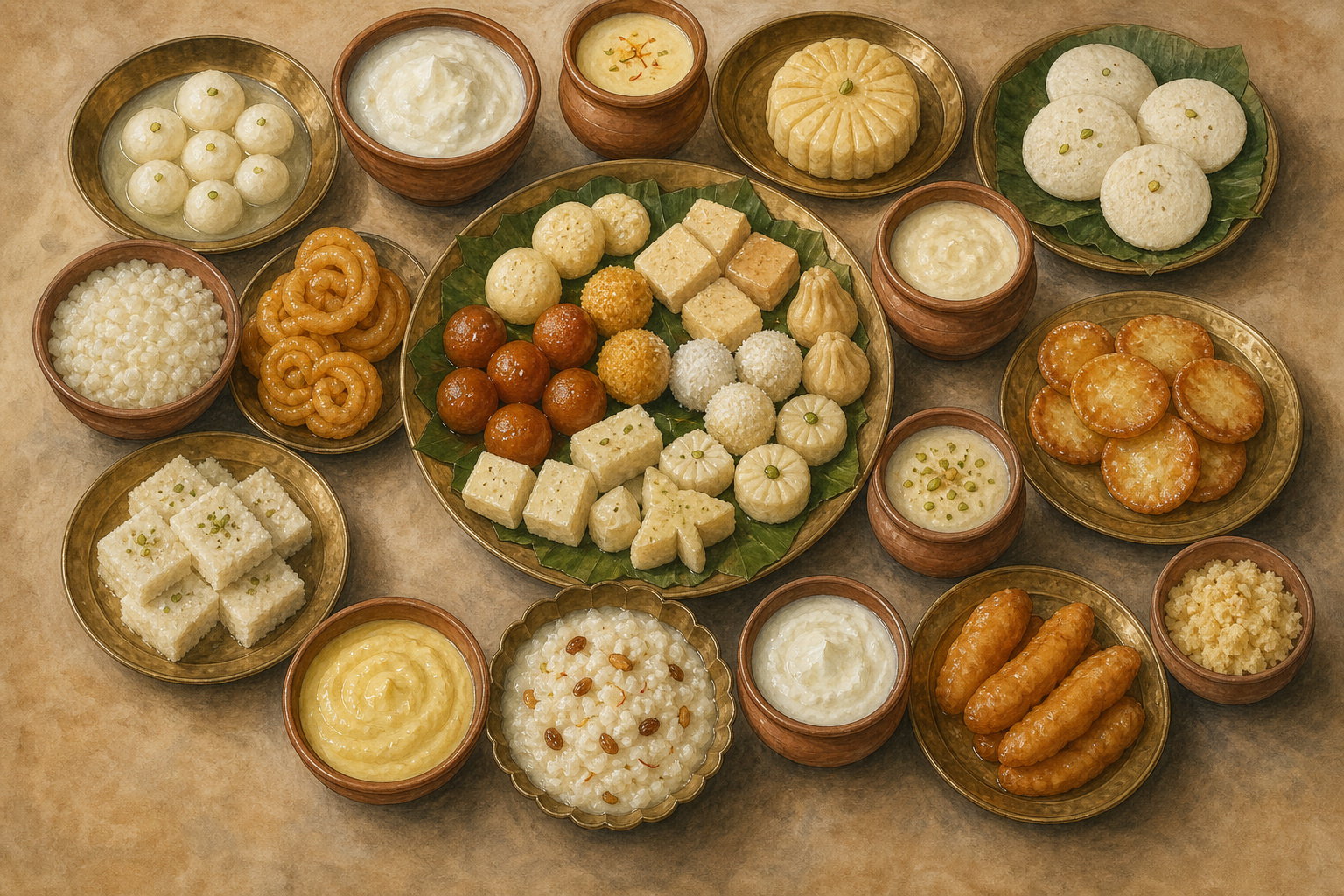
The verse names manohara-ladu, amrta-gutika and numerous varieties of condensed-milk preparation, while indicating a much larger range of sweets. Its immediate significance becomes clearer when read with the surrounding passage rather than in isolation.
The chapter sequence reports that Vaninatha Raya brought prasadam and that Sri Caitanya Mahaprabhu accepted lunch with the devotees. It also describes provisions sent by the King through Sarvabhauma Bhattacarya, Ramananda Raya and Vaninatha Raya. The neighboring verses extend the inventory across fruits, dairy foods, breads, confections and other preparations. Text 28 is thus one detail within a broader scene of offering and communal reception.
Prasadam, in ordinary devotional usage, is food first offered to the deity and subsequently received as grace. That relationship changes the interpretive center of the passage. The food is not presented merely as private consumption or culinary display; it belongs to a sequence involving preparation, offering, acceptance and distribution among devotees.
Why an inventory of sweets carries devotional meaning
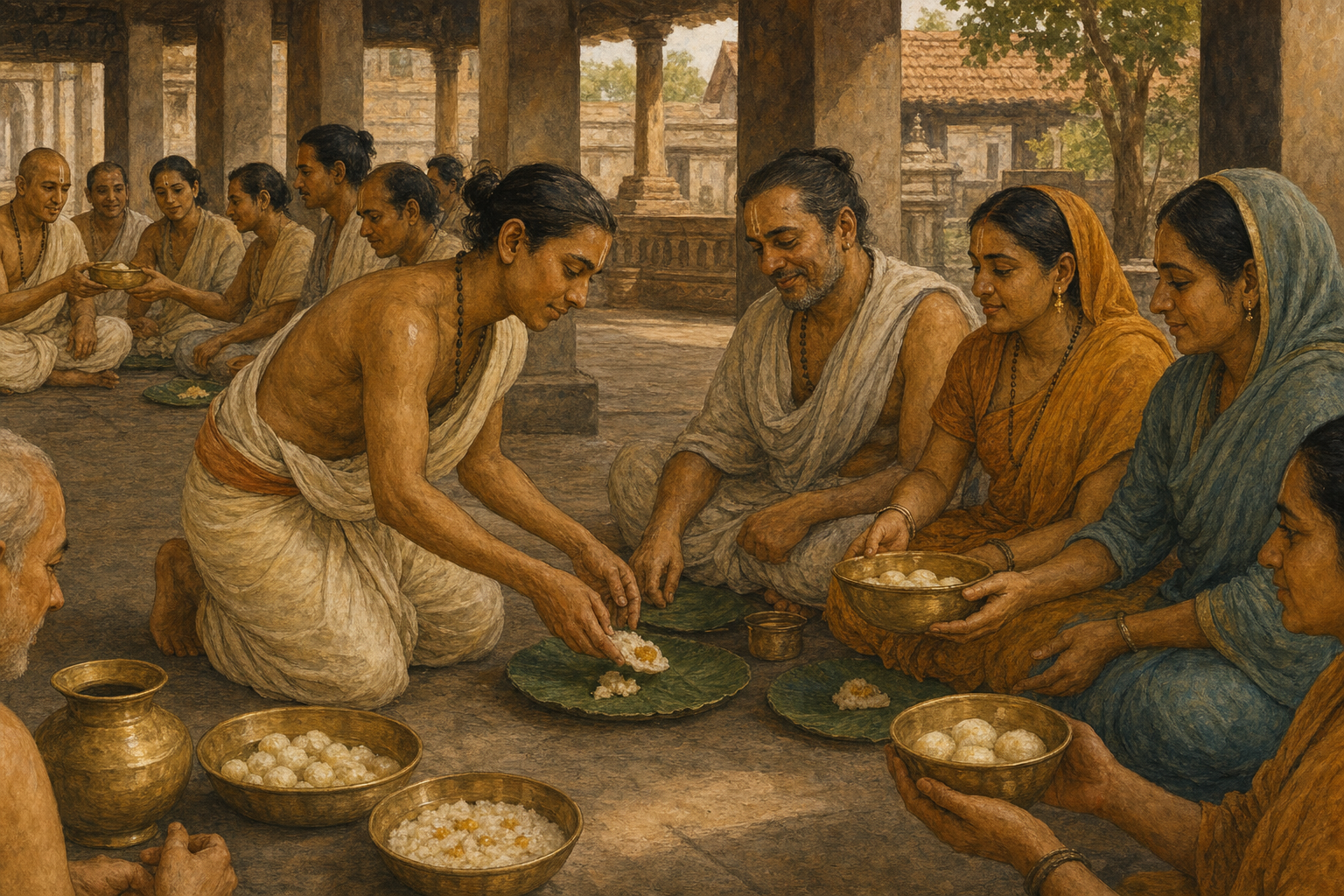
The verse’s abundance can be read on several levels without forcing symbolism onto every named preparation. At the literal level, it records variety. At the narrative level, that variety conveys the scale and care of the service. At the devotional level, it shows ordinary ingredients and culinary skill being directed toward an offering and then shared.
The specificity matters. Naming different preparations prevents “abundance” from remaining an abstraction: service appears through distinctions of texture, method and ingredient. The passage thereby gives devotional attention a material form. Care is expressed not only through inward intention but also through the disciplined work of preparing many distinct foods.
Yet quantity should not be detached from relationship. The narrative does not make spiritual life equivalent to lavish consumption, nor does one verse establish a universal requirement for elaborate offerings. Its safer lesson is that abundance becomes religiously meaningful here because it is ordered toward seva, received as prasadam and situated within a community of devotees.
A sound method for hearing the discourse
A careful listener can approach a discourse on this verse in three movements. The first is textual: identify exactly what text 28 names. The second is narrative: follow the preceding and succeeding verses to see who brings, offers, accepts and shares the food. The third is reflective: consider how skilled work, generosity and communal participation can become forms of devotional care.
This method also supplies a useful test for commentary. Interpretations should illuminate the recorded scene rather than replace it. Claims presented as the speaker’s own teaching require access to the recording or a transcript; claims derived from the verse should remain identifiable as textual interpretation.
Key takeaways
- The Dandavats notice attributes a C.C. Madhya 14.28 discourse to H.G. Rasamaya Nitrananda Das, but the supplied source material contains no transcript of his remarks.
- The cited text belongs to Sri Caitanya-caritamrta, despite the different work label used in the notice’s title.
- The verse describes numerous sweets and condensed-milk preparations within a larger prasadam episode shared by Sri Caitanya Mahaprabhu and the devotees.
- Its strongest interpretive themes are attentive service, offered abundance and communal reception, not culinary extravagance considered by itself.
Future treatments of the discourse would benefit from a verified recording or transcript. Until one is available, keeping textual evidence separate from attributed speech allows the verse’s devotional richness to be explored without assigning unrecorded claims to the announced speaker.
References
- Dandavats — Srimad Bhagavatam (Text C.C. Madhya 14.28), Speaker: H.G. Rasamaya Nitrananda Das
- Vedabase — Sri Caitanya-caritamrta Madhya-lila 14.28
- Bhaktivedanta VedaBase — Sri Caitanya-caritamrta Madhya-lila, Chapter 14