

If these three verses have left you wondering whether the Bhagavatam is praising Kali-yuga, privileging South India, or promising bhakti to anyone who drinks from a sacred river, your questions are exactly where careful reading begins. The passage is compact enough to quote quickly and subtle enough to misuse.
Read verses 38-40 as one movement. The first identifies Kali-yuga’s unexpected spiritual opportunity. The second locates a notable concentration of devotees in Dravida. The third joins sacred water to pure-hearted devotion. The movement is from time, through place, into the heart.
Kali-yuga’s advantage is access to bhakti, not its defects
Verse 38 makes a deliberately surprising claim: people belonging to earlier yugas desire birth in Kali-yuga because devotees devoted to Narayana will appear in this age. The desirable feature is not Kali’s confusion, conflict or decline. It is the presence of Narayana-centered bhakti amid those conditions.
This distinction matters. You don’t have to romanticize disorder to appreciate the opportunity available within it. Adharma remains adharma. The verse directs your attention away from the age’s defects and toward the company of those who make Narayana their supreme shelter.
That changes the practical question. Instead of asking only, “How bad is Kali-yuga?” ask, “Whose association is shaping my consciousness within Kali-yuga?” An age can be spiritually difficult while offering unusually accessible forms of remembrance, congregational devotion and satsanga. The sane response is neither despair nor complacency. It is deliberate association.
- Do not use the verse to excuse the age’s disorder. Resist what degrades dharma.
- Do not make cataloguing Kali-yuga’s faults your main spiritual occupation. Constant outrage can become another form of absorption in Kali.
- Find devotees whose conduct makes remembrance of Bhagavan easier, and become that kind of association for others.
The verse therefore gives you a different measure of good fortune. Comfort, wealth and social stability matter, but they do not by themselves reveal the spiritual value of a birth. Access to sincere bhakti can turn an outwardly difficult situation into a decisive opportunity.
Dravida is emphasized without making bhakti regional property
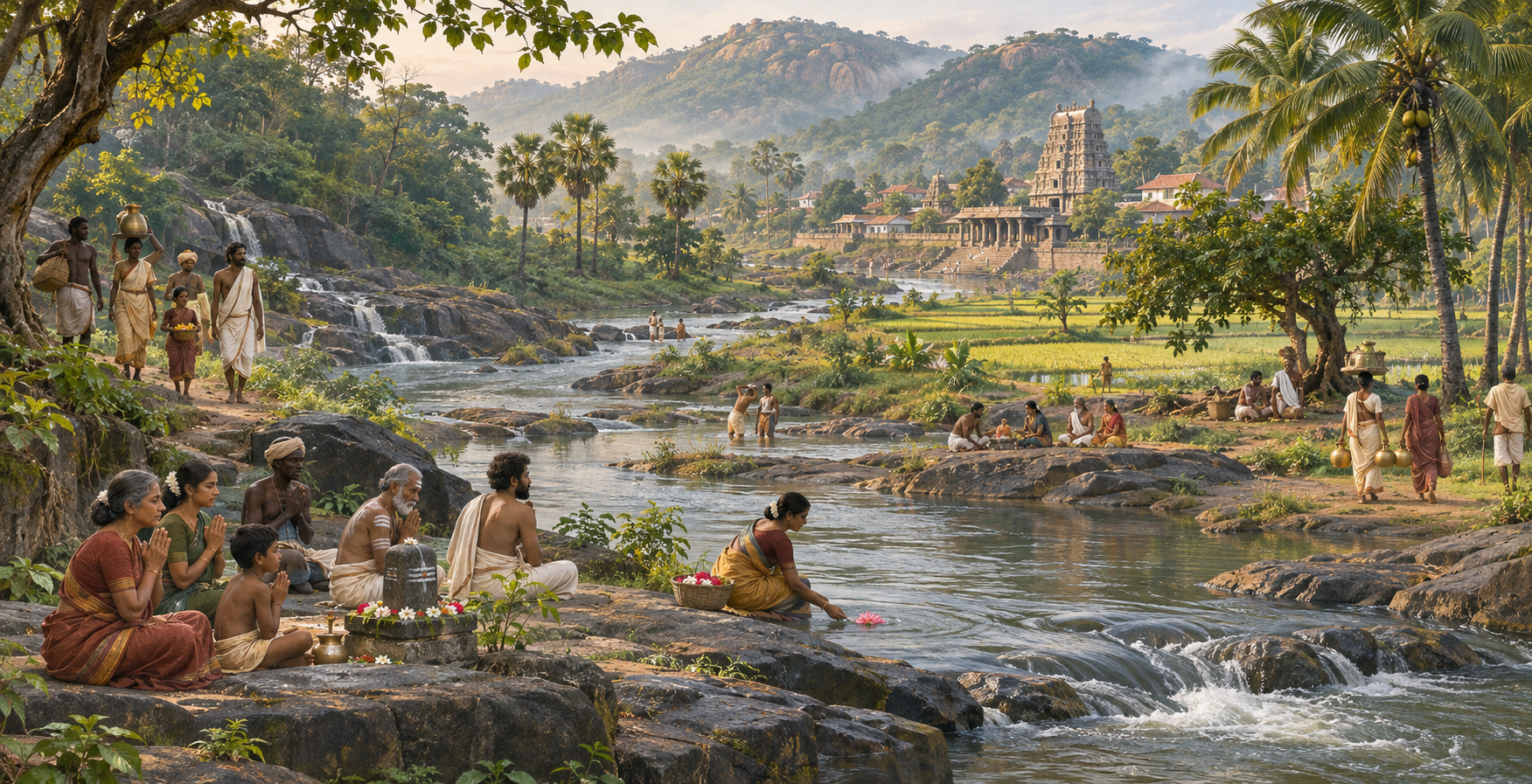
Verse 39 needs both halves of its geographical statement. Devotees arise kvacit kvacit, in various places, and they are bhurisah, especially numerous, in Dravida. If you retain only “various places,” you erase the passage’s deliberate emphasis on southern Bharat. If you retain only “Dravida,” you turn a concentration of bhakti into an exclusive territorial claim.
The Bhagavatam does not treat geography as spiritually meaningless. It names Tāmraparṇī, Kṛtamālā, Payasvinī, Kāverī and Pratīcī Mahānadī. These are not decorative scenery. They place the discourse in a recognisable sacred landscape and honour a region in which devotion to Narayana would be abundant.
Nor should the passage be forced into today’s political categories. Its concern is not a modern contest over regional identity. It presents Dravida as a major field of bhakti while explicitly leaving room for devotees elsewhere. Sacred geography can be particular without becoming possessive.
For a reader concerned with Bharatiya civilisation, this is an important correction to placeless spirituality. Dharma is transmitted through people, but also through languages, temples, pilgrimage routes, rivers, inherited observances and communities of memory. Universal truth does not require a geography with all its names rubbed out.
- Locate the named rivers when you study the verses. A map can prevent sacred names from becoming vague religious vocabulary.
- Read “various places” and “abundantly in Dravida” together every time. The first prevents exclusion; the second prevents erasure.
- Approach living southern traditions as communities from which to learn, not as exhibits from a vanished devotional past.
- Do not convert the passage’s praise into regional pride detached from humility, service and devotion.
The test is simple: does your reading deepen gratitude for the region’s Dharmic inheritance while increasing respect for sincere bhaktas wherever they appear? If so, you have preserved both the particular and the universal dimensions of the verse.
Sacred water is a relationship, not an automatic mechanism
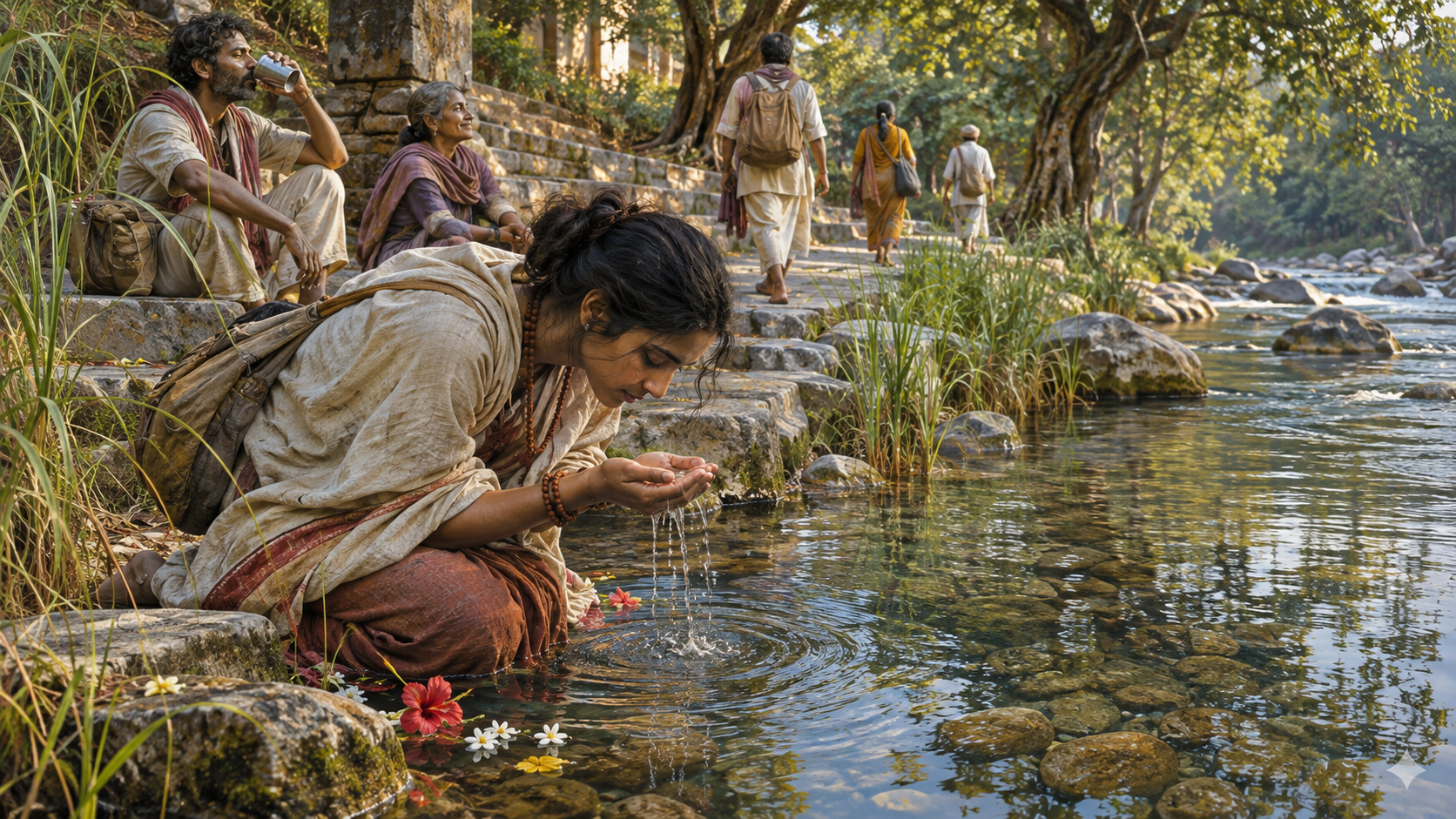
Verse 40 associates drinking the waters of these rivers with becoming devotees of Bhagavan whose hearts are pure in relation to Vāsudeva. The word prāyeṇa, meaning generally or for the most part, deserves attention. It discourages the crude formula that physical contact automatically guarantees spiritual attainment.
In a Dharmic reading, sacred water is more than an isolated substance. Receiving it can join bodily action to remembrance, pilgrimage, reverence, inherited discipline and the association of a holy place. The outer act is meant to awaken an inner orientation. Separating the water from that devotional world leaves only a mechanism that the passage itself does not require you to invent.
This also means that reverence is incompatible with carelessness. Calling a river sacred while polluting it preserves the label and violates the relationship. If its waters carry memory, worship and life, protecting them is not an optional environmental interest added to Dharma from outside. It is one way reverence becomes honest.
The verse is not modern medical advice to consume untreated water. Present-day contamination and local safety conditions must be taken seriously. If water is not known to be safe, do not drink it. Pranama, remembrance and respectful symbolic contact do not become less devotional because you refuse an avoidable health risk.
- Follow the instructions of trustworthy local temple or tirtha custodians before receiving water.
- Never assume that the word “sacred” is a guarantee of physical potability.
- Follow local rules for offerings, and never leave plastic or other non-biodegradable waste at the river.
- Pair pilgrimage with nama, prayer, study, dana or seva so that visiting the place changes more than your location.
- If you cannot travel, learn the river’s name, remember the tirtha with respect and support responsible care for sacred water where you live.
A mature reading can therefore affirm the river’s sanctity without superstition and affirm physical safety without reducing the river to chemistry. The two concerns belong together because both refuse to treat sacred water casually.
The inward test is whether Narayana becomes your shelter
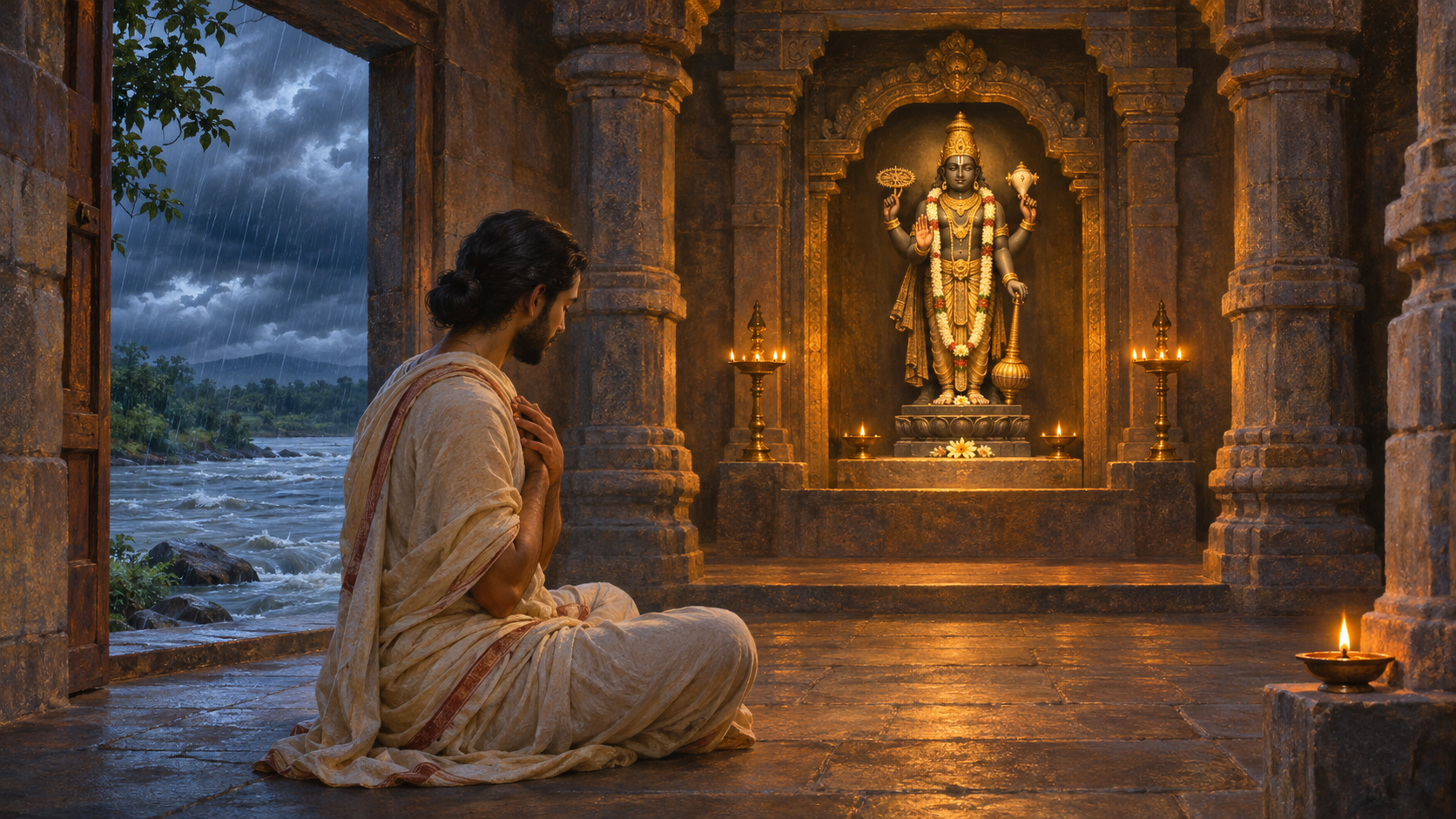
The passage begins with narayana-parayanah and ends with vāsudevāmalaśayāḥ. These expressions tell you what the praise of time and place is for. Narayana-parayana describes an orientation in which Narayana is the highest destination and shelter. The final expression points to devotees whose inner purpose is unclouded in relation to Vāsudeva.
This is more demanding than adopting a devotional label. A label can be inherited, displayed or defended without reorganising the heart. Parayana asks where you finally turn. The reference to purity of heart asks whether your visible devotion carries a concealed second agenda: prestige, control, resentment, factional advantage or exemption from correction.
Do not turn amala, purity, into a claim of personal perfection. Treat it as a direction of purification. Bhakti begins before every motive is clean, but sincere bhakti allows those motives to be seen and corrected. The person who notices impurity and brings it before Bhagavan may be moving more honestly than the person who uses sacred identity to declare the examination finished.
Use these questions as an examination of practice, not as a word-for-word translation of the verses:
- When fear or humiliation strikes, what do you treat as your first refuge: remembrance of Bhagavan, or the urge to retaliate and control?
- Does your practice make deception harder to tolerate in your own conduct, or only easier to condemn in someone else?
- Are you using region, lineage, institution or learning as a badge, or as a responsibility to serve?
- What attachment would remain threatened if no one could see or praise your devotional activity?
- What act of seva would make your reverence for Bhagavan, devotees and sacred geography visible in conduct?
You can also study the passage without losing its sequence. Read all three verses together. Mark the words that qualify the claims: kvacit kvacit, bhurisah and prāyeṇa. Then mark the movement from Narayana-centered devotees, to Dravida and its rivers, to the Vāsudeva-centered heart. Finally, choose one corresponding practice: seek sound satsanga, honour a sacred place responsibly, and correct one mixed motive in your own worship.
If you want to continue through oral teaching, hear Bhakti Brihad Bhagavat Swami’s discourse on SB 11.5.38-40. Listen with the verses open, and note where the explanation changes how you understand the relationship among yuga, geography and inner purification.
Key takeaways
- Verse 38 praises Kali-yuga’s opportunity for Narayana-bhakti, not Kali-yuga’s disorder.
- Verse 39 says devotees appear in various places while giving a distinct emphasis to Dravida; neither part should cancel the other.
- The named rivers root bhakti in Bharat’s sacred geography without restricting devotion by ancestry or residence.
- The qualifier prāyeṇa resists the idea that drinking river water works as an automatic spiritual guarantee.
- The passage culminates in orientation toward Vāsudeva and purification of the heart; time, place and ritual contact are directed toward that transformation.
When you next approach these verses, begin where they begin: seek the association of those who make Narayana their shelter. Continue where they travel: honour the sacred geography that carries Dharma across generations. End where they end: examine what is happening within your own heart. That is how praise of Kali-yuga and Dravida becomes a practice instead of a slogan.
References
- Śrīmad-Bhāgavatam 11.5.38-40.
- Dandavats – HH Bhakti Brihad Bhagavat Swami || (SB-11.05.38-40) || 11-11-2026

Leave a Reply
You must be logged in to post a comment.