

If you searched for Bala and Atibala because someone described them as shortcuts to extraordinary power, begin with their place in Rama’s education. Their significance lies first in a relationship: Vishwamitra entrusts sacred knowledge to Rama before Rama receives a larger array of divine weapons and mantras.
In Bala Kanda, chapter 21, Bala and Atibala are presented as the first powerful mantras Rama accepts from Sage Vishwamitra. Later gifts help him fulfil his mission on earth. That order offers the safest key to the episode: these mantras belong to Rama’s preparation, not to a detached catalogue of supernatural techniques.
What Bala and Atibala are in Rama’s story
The name Bala points toward strength, while Atibala intensifies the idea toward surpassing or exceptional strength. Those ordinary meanings help you remember the pair, but they should not be inflated into a detailed list of powers that the available account does not establish.
The secure narrative facts are simple. Vishwamitra is the giver. Rama is the recipient. Bala and Atibala come first, and the transmission is followed later by further mantras and divine weapons. Their position in that sequence is as important as their names.
This also helps you separate three questions that are often mixed together. The narrative question asks what Rama receives and from whom. The interpretive question asks why this gift comes before later powers. The practice question asks whether and how a person should recite the mantras. The episode directly answers the first question, gives material for reflecting on the second, and should not be treated by itself as a complete answer to the third.
Why inner preparation comes before greater power
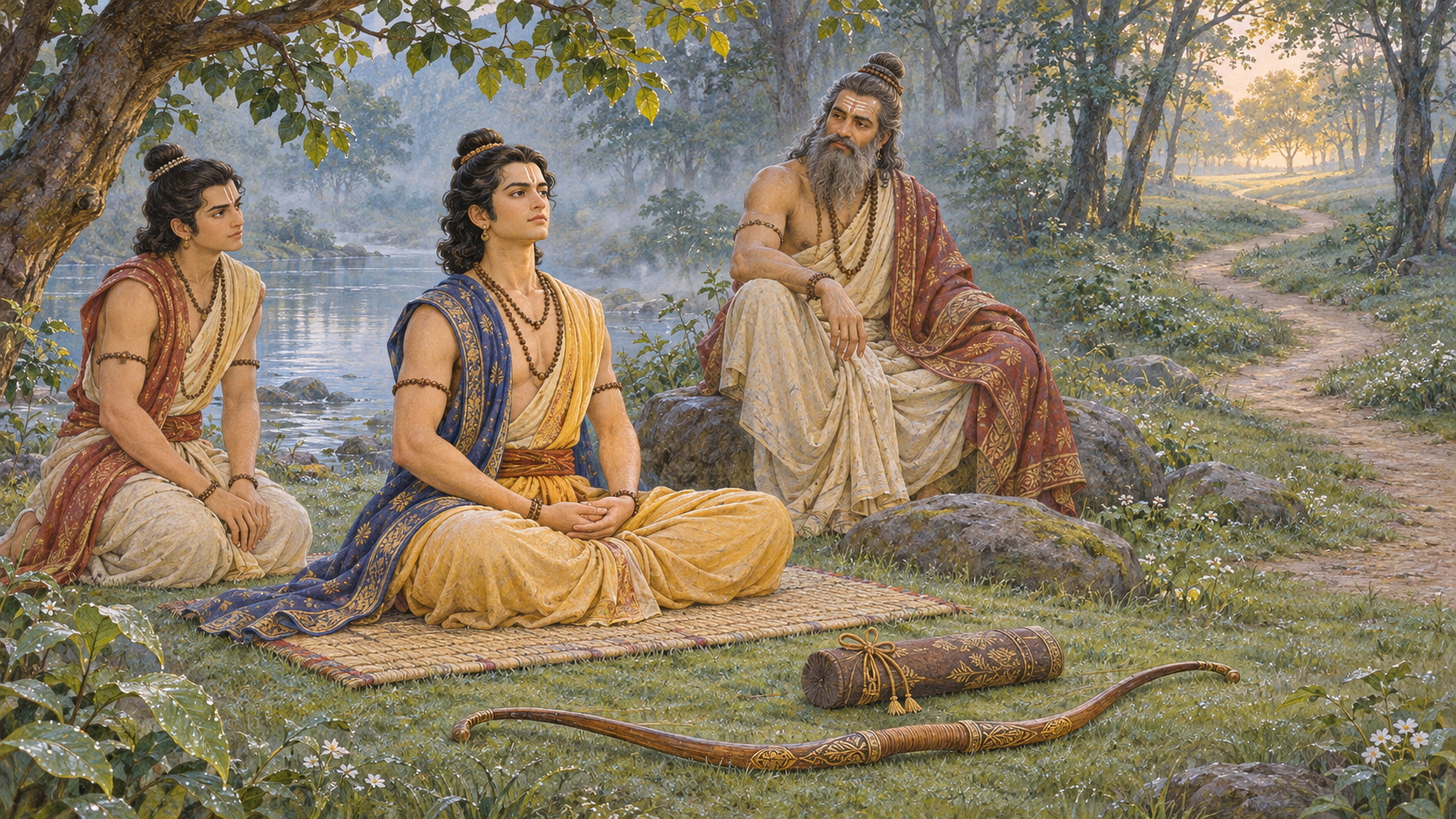
A fruitful reading of the sequence is that capacity must precede escalation. Rama’s path does not begin with the most spectacular weapons. It begins with knowledge received under the guidance of a rishi. The bearer of power is prepared before the inventory of power expands.
Strength is placed within discipline
Bala and Atibala are not introduced as trophies Rama seizes for himself. They are entrusted to him. That distinction matters in a Dharmic reading: the ability to obtain something is not the same as readiness to use it. Knowledge becomes part of dharma when it is joined to formation, responsibility and purpose.
The teacher comes before the technique
You can know the names Bala and Atibala without possessing what the narrative presents as transmitted knowledge. The episode therefore resists a common modern assumption that access to a term is equivalent to mastery of the thing named. Vishwamitra’s role is not decorative. It tells you that relationship, guidance and fitness belong to the meaning of the transmission.
Power is connected to a mission
Rama later receives more mantras and divine weapons that assist his mission. This makes Bala and Atibala part of a developing responsibility rather than an isolated promise of personal advantage. If you read the pair only as a way to acquire unusual abilities, you remove the very context that explains why Rama receives them.
Four common mistakes that distort the episode
Turning the names into a complete practice. A mantra’s name, a translation of that name and a disciplined method of practice are different things. Knowing that Bala concerns strength does not supply pronunciation, procedure, eligibility or instruction. If you want a living practice rather than literary understanding, seek guidance within a lineage that actually teaches it.
Reading Rama’s reception as a consumer promise. A sacred narrative about Rama receiving mantras from Vishwamitra does not automatically promise identical results to anyone who finds a formula online. Ask first what the episode reveals about Rama’s formation. Do not convert a moment of transmission into an advertisement for instant power.
Ignoring instruction because Rama is divine. Readers who approach Rama as divine can still notice that the story gives real weight to teaching and preparation. Divinity is not used to make discipline irrelevant. Rama receives, learns and proceeds through an ordered path. For a devotee, that can make his conduct more instructive, not less.
Collapsing mantras and weapons into one category. Keep the sequence clear. Bala and Atibala are identified as mantras. Later stages include additional mantras as well as divine weapons. Treating every sacred acquisition merely as a weapon hides the formative role played by the first transmission.
A practical way to study Bala and Atibala

You do not need to settle every theological question before learning from this passage. Use the following reading method to distinguish what the narrative states from what you infer from it.
- Anchor the scene. Begin in Bala Kanda around chapter 21. Read enough before and after the transmission to see what role it plays in Rama’s developing preparation.
- Write the sequence in one line. Record only the explicit movement: Vishwamitra gives Bala and Atibala to Rama; later Rama receives further mantras and divine weapons for his mission.
- Separate statement from interpretation. On one side of a page, write what happens. On the other, write what you think it means. For example, “Vishwamitra gives the mantras” is a narrative fact; “power requires disciplined preparation” is an interpretation of that fact.
- Ask a question the sequence can answer. Try: Why does Rama’s expanding power begin with instruction from a rishi? That question keeps your attention on dharma, formation and responsibility instead of speculative lists of benefits.
- Keep study and formal practice distinct. You may study the episode, contemplate its teaching and discuss its symbolism without claiming initiation into a mantra practice. If you seek recitation instruction, take that separate question to a qualified teacher rather than reconstructing a method from isolated names.
This method is useful beyond this single scene. Whenever an epic presents a mantra, blessing or weapon, note the giver, recipient, purpose and position in the larger journey. Those four details often reveal more than a detached description of the power itself.
Key takeaways
- Bala and Atibala are the first powerful mantras Rama receives from Sage Vishwamitra in the cited Bala Kanda episode.
- Their position before later mantras and divine weapons makes them foundational to Rama’s preparation.
- The transmission joins strength to guidance, discipline and mission rather than presenting power as an end in itself.
- Knowing a mantra’s name or general meaning is not the same as receiving a complete method of practice.
- You can study the passage responsibly by separating its explicit narrative facts from your theological or symbolic interpretation.
Your next step is concrete: open Bala Kanda at this episode, mark the exact movement from teacher to student, and write one sentence explaining why it occurs before Rama’s later acquisitions. If that sentence includes preparation, responsibility and purpose, you will be reading Bala and Atibala in the order the narrative gives them.
References

Leave a Reply
You must be logged in to post a comment.