
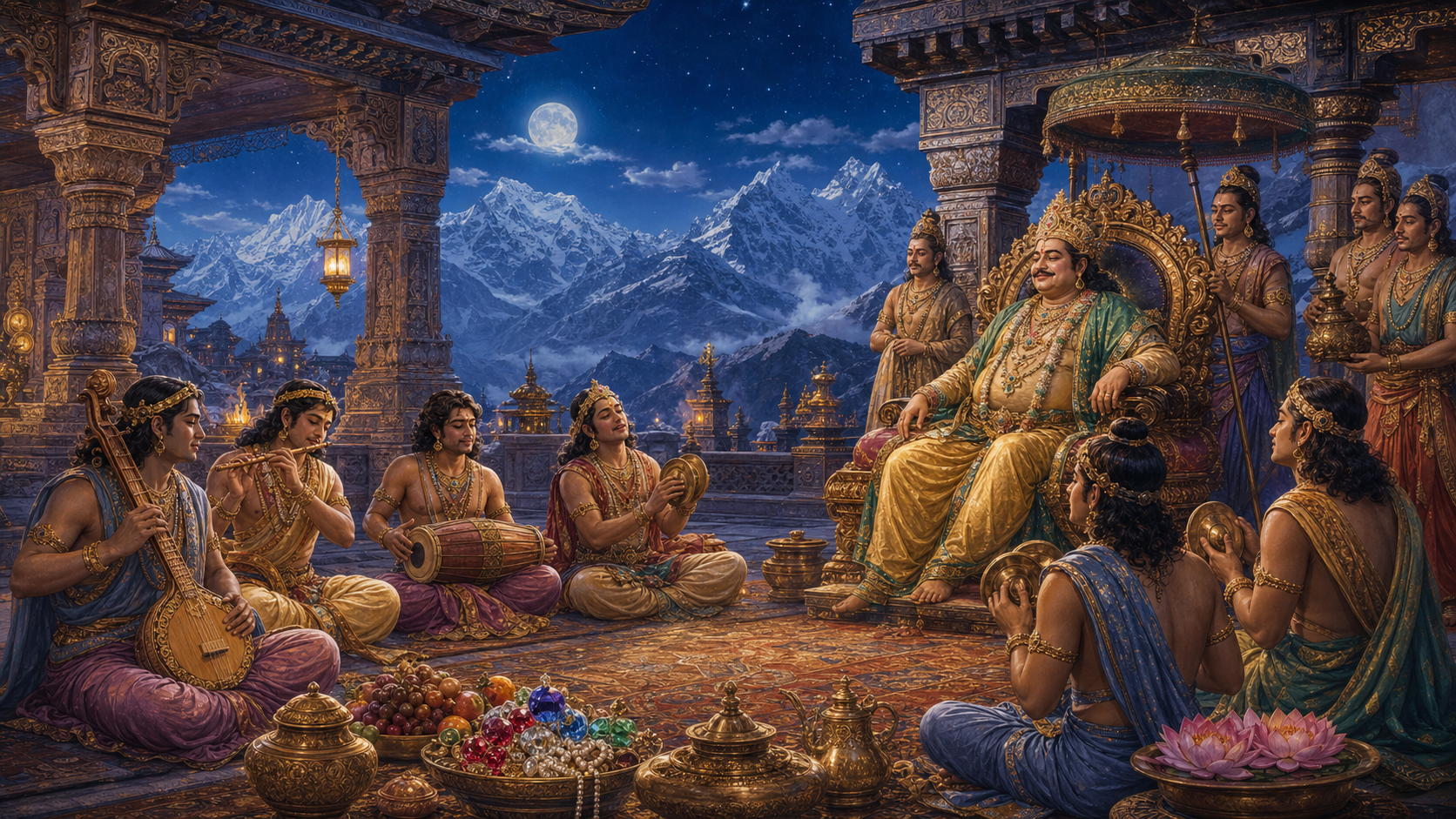
You have found the name “Agneyas” in a catalogue of celestial beings, but the surrounding vocabulary seems to point in several directions. Does the name mean descendants of Agni, inhabitants of the southeast, a class of Gandharvas, or musicians attached to Kubera?
The safest answer comes from reading the name in context. Sanskrit permits an Agni-related adjective, a directional term, and a collective name, but you should not combine those meanings into a biography that the passage itself never gives. Once that distinction is clear, the Agneyas become a useful window into the Dharmic relationship between sacred sound, prosperity, and order.
First decide what “Agneya” is doing in the passage
The Sanskrit term āgneya commonly means “pertaining to Agni” or possessing a fiery character. It can also indicate the southeast, the direction traditionally designated by the same word. In mythological catalogues, however, the plural “Agneyas” can function as the proper name of a group.
These senses are related at the level of language, but they are not interchangeable in every sentence. A directional reference does not automatically identify a community of beings. A group called the Agneyas does not automatically consist of Agni’s children. Etymology gives you a field of possible associations; context decides which association the passage activates.
Use three checks when you meet the term:
- Check the grammar. If āgneya qualifies a quality, object, place, or action, it is probably functioning as an adjective rather than naming a population.
- Check the geography. If the surrounding passage maps directions, guardians, or spatial divisions, the southeast sense deserves priority.
- Check the company it keeps. If the word occurs in a list of Gandharvas or other celestial communities, “Agneyas” is more likely to be a collective designation.
For your own notes, it helps to write āgneya for the adjective or direction and “the Agneyas” for the named group. That English convention is only a reading aid, not a claim that capitalization settles the Sanskrit.
You should also resist filling a short catalogue entry with an unsupported genealogy, icon, mantra, or individual leader. Puranic lists can vary among recensions and regional tellings. The Agneyas may be named in one strand while another passage emphasizes different Gandharva groups or places Gandharvas more generally in Indra’s assembly. Such variation calls for precision: identify what your passage actually supplies, and leave unspecified details unspecified.
The Agneyas make sense as a Gandharva community
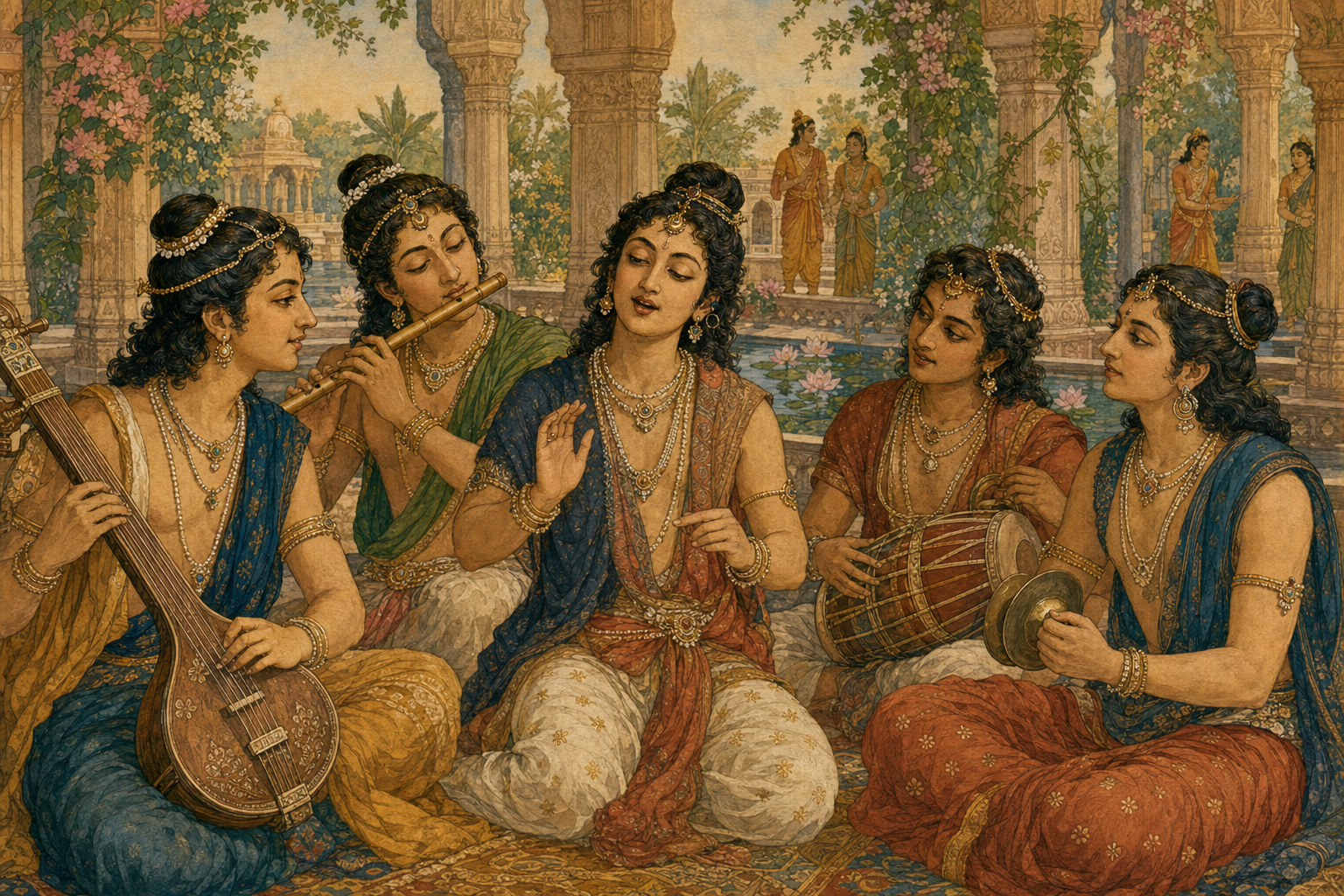
Gandharvas occupy a liminal position in Hindu cosmology. They are celestial rather than human, yet they are not usually portrayed as sovereign deities. Their importance lies in specialized service: sacred sound, refined performance, ceremonial presence, and the cultivation of an auspicious atmosphere.
Their identity also develops across layers of tradition. Vedic material presents Gandharva in an older and more elusive form, associated with the guarding of sacred things and the maintenance of cosmic order. Epic and Puranic narratives expand that profile into a populated celestial community of singers, musicians, and connoisseurs of rasa. Familiar figures such as Tumburu and Citraratha illustrate the artistic and diplomatic range of the larger class, although their individual stories should not be transferred to the Agneyas without textual warrant.
Calling the Agneyas a Gandharva group therefore tells you more about function than personal biography. Think of a cohort with a recognized place in divine society, not a modern musical band with a fixed membership list. The comparison to a guild can be helpful if you keep it modest: the name marks shared competence and service, while individual identities may remain unnamed.
When a Gandharva group enters a divine assembly, notice what changes in the scene. Music establishes the emotional and ritual register of an arrival, celebration, coronation, reconciliation, or act of worship. It turns a gathering of powerful beings into an ordered court. Performance is doing cosmological work.
This corrects a common modern misreading. Celestial music is not merely entertainment added after the important business has finished. In a Dharmic setting, sound can prepare attention, coordinate a community, carry praise, and make an occasion fit for sacred action. Rasa—the experienced essence or savor of art—is not opposed to order. Properly directed, it helps people perceive and inhabit that order.
So, when you encounter the Agneyas in a narrative, ask three functional questions: What ceremony or assembly is taking place? Whose court are they attending? What quality does their performance establish—welcome, praise, celebration, reconciliation, or auspiciousness? Those questions will usually reveal more than an attempt to invent a complete family tree from the name alone.
Why Kubera’s wealth is surrounded by music
Kubera, also called Vaiśravaṇa, is the treasurer of the devas, sovereign of the Yakshas, and guardian of the northern direction. His domain is consequently larger than a storehouse of precious objects. It is a court: an ordered society in which Yakshas, Kinnaras, Gandharvas, and other specialized beings can appear.
Some Puranic and later narrative strands place the Agneyas within this milieu as Gandharva musicians. The qualification matters. Gandharvas are not always exclusive servants of Kubera; they can attend other deities and divine assemblies. The Kubera connection is a meaningful traditional placement, not a rule that erases every other affiliation.
There is also no directional contradiction to solve. Āgneya can designate the southeast, while Kubera guards the north, but the Agneyas in his retinue are being read as a named Gandharva group. Treating the directional sense and the group name as separate contextual uses removes the apparent mismatch.
The deeper point is ethical. Kubera represents wealth, but his court is imagined with music, poetry, beauty, and ceremony. That arrangement places artha, material prosperity, within an environment shaped by dharma, auspiciousness, cultivated joy, and right relationship. The presence of the Agneyas helps make wealth civilized.
This does not mean that music mechanically produces money, nor does it turn Kubera into a promise of private enrichment. The symbolism runs in the other direction: abundance is incomplete if it cannot sustain worship, artistry, hospitality, generosity, and shared celebration. Wealth needs a worthy atmosphere and a worthy use.
The imagined terraces of Alakapuri, Kubera’s city, make this logic visible. A treasury without song would signify accumulation alone. A prosperous court animated by disciplined art presents abundance as something that circulates through service and gratitude. The musician’s skill and the treasurer’s resources become interdependent contributions to an ordered whole.
You can apply that standard without pretending that a mythological court is a household budget manual. When you spend for a temple festival, devotional gathering, or cultural programme, ask whether the resources support the occasion’s Dharmic purpose. Are artists treated as practitioners whose discipline matters? Does the performance serve prayer and community, or has spectacle displaced both? The Kubera-Gandharva relationship gives you a criterion: prosperity should make refined, auspicious participation possible.
Read the motif across Dharmic traditions without flattening it
Gandharvas and Vaiśravaṇa belong to a vocabulary that travelled across Dharmic traditions. Buddhist cosmology recognizes Gandharvas—gandhabbas in Pāli—and Vaiśravaṇa as celestial categories. Jain classifications place Gandharvas among the vyantara devas. These parallels reveal a shared civilizational grammar of celestial music, guardianship, and ordered abundance.
Shared grammar does not mean identical doctrine. Hindu, Buddhist, and Jain cosmologies arrange celestial beings within different accounts of karma, liberation, worship, and spiritual authority. A familiar name can retain recognizable features while acquiring a different doctrinal position.
Use a three-level comparison:
- Name: Is the term identical, translated, or merely cognate?
- Function: Does the being perform music, guard a direction, protect a realm, attend a sovereign, or fulfill another role?
- Framework: How does that tradition classify the being, and what spiritual importance does the classification carry?
This method lets you recognize continuity without claiming that every Gandharva account describes the same entity in precisely the same way. It also prevents a narrower mistake: the presence of Gandharvas and Vaiśravaṇa in another tradition does not, by itself, prove that its texts recognize the specific Agneya cohort. Similarity at the level of a celestial class is not evidence for every subgroup named in every Hindu catalogue.
The result is a stronger account of Dharmic kinship. Civilizational relationship does not require the traditions to be copies of one another. It appears in recurring concerns—sound that elevates an assembly, guardianship that protects order, and prosperity made meaningful through ethical purpose—while each path preserves its own teachings.
Key takeaways for study and practice
Keep these distinctions beside you when reading a Purana, hearing a discourse, or preparing a cultural programme:
- Context controls the meaning of Agneya. Separate the Agni-related adjective, the southeast direction, and the named group before interpreting the passage.
- The Agneyas are best approached as a Gandharva cohort where the catalogue identifies them that way. Do not manufacture individual biographies to fill a textual silence.
- Gandharva art is functional. Music and performance establish the auspicious, emotional, and ceremonial conditions of divine order.
- The Kubera association is qualified rather than exclusive. Some traditions place the Agneyas in his court, while Gandharvas more broadly can appear in other divine assemblies.
- The symbolism joins artha to dharma. Music in a treasury-god’s court portrays prosperity as a support for beauty, gratitude, generosity, and ordered community.
- Cross-Dharmic parallels require two kinds of honesty. Recognize the shared vocabulary of Gandharvas and Vaiśravaṇa, but preserve the doctrinal distinctions among Hindu, Buddhist, and Jain systems.
The motif can also refine your approach to sacred sound. Mantra recitation, kīrtana, and the musical dimensions of pūjā are not occasions to improvise a supposedly ancient “Agneya practice” for which your lineage gives no basis. Follow the liturgy and musical discipline you have actually received. Let the Agneyas serve as an interpretive image of careful offering rather than a pretext for inventing ritual authority.
That image asks something practical of performers and listeners alike. Prepare the sound well. Give the words priority over display. Fit the music to the sacred setting. Support the people whose disciplined work sustains the gathering. These are ordinary decisions, but they embody the same principle expressed by Gandharva artistry within an auspicious divine court: beauty serves dharma when excellence becomes an offering.
The next time you meet the Agneyas in a celestial list, make three notes in the margin: “Which meaning of the name?”, “Which Gandharva function?”, and “Which court or ceremony?” Read the neighboring lines before reaching for a grand theory. You will preserve the text’s ambiguity where it is real, recover its precision where it is available, and see why Kubera’s abundance needs musicians beside it.


References
