

You attend a discourse, copy the explanation, repeat the verse, and still find the meaning sealed the next day. The quickest conclusion is also the most damaging: “Perhaps I am simply not capable of this.” Sri Vaishnava pedagogy asks you not to mistake a present obstruction for a permanent identity.
An acharya does more than supply missing information. The acharya identifies what is preventing you from receiving it, gives you a practice suited to your present capacity, and restores study to its proper setting of devotion, discipline, and service. Guru’s grace is not an escape from learning. It is compassion making right effort possible and fruitful.
Grace does not replace effort; it makes effort fruitful

Ordinary instruction can be reduced to a transaction: the teacher explains, the student remembers, and an examination measures the result. Sri Vaishnava learning is more demanding because the object is not merely textual competence. The student is being formed into someone capable of hearing sacred teaching with attention, humility, and a willingness to live by it.
This is why śabda-pramāṇa, authoritative testimony, cannot be separated from the condition of the listener. A verse may be recited accurately and still remain external to you. Restlessness scatters attention. Shame makes correction feel like condemnation. Competition turns a shared inheritance into a contest. Irregular practice forces you to begin again every time you sit down.
The acharya addresses these conditions as part of the lesson. Grace commonly becomes visible through three pedagogical acts:
- Seeing the obstacle correctly: the acharya distinguishes lack of preparation from lack of worth.
- Assigning fitting means: a short passage, steady repetition, mantra, routine, and seva replace an unmanageable demand with disciplined practice.
- Restoring the purpose of study: learning becomes service to Bhagavan and the community, not a performance of superiority.
Bhakti and prapatti work together in this formation. Devotion directs your desire toward Bhagavan. Prapatti places final reliance on divine compassion rather than on intellectual self-sufficiency. Neither makes effort unnecessary. Surrender removes the fantasy that effort alone gives you ownership of wisdom; it does not give you permission to neglect recitation, correction, conduct, or service.
A useful test follows. If “grace” is being used to avoid preparation, dismiss correction, or claim attainment without transformation, the word has been detached from Sri Vaishnava pedagogy. Authentic grace makes you more teachable, not less accountable.
Periyavachanpillai corrected the diagnosis before the student
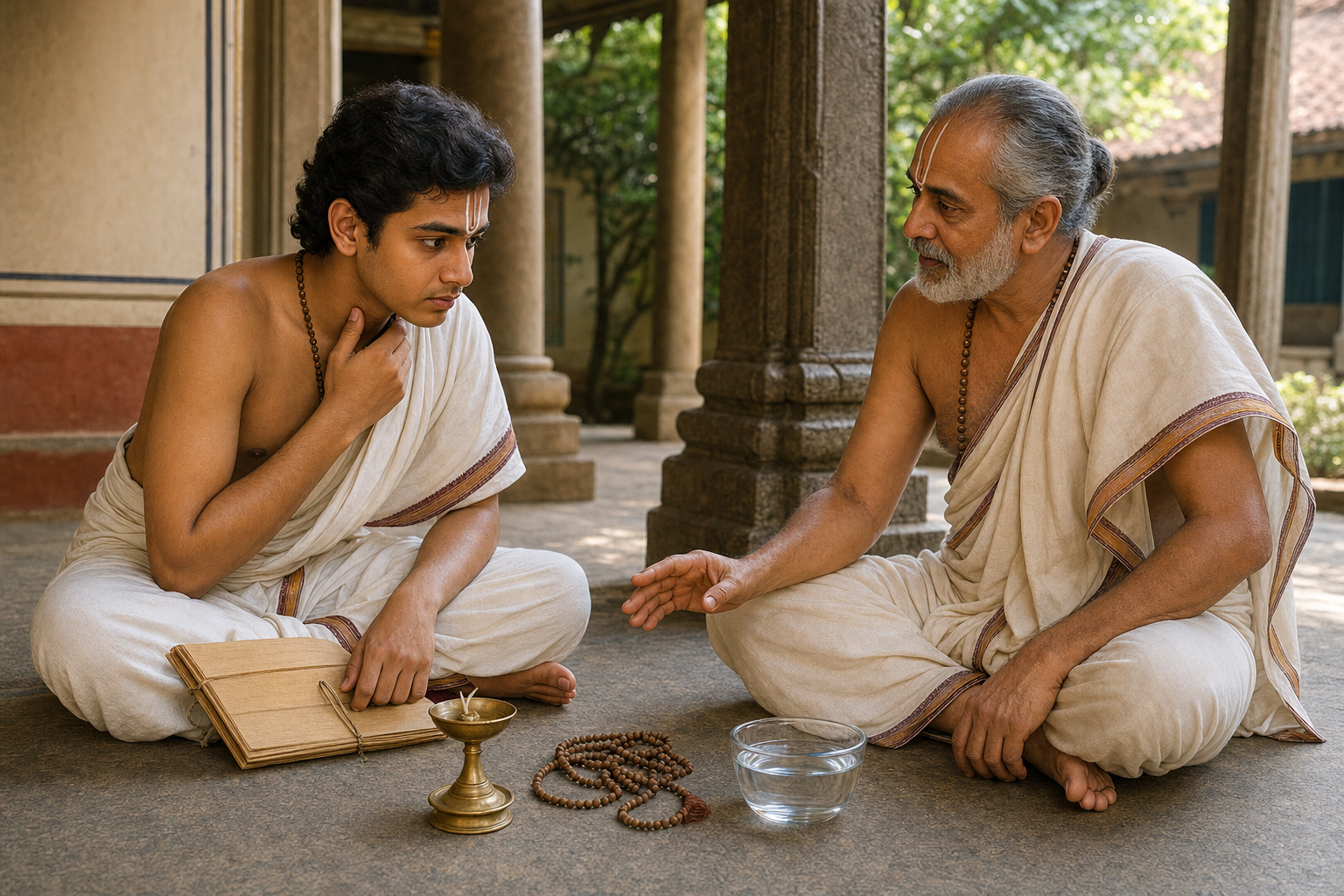
Acharya Periyavachanpillai is remembered in the Sri Vaishnava lineage for lucid exposition of the Tamil Divya Prabandham and for a teaching culture that joined rigorous study to bhakti, humility, and seva. A devotee remembered in the traditional episode associated with Periyavachanpillai approached him convinced that he was “dull-headed.” Other students seemed to progress. His memory failed, and even elementary lessons felt impenetrable.
Periyavachanpillai did not accept the student’s label as a diagnosis. He recognized a combination of restlessness, self-judgment, and an unprepared mind. In this context, insufficient adhikāra meant that the conditions for receiving the teaching had not yet been established. It was not a declaration that the devotee possessed a permanently inferior intelligence.
The prescribed remedy addressed the whole learner. The devotee undertook steady seva in the matha, followed a regulated routine, returned to foundational verses of the Divya Prabandham, and learned through attentive listening and repetition. Japa of Om Namo Narayanaya, the aṣṭākṣarī, and the Dvaya Mantra helped gather the mind around its devotional centre. Cleaning, assisting elders, and participating in the community gave study an embodied purpose beyond personal achievement.
Months of quiet discipline preceded the breakthrough. When the devotee was eventually asked to read a passage that had long defeated him, the words came with unexpected clarity. Periyavachanpillai’s benediction and encouragement did not function as a theatrical transfer of literacy. They released the hold of self-doubt at the moment when sustained practice had prepared the student to receive confidence without pride.
The order of events is the lesson. Seva came before visible mastery. Repetition came before fluent recitation. The acharya’s blessing crowned a process that he had already shaped. If you isolate the final benediction from the discipline that preceded it, you lose the pedagogical meaning of grace.
The method is also educationally precise. Short, repeated passages reduce the burden placed on an anxious learner. Listening supplies a reliable model before independent performance is demanded. Routine prevents every session from becoming a fresh negotiation with distraction. Seva redirects attention from comparison toward contribution. Timely encouragement allows correction to be received without turning an error into a verdict on the person.
Use a study rhythm that prepares the inner instrument

If your study is stalled, do not respond by collecting more texts or increasing the difficulty. First determine where the learning process is actually breaking. “I cannot understand the Divya Prabandham” is too broad to guide practice. You need to know whether you are struggling with pronunciation, vocabulary, recall, the structure of a commentary, sustained attention, or fear of reciting before others.
Take that precise difficulty to a qualified teacher within a recognized paramparā. Then build a repeatable cycle around the instruction you receive:
- Name one obstruction. Write a concrete sentence such as, “I lose the sequence after hearing the verse,” or, “I can recite the words but cannot state the meaning.” This gives your teacher something that can be corrected.
- Return to the smallest sufficient unit. Work with one foundational verse or another short passage assigned by the teacher. Hear it correctly, repeat it, and connect the words to their meaning before adding more material.
- Keep the same daily window. A stable place in your routine matters more than an occasional burst of enthusiasm. Follow the same order each time so that attention is not spent deciding how to begin.
- Include the authorized contemplative practice. If the aṣṭākṣarī or Dvaya has been taught to you within your sampradaya, follow the form and discipline given by your acharya. Do not reduce mantra to a memory trick or improvise instructions that belong within a teacher-disciple relationship.
- Attach study to assigned seva. Accept a useful task that the temple, matha, teacher, or learning community has actually entrusted to you. Helping elders, preparing learning materials, or maintaining the shared space can loosen the obsession with your own performance.
- Return for correction. Recite or explain the passage before the teacher. Record the specific correction and make that correction the focus of the next cycle.
- Measure the right fruit. Notice whether agitation is decreasing, recall is becoming steadier, your questions are becoming more precise, and you are becoming more useful to other learners. Speed and public display are poor measures of spiritual education.
This rhythm prepares the antaḥkaraṇa, the inner instrument through which you attend, remember, judge, and respond. Mantra gathers attention. Seva disciplines motive. Repetition stabilizes memory. Guidance prevents repeated error. Prapatti keeps achievement from hardening into self-importance.
Do not judge the practice after a single sitting. The devotee associated with Periyavachanpillai changed through months of formation, not through one dramatic encounter. Review your progress periodically with the teacher who assigned the practice. If the obstacle has changed, the instruction may also need to change.
Grace-filled authority has recognizable guardrails
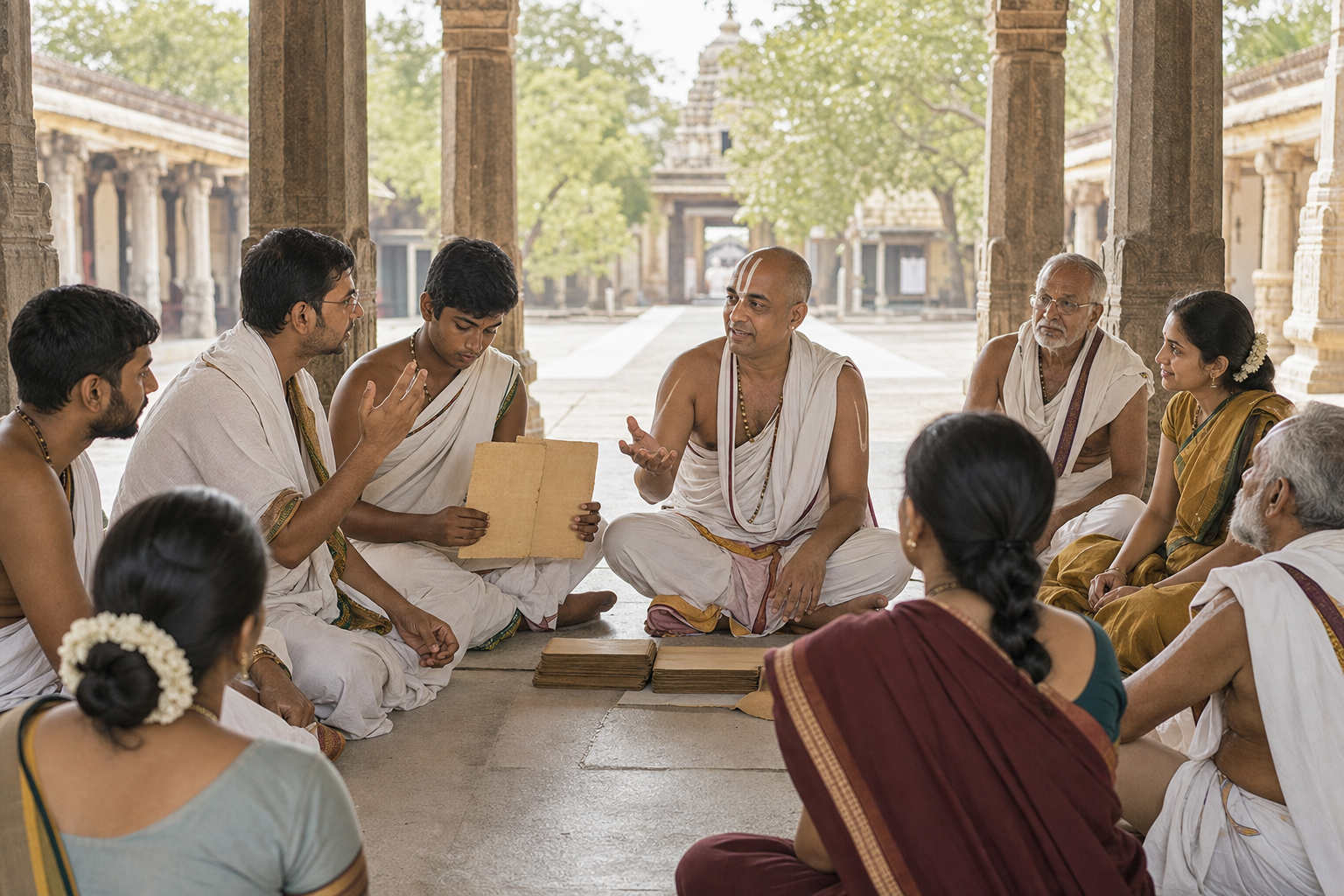
Because the acharya holds real authority, the quality of that authority matters. Prapatti cannot be used to excuse domination, humiliation, or the personal exploitation of a disciple. The model offered by Periyavachanpillai combines compassion with rigor: he rejects the degrading label, prescribes disciplined work, and remains present long enough to recognize genuine growth.
Look for these features when entrusting your formation to a teacher:
- Continuity: the teacher is embedded in a recognized paramparā rather than presenting private charisma as sufficient authority.
- Accountability: instruction remains answerable to śāstra, the lineage, and community norms.
- Proportion: the assigned practice fits the student’s present condition instead of displaying the teacher’s power through impossible demands.
- Dignity: correction identifies an error without turning that error into the student’s identity.
- Purposeful seva: service benefits the sacred and learning community rather than becoming a mechanism for personal control.
- No transactional promise: blessings are not sold as shortcuts to instant intelligence, status, or spiritual accomplishment.
You can also examine the fruit of the relationship. Are you becoming steadier, more truthful about your limitations, more receptive to correction, and more capable of serving others? Or are you becoming fearful, dependent on personal approval, and reluctant to ask honest questions? The first pattern forms a disciple. The second protects authority from accountability.
The acharya mediates divine kindness without replacing Bhagavan as the goal. This distinction preserves both surrender and moral agency. The disciple does not become autonomous from the tradition, but neither does the teacher become exempt from its standards.
Key takeaways
- In Sri Vaishnava pedagogy, guru’s grace prepares and directs effort; it does not eliminate study, repetition, or correction.
- A present lack of adhikāra can mean that attention, routine, confidence, or foundational knowledge needs preparation. It is not necessarily a verdict on intelligence.
- Seva, mantra, attentive listening, and work with short passages address different parts of the same learning obstruction.
- Prapatti is reliance on Bhagavan’s compassion, not passivity or a claim to achievement without discipline.
- Authentic acharya guidance preserves dignity, remains accountable to śāstra and paramparā, and makes the student more capable of serving others.
At your next study session, bring one short passage and one honest description of where you become stuck. Ask for a practice small enough to repeat faithfully, carry it into a stable daily rhythm, and connect it to a real act of seva. Let the blessing take the form it often takes in a living tradition: accurate diagnosis, patient correction, disciplined companionship, and the courage to discover that difficulty was never your final identity.
References
