

You may chant, read the Bhagavad Gita, visit a temple, and still wonder whether devotion is actually changing you. Prayer feels alive on some days and mechanical on others. If you judge bhakti by emotion alone, ordinary days look like failure, while an intense spiritual moment can masquerade as lasting realization.
A more reliable test appears in the middle of ordinary pressure: What happens to your attention, choices, and treatment of people when your plans are frustrated? Bhakti becomes transformative when remembrance begins to govern duty, surrender clarifies action, and grace gives you a reason for greater honesty rather than an excuse to avoid effort.
Bhakti changes the center from which you live
You do not need to manufacture devotional emotion before beginning. Bhakti starts when you repeatedly turn attention, intention, and action toward the Divine. Feeling may accompany that movement, but feeling is not its sole measure. A dry act of sincere service can carry more spiritual weight than an emotional experience that leaves your conduct unchanged.
The practical architecture is simple: hear what recalls the Divine, speak or sing what deepens that remembrance, and return the mind to it during action. The traditional sequence of śravaṇa, kīrtana, and smaraṇa is therefore more than a collection of religious activities. Hearing supplies the mind with sacred meaning. Kīrtana regulates speech and affection. Remembrance carries both into work, family life, and difficult decisions.
Dhruva Maharaja offers a demanding model of this integration. He does not abandon rulership after encountering Viṣṇu. He governs, distributes resources, honours obligations, and remains inwardly anchored. Bhakti governs his karma; his duties do not govern his identity. That distinction matters if you have ever assumed that serious devotion requires withdrawal from professional or household responsibility.
To apply this, choose one duty already in front of you and define how it would look as sevā. Do not merely say that your work is an offering. Name the change the offering requires: tell the truth when concealment would be convenient, decide impartially when preference pulls the other way, feed your family without making them pay for your resentment, or complete an unnoticed task without demanding recognition. Bhakti becomes concrete at the point where remembrance alters behaviour.
The heart and intellect should support each other here. The Azhwars gave devotional experience a language of longing, intimacy, and surrender, while Ramanujacharya gave that life of devotion a rigorous metaphysical and ethical structure. Their convergence of sacred song and reasoned Vedanta corrects two common imbalances: emotion without discernment, and philosophy without self-offering. If your practice has become sentimental, study can steady it. If it has become merely conceptual, song, worship, and service can return knowledge to the heart.
Grace exceeds merit without cancelling responsibility
Grace is often misunderstood in opposite ways. One mistake treats it as a reward purchased by sufficient chanting, austerity, or moral achievement. The other treats it as permission to ignore consequence because the Divine is compassionate. Neither position can sustain mature devotion.
The Pūtanā episode in Śrīmad Bhāgavatam makes the tension impossible to avoid. Pūtanā approaches the infant Kṛṣṇa under the appearance of maternal care while intending to poison Him. Her intention remains morally serious, yet contact with Kṛṣṇa transforms an act of hostility into an extraordinary salvific outcome. Grace does not declare poison harmless. It reveals that divine compassion is freer and more powerful than the evil presented to it.
Three practical conclusions follow:
- Your intention matters. A devotional appearance does not purify manipulation, cruelty, or dishonesty.
- Grace cannot be demanded as wages. Practice makes you receptive; it does not place the Divine in your debt.
- No person is exhausted by the worst intention or action they have carried. Accountability and hope can coexist.
When you have caused harm, do not invoke grace before doing the work of repair. Name the fault without decorating it. Correct what can be corrected. Apologize without making the injured person comfort you. Accept consequences that belong to the action. Then continue your sādhana without turning remorse into another form of self-absorption. Grace enables return; it does not make repair unnecessary.
The same distinction protects you from fatalism. A disappointment is not automatically a divine verdict, and an obstacle is not automatically a command to surrender the task. Continue to use judgment, fulfil dharma, seek counsel, and act. Ask for grace not merely to obtain your preferred result, but to see clearly, choose rightly, and remain devoted under either result.
Sister Dharmic traditions illuminate different sides of this problem without becoming interchangeable. Buddhist attention to cetanā keeps intention in view. Jain ahiṃsā demands vigilance regarding the harm an action may carry. Sikh remembrance of divine nadar preserves the gratuity of grace beyond strict calculations of merit. You can honour these resonances while allowing each tradition to retain its own theology, disciplines, and final aims.
Surrender is a disciplined decision, not passive helplessness
People often use surrender to mean whatever happened after they stopped trying. Śaraṇāgati is more exacting. It joins trust with discrimination, and dependence on the Divine with deliberate moral action. The Sri Vaishnava framework makes that surrender concrete through five mutually supporting commitments.
| Commitment | Meaning in practice | Question to ask |
|---|---|---|
| Anukūlyasya saṅkalpa | Choose what is favourable to devotion. | Which option helps truthfulness, remembrance, compassion, and service grow? |
| Prātikūlyasya varjanam | Refuse what obstructs devotion. | What habit, environment, or compromise repeatedly pulls me away from dharma? |
| Rakṣiṣyatīti viśvāsa | Trust in divine protection. | Can I act responsibly without treating control of the result as my source of safety? |
| Goptṛtva varaṇam | Accept the Divine as guardian. | Am I willing to be guided, or am I asking only for approval of a decision already made? |
| Kārpaṇya | Recognize your dependence with humility. | Where has pride made correction, prayer, or help difficult to receive? |
This framework prevents surrender from becoming passivity. Avoiding what is adverse is itself part of surrender. If a demand requires deception, enables harm, or violates a genuine duty, refusal may be more surrendered than compliance. Trust in protection also does not mean ignoring foreseeable consequences. You still plan, protect dependants, honour commitments, and seek competent help where it is needed.
Kārpaṇya deserves special care. Humility is not self-hatred, public self-belittlement, or the erasure of legitimate boundaries. It is the recognition that the isolated ego is neither omniscient nor self-sufficient. A humble person can admit dependence without denying dignity, and can accept guidance without surrendering moral discernment to another human being.
Use the five commitments before a decision that has become tangled with fear or desire. Write a brief answer to each question in the table. The exercise will not produce a supernatural guarantee, but it will expose where preference is disguising itself as divine guidance. Often the decisive issue is not a lack of information. It is the reluctance to relinquish an outcome, status, resentment, or convenience.
Build a devotional rule that survives an ordinary day
A practice that exists only when you feel peaceful will disappear precisely when you need its guidance. Build your rule around stable events rather than moods. The aim is not to crowd the day with religious activity. It is to create reliable returns to the Divine before distraction becomes the day’s default.
- Establish an opening anchor. Before the first avoidable stream of messages or entertainment, turn to your chosen name, prayer, verse, or sacred reading. Choose an amount you can keep with attention instead of an impressive amount you repeatedly abandon.
- Carry one sentence into duty. After reading or chanting, identify one quality to practise that day: patience in speech, impartiality in a decision, restraint in consumption, courage in truth, or steadiness in service.
- Attach remembrance to transitions. Return to the Divine Name when crossing a doorway, beginning a work block, preparing food, or moving from one conversation to another. Existing transitions are more dependable than waiting for a free period.
- Offer the difficult task before beginning it. Name the aversion honestly, ask that the action become service, and then start. Offering is incomplete when it becomes a refined way of postponing the work.
- Protect the climate of the home. Prasāda, kīrtana, sacred reading, and respectful conversation shape what family members repeatedly notice. Keep these practices participatory and warm; do not use them as instruments for controlling another person’s faith.
- Close with an audit, not a verdict. Recall where remembrance changed a response, where ego took control, and what repair is now required. End with gratitude and a specific intention for the next return.
Rituals, mantras, auspicious markings, and household observances can stabilize attention and carry inherited culture. They should not be treated as mechanical guarantees against every difficulty. Vraja’s protective life combines sacred rites, communal care, and renewed daily responsibility. Your household practice should do the same: deepen trust, strengthen vigilance, and help people resume dharmic action together.
Community also matters because private intention is easy to romanticize. Regular kīrtana, study, temple participation, or sevā places your practice among people whose needs interrupt self-preoccupation. Choose a community that encourages scripture, ethical accountability, humility, and service. Charisma without accountability can intensify dependence on personalities rather than devotion to the Divine.
Look for transformation in your responses, not your image
Spiritual transformation is often visible before it feels dramatic. The signs are behavioural: the distance between anger and repair becomes shorter; praise and criticism lose some power to dictate your identity; duties receive steadier attention; correction becomes easier to hear; and compassion expands without eliminating discernment. None of these signs proves realization, but together they are more trustworthy than the ability to speak impressively about devotion.
Watch for counterfeits as carefully as you watch for progress:
- Emotional intensity that repeatedly leaves the same cruelty or dishonesty untouched.
- Public devotional display paired with contempt for ordinary service.
- Claims of surrender used to avoid planning, apology, work, or responsibility.
- Sectarian superiority that makes devotion narrower and compassion weaker.
- Constant consumption of teachings without applying one teaching to a live decision.
- Dramatic vows after every lapse, followed by neglect of a sustainable daily rule.
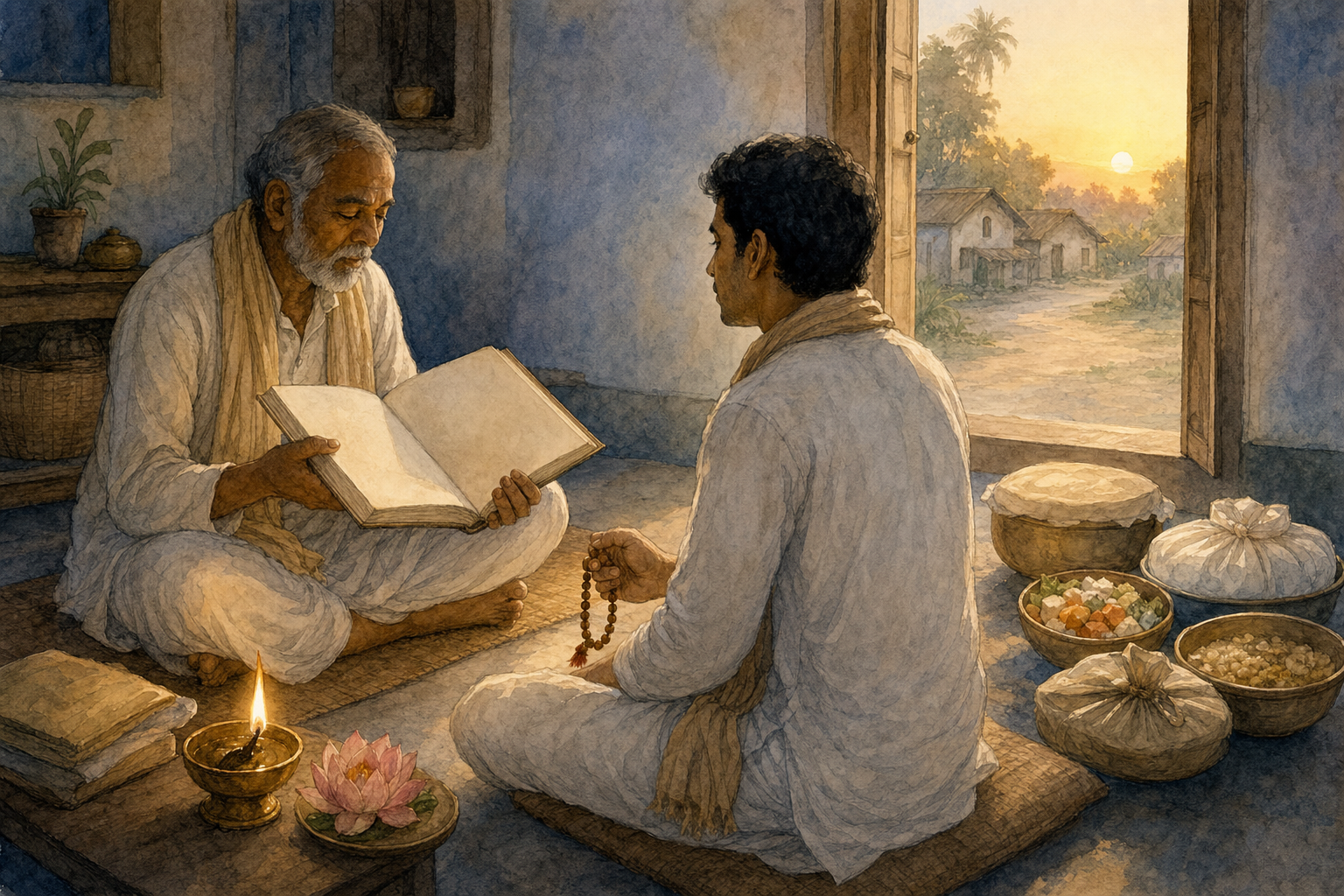
Do not wait for perfectly pure motivation before placing yourself in contact with sacred meaning. A college student in Burma once began reading a large English Bhagavad Gita simply to improve his language. He worked slowly, consulting a dictionary for every second or third unfamiliar word. By the end of the sixth chapter, the practical exercise had become sustained devotional study; it eventually shaped initiation, service, leadership, temples, and his father’s own devotional commitment.
The useful point is not that every reading project will produce the same outward result. It is that grace can meet an incomplete motive and educate it from within. Begin with the need that honestly brought you to the text. Read attentively. Return when novelty fades. Let the words question your conduct. A mixed motive offered repeatedly can mature; a supposedly pure motive that never becomes practice cannot transform much.
Key takeaways
- Measure bhakti by what remembrance does to attention, duty, speech, and relationships, not by emotion alone.
- Receive grace as compassion beyond calculation, never as permission to evade consequence or repair.
- Practise surrender through favourable choices, refusal of the adverse, trust, guardianship, and humility.
- Anchor devotion to events that already occur each day so the practice can survive changing moods.
- Look for shorter delays in repair, steadier service, greater receptivity to correction, and less dependence on recognition.
Begin at the next ordinary threshold. Choose one form of remembrance, offer the next unavoidable duty as sevā, and examine one reaction before the day closes. Do not wait to feel transformed. Give grace a truthful, disciplined place to work.



References
- Dandavats — How One Gita Bridged Burma and New York: A Transformative Journey of Language, Bhakti, and Unity
- Dandavats — Morning Class on SB 10.6.10: Pūtanā, vātsalya-rasa, and the life-changing power of divine grace
- Dandavats — Lead with Devotion, Live Unattached: Dhruva Maharaja’s Lessons in Bhagavatam 4.12 (10–16)
- DharmaRenaissance Blog — Azhwars and Ramanujacharya: Timeless Bhakti, Living Vedanta, and the Path of Grace
