
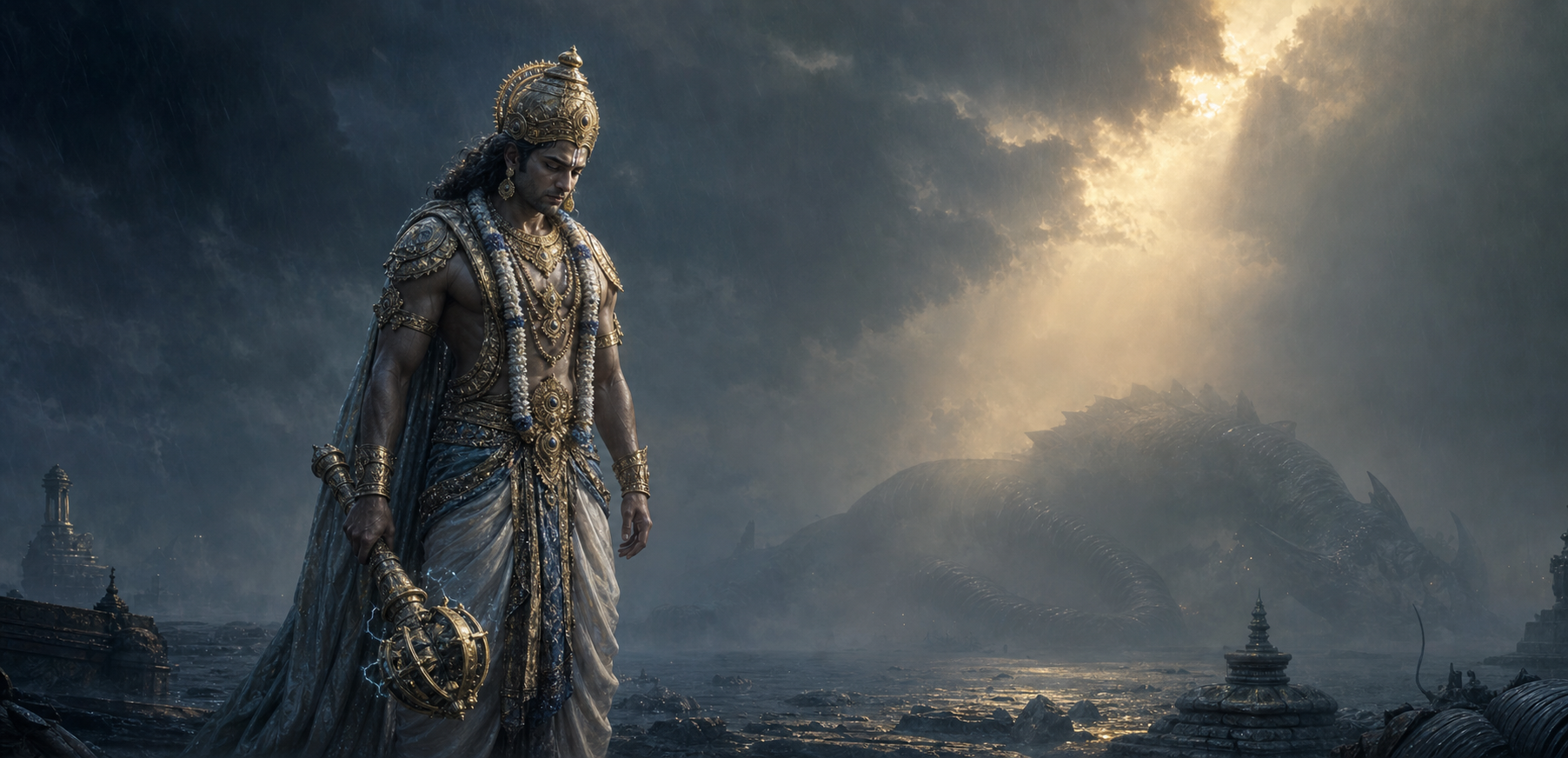
Indra defeats Vritra, yet the episode’s moral climax begins only after the apparent victory. The king of the Devas cannot simply resume his throne: the violence that preserved his authority has also compromised his fitness to exercise it.
Read as a connected account rather than a sequence of isolated marvels, the story explores four related questions: how fear corrupts judgment, why wrongdoing cannot be reduced to private remorse, what a ruler’s withdrawal costs the wider community, and what must change before authority can be restored.
Why Vritra’s defeat does not settle the moral crisis
The DharmaRenaissance source traces the crisis to Indra’s fear of Trishira, the three-headed son of Tvashta. Trishira’s austerities generate formidable spiritual power, and Indra interprets that growing potency as a possible threat to his sovereignty. After attempts to disrupt the austerities fail, Indra kills the ascetic with his thunderbolt.
The ethical failure therefore precedes the battle with Vritra. Trishira may possess the capacity to challenge Indra, but feared future conduct is not the same as an accomplished attack. The episode places a limit on the ruler’s appeal to security: power to eliminate a potential rival does not automatically make pre-emptive violence righteous.
Tvashta answers his son’s death by creating Vritra through sacrificial and ascetic power. Indra’s attempt to prevent instability thus generates a more dangerous confrontation. Fear produces violence; violence provokes retaliation; retaliation expands into a crisis affecting the worlds. This causal chain is essential because Indra’s later burden arises from accumulated choices, not from a single inexplicable moment.
According to the source account, Vritra is protected by a compact whose conditions exclude an ordinary killing: he is not to die by something conventionally dry or wet, by an ordinary weapon, or at a time clearly identifiable as day or night. Indra strikes at twilight and uses foam, with divine assistance making the unconventional means effective. The tactic is ingenious, but its reliance on the edges of the agreement leaves the victory ethically unsettled. The narrative distinguishes defeating an adversary from resolving the wrongs that produced the conflict.
Brahmahatya turns guilt into a crisis of order
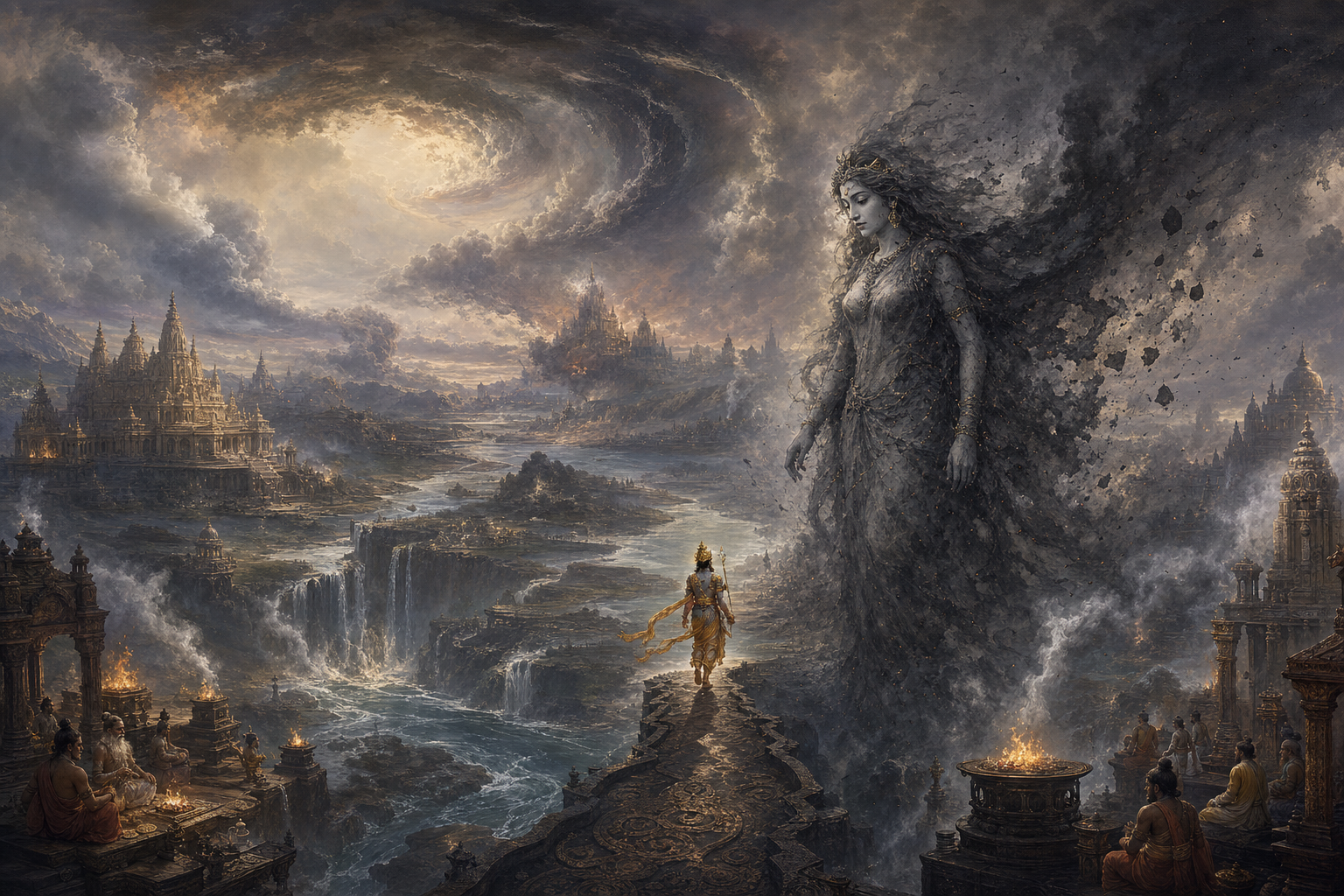
The source describes Indra as afflicted or pursued by brahmahatya after Vritra’s death. In the epic framework presented there, brahmahatya is associated with the gravest transgression of killing a Brahmana or a being bearing comparable sacred status. It is not merely a troubled feeling within the offender. It can operate as ritual pollution and as an active moral consequence that damages the offender’s relationship with society and the cosmos.
Calling Indra’s condition guilt is illuminating but incomplete. Guilt helps explain why he can no longer occupy the public role of victorious sovereign as though nothing has happened. Brahmahatya adds an objective dimension: the deed has consequences that cannot be erased by confidence, secrecy, military necessity, or the passage of time. Purification and accountability are required because the disorder extends beyond Indra’s emotions.
The episode also permits a careful distinction between guilt and shame. Guilt remains focused on what a person has done; shame can overwhelm the person’s entire sense of identity. Indra’s contraction from a magnificent public king into an almost inaccessible fugitive suggests that his identity has collapsed beneath his conduct. This is a literary and ethical reading, not a clinical diagnosis. Its value lies in showing how remorse can become self-erasure when the offender sees no path from admission to repair.
The lotus reveals the public cost of private withdrawal
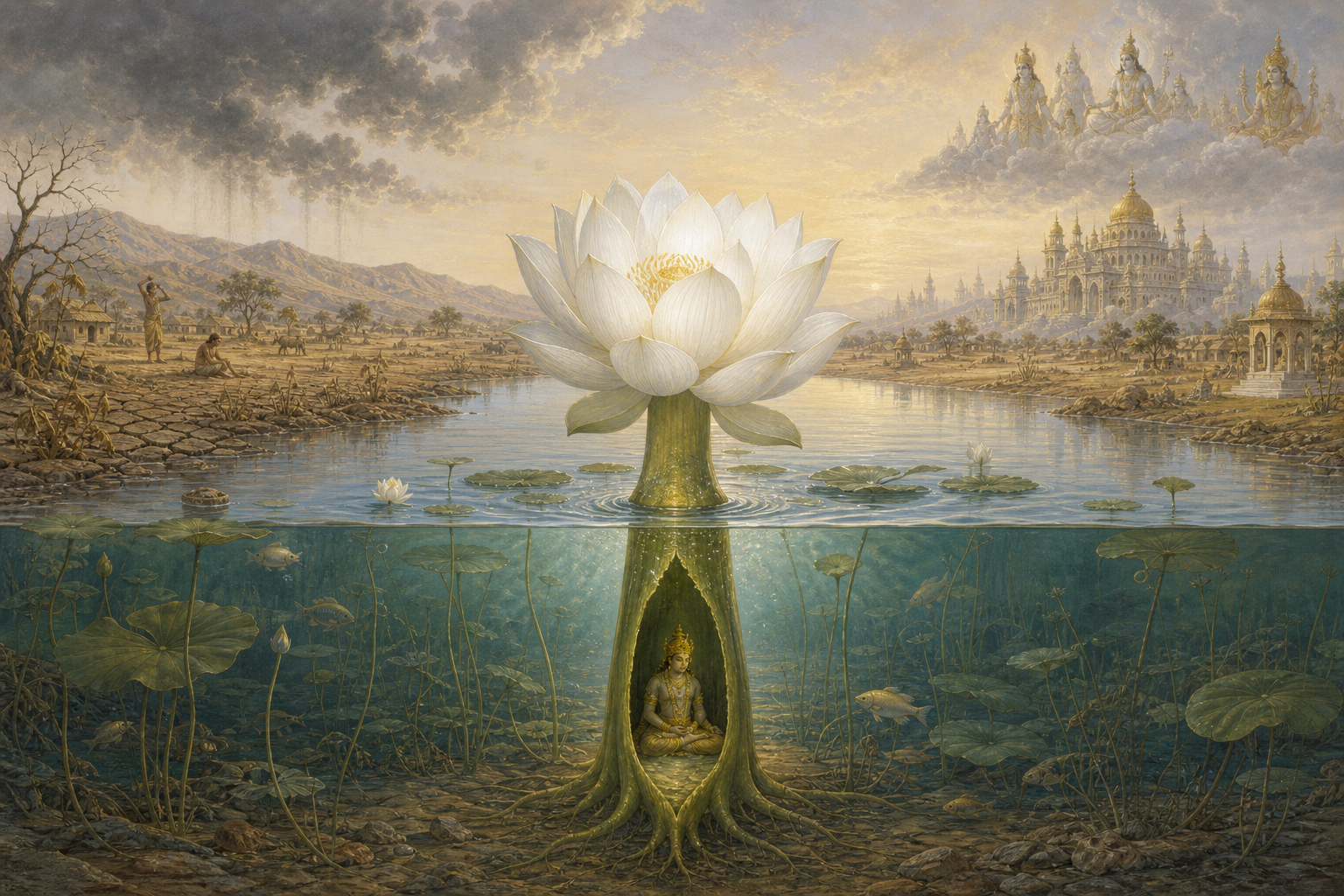
Indra’s concealment within a lotus stalk reverses every visible sign of his office. A deity associated with rain, protection, authority, and public victory becomes minute, silent, and hidden. The lotus is therefore not merely a picturesque refuge. It gives form to the distance between possessing a title and being inwardly capable of bearing it.
Withdrawal initially protects Indra from exposure, but his office cannot disappear with him. The source emphasizes that his absence contributes to disorder because the celestial kingship is connected with the regulated life of the worlds. What feels private to the person hiding imposes costs on everyone who depends upon neglected responsibilities.
This makes the episode more demanding than a simple lesson about feeling sorry. Remorse can mark the beginning of moral recognition, but retreat alone does not repair injured relationships or restore functioning institutions. At the same time, an immediate return without purification would reduce kingship to possession of power. The lotus holds Indra between two inadequate responses: indefinite disappearance and unexamined restoration.
Sachi, Nahusha, and the conditions of restoration
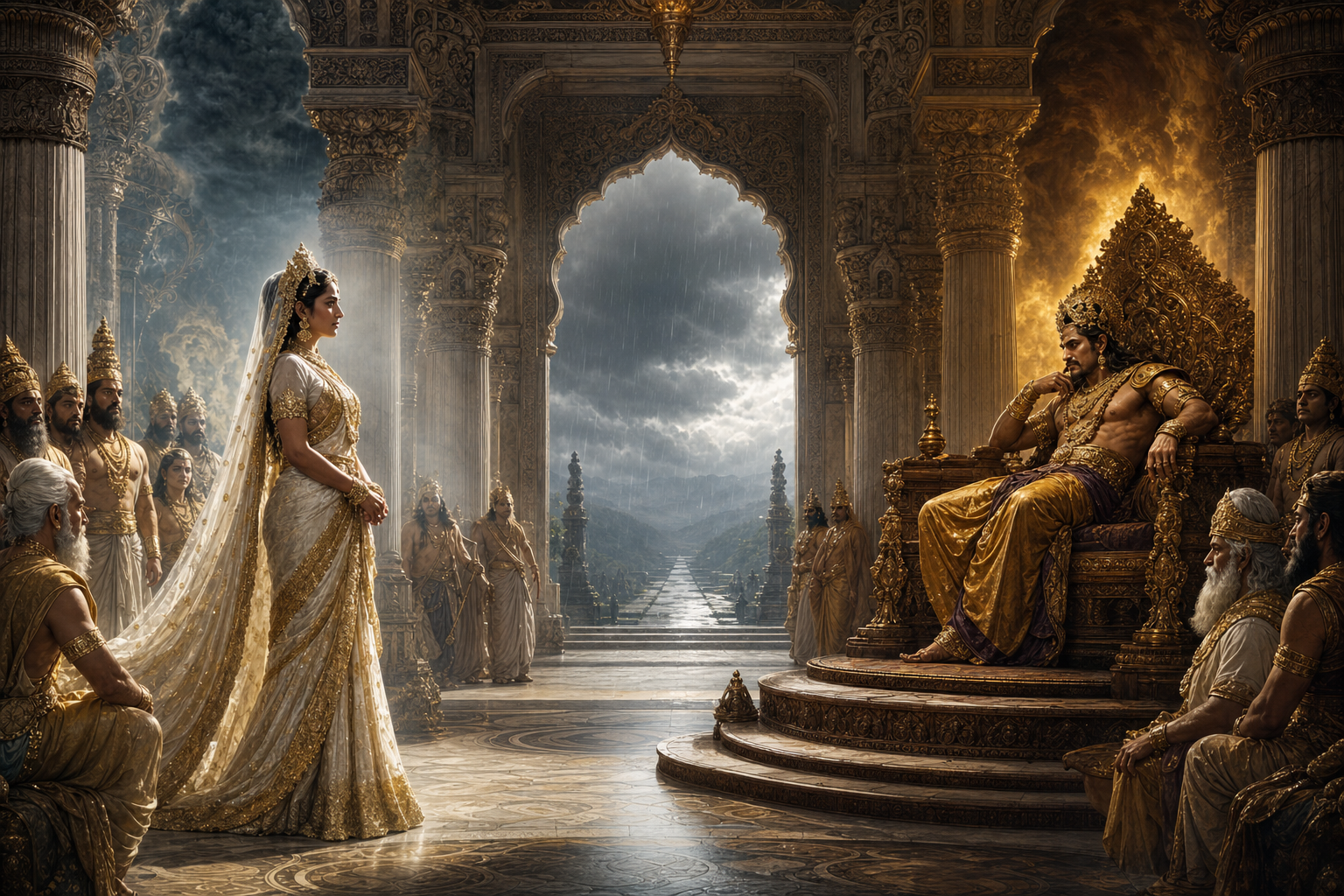
The vacancy in heaven turns Indra’s personal crisis into a succession crisis. The DharmaRenaissance account says that the Devas and sages elevate Nahusha, a distinguished human king, and contribute their energies so that he can carry the office. His authority is therefore delegated and relational rather than self-created. As power accumulates, however, Nahusha becomes intoxicated by status and increasingly treats others as instruments of his desire.
Nahusha’s deterioration reveals why replacing a compromised ruler does not by itself restore dharma. An office can outlast its occupant, but a successor who mistakes entrusted power for personal entitlement reproduces disorder in another form. Indra’s fear-driven violence and Nahusha’s status-driven arrogance differ in expression, yet both subordinate legitimate limits to the ruler’s own appetite.
Sachi Devi supplies the episode’s counter-model of agency. The source portrays her as resisting coercion, seeking protection, asking for time, following sacred guidance, and finally locating Indra inside the lotus stalk. Her devotion is neither passive waiting nor denial of his wrongdoing. It joins fidelity to discernment: she protects herself, refuses an illegitimate demand, and works toward a restoration that cannot be achieved by pretending the crisis never occurred.
The source frames Indra’s eventual redemption as a process involving discovery, sacred counsel, ritual expiation, the exposure of illegitimate power, and the recovery of political fitness. No single element is sufficient. Affection without accountability would excuse the deed; punishment without a route back would make transformation impossible; restoration without attention to the vacant office would ignore the community; and political necessity without purification would leave the central moral breach unanswered.
This political dimension also helps explain the story’s placement. The source locates Sachi’s discovery of Indra in the Mahabharata’s Udyoga Parva, commonly identified as Chapter or Section 14 while noting that numbering varies by edition. Appearing within the larger Indra-Sachi-Nahusha sequence amid preparations preceding the Kurukshetra war, the episode becomes a precedent for thinking about dispossession, loyalty, legitimacy, and the difference between holding authority and deserving it.
Key takeaways
- Indra’s guilt cannot be understood apart from the full chain beginning with fear of Trishira, continuing through retaliatory violence, and culminating in the morally ambiguous defeat of Vritra.
- Brahmahatya makes wrongdoing more than an inward emotion: it represents religious, social, and cosmic consequences that require an accountable response.
- The lotus stalk symbolizes shame and withdrawal, while Indra’s abandoned office shows that avoidance transfers burdens to others.
- Redemption becomes credible only when devotion, purification, institutional order, and renewed fitness for responsibility converge.
The episode ultimately leaves rulers and communities with a continuing task: to preserve a path back from wrongdoing without confusing forgiveness with denial or restored authority with automatic entitlement.