
If you have wondered why Abhimanyu’s death is called adharmic when he willingly entered a lethal formation, separate two questions. Was he a legitimate combatant who could be defeated in battle? Yes. Were his enemies therefore entitled to defeat him by any means available? No.
His youth and courage deepen the tragedy, but they are not the decisive ethical facts. The judgment turns on how the Kaurava warriors isolated, disabled, and killed him. That distinction is essential if you want to understand Dharma-Yuddha as more than a slogan for declaring one camp righteous and the other wicked.
Read the thirteenth day as a chain of choices
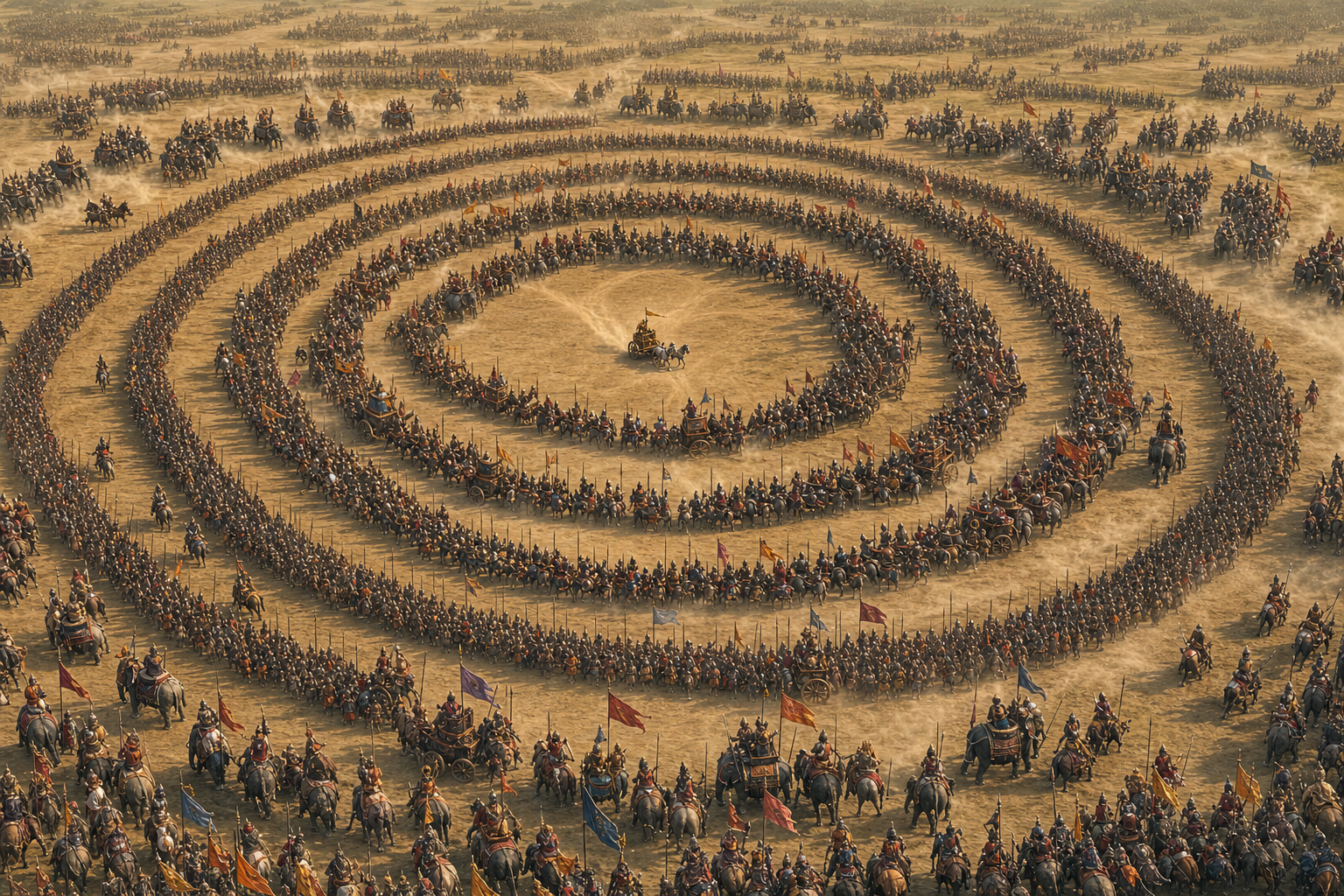
On the thirteenth day of the Kurukshetra War, Drona deployed the Chakravyuha with the operational aim of breaking the Pandava formation and capturing Yudhishthira. The array was not a stationary maze. It was a coordinated, shifting formation whose successive layers had to be penetrated without allowing the opening to close behind the attacker.
The Kaurava plan began by removing the warrior best equipped to counter it. The Trigarta samshaptakas drew Arjuna away under their vow of relentless combat. In his absence, Abhimanyu possessed the knowledge and ability needed to open the Chakravyuha. Tradition holds that he knew how to enter it but had not learned the method of exit.
That incomplete knowledge did not mean the Pandavas deliberately sent him on an unsupported suicide mission. The plan was for Abhimanyu to create the opening while Bhima, Satyaki, and other warriors followed immediately behind him. Jayadratha checked that supporting force and allowed the formation to close. Abhimanyu was trapped only after the reinforcement plan failed.
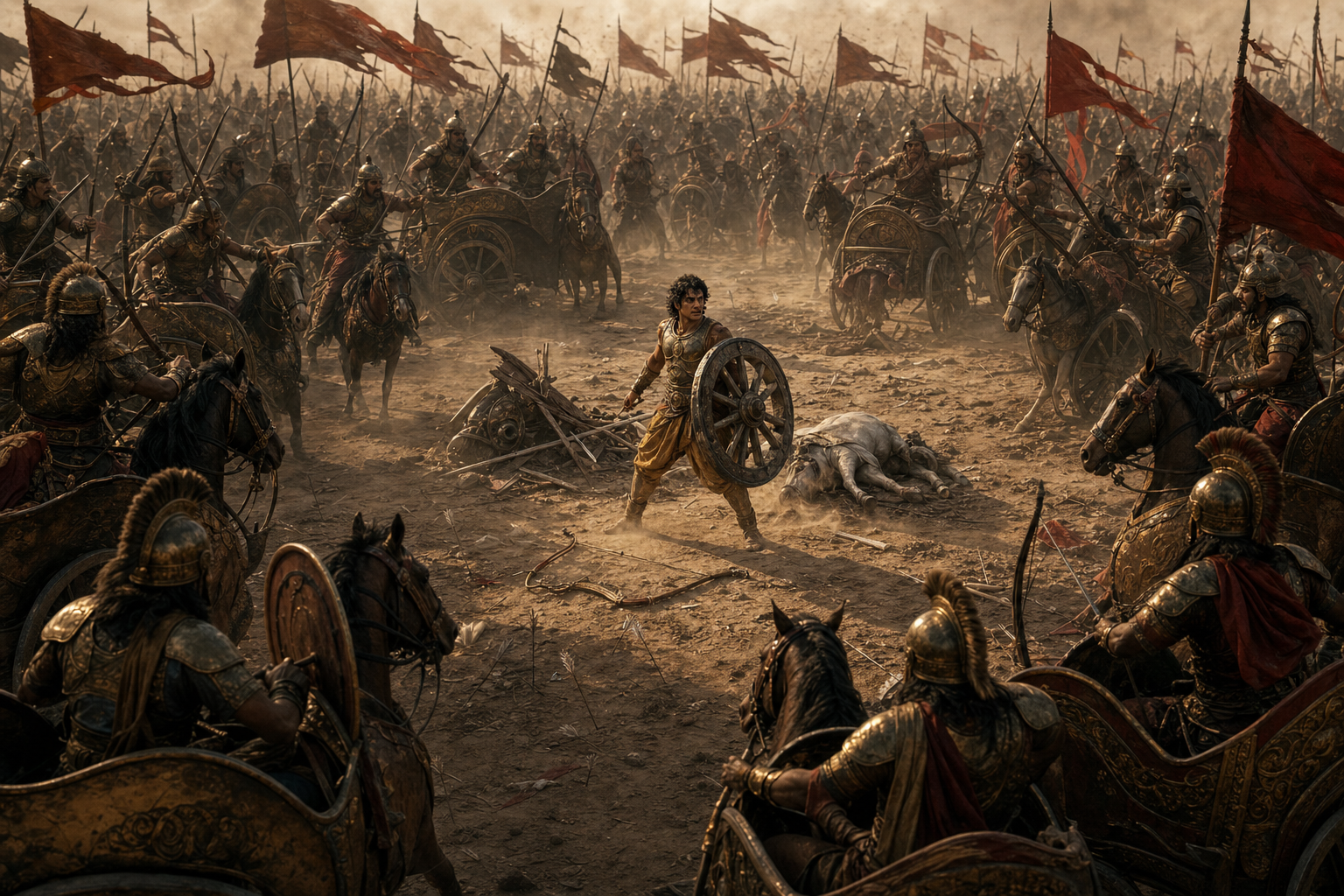
Once inside, he did not collapse. He broke through successive layers, destroyed chariots, defeated experienced opponents, and threw the Kaurava ranks into disorder. Many recensions include King Brihadbala of Kosala among those he killed. His success created the pressure under which the Kaurava commanders made their defining choice.
- Arjuna was drawn away from the main battlefield.
- Abhimanyu opened the Chakravyuha for the Pandava force.
- Jayadratha prevented the intended supporting warriors from following him.
- Senior Kaurava fighters converged on the isolated warrior instead of maintaining single combat.
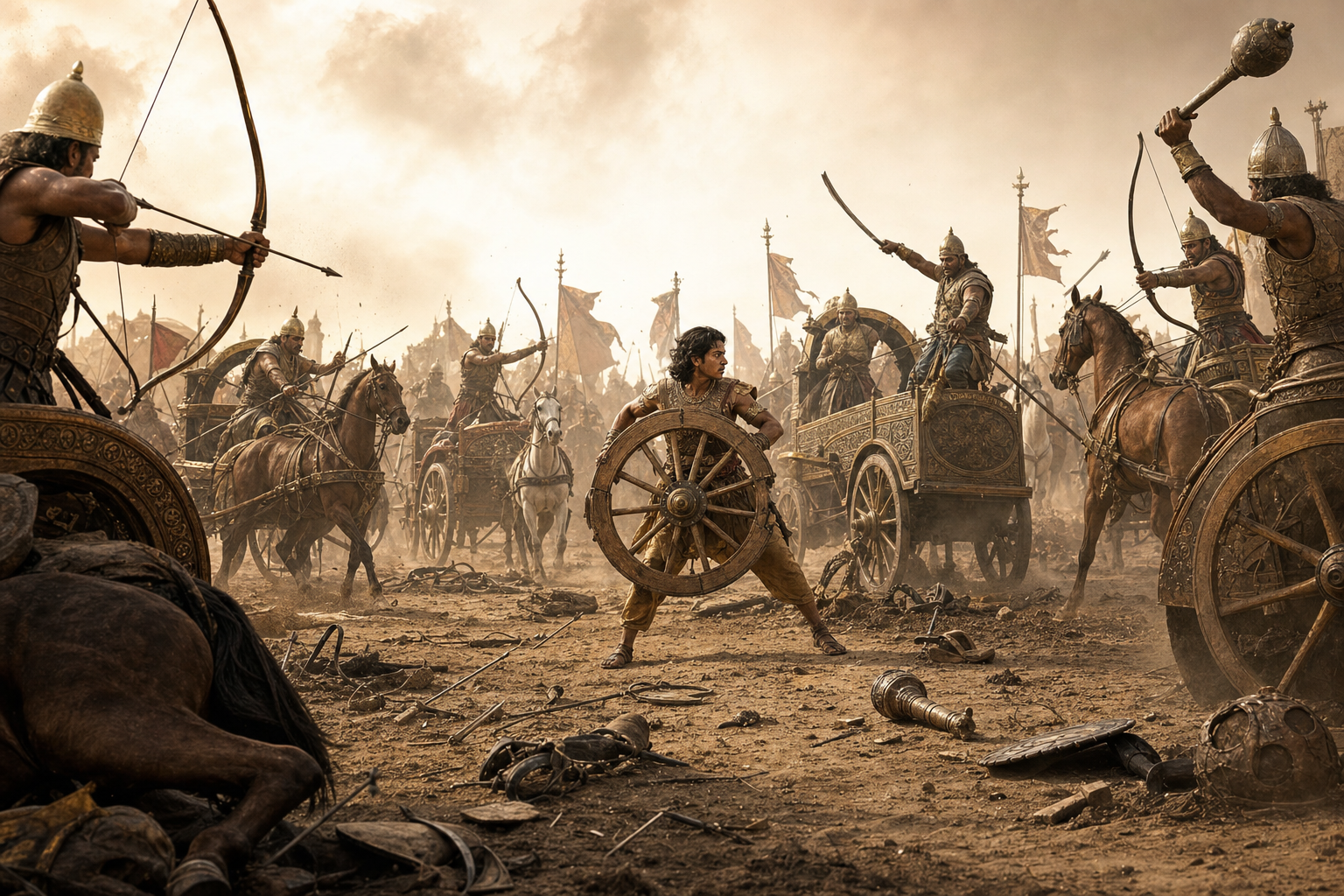
- Karna severed Abhimanyu’s bowstring while other attackers destroyed his chariot and weapons in quick succession.
- Abhimanyu continued with improvised means, including a chariot wheel and then a mace, before Duhshasana’s son struck him down with a blow to the head.
Lists of combatants and the exact sequence of blows differ across textual traditions and later retellings. You do not need every dramatic embellishment to make the ethical judgment. The durable core is the deliberate isolation of one warrior, the coordinated destruction of his ability to defend himself, and the collective attack that followed.
The breach concerned the method, not the battlefield death
Dharma-Yuddha does not treat every battlefield killing as murder. A kshatriya could meet an armed opponent, use lethal force, and remain within the discipline of war. Abhimanyu himself killed numerous adversaries that day. His prowess did not grant him immunity from defeat.
The problem was that the Kauravas abandoned restraints when observing them became costly. The martial norms associated with Dharma-Yuddha rejected warriors swarming a solitary opponent, attacking someone who had been rendered unarmed, and exploiting methods such as attacks from behind. The broader code also placed limits on fighting outside the appointed time and on harming noncombatants. Not every one of those rules is at issue in Abhimanyu’s final moments, but the many-on-one assault and coordinated disarming are central.
Abhimanyu’s attempt to defend himself with a wheel and a mace does not erase the preceding breach. An improvised act of survival cannot retroactively turn a collective assault into an honourable duel. The attackers had already created the overwhelming inequality they then used to finish him.
Three common shortcuts therefore miss the point:
- It was not automatically adharmic because Abhimanyu was young. His age heightens our sense of loss, but the governing test is conduct.
- It was not automatically adharmic because several warriors opposed him during a large battle. Formations naturally bring many forces into contact; the violation lay in the coordinated attack on an isolated and progressively disarmed combatant.
- It was not adharmic merely because the victim belonged to the Pandava camp. Dharma loses its meaning if the same act is condemned or excused according to the banner under which it is performed.
This gives you a precise answer when the episode is reduced to “Abhimanyu was outnumbered.” Being outnumbered describes his predicament. The moral charge comes from the choices his opponents made once they had isolated him.
Dharma binds power precisely when restraint is expensive
Abhimanyu had begun to reverse the logic of the Chakravyuha. Instead of being consumed by the formation, he was damaging it from within. The Kaurava commanders faced mounting losses and the possible failure of Drona’s plan. Their temptation was therefore real: follow the restraints of combat and risk further defeat, or remove the threat through collective force.
That is why the incident is such a severe test of Kshatra Dharma. Martial dharma is not courage alone. It joins the ability to exercise force with the discipline to limit that force. A warrior who displays valour but discards restraint under pressure possesses only half of the required character.
“Military necessity” explains why the Kauravas wanted Abhimanyu stopped; it does not settle whether their method was dharmic. Explanations identify motives. They do not by themselves provide moral permission. If a rule binds only when following it costs nothing, it is etiquette of convenience rather than a restraint on power.
You need not collapse Hindu, Buddhist, Jain, and Sikh teachings into one doctrine to see a Dharmic family resemblance here. Right action, restraint toward violence, responsibility for the means one chooses, and disciplined valour all resist the claim that a desirable result cleanses every method used to obtain it. The traditions articulate those duties differently, but they meet in their suspicion of power without self-command.
This is also the safest way to carry the lesson beyond Kurukshetra. Do not treat an ancient battlefield code as a ready-made manual for every modern conflict. Use it as an ethical diagnostic. When a leader claims that urgency requires an exception, ask which restraint is being suspended, who bears the cost, whether the same rule would be accepted if the opposing side used it, and whether the exception is likely to become a precedent.
One unlawful victory changed the logic of the war
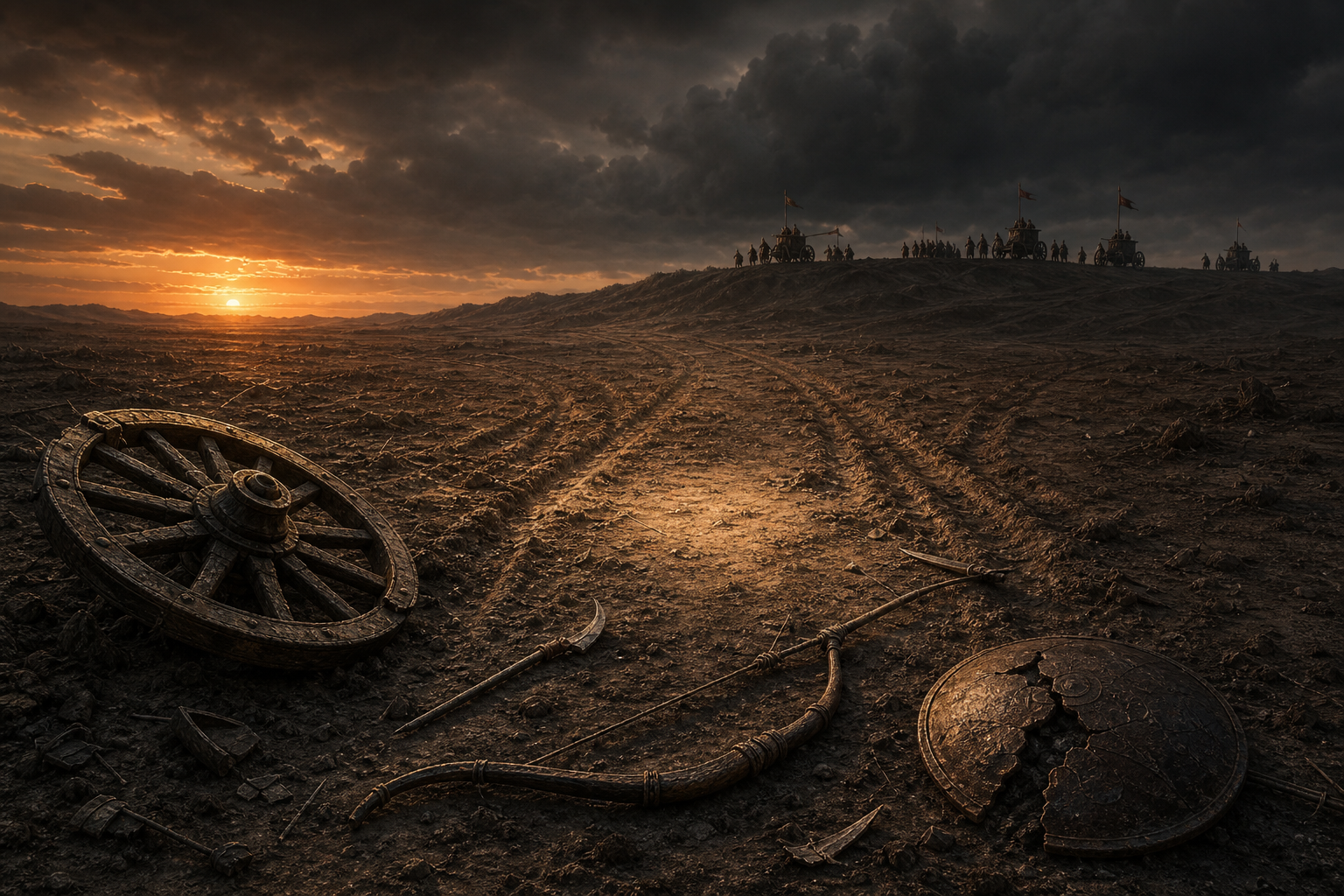
The Kauravas achieved their immediate objective: Abhimanyu was no longer tearing through their formation. Yet the manner of his death created consequences much larger than the tactical gain.
When Arjuna returned and learned what had happened, he vowed to kill Jayadratha before the following sunset or enter the fire himself. That vow reorganised the fourteenth day around a single deadline. The Kauravas had to shield Jayadratha behind successive lines, while Arjuna and Krishna had to break through those defences before daylight ended. Abhimanyu’s killing thus generated the concentrated operation that ended in Jayadratha’s death.
The consequences moved along three connected paths:
- Operationally, the Kauravas surrendered freedom of action because protecting Jayadratha became their immediate priority. Arjuna, meanwhile, had one target and one deadline around which force could be concentrated.
- Psychologically, Pandava grief acquired a specific objective. The Kauravas had to confront an opponent whose resolve had been hardened by a violation they themselves had committed.
- Morally, the victory damaged Kaurava legitimacy. A force that invokes martial honour while discarding its limits under pressure makes its own claims to righteous rule less credible.
This does not mean one death mechanically caused every later Kaurava defeat. Bhishma had already fallen, and the eventual deaths of Drona, Karna, and Duryodhana arose from their own circumstances. Calling the thirteenth day a moral pivot means something more exact: the killing altered incentives, morale, strategic priorities, and the credibility of the Kaurava cause at the same time.
Nor should Arjuna’s vow be read as a simple endorsement of rage. It placed both his life and the Pandava cause under an extreme deadline. Its strategic effect depended on Krishna’s direction and on converting grief into a defined military objective. The lesson is not that anger becomes dharma when the injury is severe. It is that an adharmic act can provoke consequences its perpetrators cannot contain.
Key takeaways
- Abhimanyu’s decision to enter the Chakravyuha was dangerous, but that decision did not authorise his enemies to abandon the restraints of combat.
- The decisive violations were the coordinated many-on-one assault and the systematic destruction of a lone warrior’s means of defence.
- Dharma-Yuddha judges how power is used, especially when restraint threatens an immediate tactical objective.
- The killing changed the next day’s strategy through Arjuna’s vow and weakened Kaurava morale and legitimacy, but it was not the sole cause of their eventual defeat.
- Variant details should be handled carefully; the moral analysis does not require treating every later dramatic element as textually uniform.
Use three questions to recognise the dharmic boundary
When you encounter competing claims about whether an act in the Mahabharata was dharmic, do not begin with allegiance. Reconstruct the decision in three steps:
- Identify the legitimate duty. Abhimanyu could fight to open the formation; the Kaurava warriors could defend their army and attempt to defeat him.
- Identify the restraint that limited that duty. The right to fight did not include a licence to swarm and systematically disarm an isolated opponent through collective attack.
- Locate the choice that crossed the boundary. The ethical break occurred when senior warriors abandoned reciprocal combat because Abhimanyu had become too costly to face within its restraints.
The same method prevents another misuse of the episode: treating remembered injustice as unlimited permission for revenge. An injury may create a duty to pursue justice, protect others, or restore order. It does not make every retaliatory means dharmic. The conduct of the response must still be judged on its own.
The next time Abhimanyu’s death is invoked to prove that one side was simply good and the other simply evil, look one step closer. Ask what each actor was entitled to do, what limit still applied, and whether that actor would accept the same rule from an enemy. That is where Dharma-Yuddha becomes a usable moral discipline rather than a label attached after victory.
References
