
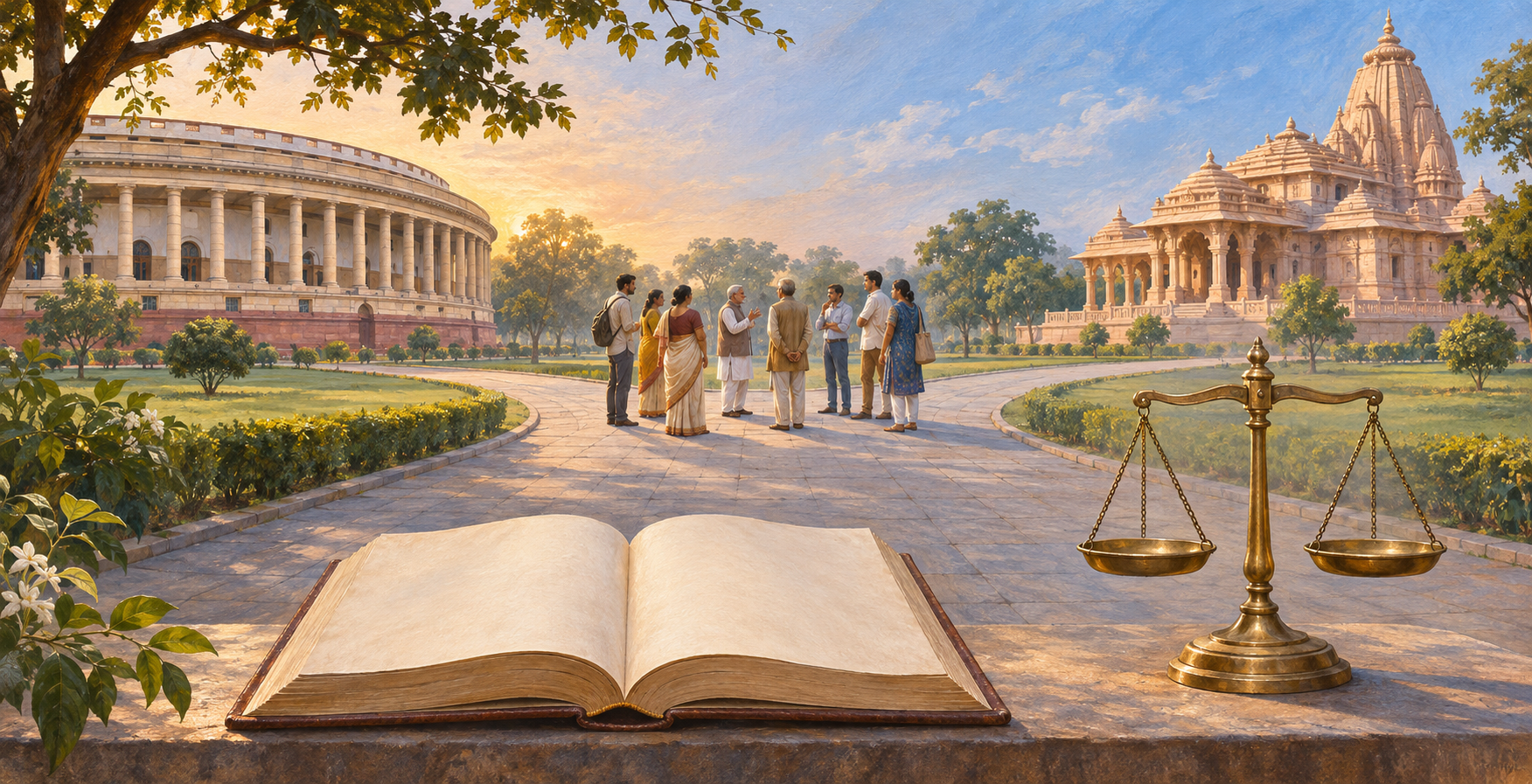
If you are trying to decide whether the VHP’s demand for a nationwide Uniform Civil Code and its challenge to Akhilesh Yadav over a Ram Temple visit belong to one political campaign, the answer is: politically yes, substantively no. They are being placed inside the same account of equal citizenship, Hindu memory and public accountability, but each claim still needs its own evidence.
You do not have to choose between forgetting the past and accepting every slogan built around it. The useful approach is to separate the proposed law, the demand for an apology and the accusation of appeasement. That separation makes it easier to see what deserves support, what needs clarification and what remains campaign rhetoric.
Key takeaways
- The VHP’s nationwide UCC demand concerns civil law. You should judge it by an actual legislative proposal, including its scope, protections, exceptions and transition rules.
- The demand that Akhilesh Yadav apologise before visiting the Ram Temple treats the visit as a test of political credibility tied to the memory of kar sevaks. It should not be confused with a formal rule governing worship or entry.
- An accusation of Muslim appeasement is not self-proving. Ask which policy is being challenged, how citizens are treated differently and what neutral alternative is proposed.
- The Ram Temple carries sacred, civilisational and political meanings at once. Keeping those meanings distinct prevents a campaign appearance from substituting for either repentance or policy.
- A Dharmic standard should be symmetrical: one rule of evidence for allies and opponents, one standard of accountability for political violence, and equal concern for the dignity of every citizen.
Three disputes are being placed inside one political frame

VHP chief Alok Kumar has called for nationwide implementation of a Uniform Civil Code, demanded an apology from Akhilesh Yadav before a Ram Temple visit, and accused Rahul Gandhi and Congress of Muslim appeasement. The three interventions reinforce a common political story: civil law should not depend on religious identity, Hindu suffering should not be erased, and parties should not seek minority support through unequal treatment.
That common frame explains why the issues appear together. It does not make them interchangeable. A UCC is a question about the contents and operation of law. Responsibility for the treatment of kar sevaks is a historical and moral question. Appeasement is an allegation about political conduct and motive. Each requires a different kind of proof.
- For the UCC, the decisive evidence is legislative text: which rules would change, who would be affected, and what safeguards would apply.
- For an apology, the decisive evidence is responsibility: which act, decision, defence or continuing position the person is being asked to acknowledge.
- For appeasement, the decisive evidence is unequal policy: what benefit, exemption or indulgence is based on community identity, and how comparable citizens are treated.
This distinction matters because emotional force can migrate from one issue to another. Anger over historical violence can make an unspecified legal proposal seem complete. Support for equal civil law can make a disputed allegation about a political opponent appear proven. Reverence for Ram Lalla can make an ordinary campaign visit appear spiritually conclusive. You should resist all three shortcuts.
A nationwide UCC must be judged beyond the slogan
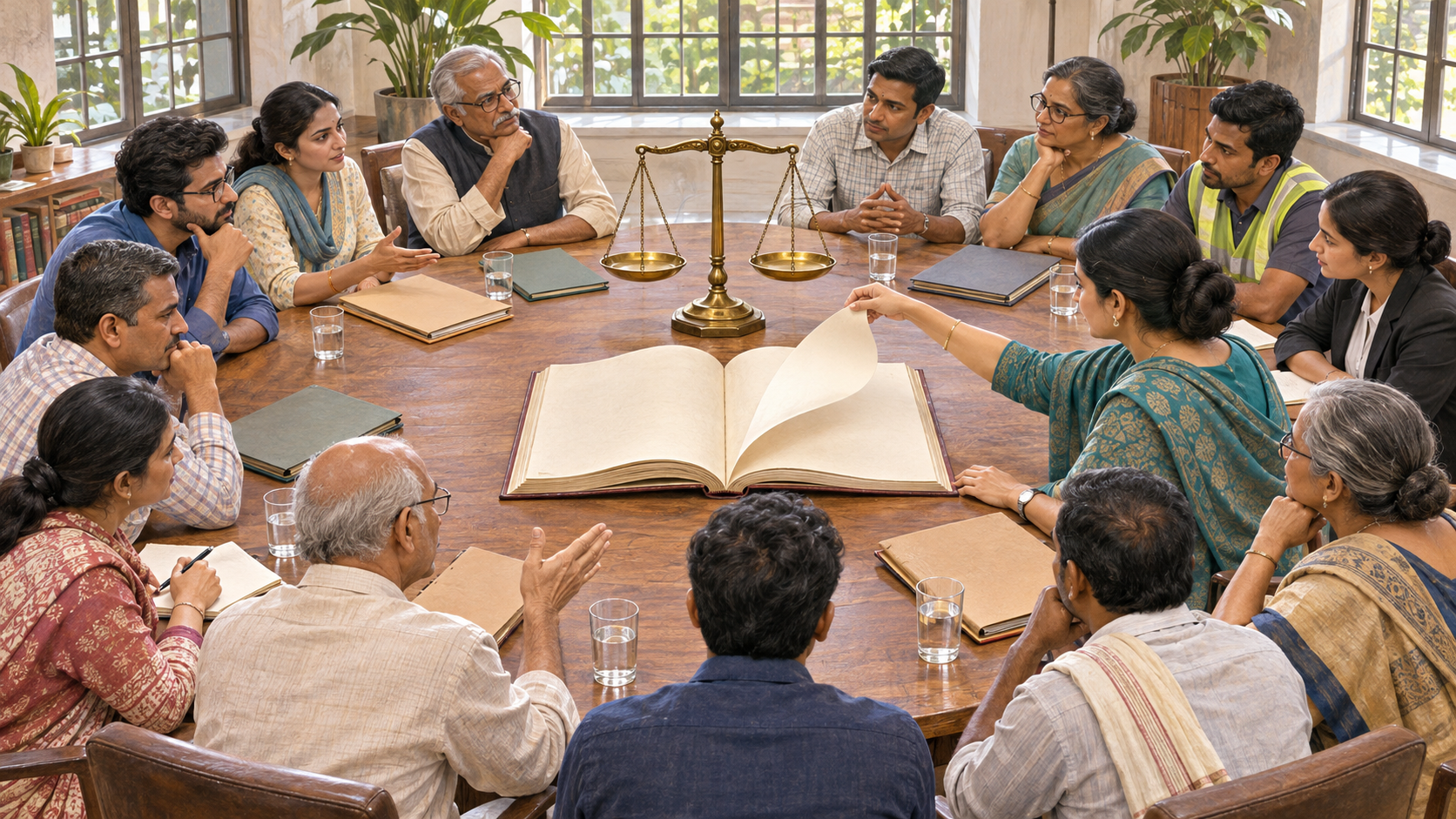
A Uniform Civil Code ordinarily refers to common civil rules for family matters such as marriage, divorce, maintenance, adoption, succession and inheritance. It does not mean common worship, common theology or the erasure of religious identity. The central question is whether citizens facing comparable civil situations would receive comparable rights and obligations under the law.
That principle has an intuitive appeal. A citizen’s legal protection should not become weaker because of a religious label. Yet the word “uniform” cannot answer the questions that a statute must answer. A rule can be applied uniformly and still be badly designed. A custom can carry genuine cultural meaning and still produce an unequal civil consequence. The work lies in distinguishing religious practice from enforceable legal status.
Before supporting or opposing a nationwide UCC proposal, look for clear answers to these questions:
- Scope: Which civil matters would the code govern? A promise of uniformity is incomplete if voters cannot tell what is being made uniform.
- Rights: Does the proposal give similarly situated adults and children equal legal protection, irrespective of community?
- Existing arrangements: How would the law treat marriages, property arrangements, wills or other legal relationships created before it took effect?
- Custom and exemption: Which customs would remain recognised, and what neutral principle would determine an exception? An exception should not depend merely on the electoral influence of the group requesting it.
- Access and enforcement: Can an ordinary person understand, register and enforce the rights the code creates? Equality on paper is thin if the process is inaccessible.
- Consultation and revision: Has the proposal allowed affected communities, jurists and citizens to identify unintended consequences before implementation?
Do not let a politician replace these questions with an identity test. Opposition to a particular draft would not automatically prove opposition to equal citizenship; the objection may concern the draft’s contents. In the other direction, invoking minority protection does not by itself justify unequal civil rights. Ask for the clause, the effect and the neutral alternative.
The strongest Dharmic case for a UCC is therefore not that one community should prevail over another. It is that the state should apply a defensible standard of justice without ranking citizens by religious identity. Support should become firmer as the text becomes clearer, more symmetrical and more protective of those with the least power inside any family or community.
The Ram Temple apology demand is about political legitimacy
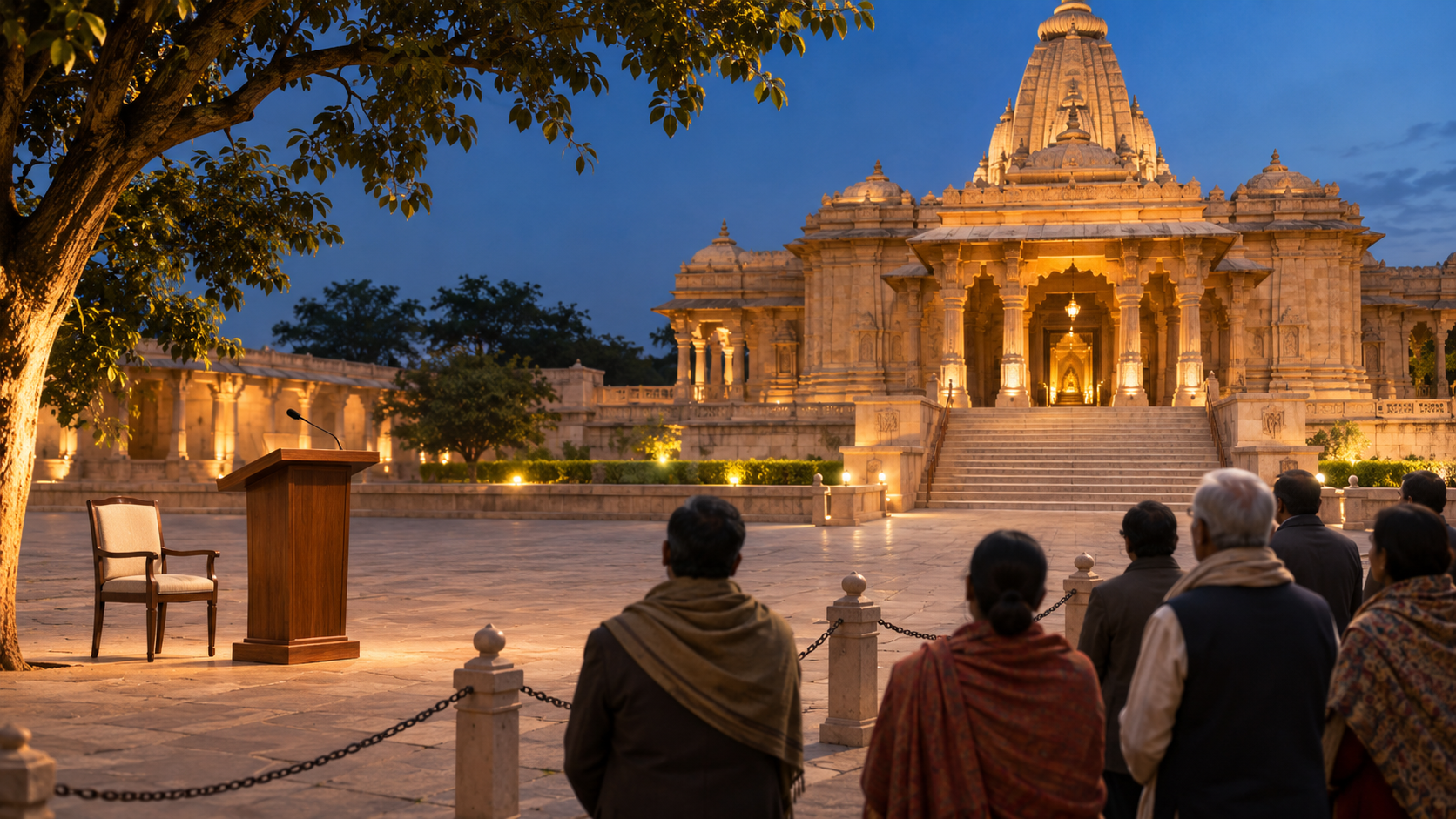
The VHP chief has said that Akhilesh Yadav should apologise for the killing of kar sevaks before visiting the Ram Temple. As framed, this is a demand for historical acknowledgement before a political act is treated as credible. It is not, on the facts available, a formal temple-entry rule.
That distinction protects both memory and the sacred character of the temple. A political leader’s ability to seek darshan is one question. Whether the public should accept the visit as evidence of respect for the Ram Janmabhoomi movement is another. Whether that leader or his party owes an apology for earlier conduct is a third. Collapsing the three allows a photograph to do work that only a truthful statement can do.
The demand also leaves a necessary question for VHP supporters to press: what precisely is Akhilesh Yadav being asked to accept responsibility for? His own words or actions, a party’s continuing defence of past conduct, political inheritance, and a governmental decision are different grounds of responsibility. Naming the ground would make the demand harder to evade and easier for the public to judge.
A meaningful political apology should do more than express generic sadness. Look for four elements:
- A clear identification of the conduct and the people harmed.
- An acknowledgement of the relevant responsibility, without hiding it inside passive language.
- A rejection of any continuing justification for wrongful violence or excessive state action.
- A commitment that comparable political or governmental conduct will not be defended in the future.
If those elements are missing, a temple visit may remain a gesture rather than reconciliation. If they are present, supporters should assess the apology by its clarity and subsequent conduct, not by whether it supplies a convenient campaign spectacle.
For a pro-Hindu audience, this is an important discipline. Ram Mandir should not be reduced to a prop that automatically cleanses a political record. Nor should grief over kar sevaks be reduced to a permanent instrument that makes repentance impossible in principle. Memory requires truth; reconciliation requires a credible change of position.
Test the appeasement charge with policy, not labels

Alok Kumar’s charge that Rahul Gandhi and Congress practise Muslim appeasement is a partisan allegation, even when it expresses a concern shared by many Hindu voters. You can take the concern seriously without treating the label as proof.
Begin with the policy being criticised. Identify the benefit, exemption, promise or silence at issue. Then name the comparison: how would a Hindu, Muslim, Sikh, Buddhist, Jain or other citizen in an equivalent situation be treated? Finally, ask what rule the critic would apply to everyone. Without those three steps, “appeasement” can become a way to assign motive without demonstrating unequal treatment.
The same scrutiny must apply to UCC advocates. If uniform civil law is defended as equality, politically convenient exceptions cannot be granted without a neutral justification. Symmetry is the test that turns a campaign argument into a governing principle.
When the next speech combines the UCC, a Ram Temple visit and the memory of kar sevaks, make three columns in your notes: proposed law, historical responsibility and electoral accusation. Put the relevant evidence under each. If one column contains only labels, do not let the emotional force of the other two fill the gap. Support equal law where the text earns support, insist on a precise accounting of political violence, and judge every temple visit by what the visitor is willing to acknowledge after the cameras leave.
References

Leave a Reply
You must be logged in to post a comment.