

You may have seen the controversy reduced to a blunt claim: Uddhav Thackeray called a political organiser an avatar of Vishnu. If you are deciding whether to repeat that claim or challenge the remark, pause at the wording. A Dharmic response loses force when an interpretation is passed off as a quotation.
The reported remark is still serious. Sacred language can illuminate public life, but it can also be used to confer holiness on a political faction. Hindus can object firmly while remaining exact about what was said, what was inferred, and what still needs evidence.
What Thackeray reportedly said, and what was inferred

The controversy contains three connected but distinct claims. Thackeray praised Abhijeet Dipke and people participating in the demonstrations. Recalling his visit to Jantar Mantar, he reportedly described what he saw as “Vishnu taking the form of the people”. He also presented the protesting youth as defenders of humanity, democracy, and the nation.
Those points do not amount to a reproduced, verbatim sentence declaring, “Abhijeet Dipke is an avatar of Vishnu.” That formulation combines Thackeray’s praise for a named organiser with his collective metaphor about the people. It may express how critics understood the combined remarks, but it should not be placed inside quotation marks as though those exact words were spoken.
This distinction does not clear the remark of objection. A collective comparison can be religiously inappropriate even if Thackeray did not confer individual avatarhood on Dipke. It simply tells you where the strongest criticism lies: in the decision to identify a contested political mobilisation with Bhagwan Vishnu, not in a quotation that has not been established.
If you share the episode, use the accurate formulation: Thackeray reportedly portrayed the protesting people as Vishnu taking form and separately praised Dipke. If a complete recording establishes stronger words, those words can then be assessed directly. Until then, do not let a headline become a transcript.
Why the collective metaphor still crosses a Dharmic line
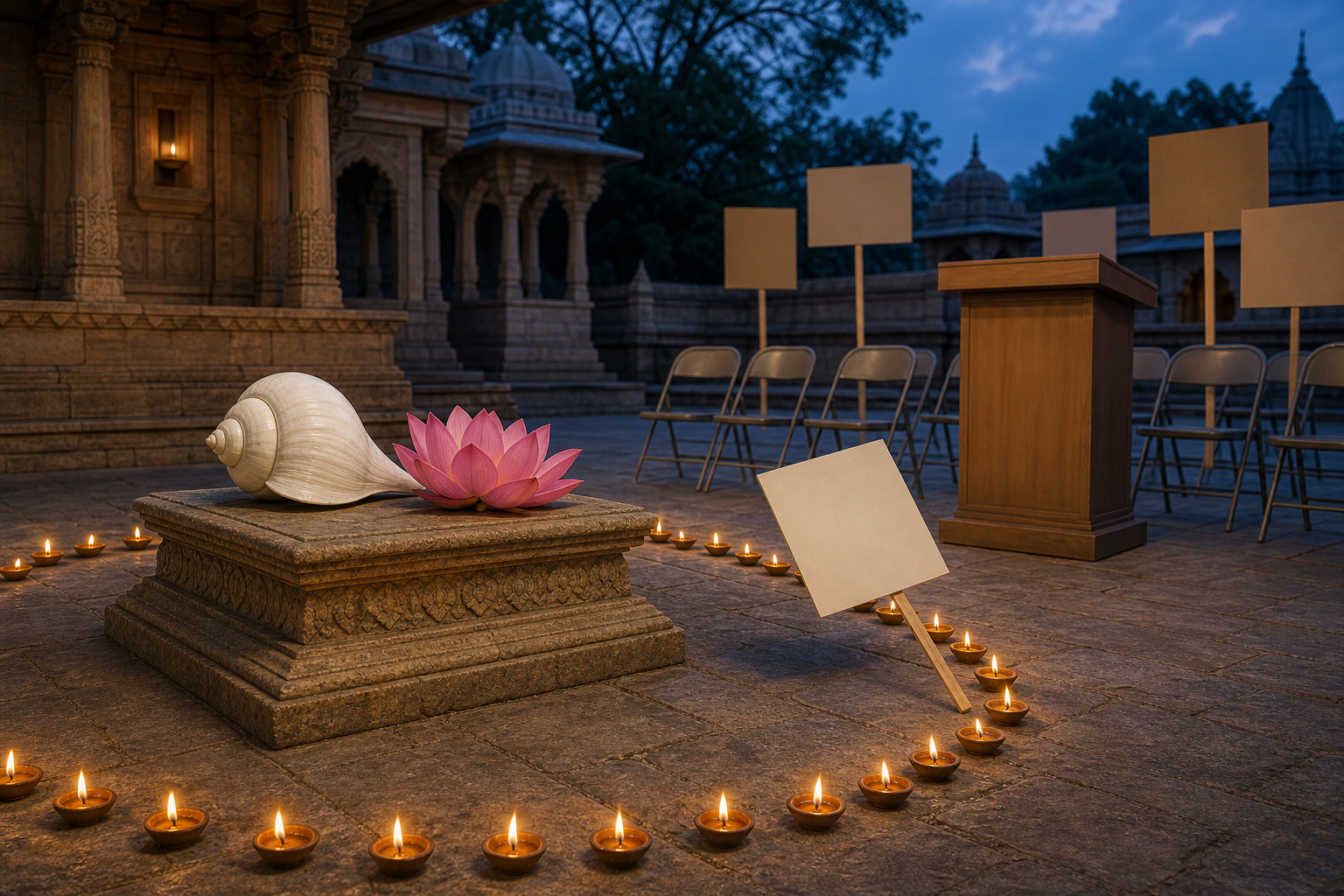
In ordinary English, “avatar” can be used loosely to mean an embodiment or representative. In Hindu Dharma, avatara carries far greater theological and devotional weight. Bhagwan Vishnu is revered as the protector and preserver of cosmic order. For Vaishnavas especially, language about Vishnu manifesting in the world is not a disposable synonym for “people whose cause I support.”
A charitable reading is possible. Thackeray may have meant that ordinary citizens were acting as agents of preservation: overcoming fear, defending democratic institutions, and protecting society. Metaphors do not always express literal theological propositions.
But metaphor does real work. By presenting a political crowd through the image of Vishnu, a speaker gives that crowd a presumption of sacred righteousness before its aims, methods, leadership, and conduct have been independently tested. Political approval begins to sound like religious recognition. Disagreement can then be treated not merely as a different judgment but as opposition to dharma itself.
Keep three boundaries clear:
- Praising someone’s courage is not the same as identifying that person with a deity.
- Saying that a cause may serve dharma is not the same as declaring its participants a divine manifestation.
- Applying a Dharmic moral standard to politics is not the same as using Bhagwan Vishnu as a certificate of partisan legitimacy.
The objection, then, is not that Hindu vocabulary must be excluded from politics. Dharma necessarily informs ethical judgment for many Hindus. The problem arises when a deity is conscripted into endorsing a particular movement, especially while the movement’s conduct and claims remain politically disputed.
Balasaheb Thackeray’s Hindutva legacy helps explain why Uddhav Thackeray’s language has produced a particularly sharp sense of betrayal. But lineage should not replace argument. “His father would not have said this” is weaker than the precise objection that sacred status should not be awarded to political actors through a casual metaphor.
Political grievances and sacred legitimacy are separate tests
Thackeray connected the demonstrations with unemployment, inflation, governance, public fear, and the defence of democracy. Each is a political claim that must be examined on its own merits. Invoking Vishnu does not prove those claims. Objecting to the invocation does not disprove them.
This separation matters because public controversies encourage an all-or-nothing response. Supporters may assume that a worthy grievance sanctifies every participant and method. Opponents may assume that misconduct by some participants invalidates every grievance. Neither conclusion follows automatically.
Before deciding what you support or condemn, ask four distinct questions:
- What specific demands are the protesters making?
- Which acts of violence, intimidation, or property damage have been independently established?
- Who committed or directed those acts, rather than merely being present near them?
- What reliable evidence connects any named organiser to the alleged conduct?
Any assertion that a named organiser is wanted by an investigative agency, connected to extremist activity, or responsible for violence is a serious allegation. Do not repeat such a claim as settled fact merely because you find the Vishnu comparison offensive. Look for a current official agency statement, a case record, or another direct legal document, and distinguish an accusation from a conviction.
The same discipline applies to claims about damage during a protest. Identify the act, the location, the evidence, and the responsible actor. A crowd is not morally purified by a politician’s metaphor, but neither is every individual in a crowd automatically responsible for every unlawful act attributed to the gathering.
Key takeaways
- The reported wording portrays Vishnu as taking the form of the protesting people; it does not reproduce a direct statement declaring Dipke personally to be an avatar.
- The collective metaphor remains open to strong Dharmic criticism because it lends sacred authority to a contested political movement.
- The merits of the protests, the conduct of participants, and allegations against an organiser must each be tested separately.
- The most credible Hindu response asks for clarification and withdrawal while refusing to circulate inaccurate quotations or unverified criminal claims.
How to object without weakening your case
Outrage is easy for a politician to dismiss when it contains a factual overreach. A precise objection is harder to evade. Use this sequence when discussing the remark publicly:
- Quote only the established words. Say that Thackeray reportedly spoke of Vishnu taking the form of the people. Describe the individual-avatar claim as an interpretation unless a complete recording supplies that exact sentence.
- Name the religious problem. Explain that Bhagwan Vishnu should not be used to confer divine standing on a political crowd. This is more exact than calling every objectionable metaphor “anti-Hindu” without explaining the offence.
- Ask for clarification. Did Thackeray mean only that citizens can help preserve society, or did he intend an avatara comparison? The distinction should come from him, not from competing partisan guesses.
- Request a specific remedy. Ask him to withdraw the Vishnu comparison and present his democratic or economic arguments in ordinary political language.
- Keep legal allegations in a separate paragraph. Attach direct evidence, preserve words such as “alleged” where appropriate, and never use religious offence as proof of criminal guilt.
- Apply the rule across parties. No leader, ally, protest movement, or electoral constituency should receive divine status merely because its politics are congenial to us.
A concise response could read: “Uddhav Thackeray should clarify whether he meant only that citizens can act to preserve society or whether he intended an avatara comparison. Even as a metaphor, identifying a political crowd with Bhagwan Vishnu is religiously careless and grants sacred authority to a contested movement. He should withdraw the comparison and argue his political case without appropriating the deity.”
That wording does three useful things at once. It preserves the distinction between literal and metaphorical meaning, identifies the harm without exaggeration, and gives Thackeray a clear action by which to correct the matter.
The standard Hindus should carry into the next controversy
Hindu public advocacy should be anchored in both reverence and satya. Reverence without factual discipline becomes an easy vehicle for political manipulation. Factual discipline without reverence can miss why sacred language wounds devotees when it is treated as campaign decoration.
The workable boundary is simple. A politician may derive moral duties from dharma, explain how policy relates to justice, or appeal to citizens’ conscience. A politician should not turn Bhagwan Vishnu into a partisan endorsement or treat avatara language as applause for a favoured crowd.
If you discuss this episode, put the exact reported wording and your objection side by side. Ask for one clear correction. Verify every separate allegation before repeating it. That combination protects the dignity of Bhagwan Vishnu while denying political actors an escape through inaccuracies in their critics’ case.
References
