

If you came to the Sahibganj case trying to separate a serious safeguarding concern from the claims circulating around it, start with two duties: protect the minor and preserve the truth. You do not have to minimise alleged religious-identity deception to insist on due process, and you do not have to declare guilt in order to take the allegations seriously.
The useful question is not which slogan to attach to the case. It is what has been alleged, what the authorities have actually done, what remains unproved, and how families and temple committees should respond when a minor may be at risk.
What the Sahibganj case actually establishes

The case concerns Manowar Ansari, a resident of Santali Momin Tola in the Barhet area of Sahibganj district, Jharkhand. The minor girl’s mother alleged in an FIR that he introduced himself to her daughter as “Manohar,” presented himself as Hindu, and took the girl from Ranga to the Shivgadi Temple with the apparent intention of marrying her. These are allegations recorded through the mother’s complaint, not judicial findings.
The mother placed the later episode on July 15. She said her daughter left home saying she was going to school in Barhet and that, at about 11:30 a.m., she received information that the girl had been molested. She also alleged that the same person had previously taken her daughter to Ranchi on June 29 and had harassed her and engaged in sexual contact with her. The public information supplied about the case does not include the girl’s account of those events, medical findings, the accused’s response, or a court’s assessment of the allegations.
At Shivgadi Temple, people reportedly noticed the accused applying vermilion to the girl’s forehead. Members of the temple management committee then examined CCTV footage and informed Barhet police. The police station in-charge said that an FIR had been registered, the accused had been arrested and sent to jail in judicial custody, and the girl’s statement had been recorded in court.
Those procedural steps matter, but they must be described accurately. An arrest, judicial custody, and the recording of a statement show that the criminal process has begun. They do not amount to a conviction. Nor should anyone invent the contents of the girl’s court statement merely because a statement was recorded.
| Point | Present status | Responsible reading |
|---|---|---|
| Use of the name “Manohar” and presentation as Hindu | Alleged by the girl’s mother in the FIR | Treat identity deception as a central allegation, but not yet as an adjudicated fact. |
| Vermilion applied at Shivgadi Temple | Reportedly noticed by people present and checked by the temple committee on CCTV | Describe the observed ritual act without converting it into a legal conclusion about marriage. |
| Arrest and judicial custody | Confirmed as police action by the station in-charge | These are procedural facts, not proof of guilt. |
| Harassment and sexual contact | Allegations associated with the mother’s complaint | Take them seriously while preserving the distinction between an allegation and a finding. |
| Burqa reportedly present on the scooter | The item’s presence was reported; its intended use was expressed only as a fear or suspicion | Do not state that it was used to disguise the girl unless evidence establishes that point. |
Why the alleged deception matters without deciding the verdict
This cannot responsibly be reduced to a disagreement over an adult interfaith relationship. The person at the centre of the safeguarding concern is described as a minor. The mother alleges not merely a difference of religion but concealment of identity, prior travel away from home, harassment, sexual contact, and a later temple ritual.
False identity, if proved, matters because it prevents a young person and her family from understanding whom they are dealing with. It also makes ordinary verification harder: a name may not connect to the person’s home, relatives, school records, or local reputation. When secrecy is then combined with travel and pressure toward a marriage-like ceremony, the risk is no longer an abstract debate about social approval. It is a concrete child-safeguarding problem.
- Age comes first. Do not frame a case involving a minor as though it were simply an adult’s private choice.
- Deception is a separate issue from religious difference. An honest interfaith relationship and a relationship allegedly built on a false religious name are not the same situation.
- Escalation matters. The reported sequence moves from a school acquaintance to an alleged Ranchi trip and then to a temple episode. Each event requires verification, but the sequence gives families a reason to act promptly when travel or marriage plans are concealed.
- Religious details should be neither erased nor inflated. The alleged Hindu identity, the name “Manohar,” and the use of Shivgadi Temple are relevant to this particular complaint. They do not, by themselves, prove an organised network or collective responsibility.
A pro-Hindu response can be firm about the alleged targeting and deception while remaining disciplined about evidence. Satya is not served by turning suspicion into fact. Raksha is not served by dismissing warning signs until a final judgment arrives. The two duties belong together.
What a family should do when a minor may be at risk

If a minor has left for school but cannot be located, has travelled secretly, or is being taken toward a sudden marriage-like ritual, treat location and immediate safety as the first problem. Do not wait for certainty about the other person’s motive before trying to find the child. If there is immediate danger or the minor is missing, contact the police rather than arranging a private confrontation.
- Establish the last verified location. Record when the minor left, what destination she gave, what she was wearing, who last saw her, and which vehicle or route may be involved. Separate what someone directly observed from what another person merely heard.
- Build one exact timeline. Write down dates, times, calls, trips, name variations, and disclosures in chronological order. In the Sahibganj complaint, June 29, July 15, the school explanation, the reported 11:30 a.m. alert, the Ranchi trip, and the temple episode are distinct points. Keeping them distinct prevents later retellings from merging separate events.
- Preserve original communications. Save messages, call records, profile links, usernames, photographs, travel details, and payment or vehicle information without editing them. Keep the original device available. Do not circulate intimate material or forward it through community groups.
- Verify identity independently. Check the person’s full name, home address, family connection, school or workplace, and any second name being used. Ask a trusted adult to perform the verification; do not send the minor to confront the person.
- Keep the disclosure channel open. The first conversation should establish safety and facts, not become a public moral interrogation. Record the minor’s own words as accurately as possible without supplying answers for her or forcing repeated retellings before relatives and neighbours.
- Use qualified help for serious allegations. If sexual contact, coercion, assault, or abduction is alleged, seek prompt assistance from police and appropriate medical professionals. Social-media discussion is not a substitute for a formal complaint, evidence preservation, or care for the minor.
No single sign proves deception. A classmate using a nickname is not automatically dangerous, and an unexplained absence can have more than one cause. The point at which you should move from conversation to active verification is the cluster: inconsistent identity, secrecy about location, travel away from home, isolation from guardians, pressure for an immediate ceremony, or an attempt to prevent recognition.
How temples and community members should respond
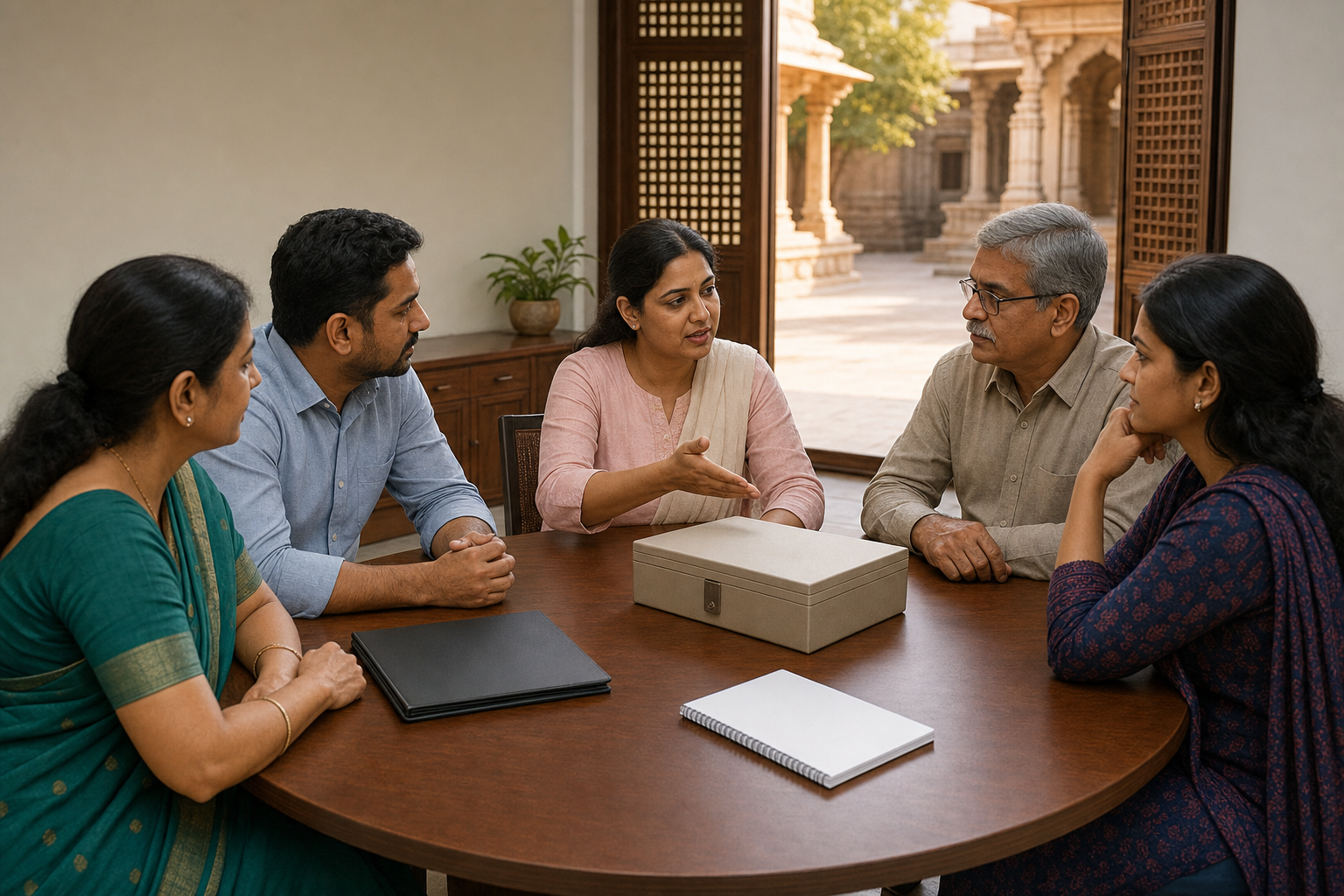
The Shivgadi Temple episode offers a practical sequence for temple administrators: people noticed an irregular situation, the management committee checked CCTV, and the police were notified. That sequence is more useful than either indifference or mob action. Temple personnel are often placed at the point where a private claim becomes a public ritual, so a simple safeguarding protocol can prevent confusion and protect evidence.
- Pause when age or willingness is in doubt. If someone appears to be a minor, distressed, concealed, or unable to answer basic questions independently, stop the ritual activity and move the situation into a visible, calm setting.
- Call the appropriate authorities. Contact police when a minor may be missing, coerced, assaulted, or brought under a disputed identity. Avoid a crowd confrontation that could endanger the minor or contaminate later accounts.
- Preserve CCTV promptly. Export the relevant period before an automatic system overwrites it. Retain an unedited copy, note when it was copied and by whom, and provide it through formal channels.
- Write only what was observed. Record the time, people present, vehicle, visible objects, spoken names, and actions. Do not add a motive to an object such as clothing unless someone directly observed how it was used.
- Protect the minor’s privacy. Do not release her name, face, school, home, court appearance, or footage to community pages. Public identification can deepen harm while contributing nothing necessary to accountability.
- Reject collective retaliation. Responsibility belongs to the person whose conduct is under investigation and to anyone evidence shows was involved. A serious allegation against one accused does not authorise harassment of unrelated people.
Public discussion needs the same discipline. Use “accused” and “alleged” for contested conduct. Say that police arrested the accused and that the girl’s statement was recorded; do not say that a court has proved the charge. Say that a burqa was reportedly present on the scooter; do not state its purpose as fact. Say that the mother alleged a false Hindu identity; do not quietly remove the religious element to make the case more comfortable.
Key takeaways
- The central complaint is that Manowar Ansari allegedly used the Hindu name “Manohar” while approaching a minor Hindu girl.
- The mother also alleged prior travel to Ranchi, harassment, sexual contact, and an attempt to take the girl through a marriage-like temple ritual.
- Temple observers, a CCTV review, an FIR, an arrest, judicial custody, and the recording of the girl’s court statement are reported procedural events; they are not a conviction.
- Families should act on a cluster of identity inconsistency, secrecy, travel, isolation, and sudden marriage pressure by locating the minor, preserving evidence, and using formal authorities.
- Temples should pause questionable rituals, protect CCTV, contact police, and keep the minor’s identity out of public circulation.
- A dharmic response protects both the vulnerable and the truth: neither denial nor exaggeration serves justice.
Before forwarding the next claim about this case, ask three questions: Is this an allegation or a verified procedural fact? Does the message expose the minor? Will sharing it improve her safety or the integrity of the investigation? If the message fails those tests, do not amplify it. Protecting a Hindu minor and protecting the truth are not competing duties.
References
