

If you are trying to decide whether the RSS is simply another name for the BJP, start by refusing a false choice. The RSS does not have to be politically silent to be institutionally distinct from a political party. The useful question is whether its purpose, authority, daily work, and standards of success can be reduced to winning elections.
This distinction matters whether you admire the Sangh, distrust it, or are still forming a view. It replaces partisan shorthand with tests you can actually apply: identify who acted, determine in what capacity, examine the work, and draw only the conclusion the evidence supports.
Political independence is not the same as political absence
At the RSS centenary lecture series in Kolkata on 21 December 2025, Sarsanghchalak Mohan Bhagwat called it a "huge mistake" to view the RSS through a BJP lens. That is an institutional claim. It deserves to be understood precisely and tested seriously, not merely repeated by supporters or dismissed by opponents.
A political party is organized around electoral competition, candidates, government, and public office. A socio-cultural organization may influence civic life, form opinions, and include people who enter politics without making elections its defining purpose. Political relevance, ideological affinity, personal association, and institutional control are not interchangeable categories.
Keep three layers separate whenever you assess the RSS:
- The institution: its declared purpose, leadership, decision-making, regular programmes, allocation of effort, and internal accountability.
- The individual volunteer: a person who may hold political views, vote, campaign, or enter public life without turning every personal act into an institutional directive.
- The electoral actor: a party, candidate, campaign, or office-holder seeking political power through elections.
Collapsing these layers creates two opposite errors. One is to treat every statement or political choice made by a volunteer as an RSS command. The other is to use the label "cultural" to wave away conduct that may genuinely be organized for a political objective. Neither approach is rigorous.
Institutional independence is best understood as operational autonomy: the ability to set priorities, organize work, and judge success according to a societal mission rather than the immediate needs of a party. It does not require ideological neutrality. It does require more than a formal claim of separation.
When you examine a disputed case, ask:
- Who made the decision, and what office or role did that person hold?
- Was the action authorized by an RSS body, undertaken by individual volunteers, or organized by a party?
- Does the activity continue between elections, when it offers no obvious campaign advantage?
- Is success measured through votes and offices, or through social outcomes such as sustained service, trust, education, and community capacity?
- Can the institution maintain its stated priorities when they do not match a party’s immediate incentives?
You do not need to force a total verdict. Evidence may show close alignment on one issue, individual participation on another, and genuine institutional independence in a third area. A mixed conclusion is often more accurate than a sweeping label.
Seva is where institutional identity becomes observable
The RSS presents character-building, seva, and social cohesion as central to its societal orientation. Those commitments become meaningful only when they can be seen in conduct. Seva therefore is not ornamental language attached to institutional identity. It is one of the main places where that identity can be examined.
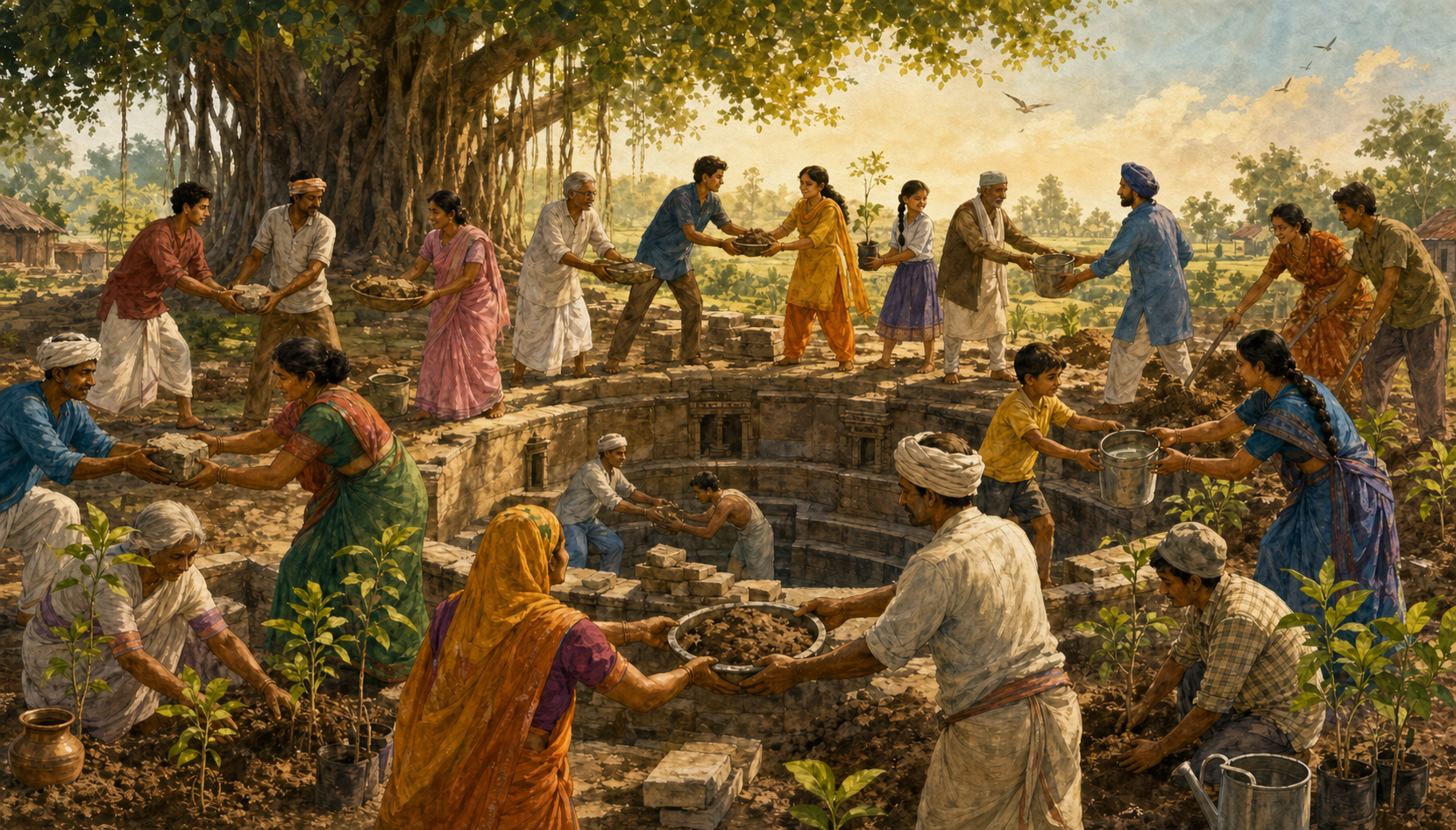
Look locally. Neighborhood work, education, relief efforts, and community outreach are more informative than a slogan because they involve repeated choices: which needs receive attention, who is welcomed, how volunteers behave, whether work survives the news cycle, and what remains after the immediate intervention ends.
A useful assessment of seva asks six concrete questions:
- Need: Does the activity address a specific problem recognized by the affected community?
- Continuity: Is the work maintained outside election periods and moments of public attention?
- Dignity: Are recipients treated as neighbors with agency, rather than as an audience, a vote bank, or material for publicity?
- Access: Is help offered without making political allegiance a condition of service?
- Capacity: Does the effort strengthen local knowledge, organization, and resilience instead of leaving people permanently dependent?
- Accountability: Can organizers explain what they did, who participated, what was achieved, and what still needs correction?
This test should be demanding without becoming cynical. A modest, regular activity may tell you more about institutional character than a large one-time event. Conversely, the mere use of the word seva does not settle questions about effectiveness, fairness, or political purpose.
Before you donate, volunteer, endorse an initiative, or criticize it, ask for a concrete account: What need is being met? Who is responsible? How often does the work occur? Which other community institutions participate? What continues after the emergency or event? Specific answers let you judge the work itself.
Character-building should be assessed in the same practical way. The relevant signs are not self-description but habits: reliability, restraint, truthfulness, disciplined cooperation, respect for beneficiaries, and willingness to correct mistakes. If those qualities do not appear in the work, invoking character cannot substitute for them.
Dharmic unity should create cooperation without erasing difference
A Dharmic framework can connect Hindu, Buddhist, Jain, and Sikh communities through a shared moral vocabulary that includes duty, compassion, self-discipline, truthfulness, and service. It should not flatten distinct teachings, histories, institutions, or forms of practice into an artificial sameness.
The practical test of unity is whether different communities can cooperate while remaining recognizably themselves. A gurdwara need not become a temple, a vihara, or an RSS shakha in order to share responsibility for a local need. Respectful cooperation is stronger when no participant must surrender identity as the price of belonging.
If you want to turn Dharmic unity into local action, use a small and verifiable process:
- Name one shared need. Choose a concrete issue that can be acted on locally rather than beginning with a grand declaration of unity.
- Invite institutions as institutions. Include temples, gurdwaras, viharas, Jain organizations, sanghas, schools, and neighborhood groups while respecting their different capacities.
- Agree on boundaries before beginning. Service should not become party recruitment, a test of belief, or a competition for institutional credit.
- Assign visible responsibilities. Decide who will organize volunteers, manage materials, communicate with the community, and review results.
- Practice samvada when disagreement appears. State the disagreement plainly, hear the reasoning behind it, and keep the shared work focused on the agreed need.
- Review what changed. Record what was completed, what failed, who was left out, and whether the effort should continue.
This kind of collaboration does two jobs at once. It addresses a community need, and it tests whether appeals to Dharmic unity can produce disciplined coexistence rather than rhetorical conformity.
Use a disciplined test when an RSS claim becomes partisan
Most arguments about the RSS become unproductive at the moment a broad label replaces a specific claim. "The RSS controls everything" is too vague to verify. So is "the RSS has nothing to do with politics." Convert either assertion into a claim about an identifiable actor, action, authority, time, and consequence.
Use this sequence:
- Identify the actor. Was it the RSS leadership, a local unit, an affiliated body, an individual volunteer, a BJP office-holder, or an unnamed person being assigned a label?
- Identify the act. Distinguish a public statement, service programme, personal endorsement, campaign activity, policy position, and formal organizational decision.
- Ask what proves authorization. A person’s association may establish context, but it does not automatically prove an institutional instruction.
- Check the time horizon. A pattern sustained across ordinary years carries a different meaning from activity that appears only around an election.
- Separate purpose from effect. An activity may be presented as social work yet have political effects. Political effects alone do not establish that electoral gain was its controlling purpose.
- Limit the conclusion. State only what the evidence supports about that actor and action. Do not turn one episode into a total theory of the institution.
Suppose a named volunteer endorses a candidate. That supports a conclusion about the volunteer’s political choice. An inference about institutional direction requires additional evidence of authority, coordination, or organizational decision-making. Apply the same discipline in the other direction: evidence of a worthwhile relief effort establishes that the work occurred; it does not answer every criticism involving the organization.
This method protects you from partisan reduction in both directions. One political affinity should not make non-electoral work invisible. One service project should not grant permanent immunity from scrutiny. Judge political conduct, social service, institutional autonomy, and ethical consistency as related but distinct questions.
Key takeaways
- Political independence means institutional autonomy, not the absence of political views or public influence.
- Separate the RSS as an institution from the personal conduct of volunteers and the electoral conduct of a party.
- Judge seva through need, continuity, dignity, access, local capacity, and accountability.
- Treat Dharmic unity as cooperation among distinct traditions, not the erasure of their differences.
- Demand evidence for both sweeping accusations and sweeping defenses, then keep your conclusion proportional to that evidence.
The next time an argument about the RSS collapses into a BJP label, ask one clarifying question: Which actor, action, and level of authority are we discussing? Then look for the answer in sustained conduct. That small discipline will tell you more than another round of partisan shorthand.



References
