

You are not choosing between Hindu self-respect and respect for distinct Buddhist, Jain and Sikh identities. The real choice is whether unity will be built by imposing one label or by making a common civilizational bond precise enough to hold real differences.
This distinction matters whenever an RSS statement, a family discussion or a social-media argument turns on the claim that everyone belongs to one Hindu civilization. You need more than a slogan at that moment. You need language that tells people what kind of unity you are offering, what you are not asking them to surrender, and what common work should follow.
Separate four kinds of belonging before debating one word

Arguments about Hindu identity often become needlessly bitter because one word is being asked to carry four different meanings. Before you agree or object, identify which kind of belonging is actually under discussion.
- Religious identity names a person’s spiritual path, community and chosen affiliation. Hindu, Buddhist, Jain and Sikh are not interchangeable religious descriptions.
- Dharmic kinship describes a family of traditions rooted in Bharat and connected by overlapping ethical and philosophical concerns. Kinship means relationship, not doctrinal sameness.
- Civilizational belonging refers to participation in the historical and cultural life of Bharat. The word Bharatiya often carries this meaning more clearly when the audience includes several religious communities.
- Civic belonging means equal membership in the constitutional polity. It rests on citizenship, equal dignity and freedom of conscience and religious practice, not acceptance of a civilizational theory.
These forms of belonging can overlap without collapsing into one another. A Sikh may affirm Bharatiya civilization and dharmic kinship while declining Hindu as a religious identifier. A Hindu can respect that refusal without treating it as hostility to Bharat. The same principle applies when Buddhist or Jain participants describe their own traditions.
Use a simple clarifying question: When you say Hindu here, do you mean a religion, a dharmic family, a civilization or citizenship? If the intended meaning is religious, self-identification must govern. If it is civilizational, say so explicitly. If it is civic, use the language of citizens and constitutional equality. Much apparent disagreement disappears once the category is named accurately.
This also gives you better replacements for an ambiguous claim. Say the Hindu religious community when you mean Hindus. Say the dharmic traditions when you mean Hinduism, Buddhism, Jainism and Sikhism together. Say Bharatiya civilization when you mean a wider cultural inheritance. Say Indian citizens when rights and public duties are at issue.
Understand what the RSS unity claim can and cannot carry

The RSS was founded in 1925 and developed a grassroots model of social organization. Its 2025 centenary therefore invited a serious assessment of what a century of organized Hindu thought has contributed and what its language still needs to clarify.
For many supporters, a unified Hindu identity expresses cultural continuity, social cohesion and confidence in Bharat’s civilizational inheritance. For some listeners, however, the assertion that apparently different communities are all Hindu sounds like a religious classification imposed from outside. The statement attributed to Mohan Bhagwat brought precisely this gap between intended breadth and received meaning into view.
Intent and reception are different facts. A speaker may intend Hindu as a generous civilizational umbrella, while a Sikh, Jain or Buddhist listener hears the denial of a distinct tradition. Repeating the umbrella term does not repair the mismatch. Defining it, limiting its claim and recognizing the listener’s chosen identity can.
Treat shared DNA as a metaphor, never as proof
The phrase same DNA should not be treated as a literal scientific conclusion. The subcontinent contains both deep overlapping ancestry and substantial internal diversity shaped by migration, exchange and endogamy. That history can support a metaphor of relationship. It cannot demonstrate that everyone has one uniform identity.
- Use ancestry to illustrate historical connection, not to decide another person’s religion.
- Do not say genetics proves cultural, theological or political sameness. It does not.
- Do not turn genealogy into a test of patriotism or civilizational membership.
- If you use the metaphor at all, pair it immediately with recognition of India’s internal diversity and each community’s right to name itself.
A more defensible formulation is: We inherit a connected civilization, but we do not have to erase our chosen religious names to protect it. That sentence preserves the intended bond while refusing biological determinism.
Build dharmic unity as a covenant of conduct

Unity becomes durable when it answers what we owe one another, not what everyone must be called. Hinduism, Buddhism, Jainism and Sikhism share an overlapping moral vocabulary of dharma, ahimsa, karuna, daya and seva. These concepts are not defined identically in every tradition, and they do not make the traditions theologically identical. They can still furnish a common discipline for public life.
- Recognition: Name Hindu, Buddhist, Jain and Sikh participants as they name themselves. Do not make absorption into a larger label the price of cooperation.
- Non-harm: Reject threats, coercion, collective blame and political violence, including when they are used by people who claim to defend your preferred cause.
- Compassion: State another tradition’s concern fairly before answering it. Distinguish criticism of an institution or leader from suspicion directed at every adherent.
- Service: Convert civilizational language into community-led work in education, health, livelihoods or cultural preservation. Keep beneficiary criteria public and participation non-partisan so that seva does not become a recruitment test.
- Constitutional conduct: Pursue disagreements through argument, lawful institutions and democratic accountability. A dharmic end does not excuse an adharmic method.
This covenant changes how you organize a joint event. Do not advertise Hinduism, Buddhism, Jainism and Sikhism as four versions of one religion. Name all four traditions, state the shared civic or service objective, and allow each participant to explain the tradition-specific reason for joining. Agreement on action does not require a manufactured agreement on doctrine.
The same rule protects Hindu identity. A confident Hindu does not need to hide the Hindu name in order to cooperate, just as a confident Sikh, Jain or Buddhist should not have to surrender a distinct name. Reciprocity is the test: claim the freedom for your community that you are prepared to defend for the others.
Put the principle to work in conversation and politics
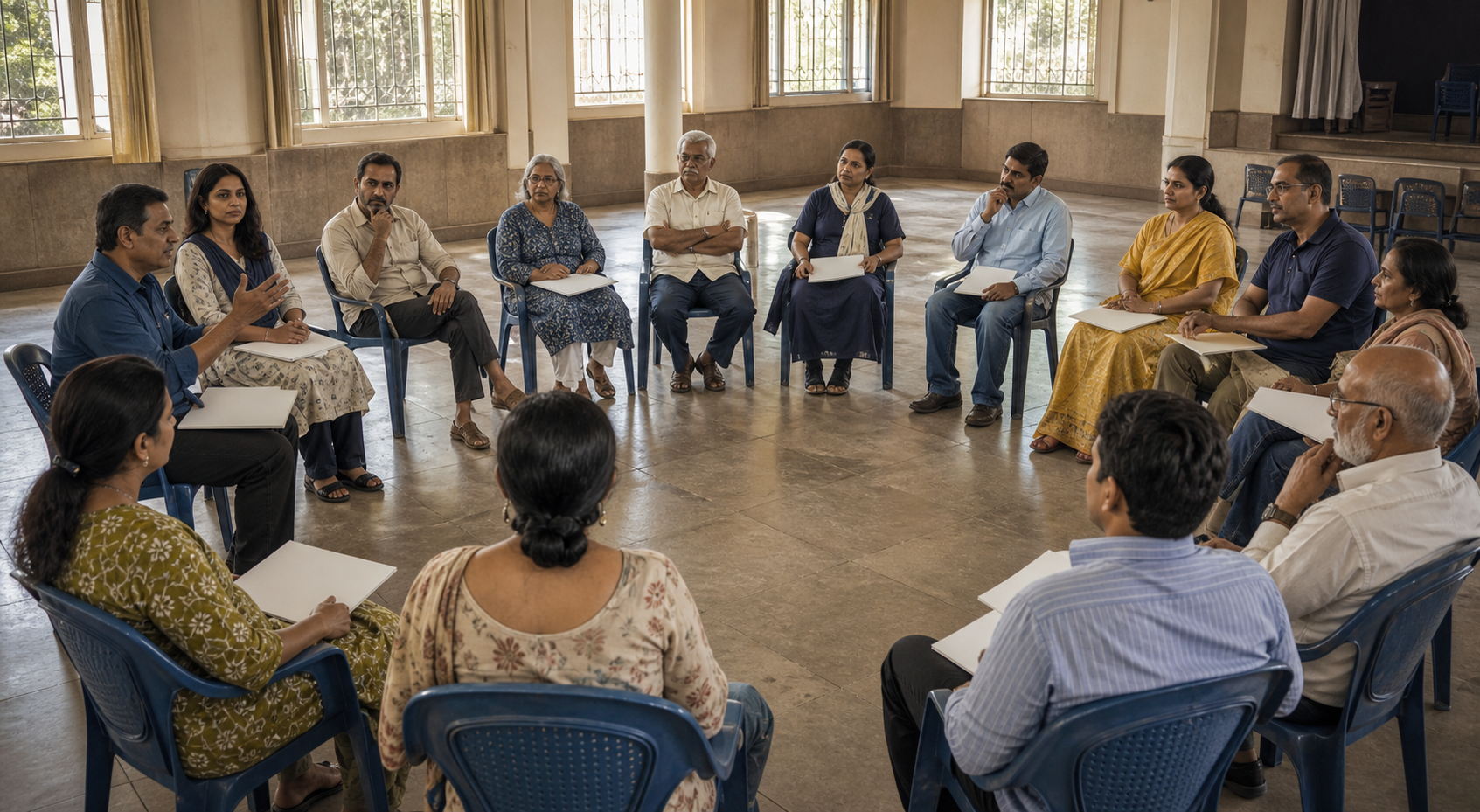
Use this sequence in a difficult conversation
- Identify the concern before defending the slogan. Ask, “Are you worried that this language denies your tradition’s distinct identity?”
- Define your use of Hindu. Say whether you mean religious affiliation or a broad civilizational category. Do not move between the two meanings halfway through the discussion.
- Respect the other person’s description. You can say, “I use Hindu civilizationally, but I will not impose it as your religious identity.”
- Name the common duties. Move to freedom of conscience, non-harm, compassion, service and protection of cultural heritage.
- Propose one cooperative action. A community education effort, health initiative, livelihood project or heritage activity tests unity more honestly than obtaining verbal submission to a disputed label.
If disagreement remains after these steps, stop trying to secure a ceremonial concession. A person can reject your terminology while still behaving as a trustworthy civilizational partner. Judge the relationship by reciprocity and conduct.
Check public language before you publish it
Before sharing a speech clip, drafting a resolution or posting a claim about Hindu unity, ask:
- Can a reader tell whether Hindu means religion or civilization?
- Does the wording preserve the right of Buddhist, Jain and Sikh communities to describe themselves?
- Have you turned an ancestry metaphor into a false scientific conclusion?
- Does the message identify a duty or shared project, or does it merely demand agreement?
- Would a polite refusal of the label be treated as disagreement, or unfairly recast as disloyalty?
- Does the statement invite constitutional participation, or divide citizens into cultural insiders and outsiders?
If the wording fails one of these checks, revise the wording rather than accusing the audience of bad faith. Precision is not capitulation. It is what prevents a civilizational idea from becoming narrower in practice than it was intended to be.
Keep dharmic unity larger than party loyalty
No modern organization can exhaust Hindu civilization, and support for the RSS should not become a religious purity test. Criticism of an RSS claim is not automatically hostility to Hinduism. By the same measure, association with the RSS is not by itself proof of prejudice. Examine the particular statement, action and consequence.
The same discipline is needed when Hindutva and Communism are presented as absolute opposites. Both contain diverse strands. Class analysis can raise real questions about inequality, while civilizational analysis can defend cultural continuity and social cohesion. They differ sharply over the weight given to economic and cultural causes, as well as over institutions and political methods. The useful question is not which label has won, but which proposal protects dignity without destroying liberty, memory or social peace.
Evaluate a movement or policy by its effects on education, health, livelihoods, cultural heritage and civic peace. Support welfare that reduces hardship without fragmenting society. Defend cultural inheritance without excusing inequality. Reject coercion and political violence regardless of the banner under which they appear. This standard is harder than partisan loyalty, but it is closer to dharmic responsibility.
Key takeaways
- Religious identity, dharmic kinship, civilizational belonging and citizenship are related but distinct.
- If Hindu is being used in a broad civilizational sense, define that sense instead of assuming everyone hears it.
- Shared ancestry may symbolize connection, but it cannot prove religious or cultural sameness.
- Dharmic unity should protect Hindu confidence and the self-chosen identities of Buddhists, Jains and Sikhs at the same time.
- Measure unity through recognition, non-harm, compassion, seva and constitutional conduct rather than compulsory terminology.
- Judge political organizations by particular actions and public consequences, not by unconditional loyalty or automatic condemnation.
The next time a unity claim enters your community meeting or timeline, begin by naming the kind of belonging you mean. Protect each person’s right to self-description, then invite cooperation around a specific duty. A Hindu civilizational confidence capable of doing both will be stronger, clearer and more faithful to Dharma.
References
- DharmaRenaissance Blog — Complete Analysis: RSS@100 vs Communism Discover a Dharmic Unity Breakthrough
- DharmaRenaissance Blog — Complete Analysis: RSS Chief’s Unified Hindu Identity Claim and Paths to Dharmic Harmony
