
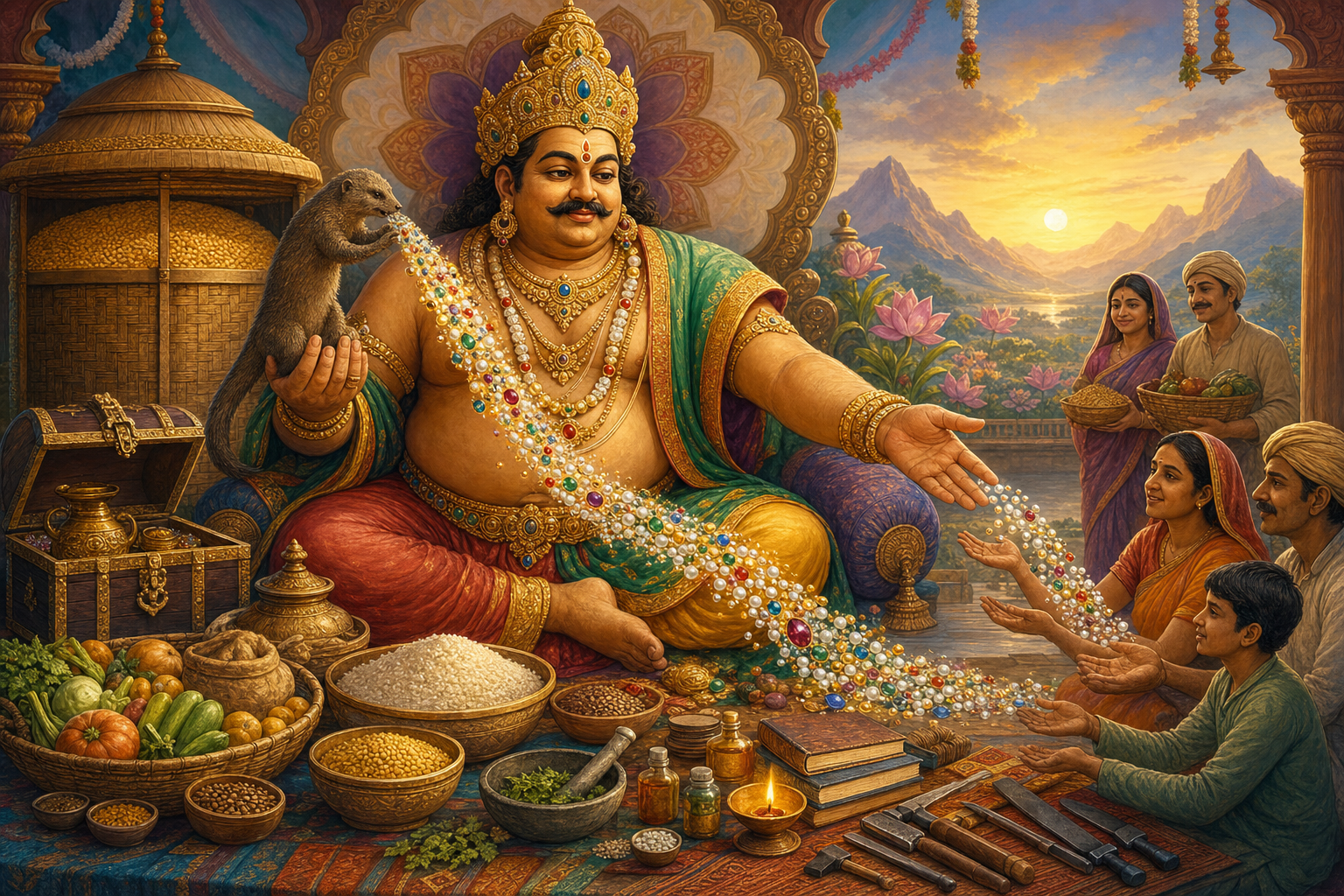
You want to prosper without becoming possessed by prosperity. Perhaps you are earning more, building a business, managing family assets, or deciding how much to keep and how much to give. The difficult question is not whether wealth is permitted. It is what makes your relationship with wealth dharmic.
Kubera’s mongoose offers a demanding answer. Earn through right conduct. Guard what has been entrusted to you. Know when protection has turned into grasping. Then make resources move toward nourishment, opportunity, culture, compassion, and the common good.
Read the whole image, not just the animal
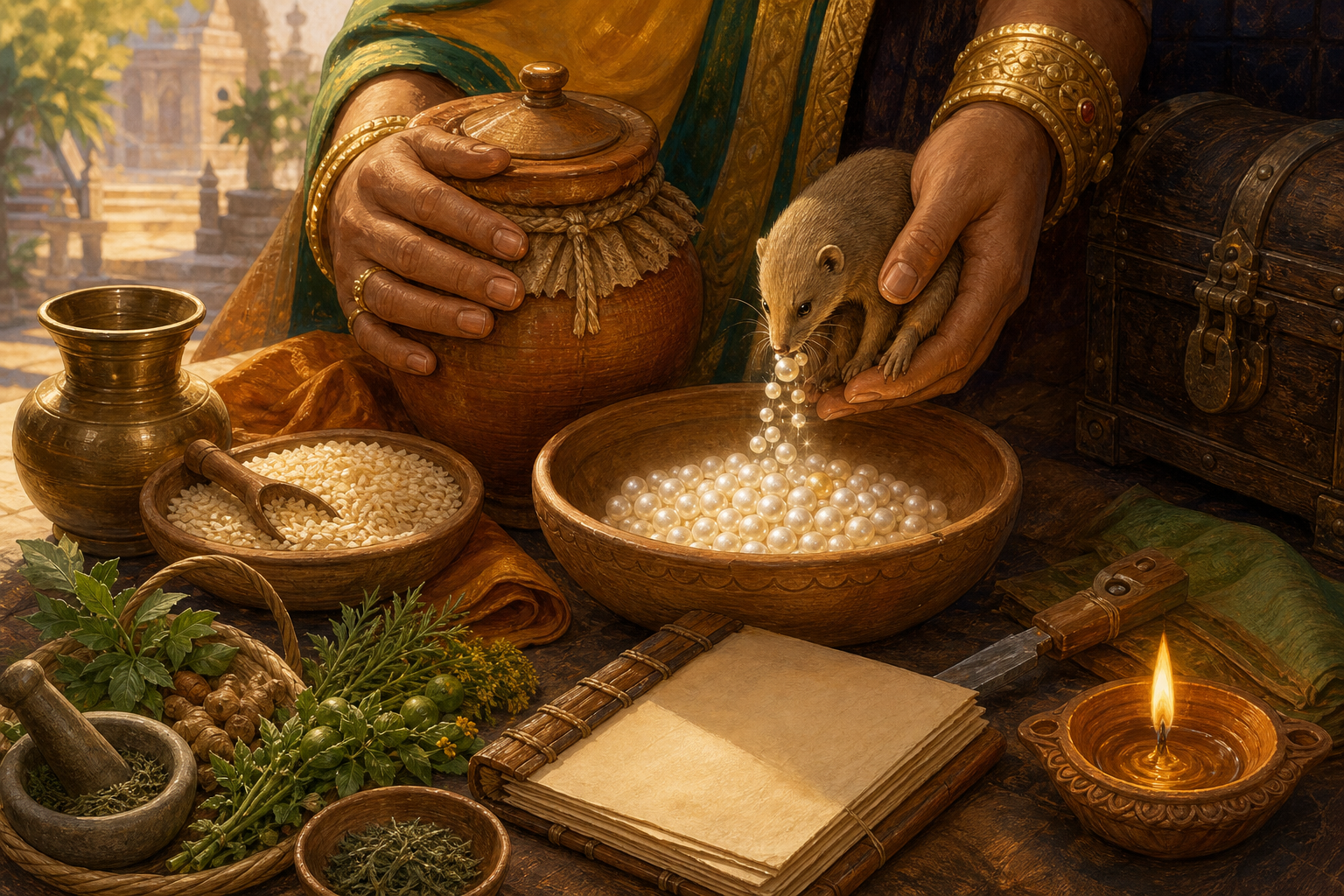
Kubera, also known as Vaiśravaṇa, is not simply a divine promise that more money will appear. He is a guardian: Lokapāla of the North, chief of the yakṣas, lord of treasures, and Dhanada, the giver of wealth. Those roles combine possession with responsibility. A guardian neither squanders what he holds nor mistakes custody for absolute ownership.
That distinction becomes visible when you read Kubera’s attributes together. The crown, treasure vessel, fruit, mace, and mongoose form a coherent ethical vocabulary rather than an assortment of prosperity charms:
- The crown and jewels indicate authority over artha, the material means required to sustain life, family, institutions, and worthy aims.
- The treasure pot or money bag represents the capacity to hold resources. Wealth needs competent custody before it can serve anyone reliably.
- The citron or pomegranate points toward fertility and auspicious fruition. A resource is judged partly by what it enables to grow.
- The mace represents order and protection. Promises, property, wages, reserves, and public resources all require vigilance.
- The mongoose reveals the intended direction of that power. What has been acquired and protected must eventually become benefit rather than dead accumulation.
Kubera is also associated with the nava-nidhi, or nine treasure-streams. Their lists vary, but the larger idea matters: treasure is not exhausted by coin. Productive capacity, fertility, stability, skill, stored provision, and auspicious opportunity can all belong to the field of abundance. In a modern household or institution, your own inventory might therefore include money, knowledge, tools, land, time, relationships, and access. That inventory is a practical application, not a claim that these are canonical translations of the nava-nidhi.
This is why artha belongs among the puruṣārthas alongside dharma, kāma, and mokṣa. Material capability is a legitimate human aim, but it does not authorize every way of becoming rich. Dharma governs the means, the manner of custody, and the uses to which prosperity is put.
When you encounter Kubera in a shrine, sculpture, or painting, resist isolating the mongoose as a lucky token. Ask what the entire composition is saying: What must be earned? What must be protected? What must bear fruit? What must be released?
The mongoose defeats hoarding, not the natural world

The mongoose is renowned in the subcontinent for confronting serpents. Indic symbolism gives that natural encounter another layer because nāgas are often guardians of subterranean jewels, fertility, vitality, and hidden power. Nāgas are therefore not reducible to villains, and Kubera’s companion should not be treated as a license for violent conquest or reckless extraction.
The more useful reading is inward. The serpent-like impulse coils around what it possesses and refuses to loosen. The mongoose supplies the fearlessness needed to master that impulse. Hidden wealth is not stolen merely to feed another appetite; possessiveness is transformed so that guarded value can be released for a dharmic purpose.
Buddhist and Himalayan images make the outward movement especially clear. As Vaiśravaṇa or Jambhala, the prosperity deity is frequently accompanied by a mongoose pouring jewels. The animal does not clutch the gems it has overcome. It sends them outward. The image turns generosity from a private sentiment into visible action.
Placement sharpens the lesson. A mongoose resting on Kubera’s lap appears trusted, calm, and integrated. Courage and generosity are no longer emergency performances; they have become part of the steward’s character. When the animal appears near his feet, the emphasis shifts toward practice on the ground: paying people when promised, keeping agreements, using credit humanely, guarding shared assets, and making good on commitments. Iconography is not a mathematical code, so these placements should be read as interpretive emphases rather than rigid definitions.
This symbolism also helps you distinguish a reserve from a hoard. Both may look like retained wealth, but their moral structures differ:
- A reserve has a named duty. It may protect dependants, meet a contractual obligation, sustain work through difficulty, repair essential tools, or support a planned undertaking.
- A reserve has a boundary or review condition. You know why it exists and what would permit it to be used.
- A hoard has no sufficient endpoint. Its accumulation continues because fear, status, or control keeps redefining every surplus as untouchable.
- Careless giving is not the answer to hoarding. Giving that abandons dependants, employees, debts, or other legitimate duties fails the guardian side of Kubera’s teaching.
Look at one pool of money or another resource you control. If you cannot name its duty, its limit, or the condition under which it will serve life, do not automatically call it prudent saving. It may be an undefined possession asking for a dharmic purpose.
Apply four tests before calling wealth dharmic
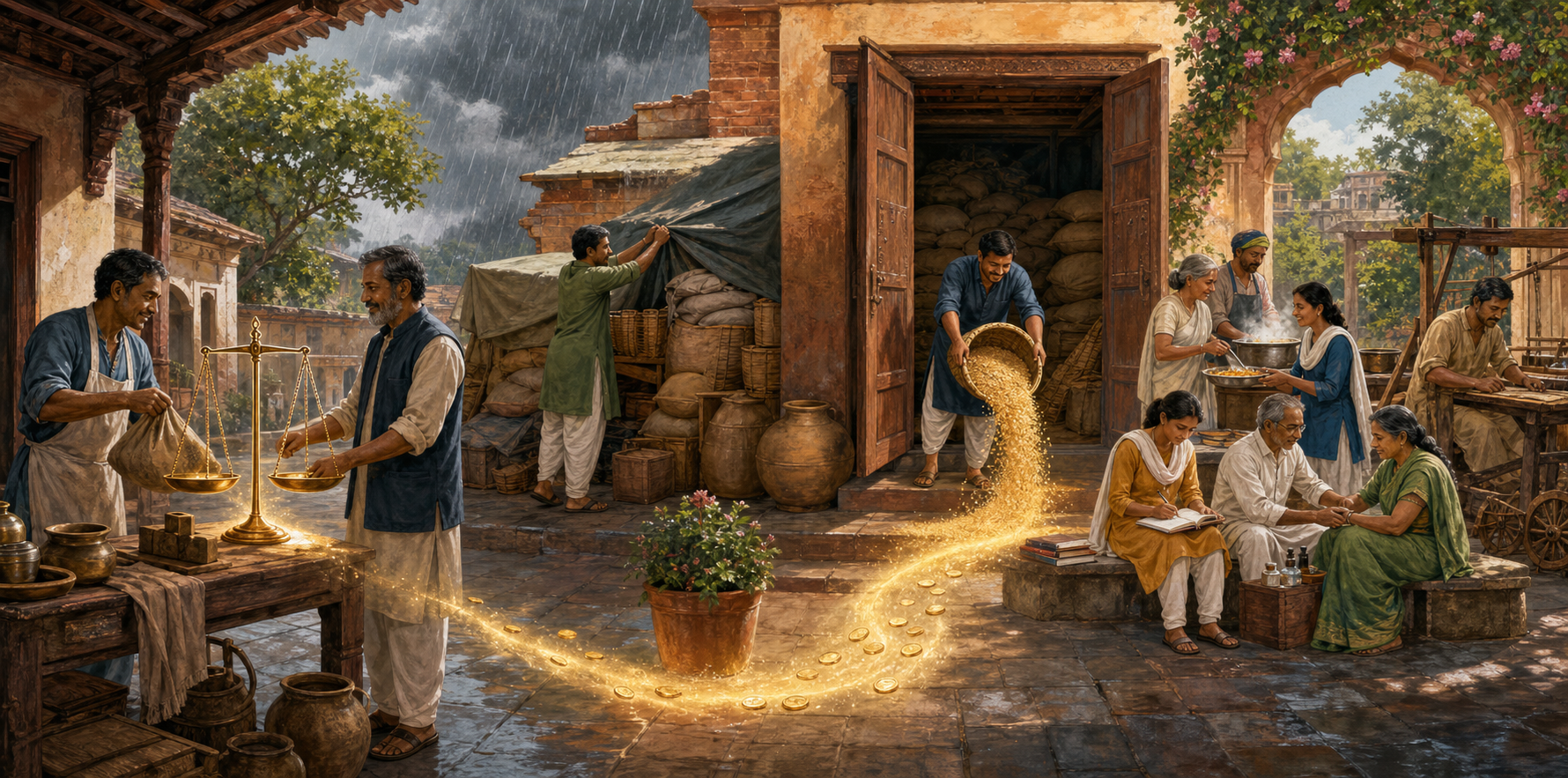
Kubera’s icon can become a usable audit. Move through four questions in order: origin, custody, sufficiency, and destination. Beginning with charity while ignoring how wealth was obtained produces a flattering but incomplete account.
- Was it earned without adharma? Examine the transaction beneath the income. Were promises honest? Were workers and counterparties treated fairly? Were wages and invoices paid when due? Were risks concealed or pushed onto someone with less power? Profit does not become righteous merely because some of it is later donated. The first offering is clean conduct in the act of earning.
- Are you guarding legitimate obligations? Before declaring money surplus, identify what has already been entrusted to it. Family support, fair compensation, debts, maintenance, contractual commitments, and the continuity of useful work may all have prior claims. Protection also means preventing leakage through neglect, corruption, vanity, or disordered accounting. Kubera’s mace belongs beside the jewel-bearing mongoose for a reason: generosity needs competent stewardship.
- Have you defined enough? Aparigraha, or non-hoarding, becomes practical only when accumulation has an intelligible limit. That limit will not be identical for every household, vocation, or institution. The useful discipline is to define the purpose of retained resources instead of allowing desire to expand silently with income. Ask what level serves a real duty and what portion now exists chiefly to enlarge status, control, or fear-based security.
- Where will the surplus fructify? Dāna is not disposal. Direct resources where they can sustain education, health, heritage, ecological care, relief, community capability, or another clear good. Money is only one form of giving. Expertise, tools, introductions, space, time, and patient attention may be the resource you are actually equipped to release.
Make a Kubera ledger beside the financial ledger
A balance sheet can tell you what you control without telling you whether that control is righteous. Add a short ethical ledger whenever you review household accounts, business books, a major purchase, or a pool of charitable funds. Record:
- Origin: how the resource was earned and which practice, if any, needs correction.
- Obligation: whose legitimate claim must be met before the resource is treated as surplus.
- Purpose: why retained wealth is being kept and what event would activate its use.
- Enough: the condition at which further accumulation stops serving the named purpose.
- Destination: where available surplus, skill, time, or access will be directed.
- Accountability: how you will know that the commitment was fulfilled rather than merely intended.
Do not use a symbolic exercise by itself to change trusts, taxes, employment arrangements, debts, or investments. Those decisions may create legal, financial, and human consequences. Carry the ethical conclusion into a discussion with the appropriately qualified legal, tax, accounting, or financial professional, and make sure generosity does not impair obligations you are already bound to meet.
Shared Dharmic direction does not erase real differences
The mongoose travels most visibly through Hindu, Buddhist, Himalayan, and some Jain iconographic settings. Sikh tradition does not depend on this image. Yet the ethical direction of righteous earning, freedom from greed, sharing, and service creates a meaningful conversation across the Dharmic family. The relationship is strongest when we state both the convergence and the difference.
| Tradition | Distinct emphasis | Question for your use of wealth |
|---|---|---|
| Hindu traditions | Artha is a legitimate puruṣārtha governed by dharma. Kubera holds, guards, and gives treasure. | Were the means righteous, the obligations protected, and the fruits directed toward flourishing? |
| Buddhist traditions | Vaiśravaṇa and Jambhala may carry the jewel-pouring mongoose, while dāna-pāramitā places giving at the beginning of the perfections. | What attachment must be loosened so that a useful resource can move toward the relief and awakening of beings? |
| Jain traditions | Yakṣa figures may bear a mongoose, while aparigraha and anukampā emphasize non-hoarding and compassion. | Does possession exceed its proper use, and can it be reduced or redirected without causing further harm? |
| Sikh tradition | The parallel is ethical rather than iconographic: kirat karni, seva, dasvandh, and langar join honest work with sharing and collective care. | Is your earning honest, and does a meaningful portion of its fruit enter disciplined service? |
This distinction matters whenever you teach the symbol or use it in an inter-Dharmic setting. Do not claim that every tradition tells the same story or employs the same deity. Say precisely what is shared: wealth is not condemned, greed is not sanctified, and resources gain ethical meaning through right acquisition, restrained possession, and service. Then name what remains particular: the Hindu framework of puruṣārthas, the Buddhist Jambhala image, Jain aparigraha, and Sikh disciplines of earning and seva.
That precision gives you a stronger common ethic than vague claims of sameness. It allows members of different traditions to cooperate on fair work, food, education, heritage, relief, and community resilience while remaining truthful about the paths from which their commitments arise.
A practical FAQ for households and institutions

Does Dharmic generosity require giving away every reserve?
No. Kubera is both guardian and giver. A resource assigned to a genuine duty is not necessarily a hoard. The test is whether you can name that duty, keep the amount proportionate to it, and release the resource when its purpose is fulfilled or no longer applies. Giving away funds needed for dependants, promised wages, debts, or essential continuity may simply transfer the cost of your generosity to someone else.
Can a company, temple, association, or public body use this ethic?
Yes, but institutional dāna begins before the donation line. Review how revenue is obtained, whether contracts are honored, whether wages and vendors are paid fairly and on time, whether shared assets are protected from leakage, and whether accumulated surplus has a declared social purpose. Philanthropy cannot cleanse an exploitative business model. Nor does an impressive charitable announcement excuse broken commitments inside the institution.
An institution can make the mongoose visible in governance by assigning responsibility for each promise: who verifies fair dealing, who protects reserves, who approves distribution, and who reports whether the intended beneficiaries actually received what was committed. Accountability is generosity made dependable.
How can Dhanteras or Lakṣmī-Kubera pūjā become more than a request for prosperity?
Dhanteras customs connect Lakṣmī-Kubera worship with enterprise, ledgers, grain stores, and auspicious beginnings. Pair the customary ritual with a written vow. Name one earning practice to keep clean, one obligation to protect, one unnecessary grasp to loosen, and one stream of surplus to place in service. If your family or guild keeps a coin, Kubera image, or yantra near the books, let it recall those commitments when the accounts are reviewed.
The next time money, opportunity, or influence enters your hands, pause before asking how much more it can produce for you. Give it a duty, a boundary, and a destination. That is how the mongoose moves from Kubera’s lap onto your ledger.
References
