
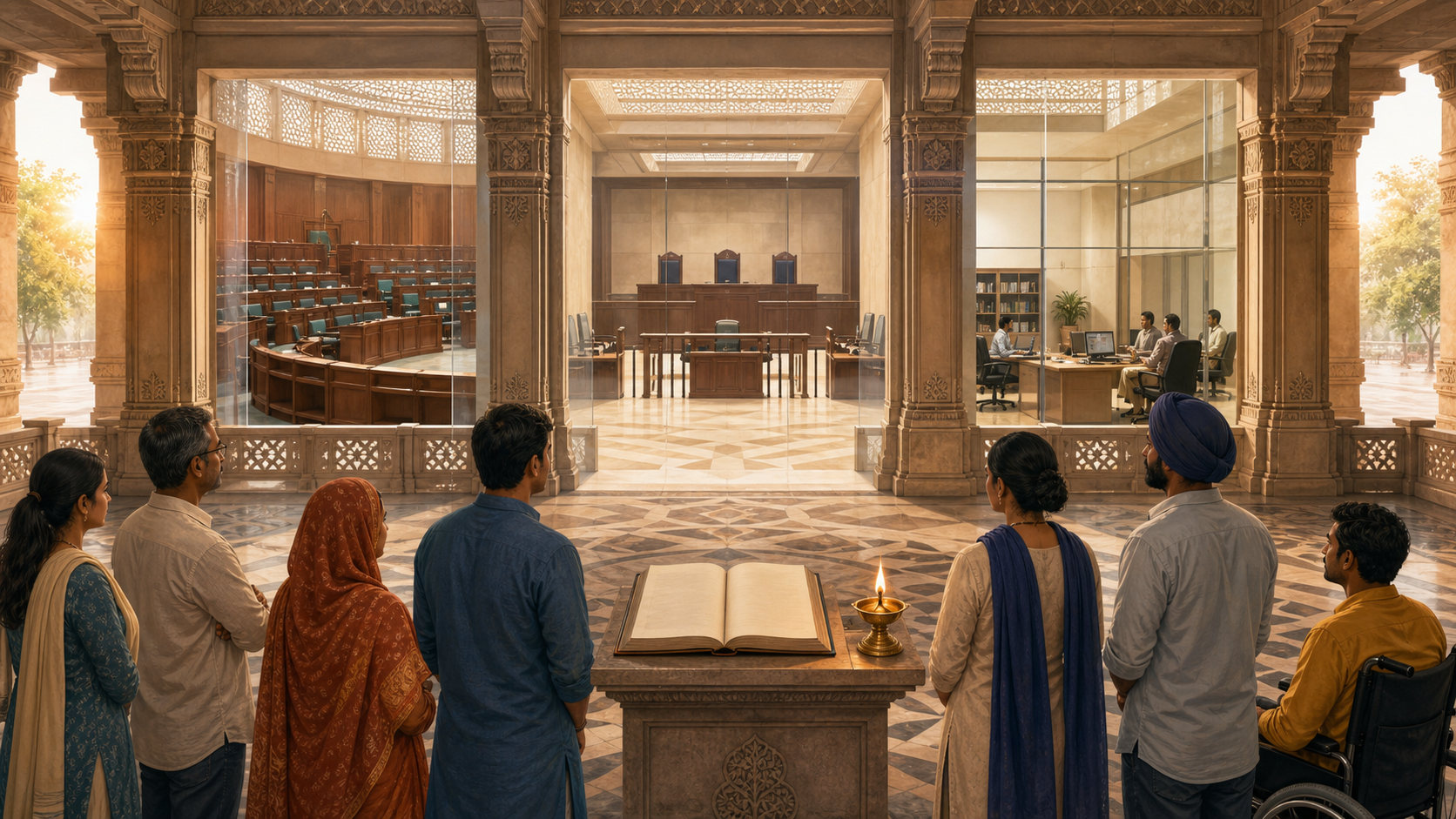
You may want Bharat’s public life to reflect Hindu civilizational values and still hesitate when someone calls for a constitutional Hindu Rashtra. That hesitation is useful. The decisive question is not whether a proposal sounds proudly Hindu, but what it would permit the state to do to an ordinary citizen.
A credible model must pass two tests at once. It must recover rajadharma as a discipline of truthful, restrained and welfare-oriented government. It must also preserve equal citizenship, freedom of conscience, due process and constitutional checks. If either side is missing, the result is not constitutional Hindu governance.
Begin with the distinction the slogan often hides
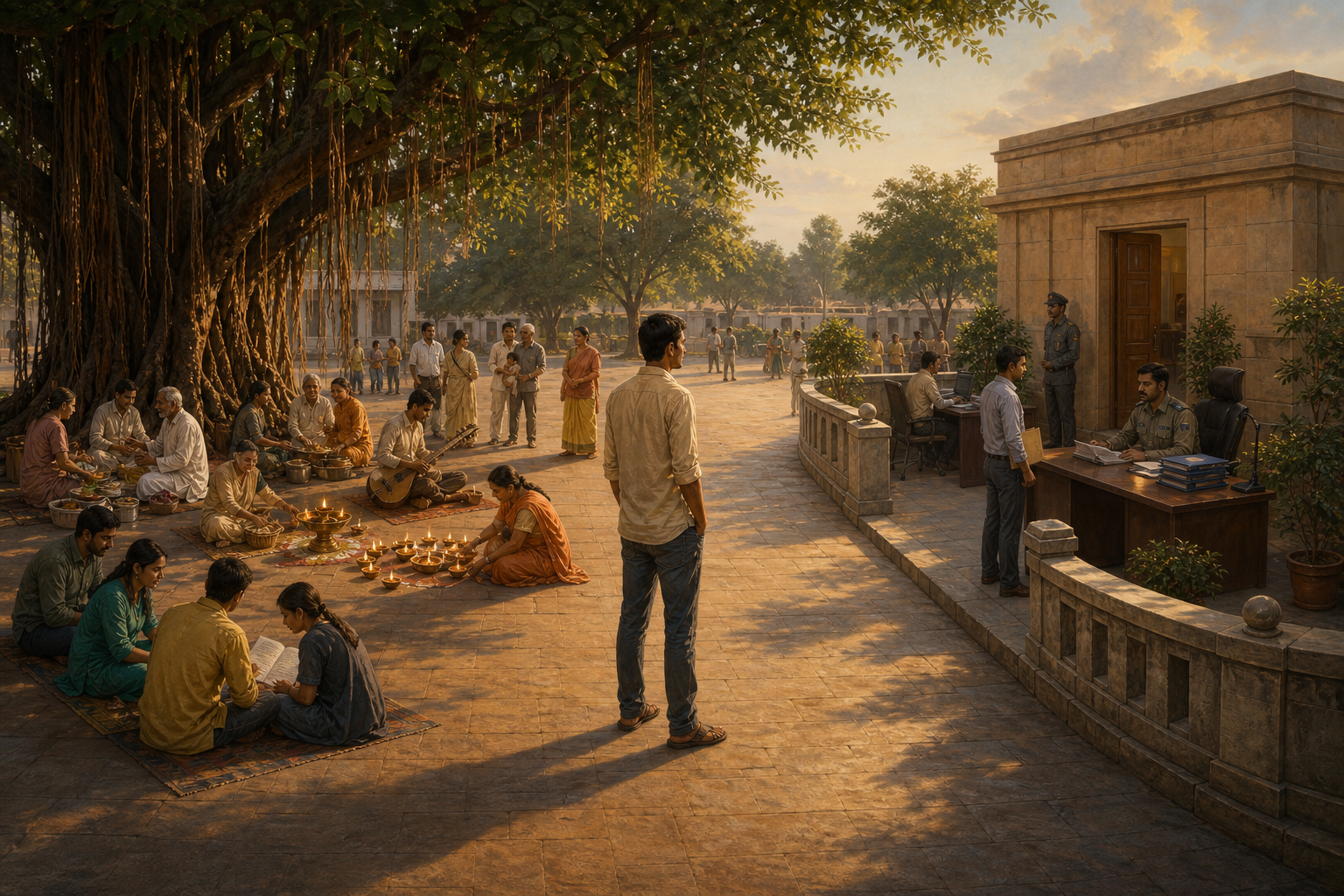
Rajadharma is not a licence for rulers to impose their private beliefs. It is the body of duties that binds political authority to dharma. The ruler must protect the vulnerable, hear counsel, administer proportionate justice, preserve social order and place public duty above personal advantage. Power is legitimate because it is answerable to an order higher than appetite, faction or electoral convenience.
Sri Rama embodies this ideal as Dharma Paripalana Moorthy, the guardian of dharma. The ethical architecture associated with Rama Rajya joins personal virtue, fair institutions and public wellbeing. Satya demands truthfulness. Daya requires compassion. Dama restrains the person who holds power. Dana directs resources toward legitimate public needs. Danda-niti makes law enforceable without turning punishment into vengeance.
That is different from a denominational state. A denominational state gives one religious identity superior legal standing or makes civic status depend upon confession. Rajadharma, properly understood, asks whether authority is being exercised justly. It does not require the state to decide the spiritual worth of its citizens.
- Civilizational recognition says that Bharat’s institutions may acknowledge the histories, concepts, festivals, sacred geographies and intellectual traditions that formed the country.
- Dharma-informed public reason applies values such as truth, duty, compassion, self-restraint, service and care for living beings to policy.
- Denominational supremacy gives one community greater civil rights, weaker legal duties or privileged access to state power because of religious identity.
The first two can be pursued within a plural constitutional order. The third cannot be reconciled with equal citizenship. Keeping these categories separate prevents a familiar political error: treating every expression of Hindu civilization as theocracy, or treating every proposal bearing a Hindu label as dharmic.
A civilizational framework should also recognize the wider dharmic family without erasing its internal distinctions. Buddhist ideals of the dhamma-raja emphasize generosity, moral conduct, honesty, gentleness, non-anger, non-violence and patience. Jain political ethics place authority within a horizon of ahimsa, self-mastery and careful stewardship. Sikh teachings join temporal responsibility to spiritual discipline through Miri-Piri, seva and the sant-sipahi ideal. These are distinct traditions, but each connects legitimate authority with restraint, service and protection. A state invoking dharma should make that shared moral inheritance visible while respecting the independence of every path.
Turn the ruler’s virtues into constitutional machinery

Personal goodness is valuable, but a modern republic cannot depend on finding a perfectly virtuous ruler. Rajadharma becomes politically serious only when its virtues are translated into institutions that continue working under an impatient minister, an unpopular government or a hostile majority.
Use these translations when you evaluate a government, party manifesto or constitutional proposal:
- Satya becomes accurate public records, reasons for official decisions, honest accounts, transparent procurement and correction of material falsehoods.
- Daya becomes timely protection for people exposed to violence, hunger, displacement, discrimination or administrative neglect. Compassion must produce an accessible remedy, not remain ceremonial language.
- Dama becomes conflict-of-interest rules, disclosure, recusal, independent review and limits on discretionary power. Self-restraint that exists only in a leader’s character disappears when the leader changes.
- Daniela becomes stewardship of public resources: balanced taxation, protection of producers, honest trade and expenditure directed toward genuine need rather than patronage. In this setting, generosity is not permission to spend without accountability.
- Danda-niti becomes published law, equal enforcement, proportionate sanctions, a fair hearing and a route of appeal. Force serves order only when it is constrained by purpose and procedure.
Rajadharma also rejects solitary rule. Ayodhya’s councils, ministers, sages and assemblies represent deliberation and counsel as parts of rightful authority. Their modern equivalents include legislatures that examine bills, committees that demand evidence, courts that review state action, auditors who follow public money and local bodies that hear the people affected by policy. Consultation is not decorative. It is one of the ways a ruler discovers facts that personal conviction cannot supply.
The traditional sequence of sama, dana, bheda and danda offers another institutional lesson. Conciliation comes before coercion; negotiated settlement and calibrated pressure are attempted before force. In foreign affairs, policing and communal conflict, ask whether the state documented its efforts to de-escalate, distinguished wrongdoers from uninvolved people and used no more force than the lawful objective required. A government that reaches for danda first may be strong in appearance while failing the discipline that gives strength moral legitimacy.
The difficult episode concerning Sita deserves equal candour. Traditional interpretations wrestle with the collision between public confidence, a ruler’s duty and grievous personal consequences. A constitutional state cannot settle such a collision through reputation or popular suspicion alone. Public confidence is protected by evidence, notice, a fair hearing and review. Whatever conclusion you reach about the epic episode, it should sharpen rather than weaken your insistence on due process in public life.
The Constitution sets a floor that dharma should strengthen
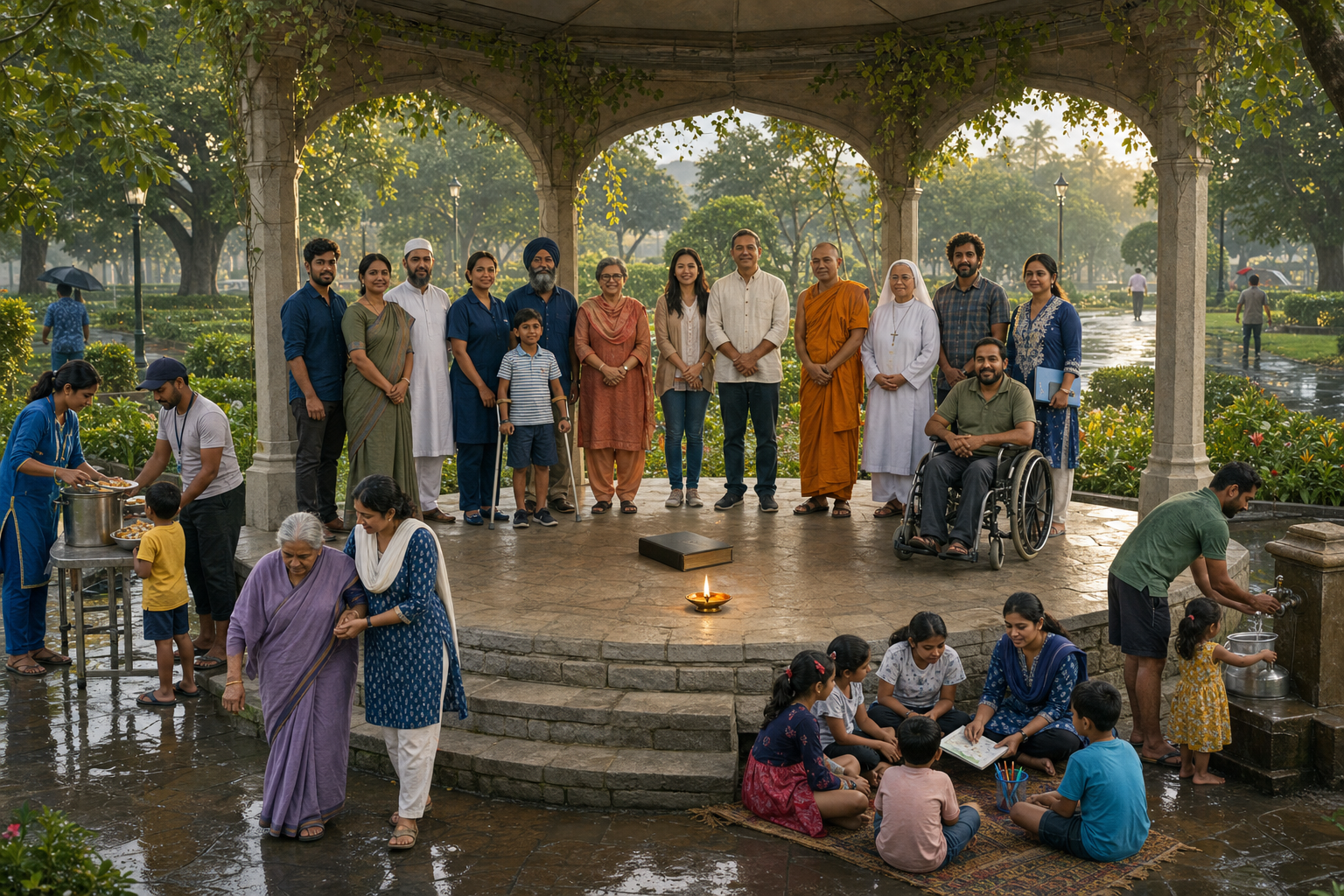
India’s Preamble describes the country as a sovereign, socialist, secular, democratic republic; socialist and secular were added by the 42nd Constitutional Amendment in 1976. Part III protects equality, liberty and religious freedom. Articles 14 and 15 address equality and non-discrimination, Article 19 protects specified freedoms, and Articles 25 through 28 protect conscience and religious practice while setting boundaries for state involvement in religion.
These provisions are not inconvenient obstacles to be cleared before civilizational renewal can begin. They are constitutional forms of a central rajadharmic obligation: the person exercising public power must not use it arbitrarily. A Hindu majority confident in its civilization does not need unequal citizenship to preserve that civilization.
The basic structure doctrine, associated with Kesavananda Bharati in 1973 and developed in later rulings, places a further limit on amendment power. Secularism is among the features protected within that framework. Article 368 supplies the formal amendment route, requiring special majorities in both Houses of Parliament and, for specified subjects, ratification by at least half of the state legislatures. Yet compliance with the voting procedure does not by itself answer the basic-structure question. An amendment that effectively destroys equality, secularism or the rule of law can still be constitutionally impermissible.
This produces three different pathways that should never be blurred:
- An interpretive or policy pathway uses dharmic concepts as public ethical reasons while leaving every citizen’s legal status unchanged. Examples include transparent government, heritage conservation, environmental stewardship and service to vulnerable communities.
- A statutory pathway gives civilizational recognition a defined legal form. Such a law still remains subject to Fundamental Rights, judicial review and non-discrimination.
- A constitutional-amendment pathway changes constitutional text through Article 368. It therefore raises the highest questions of drafting, federal consent and basic-structure compatibility. A slogan is not a substitute for a proposed clause and a legal analysis of its effects.
Part IV offers a more immediate bridge between dharmic ethics and public action. The Directive Principles address social justice, education, public health, environmental stewardship and humane treatment of living beings, including through Articles 39, 41 through 47 and 48A. Advancing those responsibilities can make governance more dharmic without assigning superior rights to a religious category.
Secular government need not require civilizational amnesia. It does require a boundary: cultural recognition cannot become a hierarchy of citizenship. If a proposal’s advocates cannot explain where that boundary lies, the proposal is not ready for constitutional support.
Apply a six-question test before you support a proposal

Do not evaluate constitutional Hindu governance by the warmth of its vocabulary. Ask for the actual text, the institution that will administer it, the remedy available after abuse and the outcome by which success will be measured. Then apply these six questions.
- Does every citizen retain the same civil status? The proposal should not alter access to public office, public services, police protection, courts, education or political participation because a person is Hindu, Buddhist, Jain, Sikh, Muslim, Christian, Jewish, atheist or follows another path. If identity changes legal worth, reject the proposal.
- Is freedom of conscience intact? Check the proposal against Articles 25 through 28. No one should be compelled to profess a belief, join worship or accept religious instruction where the Constitution bars its imposition. Cultural education should teach history and ideas accurately; it should not become a test of personal faith.
- Are institutions governed symmetrically? Rules for religious endowments, heritage funding, land use, security and administrative oversight need public criteria that can be applied consistently. Where different treatment is claimed to be necessary, demand a stated constitutional reason, published standards and an avenue of review.
- Does danda remain proportionate and reviewable? A lawful objective does not excuse collective punishment, selective policing, punishment without a hearing or unlimited executive discretion. Look for notice, evidence, recorded reasons, an appeal and consequences for officials who abuse power.
- Are welfare claims measurable? A dharmic label should produce observable public benefit. Useful measures include equal access to services, the condition and accessibility of heritage sites, the incidence and resolution time of communal disputes, the quality of civic education and the delivery of protection to vulnerable people. Without reporting, welfare language can conceal patronage or neglect.
- Can the system withstand a ruler you distrust? Imagine every new power in the hands of a hostile party. If the proposal seems safe only because its present advocates appear virtuous, it lacks institutional dama. Require judicial oversight, legislative scrutiny, transparent administration and remedies that remain available after political control changes.
This test separates three kinds of proposal. Support a measure that deepens public virtue while strengthening rights and accountability. Revise a symbolic measure whose boundaries or administrative effects are vague but repairable. Oppose a measure that creates a civic hierarchy, removes effective remedies or gives officials religious discretion that cannot be reviewed.
Several practical reforms can pass the test when designed with neutral criteria: conserving sacred and historical sites; teaching Bharat’s plural dharmic heritage alongside constitutional rights and duties; reviewing whether endowment administration treats traditions fairly; supporting community-led seva; protecting living beings and the natural world; and building local mediation mechanisms for communal disputes. The key is not merely what a programme honours. It is how eligibility, funding, enforcement and appeal are structured.
Minority protection is not a concession external to this vision. It is where the claim of rajadharma is tested most severely. A government displays restraint when it protects a disliked speaker, fairness when it hears an unpopular claimant and courage when it defends a vulnerable community against its own supporters. Constitutional safeguards therefore make a dharma-informed state more credible, not less Hindu.
Key takeaways
- Rajadharma governs the conduct of power; it does not grant rulers unchecked religious authority.
- A constitutional Hindu model must distinguish civilizational recognition from denominational privilege.
- Satya, daya, dama and danda-niti become politically useful only when translated into transparency, protection, institutional restraint, due process and review.
- Articles 14, 15 and 25 through 28, together with the basic structure doctrine, are essential tests for any proposal affecting religion and citizenship.
- The safest test for a new power is whether you would accept it in the hands of a government you oppose.
The next time you are asked to endorse a declaration, petition or manifesto for constitutional Hindu governance, request a one-page explanation of its legal effects. Ask which rights remain unchanged, who receives new authority, how that authority is reviewed and what remedy a citizen has when it is misused. Refusal to answer those questions is itself an answer.
Begin with reforms that make the state more truthful, more restrained, more protective and more accountable. If civilizational language cannot survive that scrutiny, it is only branding. If it can, it offers something more durable: a constitutional practice in which dharma limits power before power invokes dharma.
References
- DharmaRenaissance Blog – Dharma Paripalana Moorthy: Sri Rama’s Timeless Blueprint of Rajadharma in Rama Rajya
- DharmaRenaissance Blog – Virat Hindu Sammelan, Pune: A Bold Call for a Constitutional Hindu Rashtra – And Its Pathways