

You may already have a hall, willing volunteers, families asking for classes, and enough stories to fill a year. The harder question is whether your Dharmashikshan program will form compassionate judgment or merely give learners more religious vocabulary.
A useful community class teaches people to notice suffering, understand its causes, choose a response consistent with Dharma, and serve without seeking status. The framework below will help you turn dayā, karuṇā, ahiṁsā, and seva into a teachable practice while preserving the integrity of Hindu, Buddhist, Jain, and Sikh paths.
Teach a shared discipline without blending distinct paths
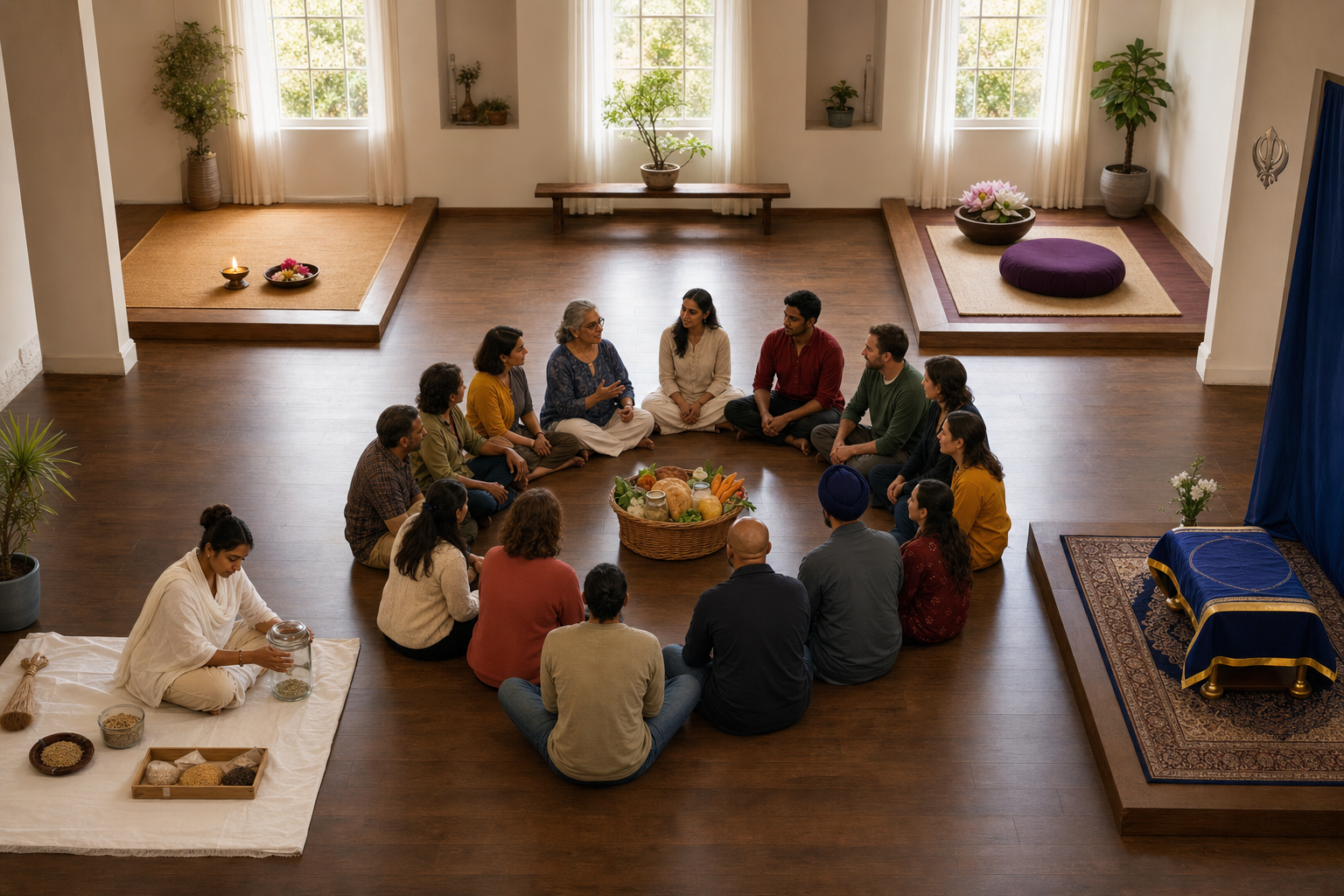
Begin by correcting a common mistake: compassion is not simply feeling sorry for someone. Feeling matters, but it is only the first movement. Durable Dharmic compassion joins sensitivity to suffering, an accurate understanding of the situation, and a deliberate effort to reduce harm. If any part is missing, the result becomes unstable.
- Feeling without discernment can become pity, indulgence, or impulsive interference.
- Analysis without fellow-feeling can become detached and severe.
- Good intentions without action leave suffering untouched.
- Action without reflection can reproduce the very harm it was meant to relieve.
This gives you a clear teaching objective. A learner should leave class able to answer three questions: What suffering or vulnerability is present? What is causing or sustaining it? What responsible action can I take without creating greater harm?
The four traditions give those questions distinct depth. Keep those distinctions visible. Unity does not require you to claim that every tradition means the same thing.
- Hindu traditions: Teach dayā within Dharma rather than as an isolated emotion. Bhagavad Gita 12.13 commends the devotee who is friendly and compassionate toward all beings, while Patañjali places ahiṁsā at the foundation of yogic restraint. Annadāna, mentoring, ecological care, japa, vrata, and meditation show how inward discipline and outward responsibility can reinforce one another.
- Buddhist traditions: Present karuṇā with prajñā. Karuṇā belongs with mettā, muditā, and upekkhā among the brahmavihāras, while non-cruel intention and the Bodhisattva ideal direct cultivation toward the relief of dukkha. Upāya, or skillful means, reminds learners that a helpful response must fit the conditions rather than follow a rigid script.
- Jain traditions: Connect jīvadayā to vows, ahiṁsā, aparigraha, and careful attention to all jīvas. Anekāntavāda trains humility by showing that one viewpoint rarely exhausts a complex situation. The practical question becomes not whether a choice is perfectly free of entanglement, but which available path minimizes violence and possessiveness.
- Sikh tradition: Show how dayā becomes nishkām seva, disciplined service without expectation of reward. Langar makes equality tangible through a shared meal, while Sarbat da bhala widens concern beyond one congregation or identity group. Compassion becomes a communal capacity to organize, feed, accompany, and protect.
Avoid teaching these as four interchangeable labels for niceness. Ask what disciplines each path uses, what excess it guards against, and what form of service it produces. Similar ethical actions can arise through distinct scriptures, vows, contemplative methods, and institutions. That is a stronger basis for inter-Dharmic respect than pretending the differences are unimportant.
Key takeaways
- Teach compassion as felt concern, clear perception, and responsible action.
- Keep Hindu, Buddhist, Jain, and Sikh terms attached to their own disciplines and contexts.
- End every learning cycle with a small, observable practice rather than a vague promise to be kinder.
- Pair dayā or karuṇā with wisdom, boundaries, and the least-harm path.
- Judge the class by conduct in the community, not by how many teachings learners can repeat.
Build every lesson around four movements

A community curriculum can become overloaded quickly. Facilitators collect verses, stories, festival explanations, biographies, and moral slogans, then struggle to connect them. A simpler method is to organize each lesson around four repeatable movements: pause, perceive, prioritize, and participate.
- Pause: Stabilize attention before judging or reacting. Depending on the community, this might involve quiet breathing, japa, mettā-bhāvanā, kīrtan, Ardas, pratikramaṇa, or silent reflection. Choose a practice appropriate to the learners and the tradition being taught. Do not turn inter-Dharmic appreciation into compulsory participation in another community’s worship.
- Perceive: Identify who or what is being harmed, what conditions produced the difficulty, and which assumptions may be distorting the response. This is where Buddhist attention to causes and conditions, Jain many-sidedness, Hindu viveka, and the Sikh orientation toward dignified service can sharpen the discussion.
- Prioritize: Compare possible responses. Look for the path that protects the vulnerable, reduces avoidable harm, respects agency, and can be sustained. A dramatic gesture is not automatically the most compassionate choice.
- Participate: Assign a real action, a responsible person or group, and a way to reflect afterward. Seva completes the lesson by moving compassion from aspiration into conduct.
Use the same sequence for scripture, stories, and contemporary cases. Suppose a festival produces discarded food and packaging near a local waterway. Learners first pause instead of blaming visitors. They then perceive the connected concerns: waste, animal welfare, water, volunteer capacity, and the dignity of workers who will handle the cleanup. They prioritize changes that prevent waste as well as remove it. Finally, they participate by coordinating with the host committee, improving collection points, reducing unnecessary materials, and joining a supervised cleanup.
The lesson should not end when the cleanup ends. Ask learners what harm was prevented, what remained unresolved, whose viewpoint was initially missed, and what should change before the next event. Reflection turns an isolated service activity into ethical formation.
Story-based learning works best when the facilitator resists supplying the moral too early. Let learners examine a decision, name competing duties, and defend a least-harm response. Dialogue reveals whether they can reason with a principle; recitation alone reveals only whether they remember its wording.
You can use a consistent lesson record without creating an administrative burden. Note the ethical principle, the tradition-specific anchor, the case discussed, the action chosen, and the reflection question to be revisited. That record helps another facilitator reproduce the class while leaving room for local language, age, and cultural context.
Let seva test whether the teaching has taken root
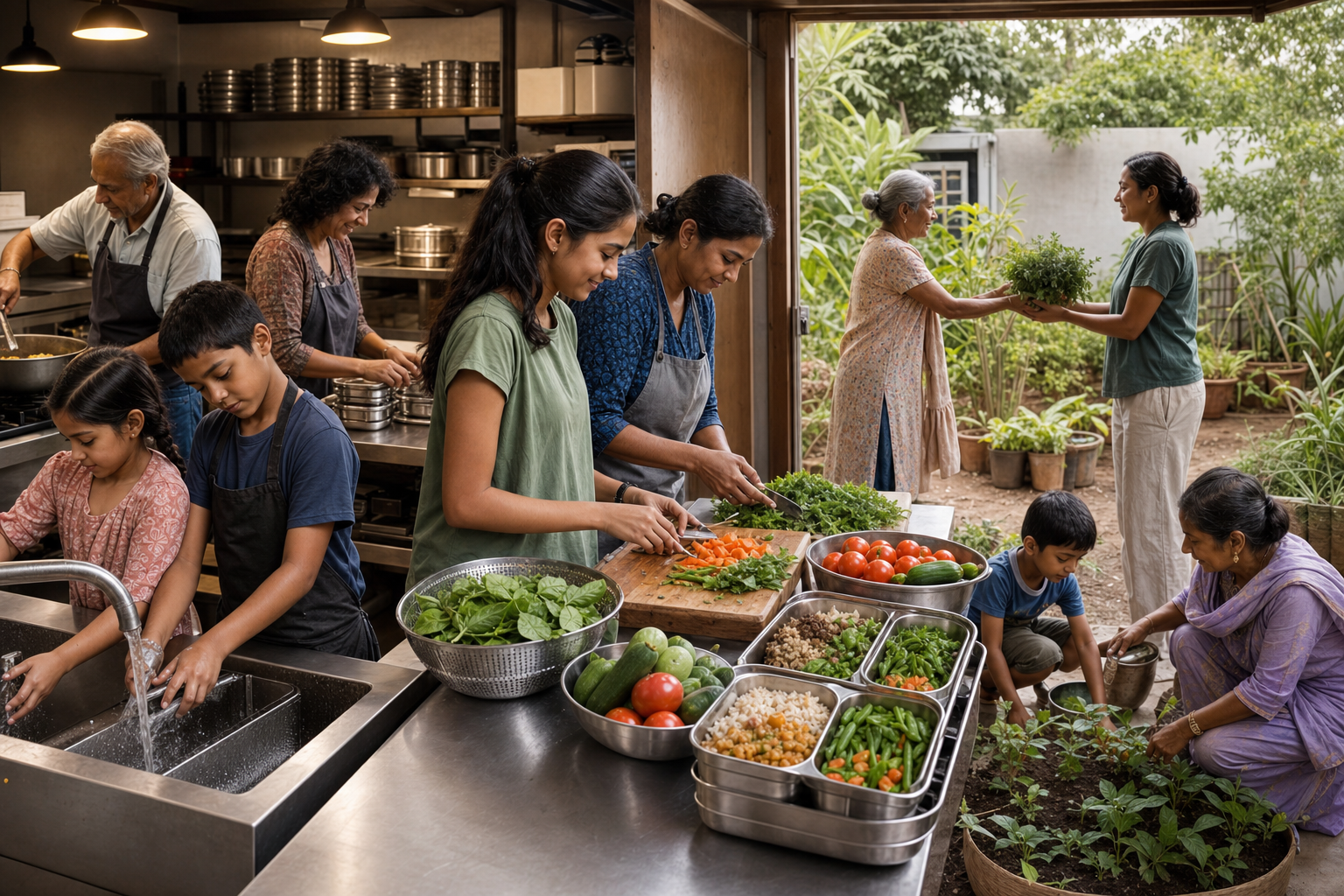
Service-learning is not an optional reward after the serious teaching. It is where learners discover whether they can carry a principle into relationships, logistics, inconvenience, and disagreement. Annadāna, langar, animal care, mentoring, disaster relief, and environmental stewardship all demonstrate that compassion becomes socially reliable when communities give it a recurring form.
Choose a project by applying five tests.
- The need is real and local: Speak with the people already responsible for the setting. Do not design help around what will look impressive to volunteers.
- The response protects dignity: People receiving food, tutoring, transport, or other assistance should not become props for publicity or objects of condescension.
- The action reflects the lesson: A class on aparigraha might examine consumption and waste. A lesson on langar might lead to inclusive food service. A discussion of jīvadayā might lead to careful support for animal welfare. The link between principle and action should be explicit.
- The burden is sustainable: A modest commitment that can be repeated is better than an ambitious event that exhausts volunteers and disappears.
- Reflection is built in: Learners should examine consequences, unintended harms, neglected viewpoints, and the next responsible step.
Do not confuse activity with formation. Meals distributed, sessions held, and service tasks completed are outputs. They tell you that the program operated. Outcomes concern what changed in judgment and conduct: whether learners recognize ethical complexity, cooperate across differences, keep commitments, and apply ahiṁsā or seva without being prompted.
| What to track | What it helps you notice | Lightweight method |
|---|---|---|
| Session regularity | Whether the program is dependable | A simple class log |
| Learner retention | Whether families find the format usable and trustworthy | Attendance patterns, reviewed without public shaming |
| Completed seva tasks | Whether teaching reaches action | A brief project record |
| Cooperative behavior | Whether learners work across differences | Facilitator observations and community feedback |
| Ethical reasoning | Whether learners can perceive causes, duties, and possible harms | The same anonymous reflective prompt at the beginning and end of the pilot |
Wise compassion also needs boundaries. Karuṇā accompanied by prajñā, dayā governed by Dharma, Jain vows that minimize violence, and seva guided by Gurmat all resist the idea that kindness means granting every request. Sometimes care requires refusing an unsafe demand, stopping exploitation, or protecting someone vulnerable. Firmness can serve compassion when it is proportionate, disciplined, and directed toward the least harmful workable outcome.
This matters especially in programs involving children. Put child-protection expectations, a grievance route, supervision responsibilities, and data-privacy practices in place before the first service activity. Do not publish a participant’s image, hardship, or personal story merely because it helps promote the program. Compassion that disregards consent and safeguarding contradicts its own purpose.
Run a 90-day pilot that another community can copy
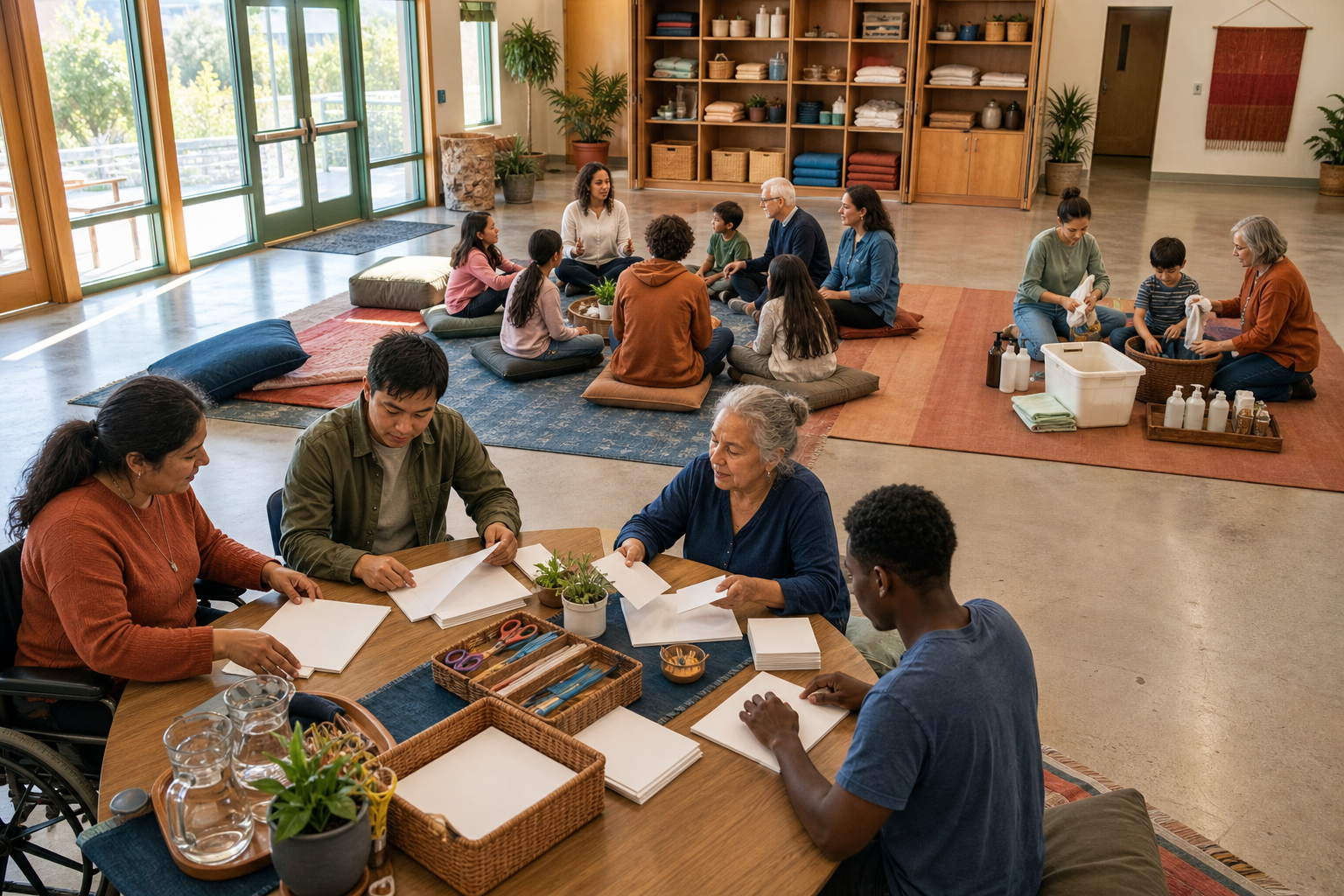
Expansion should begin with a small, repeatable pilot rather than a public promise to reach every nearby community. A 90-day hub-and-spoke approach gives facilitators enough structure to test weekly classes, local partnerships, service-learning, and feedback before adding more locations.
Before the pilot
- Name the learner outcome: Write one sentence describing what participants should be able to notice, decide, or do. Avoid outcomes such as knowing our culture, which cannot guide a lesson or be observed.
- Select a manageable cluster: Begin where a dependable local host, appropriate meeting space, and facilitator are already available. Proximity makes peer support and troubleshooting easier.
- Prepare a starter kit: Include a facilitator guide, selected readings or stories, discussion prompts, the pause-perceive-prioritize-participate sequence, seva templates, a lesson record, and reflective prompts.
- Define roles: Identify who coordinates the venue, communicates with families, facilitates lessons, oversees safeguarding, maintains records, supports the seva project, and receives grievances.
- Train for facilitation, not only content: Volunteers need practice with open questions, inclusive classroom norms, conflict-sensitive conversation, safeguarding, and simple observation. Subject knowledge cannot compensate for a classroom in which learners are afraid to disagree.
- Set the ethical boundary: State that the program is non-coercive and non-partisan. Inter-Dharmic education must not become a vehicle for humiliating another path, recruiting for a faction, or pressuring learners into ritual participation.
Local partnership is practical infrastructure, not ceremonial endorsement. Temple committees, school management committees, women’s self-help groups, youth clubs, and panchayat representatives can help with spaces, calendars, volunteers, family communication, and knowledge of local needs. Give each partner a defined responsibility so that goodwill does not dissolve into confusion.
During the pilot
- Hold classes on a predictable weekly schedule. Reliability allows families to plan and tells learners that the commitment is real.
- Use the local language and examples learners recognize. Translation is not a secondary convenience when the aim is moral reasoning rather than memorized terminology.
- Invite family engagement without making attendance depend on a parent’s religious knowledge. Explain the lesson aim, the service commitment, and any safeguarding arrangements plainly.
- Align the calendar with festivals, school demands, harvest cycles, and other local realities. A schedule that ignores community life will produce avoidable absences and may wrongly label them as lack of commitment.
- Hold monthly peer clinics for facilitators. Review one lesson that worked, one difficulty, one safeguarding or inclusion concern, and one adjustment to try before the next clinic.
- Use peer observation as support rather than inspection. The observer should look for learner participation, respect across viewpoints, clarity of the ethical question, and a credible link between reflection and seva.
- Complete small service commitments during the learning cycle. Do not postpone all action until a large closing event.
Keep the operating logic visible: trained volunteers, suitable material, and community space are inputs; weekly classes, dialogues, reflection, and seva are activities; attendance and completed tasks are outputs; ethical reasoning, cooperation, and inter-Dharmic understanding are outcomes. This lightweight logic model helps you diagnose the right problem. Poor attendance may reflect an unsuitable schedule rather than weak teaching. Completed classes with no change in conduct may indicate that the lessons never moved beyond explanation.
At the end of the pilot
Review evidence before discussing expansion. Compare the opening and closing reflective prompts. Examine regularity, retention, completed service tasks, facilitator observations, grievances, and community feedback. Ask why learners missed sessions or withdrew, but do not turn the inquiry into pressure on families.
Continue only the parts that can be explained, taught, and repeated. Revise material that depended on one unusually skilled speaker. Remove activities that created safeguarding problems, concealed costs, volunteer exhaustion, or pressure to conform. A crowded launch is not proof of a durable program; predictable delivery and observable formation are better grounds for growth.
Before your next planning meeting, write one lesson outcome and one local act of seva that could make it visible. Then assign the pause, perceive, prioritize, and participate questions. That single page is enough to reveal whether you are building a class about compassion or a community capable of practicing it.
References
- SikhNet — The Lantern of Dayā: Uniting Dharmic Traditions through Compassion, Ahimsa, and Seva
- Hindu Jagruti Samiti — Empowering Dharmashikshan: HJS Jalgaon Conference Spurs Village Expansion with Actionable Plans