
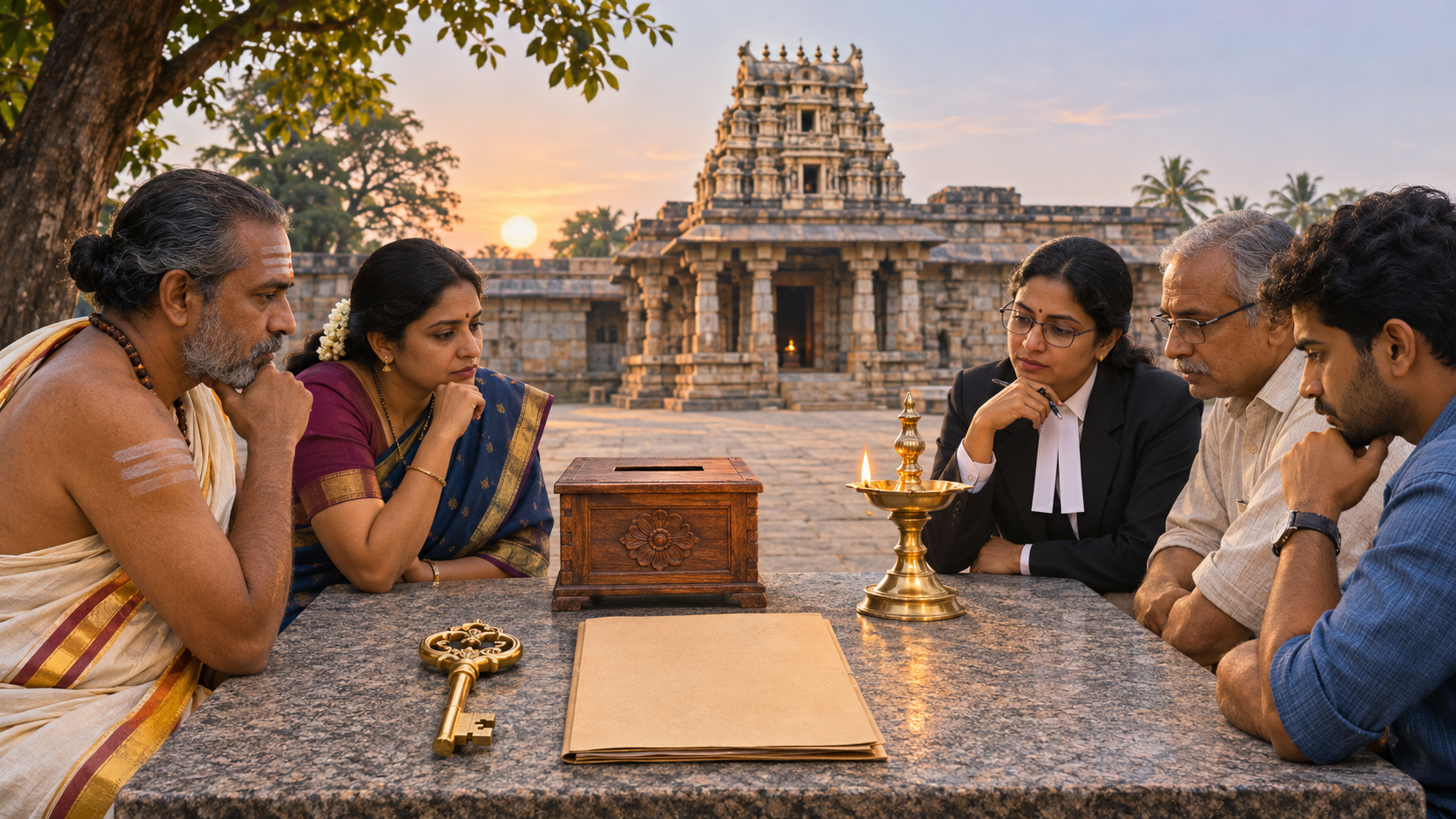
You may support freedom for Hindu temples and still be unsure what, exactly, the Karnataka campaign expects you to endorse. That uncertainty is useful. Temple autonomy can be a serious dharmic cause, but liberation has to mean more than replacing one set of administrators with another.
The practical test is simple: identify the institution that would receive authority, the rules it would follow, the people to whom it would answer, and the lawful route by which control would change. The same discipline must be applied to the call for Hindu Rashtra. A civilizational aspiration becomes a political programme only when its meaning, methods and safeguards are stated clearly.
What was placed before Karnataka’s Hindu public
At a Hindu convention in Karnataka, speakers called for a national movement to free temples from government control and also advanced the goal of Hindu Rashtra. Ramesh Shinde of Hindu Janajagruti Samiti alleged that governments neglect temple development even though temples generate substantial revenue.
That allegation identifies a legitimate line of inquiry, but it does not supply the accounts needed to prove the case for any particular temple. Substantial revenue is not the same as disposable surplus, and revenue alone does not reveal whether money was retained, transferred, restricted by donors, spent on worship, used for staff and maintenance, or reserved for future work.
If you want to evaluate the claim responsibly, ask for temple-by-temple records rather than a statewide total or a rhetorical headline. The useful fields are gross receipts, operating expenditure, capital expenditure, transfers in or out, the legal basis for each transfer, maintenance backlogs, restricted donations and the period covered. You should also ask whether the alleged neglect concerns ritual needs, structural repairs, pilgrim facilities, staff conditions, heritage conservation or all of them. Each problem requires a different remedy.
Key takeaways
- Support for temple autonomy does not require automatic endorsement of an undefined constitutional or political programme.
- Temple liberation should mean transfer to a specified, accountable and dharmically competent governance system, not the absence of governance.
- Claims about revenue and neglect should be tested against individual temple accounts, expenditure duties, asset conditions and donor restrictions.
- Hindu Rashtra must be defined in terms of concrete outcomes, lawful methods, institutional changes and safeguards before you can judge it as policy.
Temple freedom and Hindu Rashtra must be judged separately

Temple autonomy is an institutional question. It concerns who protects the deity-centred purpose of a temple, preserves its sampradaya, appoints or supervises administrators, manages land and donations, maintains the premises, and accounts for every rupee entrusted to the institution.
Hindu Rashtra is a much broader political and civilizational proposition. Until its advocates define the term, you cannot know whether they mean cultural renewal, equal treatment of Hindu institutions, a particular set of policy reforms, or constitutional redesign. Those possibilities are not interchangeable, and a person may support one without supporting all of them.
The appearance of both demands at one convention does not turn them into a single policy. Freeing a temple does not by itself establish Hindu Rashtra, and invoking Hindu Rashtra does not tell anyone how a temple board should be selected, how its accounts should be audited or how ritual authority should be protected.
Use three questions whenever organisers join the two causes:
- Can the temple reform be stated independently? If the proposal is sound, organisers should be able to describe its legal mechanism, governance structure and protections without relying on a larger slogan.
- What does the wider programme add? Ask which specific obstacle requires the Hindu Rashtra campaign and why ordinary legislation, administrative reform, public consultation or lawful adjudication would not address it.
- What are supporters authorising? A petition for audited temple autonomy is not the same mandate as support for an unspecified change to the political order. Campaign materials should not blur that distinction.
This separation strengthens rather than weakens a pro-Hindu case. It allows devotees to build agreement around a workable temple reform even when they differ over a larger political vision. It also prevents legitimate concern for temples from being used as a blank cheque for proposals that have not been explained.
A temple liberation plan needs a governance charter
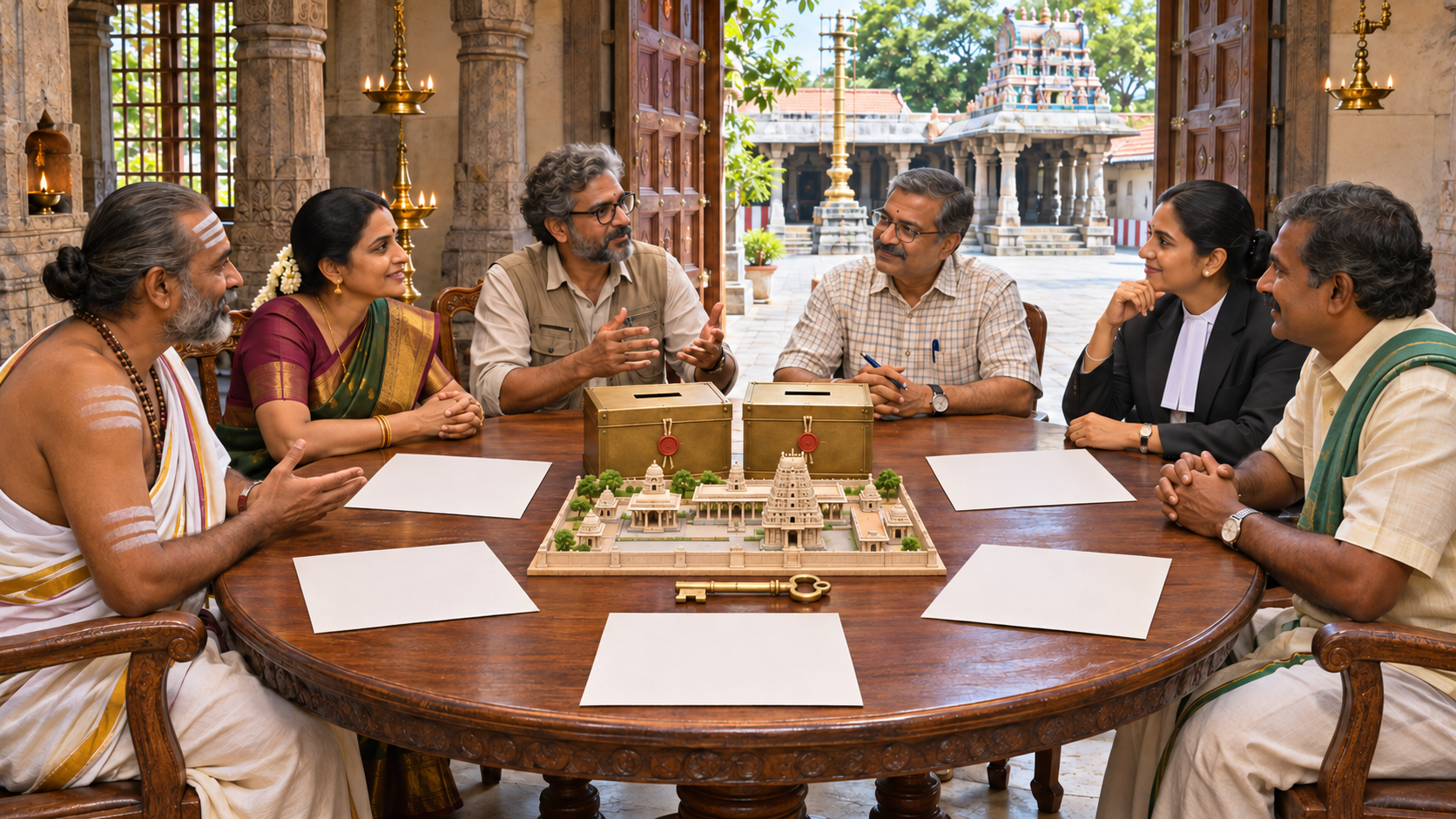
Liberation is a transfer of responsibility. Before you support that transfer, insist on a model governance charter that answers the following questions in writing:
- Sacred purpose: Which agama, sampradaya, established usage or temple-specific tradition governs worship? Who has authority over rituals, festivals and changes to religious practice?
- Custodianship: Which legal body will hold and administer the temple’s property? Is it a temple-specific trust, a local board, a denominational body or another institution?
- Trustee selection: Who appoints trustees, what qualifications are required, how long may they serve, and what disqualifies them? The rules should address conflicts of interest, political appointments, family capture and removal for misconduct.
- Financial ring-fencing: Which receipts must remain with the temple, what expenditure is permitted, and under what conditions may funds support another dharmic purpose? Donor restrictions and the temple’s own obligations must remain visible.
- Audit and disclosure: Who audits the accounts, how often are reports published, and where can devotees inspect budgets, contracts, asset registers and major decisions? Autonomy without disclosure merely relocates opacity.
- Devotee and tradition-based representation: How will practising devotees, spiritual authorities, the local community, temple workers and customary stakeholders be heard without allowing any one bloc to capture the institution?
- Protection of assets: Who maintains inventories of land, buildings, ornaments, records and sacred objects? What approval and review are required before a lease, development project or disposal of property?
- Support for temples without surplus: A model built only around prosperous temples is incomplete. It should explain how temples with limited income will preserve daily worship, pay staff and undertake essential repairs.
- Complaints and correction: Where can a devotee report financial misuse, ritual interference or trustee misconduct? The process needs an independent review path and consequences that can actually be enforced.
- Transition: Who verifies assets and liabilities before the handover, protects records during the change, honours existing lawful obligations and keeps worship uninterrupted?
A credible model must prevent two failures at once. Government involvement must not reduce a sacred institution to a revenue unit, but withdrawal of government control must not permit an opaque private group to capture the temple. Dharmic competence, local legitimacy, financial transparency and enforceable accountability belong in the same design.
The campaign should also distinguish ritual authority from financial administration. Accountants and trustees should not casually rewrite a living tradition, while religious standing should not exempt anyone from proper accounts, asset protection or conflict-of-interest rules. Different responsibilities can sit within one institution without being confused.
How you can support the cause without signing a blank cheque

You do not need to choose between indifference and unconditional endorsement. If an organiser, political representative or temple group asks for your support, take these steps in order:
- Request the adopted resolution. Ask for the exact wording approved at the Karnataka convention or by the organisation approaching you. Identify which temples, government powers and desired changes it covers.
- Ask for the model charter. A demand to transfer control should name the proposed successor body and its rules. If no model exists, urge the campaign to draft and publish one before seeking a broad mandate.
- Request an evidence file. For every example of revenue extraction or neglect, ask for the temple name, accounting period, amount or transaction at issue, applicable record, physical condition alleged and response sought. Do not circulate an unverified total merely because it supports your position.
- Separate your endorsements. You can support transparent accounts, protection of temple assets or dharmically grounded self-governance without endorsing every claim made under the banner of Hindu Rashtra. Say exactly what you support when signing, donating or speaking publicly.
- Ask Hindu Rashtra advocates for operational definitions. They should state the institutional change sought, the lawful route to it, the treatment of citizenship and religious liberty, the limits on public power, and the safeguards against arbitrary rule. Cultural vocabulary cannot substitute for these answers.
- Keep advocacy focused on remedies. Direct meetings, representations and public discussion toward draft rules, records, audits, trustee standards and transition plans. A campaign becomes harder to dismiss when every grievance is paired with a workable remedy.
- Recheck the outcome after any transfer. Freedom is not demonstrated on the handover date. Look for continuity of worship, publication of accounts, repair of neglected assets, fair handling of staff and a functioning complaints process.
The strongest next step for Karnataka’s campaign is not another expansive slogan. It is a public model charter that devotees, acharyas, accountants, administrators and legal specialists can examine clause by clause. Ask for that document first. If it protects the temple’s sacred character while making its custodians answerable, the movement will have given you something concrete to support and improve.
References
- Struggle for Hindu Existence — Karnataka Hindu Convention Calls for Temple Liberation, Hindu Rashtra

Leave a Reply
You must be logged in to post a comment.